Transcripts are produced by Sofer.ai and lightly edited—please excuse any imperfections.
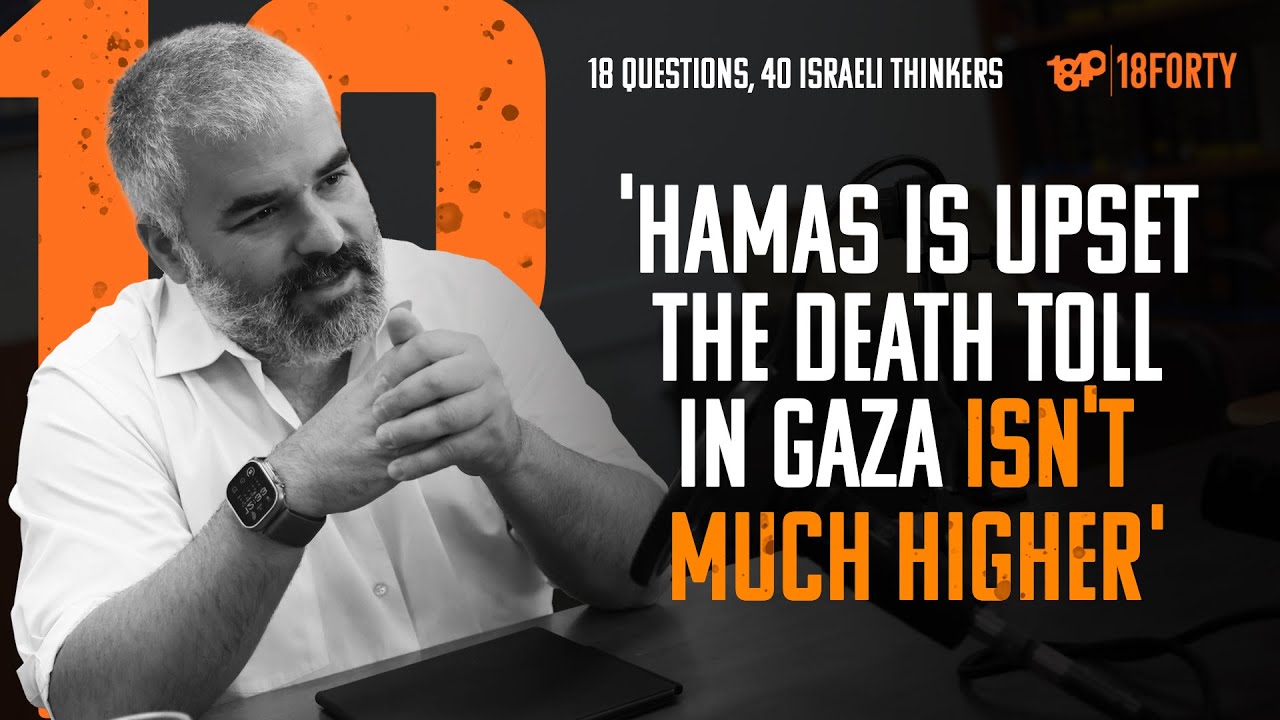
Daniel Gordis: If this war ends with the Iranian regime still in place and still in pursuit of a nuclear weapon, it’s a huge failure of Israel and the West. Hi, I’m Daniel Gordis. I’m a writer living in Jerusalem. I also work at Shalem College.
And this is 18 Questions, 40 Israeli Thinkers from 18Forty.
Sruli Fruchter: From 18Forty, this is 18 Questions, 40 Israeli Thinkers, and I’m your host, Sruli Fruchter. 18 Questions, 40 Israeli Thinkers is a podcast that interviews Israel’s leading voices to explore those critical questions people are having today on Zionism, the Israel-Hamas war, democracy, morality, Judaism, peace, Israel’s future, and so much more. Every week, we introduce you to fresh perspectives and challenging ideas about Israel from across the political spectrum that you won’t find anywhere else.
So if you’re the kind of person who wants to learn, understand, and dive deeper into Israel, then join us on our journey as we pose 18 pressing questions to the 40 Israeli journalists, scholars, and religious thinkers you need to hear from today. One of the staple books on Israeli history that is found on almost every Jewish bookshelf is Israel: A Concise History of a Nation Reborn, written by today’s guest, Daniel Gordis. Daniel Gordis is a Koret Distinguished Fellow at Shalem College and the author of 13 books, including that book Israel, which received the 2016 National Jewish Book Award as Book of the Year. His other books have also received great acclaim and recognition and awards, including Saving Israel, Becoming a Jewish Parent, Pledges of Jewish Allegiance, Conversion, Law, and Policymaking in 19th and 20th Century Orthodox Responsa, and The Promise of Israel: Why Its Seemingly Great Weakness Is Actually Its Greatest Strength.
I was really excited for today’s interview with Daniel Gordis because he is a classic thinker, writer, and voice on all things Israel. Last year, I believe just before October 7th, his latest book, Impossible Takes Longer: 75 Years After Its Creation, Has Israel Fulfilled Its Founders’ Dreams?, not only received the Yeshiva University Rabbi Sacks Book Prize for 2023, but also was posing a critical question, a vital question, about the future and direction of the state of Israel. There is so much to learn about and listen to from Daniel Gordis outside of just this interview. So I encourage you to go to his Substack, Israel from the Inside, which has tens of thousands of subscribers to get a fuller picture.
One other point of really interesting context about Daniel Gordis is that in November 2023, about a month and a half after October 7th, he wrote an essay that went viral in the Times of Israel about his decision to leave Conservative Judaism, namely the Rabbinical Assembly for Conservative Judaism, over what he called a lot of absurd anti-Israel rhetoric. You can find that article on Times of Israel called How My Toddler Grandson Convinced Me It Was Time to Leave Conservative Judaism. But anyway, this interview was really fascinating, and I think it came in as our longest thus far with 23 thinkers, Daniel being the 23rd, and I had a lovely time. So before we jump into it, if you have any questions that you want us to ask, or guests that you want us to feature for future episodes, please shoot us an email at info@1840.org and be sure to subscribe, rate, and share with friends so that we can reach new listeners.
Without further ado, here is 18 questions with Daniel Gordis. So we’ll begin where we always do. As an Israeli and as a Jew, how are you feeling at this moment in Israeli history?
Daniel Gordis: I think we don’t really know yet what to make of this moment in Israeli history. We’re obviously a year and a bit after one of the most tragic events, certainly in Israeli history, and it’s up there even in the list of Jewish history altogether.
In recent weeks and months, things have begun to look a little bit better militarily. That could change. It’s hard to know what’s going to happen in Syria, it’s hard to know what’s going to happen in Jordan, it’s hard to know what there’s going to be a hostage deal at the moment that you and I are speaking. So I think it’s very hard to know what to make of this moment.
There are very deep social divides here which seemed to have been healed a bit at the beginning of the war, when people came out of Gaza and said Yachad Nenatzeach. And you don’t hear Yachad Nenatzeach anymore. I mean, you really don’t. You don’t see it on posters, you don’t see it on the news.
It’s almost become trite to say we’re going to win together because the the social divides that almost ripped this country to shreds in the first nine months of 2023 have come back to the fore with judicial reform, with the issue of the draft of the Haredim. So how am I feeling? I’m feeling very grateful that we’ve pulled out of the darkest places. I feel personally very grateful to be living here during this. It’s much harder, I think, for somebody who cares as much as we care not to be here.
I know from my friends in America, for example, who care deeply, being away is very, very painful. So while we’ve had a son in and out of the army, and that’s obviously frightening beyond words. So I think we’re at a moment of great transition. There’s been profound catastrophes in Jewish life that have led to great changes in Jewish religious life, Jewish theological life, Jewish whatever, in which the Judaism that emerged was very, very different from the Judaism that had preceded whatever catastrophic event that was.
So if you look at the destruction of the First Temple for example, I mean there’s an exile and some of them return, but the tribal system is over. You don’t go back to having shevatim, individual tribes living in certain places in the land of Israel. After the destruction of the Second Temple, obviously biblical Judaism as we kind of knew it is over and what we call now the Rabbinic world, the world of Hazal takes over. And then after the end of the Second World War, Judaism as it existed in Europe really also didn’t exist either.
And it wasn’t just that the Jews moved from Europe to Israel or from Europe to the United States. The Judaisms that emerged in both Israel and the United States were very, very different. I think we’re in a similar moment, but we’re too close to the moment to have a sense of what’s the Judaism that’s going to emerge going to look like. I think we know more what’s cracked about the narratives that we told ourselves about our place in the Jewish world, and less about what’s going to emerge.
So, it’s a sad time. There’s some degree of hope, but we’re clearly in in a in a period of Jewish history which no one will able will be able to tell the story of the Jews for the next hundreds of years without focusing on this moment.
Sruli Fruchter: What has been Israel’s greatest success and greatest mistake in the current war against Hamas?
Daniel Gordis: Some of the great successes are on the social front. What we saw in terms of the hamalim, the civilian command centers that emerged in Jerusalem but all over the country and run mostly by Jews but not only.
There were Druze, there were Bedouins, there were Israeli Arabs. I mean people really did pull together. The way in which Israelis began to volunteer in unprecedented kinds of ways is not a success in terms of being planning, but it’s a success in terms of what the Israeli people is all about. We we got a chance to see Am Yisrael in Medinat Yisrael, in Eretz Yisrael at it’s really its very, very best.
So that’s obviously I think a major, a major success. I think the way that the country has embraced the families of the fallen and the families of the wounded and the way in which the medical system has been able to save people who clearly would have died in in earlier wars by getting them to emergency rooms and operating theaters much quicker and so forth, that’s been a success. Obviously militarily there’s been tremendous success in the latest months. I mean the destruction of Hezbollah.
If you and I were to have this conversation a year and a half ago, long before October before October 7th, and we had said, what are our major worries? Well, our major worry was not Hamas, that would have been a mistake, but our worry was 150,000 rockets from Hezbollah reigning down on Israel and destroying infrastructure, destroying hospitals, hitting civilian centers. We lived in fear of that. And we were always afraid to do anything outside the lines because we thought they can do that, Iran can attack us. And it turns out Iran can attack us but so far not terribly effectively.
We can respond and have 100 planes over Iran and come back with all of the planes thank God intact. Um so there’s been tremendous military success after the obviously abysmal military failure on October 7th. So I think there’s been some social success, there’s been some military success, and we ought to take pride in both of those. There are also great, great failures.
The great failure of the hostages is is an enormous failure. If you would said to anybody on October 8th, 400 and something days are going to go by and most of the hostages are still not going to be returned and we’re not going to actually know how many of them are alive and we’re not actually going to know where most of them are and we’re not going to be sure that if Hamas does make a deal that they even know themselves where all these hostages are, and that the families of the hostages would become the butt of political pressure, I mean they’ve become a hot political topic in a way that it to me at least should just be a human topic. I think that’s been a great failure. That’s not to say I don’t know anything about whether there was a deal to be made or not a deal to be made, but that the hostage issue has become so ugly in Israeli society feels like a failure.
Um as does the the recurrent split in the Jewish community of this country feel to me very sad.
Sruli Fruchter: So, two questions to follow up on that. One, when you list it as a failure, I’m curious, many people have framed the hostage issue and they feel strongly about it, that it’s a failure in so far as that they’re not back, but there isn’t anything Israel could have done that would have made sense or been strategic, strategically advantageous, or smart in the long sense of the war. Do you agree with that or do you think that the Israeli government has failed in their actions of rescuing the hostages?
Daniel Gordis: I’m not privy to what the negotiations were.
You know, I don’t know any more about this than anybody else who reads all the newspapers. So I really can’t make a statement. I know people have very, very hard held views, but I don’t know on the basis of what. I mean, obviously, there are certain people on the inside and obviously when Gantz or other people in the negotiating committee say that there were there were possible deals that Netanyahu torpedoed.
and I I guess I take them with a certain degree of seriousness, but others deny that, so I don’t really know. I think here is the failure. I think that the leadership of the present government has failed to communicate a sense that they are broken-hearted about this. You just don’t feel.
Sruli Fruchter: It needs a symbolic failure, not necessarily one.
Daniel Gordis: Well, it’s more than a symbolic failure. I mean, it’s about a social contract. If you’re running this country and it’s your fault, whether you did X, Y, or Z, but you were in charge at the moment that this happened, it’s your responsibility.
One of the great failures of course is that nobody’s taken responsibility yet. I mean, a few people in the military have, but basically we’re a year and a quarter in, and the same people are running the political machine and the same people are running the military machine. That’s a bit of a failure too, although you can make an argument that the time to make the change is not during a war, but but I think the failure on the hostage front is first of all that the people who run this country have failed to to convey to most Israelis that they are really deeply broken-hearted about this. You know, I hear people say that if they had been mostly religious people who had been captured on October 7th, that Smotrich and Ben-Gvir would have responded differently.
I don’t think that’s true. I mean, I don’t know them personally well, but my sense is not that that’s true, but my sense is that coalition politics and other kinds of political considerations have so trumped the Jewish discourse here that the only people that are talking with tears in their eyes are the families and their supporters. But Chavrei Knesset, members of Knesset, should be talking with tears in their eyes also. And I think another failure of the hostage issue is that it’s become so politicized.
And that’s by the way, a fault on both sides of the divide because when protests about the hostages also become protests about throwing overthrowing the government, and now also become protests about pushing back on judicial reform, you’ve you’ve you’ve made a salad here that not many people are going to be able to buy into.
Sruli Fruchter: But but to push back on that, wouldn’t many people who are at the protests for the hostages argue that if the protests aren’t having actionable demands, i.e., against Bibi, against a certain direction the government’s taking in priorities, then it’s just more of a gesture than an actual movement for action or demands?
Daniel Gordis: I think that they would say that and and there may be some truth to that.
Sruli Fruchter: But you disagree with that.
Daniel Gordis: I agree with them that unless there’s some actionable demands, that it’s very hard to know what you’re protesting about.
But I think it’s very hard. When when people were protesting against judicial reform, it was very clear what the Israeli government could do. It could stop. Doesn’t have to say we’re giving up on judicial reform, doesn’t have to say that judicial reform is a terrible idea and we’re sorry that we hatched it.
It could have just said, look, the country’s splitting apart and it’s really creating a huge wedge in a country that can’t afford it. We’re going to put it on pause. And we’re going to begin to have a national conversation in which we’re going to bring in experts from all different sides, religious and secular, and young and old, and left-wing and right-wing, and judicial this and judicial that. We’re going to have a national conversation.
And then at a certain point, we are probably going to move forward, but we want to move forward where the people really understand what we’re about. Now, so if you’re protesting, you could be protesting and saying, just don’t do this now. Don’t do it this way. And I know many people who actually feel and felt that judicial reform was actually in place.
There was room for or even need for judicial reform, but when the country’s that divided, when the country’s being split like that, when pilots say we’re not training, and when elite people in units say we’re not going to go to the, you know, we’re not going to go to the army anymore, and doctors are talking about leaving, and people and people in in high-tech are talking about taking their money out, clearly something’s gone very, very wrong. So you stop. And then you can bring it back once you’ve had a national conversation. The people who were protesting then had a very clear action item, which the government could completely do, which was, stop.
For now, put it on pause. It’s not really clear what the government’s options are right now. I mean, I just don’t know. I mean, I have no idea what Hamas is really willing to do.
I don’t know what Bibi’s really willing to do.
Sruli Fruchter: Where do you see the war going now?
Daniel Gordis: Look, lo navi anochi v’lo ben navi, right? I mean, this is a terrible part of the world in which to try to prophesy, although most of the world’s prophets came from this part of the world. You know, anybody.
Sruli Fruchter: Well, let me ask it this way instead.
Do what do you see the war’s purpose is at this moment? Do you think the war should end? Do you think the war is still after something and if so, what is that?
Daniel Gordis: I think the way this war should end is with the balance of power in the Middle East completely changed. Now, we weren’t having that conversation in in November of ’23, but now where we are, I think if this war, and it may have multiple phases, but if this war ends with the Iranian regime still in place and still in pursuit of a nuclear weapon, it’s a huge failure of Israel and the West.
Sruli Fruchter: By this war, you mean the war against Hamas or the more
Daniel Gordis: The war that Israel has been involved in since the afternoon of October 7th. I mean, it’s had lots of different phases.
Sruli Fruchter: Do you see that Israel’s military campaign in Gaza specifically links towards its actions towards Iran? Meaning, just in regards to Israel’s war against Hamas in Gaza, why do you still see that as moving forward? Do you think it should continue? If so, how? I’m curious to hear your view on that.
Daniel Gordis: The people that I that I hear, when I hear Gadi Eizenkot, or when I hear Benny Gantz, when I hear or others, and I hear generals who are actually still in the army now saying, “We’ve done what we can do in Gaza.” We’re never going to get to the point that there’s no Hamas terrorists. We’re never going to get to the point that there’s nobody running around having Hamas meetings. It’s just not going to happen.
that they’re that they’re not a serious threat. They can lob a rocket or two, that’s that’s for sure the case. And that’s probably always going to be the case. It’s probably always going to be the case from Hezbollah.
I mean, we’re going to be sure that we got every single one of the 150,000 rockets. There’s not a bunch of guys in some house somewhere that have one who could theoretically launch it. Is stuff going to start flying from Jordan? Are we still going to see things flying in from Sudan, from Yemen, excuse me. But the people that I listen to who I tend to believe, and again, it’s not based on personal expertise of any sort, say we’ve more or less gotten done what we’ve gotten done in in Gaza, what we need to get done.
So if there’s a way to make a deal to get the hostages back alive, we can do it now. Even if it means quote-unquote ending the war, because we’ve done most of what we need to do. Now, what we didn’t understand was how this was going to play out. In other words, you can look at it very ironically and say, “Well, let’s say we made a deal for the hostages six, nine months ago.” And don’t forget Hezbollah’s argument was, “If you stop the war in Gaza, we’ll stop firing rockets at Israel.” Now let’s just say hypothetically, we had done that.
And we’d said, “Okay, we want the hostages back,” which I desperately do. “and we’re going to stop the war in Gaza.” Then Hezbollah stands down. So then Hezbollah still has its 150,000 rockets. Hezbollah’s still intact.
Presumably Syria hasn’t fallen, and Iran is not nearly as shaky as Iran is. So, you know, reasonable people can can argue, what’s the hand of God here? What’s this very good luck? What’s very smart military planning? I don’t I don’t pretend to know where those lines are. But because we did not end the war in Gaza, we ended up having the war with Hezbollah, which really destroyed Hezbollah. And because we destroyed Hezbollah, Hezbollah didn’t send fighters in to support Assad when the rebels started making their way.
Russia’s too occupied with Ukraine. Iran was already feeling pretty spent because of what it’s been through. So all of a sudden, Syria falls. Now, is it good or bad for Israel? It’s an interesting question, but let’s assume that it’s good for Israel, at least in the short run.
And Iran is very weak. So the war with Hamas, if we can stop it and get the hostages back, based on the people that I respect and that I read, it sounds to me like that’s absolutely what we should do. On a human level, on a halachic level, on a Jewish social contract level. That aside, there’s the the wind is at our back.
And the Iranian axis is falling apart. And we have lived in terrible fear of Iran and Hezbollah for decades already. Now we’re not in fear of Hezbollah anymore. There is absolutely no way in which it makes sense to me, as an amateur observer, to leave Iran in.
And whatever one thinks of Trump, however one voted on the elections, we’re obviously not going to go there. This is certainly an opportunity for Israel, having Trump coming into the White House to at least give Israel a green light, perhaps to give Israel a bit more than a green light by giving it the bunker buster bombs that make it much easier to do it. And perhaps, perhaps, perhaps, even having American planes and, you know, and American military assets join the battle. I don’t know who will be there.
But the war with Hamas, personally, just Daniel Gordis, not a general, not a military guy, just what he reads in the papers, if we can get the hostages back, we should absolutely do that. Hamas is basically destroyed. And regardless of what happens on that war, if a year or two from now we have not dislodged this regime in Iran, then I think that part of the war is not a failure necessarily, but certainly not the success that we have the opportunity to make it now.
Sruli Fruchter: How do you think Hamas views the outcome and aftermath of October 7th? Was it a success in their eyes?
Daniel Gordis: Look, I can’t begin to get into the head of Hamas.
I mean, I really can’t. I mean, it’s hard to get into the head of pure evil. It’s hard to get in the head of people who would use their own children as human shields to hide their rockets. I mean, I can’t begin to understand them.
But I’m thinking if on October 6th, you know, in the hours before October 7th, someone had said to Sinwar, “Here’s how it’s going to play out,” and they had some sort of, you know, crystal ball, would he still have crossed the fence knowing that he was going to be dead, Deif was going to be dead? We don’t know exactly how many Palestinians are dead, and it’s becoming clearer and clearer that those numbers have been inflated. But a lot of Palestinians are dead, and a lot of Palestinian children are dead, and a lot of Palestinians are homeless. And we’re in December, it’s winter time. It’s not, it’s not good.
And Hamas was, I’m sorry, Hezbollah was destroyed and Syria fell, and Israel’s taken tremendously important action in Judea and Samaria, the West Bank, in order to try to quell some of the terror units there. Would would that would would would Sinwar still go ahead and do it? I mean, it’s hard for me to imagine, but it’s hard for me to put my head my my wrap my head around any pure evil person, whether it’s, you know, a Cambodian leader or it’s Hitler or it’s, I mean, these are genocidal, maniacal people for whom ideology doesn’t follow the the rules of logic. logic and reason that for you and me thinking politically does. I have no idea what they think, but they clearly know they’re in very bad shape.
Sruli Fruchter: What do you look for in deciding which Knesset party to vote for?
Daniel Gordis: Aside from the fact that I think I’ve never, ever voted for the one that won, and having lived in Israel for 25 years, I’ve had plenty of chances to, at the carnival, to throw my ball in the little bowl and get a goldfish. I’ve never brought a goldfish home from the Israeli election carnival. Now, the truth is when we lived in the States we used to get those goldfish, they would basically die in two days anyway, so it’s not a terrible, not a terrible loss, but again, I want to stay away from personalities here. But I want, it needs for me to be a person first of all who I trust, and this is not a…
Sruli Fruchter: The head of the party needs to be.
Daniel Gordis: The, well, the party is the person. I mean, really, with all due respect to the political platforms, people don’t say I voted for, they can’t even remember what Gantz’s party’s called. They can’t remember what Bennett’s party was called.
What’s Yair Lapid’s party? Okay, people know it’s Yesh Atid, but what’s what’s what’s Lieberman’s party even called? Is it still Yisrael Beiteinu? Was it not still Yisrael Beiteinu? They know that Bibi is Likud. That one they know, they got because that goes back to Begin. But I think really people do vote here. They couldn’t tell you.
They really couldn’t. I think 90% of Israeli voters could not tell you who’s numbers five, six, seven, eight, nine, and 10 on the list that they’re voting for. They can tell you one, for sure, and probably two or three, because that’s who they’ve handled with and made a deal, you join my list, I’ll put you number two. But really, we’re not voting for lists.
We’re not voting for parties. We’re voting for people. That’s the whole problem with the Israeli electoral system, but we’re voting. So I would say that when I vote for a party, I’m really voting for the person.
I want, in an ideal world, here’s what I want. I’m not saying that this party exists, but here’s what I would want. First of all, I want, I think there’s going to be a new divide now. It’s not going to be left, right, it’s not going to be religious, secular, it’s going to be served, didn’t serve.
Did your community or did your who served in this war? Who sent, who went to bed terrified because their kids were in Gaza or Lebanon? And who didn’t? I think there’s going to be much more shared sense of…
Sruli Fruchter: Is that what you’re looking for? You’re looking for people who’s…
Daniel Gordis: I right now, it would be very hard for me to endorse a party that is not going to take a very strong stance on equally supporting the need to protect this this country. You’re talking about the, you’re referencing the Haredi sector.
Talking about the Haredi vote,
Sruli Fruchter: but I’m also talking about the Arabs. I think the days of Arabs getting a free pass. We may not want to give them guns and send them to the front, but then everybody should do sherut leumi. Everybody should do national service.
But were they,
Daniel Gordis: Haredi parties and Arab parties really getting so many votes that those people are going to be… Haredi parties are getting a lot of votes.
Sruli Fruchter: But meaning the people who are voting for the Haredi parties are presumably mostly Haredim. Correct if I’m wrong.
Daniel Gordis: Correct. No, but the question is, am I going to vote for a party that has said it’s not going to make a deal with them?
Sruli Fruchter: Oh, I see. Meaning, whether or not the party themselves…
Daniel Gordis: Whether or not the party themselves, the Haredi parties, or people aren’t going to vote for them, to allow them to vote for them.
That’s fine and good. But I think if in the past I’d said, yeah, they’re going to bring them in, but whatever. For me now, I think that’s becoming a if not a red line, it’s becoming a much more, much more serious priority. That’s number one.
But I would say it’s true about Arabs also. In other words, if you want to be citizens of this country and 20% of this country, you have to help make this country tick. I understand the emotional, moral complexity for Arabs going to war against, it’s not their figurative cousins. It’s their cousins.
In other words, who was in Haifa in in May of 1948, who stayed in, the people that left, stayed in Haifa in May 1948 are now Israeli Arabs. But if their, they but if they tried to flee but they just couldn’t because their car wouldn’t start, but their brother’s car did start, and their brother’s car made it to Gaza, which is where a lot of them went, so then they’re Palestinians. In other words, when we say that’s their brothers or their cousins, it’s not, acheinu kol beit Yisrael kind of a thing. It’s not, all the house of Israel.
It’s their brothers and their cousins. So I can clearly understand why it would be very painful for them to take up arms and go to war. I really do understand that. But that’s not the same thing as saying, but I’m not going to take any role in helping to serve this country.
So I think we have to have a whole new remodeled social contract based on that because between the Haredim on the one hand and the Arabs on the other, you’re talking about 35%, 40% of the country, and the Haredi, Haredi portion is going to grow significantly. It’s their right to have children, but it’s going to grow significantly. So when I’m looking at a party, first of all, I think that the the issue here is not going to be left, right, religious, secular, anything of the sort. It’s going to be clearly Zionist to the point that you’re Zionist and your children serve this country, or not Zionist.
Number two, I want the person at the helm. He, she, personally religious, personally not religious, really couldn’t care less. But I want, I need to be able to go to bed at the end of the day believing that this person cares mostly about the Jewish state and the Jewish people, more than whatever political, every every politician has political considerations. But I need to go to bed thinking that she or he thinks mostly about what’s good for the state of Israel and then secondly for their, for their personal political…
political fortunes and whatever. So I’m looking for somebody who takes Zionism seriously, who’s not abashed about Zionism, who’s not afraid to speak in public about the right of the Jewish people to a national home in their ancestral homeland, who’s, I’m looking people who are not ashamed to talk about this as a Jewish state in which Hebrew is going to be the main language and the Jewish holidays are going to be the language of the, of of the country, of the language of the, going to be the calendar of the country, and where the curricula of the schools, whether they’re religious schools or secular schools, have to have Bible and Mishnah Talmud, much more Torah sheba’al peh, rabbinic texts than they do now. They used to have much more in the secular schools. It’s been whittled away.
I want somebody who wants to make this as a serious Jewish moral country. But now, if you’re not going to serve this country, then you can’t be part of the political block that I’m going to serve. And I think, by the way, when I listen to my kids’ friends, for whom this was a wishy-washy issue in the past, yeah, not my favorite thing in the world, but what are you gonna do? I like this guy anyway, so I’m gonna vote for this party. I think that’s becoming a hok bal ya’avor.
I mean, an uncrossable line. Unless this person stands in front of the camera and says, under no circumstances is there going to be a Haredi party that will not endorse the draft in my coalition, I think a lot of my kids’ generation who have been in and out and in and out of the war, just not going to vote for those people.
Sruli Fruchter: Which is more important for Israel, Judaism or democracy?
Daniel Gordis: What’s more important, your lungs or or or your heart? You tell me. I think that you would be very bad shape without either.
It’s I I see very few people walking around without lungs and I see a few people walking around without heart. Look, we need both. And and what it means to be a Jewish democracy is a very open and fair question. In other words, it’s not clear that you have to have exactly the balance of power between the various branches of government that you have now.
It may very well be that the courts are are too powerful. It may very well be that the system of choosing judges inclines the courts to perpetuate their own their own worldview. I don’t have any problem in principle with Israel having a national conversation about how all of this should be changed. What I have a problem with is when people feel that it’s being pushed forward because of coalition politics, specifically, Levin in this particular case and others, saying if you…
Sruli Fruchter: You’re referencing judicial reform.
Daniel Gordis: Judicial reform, yeah.
Sruli Fruchter: You saw that as an issue that was getting to the heart of the Jewish democratic question.
Daniel Gordis: It was getting to the heart of the democratic question, to be sure.
Look, I think if you get to a point where the legislative branch can do basically whatever it wants, right? The legislative branch and there’s no court oversight whatsoever. And the legislative branch can let’s say say, “We’re closing all the churches, all the reform synagogues, and all the conservative synagogues tomorrow.” Now, the way the legislation was written, unless the next Knesset re-endorsed that, then the law was going to fall back. Okay, fine. But let’s say you’ve just had an election.
You want to go four years in which the world looks at Israel as a country in which churches and conservative and reform synagogues, that’s not where I happen to go to shul, but I don’t care. I mean, you you want to, that’s just not a democracy. And I think there’s plenty of people in this in this government and in this country who would be perfectly comfortable with that. I think it’s a very narrow view.
Democracy, fourth grade democracy is everybody goes to the polls and the winner wins. That’s fourth grade. Serious democracy is about the, is about the protection of the rights of minorities. Serious democracy is about what rights of individuals are inviolable no matter who’s in power, no matter what those individuals want to say.
You can’t obviously call people to to violence, you can’t encourage somebody to kill somebody. But real democracy in the American Bill of Rights, it’s not as exactly as intact as it used to be, but it was a great idea back in the day. Yes, so I think, look, I think Israel has to figure out how to be Jewish and democratic. That is always going to be hard for Israel’s Arabs.
They’re are going to always be a bit of a fifth wheel in terms of the narrative that we tell about this country.
Sruli Fruchter: What do you mean by a fifth wheel?
Daniel Gordis: When I tell my kids or my grandchildren why we created this country, the Arabs are not part of the purpose of the country.
Sruli Fruchter: Not to be provocative, but is a different way of saying what you’re saying, second class citizens?
Daniel Gordis: No, I would like it not to be. But there’s different kinds of second-class citizens.
I’m absolutely committed that it not be second class citizens in the sense that, you know, they can’t vote for this or that, or they’re going to earn less, or they can’t live here or live there or whatever.
Sruli Fruchter: Not not legal, not legislatively second class, but from some other social…
Daniel Gordis: I mean, I made aliyah mostly because my wife was making aliyah and I was very anxious to live in the same country as her, also because she would have had custody of the children. So, I mean, in fact, she said to me, I’m, we came for a sabbatical year and she said, I’m staying.
And if you go back, I think you’re going to miss the kids. She was 100% serious. So I stayed. Obviously, I think it’s been a great…
Sruli Fruchter: The best Zionist argument.
Daniel Gordis: It’s a it’s a great bracha and I’m very glad that we stayed. Obviously, it’s had better years and worse years, but that’s life. But my wife wanted to make aliyah because she really felt that this was where she wanted her children to be raised and she wanted to live in an entirely Jewish cocoon and whatever.
Having said that, she grew up in Orange County, where to be a Jewish kid, Orange County is South of Los Angeles, which was, you know, it was, it was pretty right-wing Republican, Christian, anti-Semitic back in the day. There are still a country club or two in LA that Jews can’t join. But I grew up by the way in a very different kind of, I grew up in Baltimore, which had a huge Jewish community and it was very. And still, I never fully felt like the narrative of America really was my story.
I knew that my great, great, great, great, great grandparents were not on the Mayflower. And I knew that with all George Washington’s letters to the Jews of Newport and all that notwithstanding, that you know, I mean, in in Charlottesville, Jews will not replace us. That didn’t come out of nowhere. And you’ve had Father Coughlin and you’ve had the Ku Klux, I mean, there’s always been an undercurrent of of anti-Jewish sentiment in America.
It’s usually not been at the level that it is right now, and hopefully it’ll recede, although I don’t know how.
Sruli Fruchter: But but isn’t but isn’t this more of a validation of the Jewish desire for the affinity or the identity with Israel and a Jewish state and less so addressing the Arab reality?
Daniel Gordis: No, but what I’m saying is that I felt to a certain extent, was I a second-class citizen in America? Not a second-class legal citizen, but I was a second-class citizen in that the story that America told about itself was not.
Sruli Fruchter: Like it wasn’t the country for you even if your rights necessarily were intact.
Daniel Gordis: It was a country I could have lived a perfectly nice life, but I felt that I wasn’t part of the mainstream of the story.
And obviously, if we get to a point where Israel is not at war with its Arab neighbors, it’s going to be much more comfortable for Israeli Arabs to be Arabs in Israel. But so I’m saying yes, I don’t want them to be second-class citizens legally in any way, but I think it’s going to be hard to tell the story of this country where the flag is made to look like a talit and the national symbol is the menorah and it’s Shabbat, not Friday, that is the national day of rest weekly and so on and so forth. They’re going to be a little bit out of of that. In the same way that when all the stories had Christmas stuff going on in America, it wasn’t my thing.
And you know, everybody would say at the checkout market, you know, have Merry Christmas, you know, and all that. Fine. I mean, there was nothing wrong with it. But I always felt like I was a little bit of an outsider, and I think they’re going to feel that to a certain extent, and I don’t take any pleasure in that.
I think it’s hard and I think it’s complicated. But this country has to figure out a way of being deeply Jewish, more Jewish than it is, by the way, that does not mean observant. But it’s got to be more Jewish than it is, and that may be coming to the fore a little bit now because of the war, and deeply democratic. And if it’s not one or the other, not only do I think it doesn’t have legitimacy, I don’t think it’ll survive.
Sruli Fruchter: Should Israel treat its Jewish and non-Jewish citizens the same?
Daniel Gordis: Meaning what, in terms of letting them go to the doctor?
Sruli Fruchter: However you understand the question.
Daniel Gordis: Look, I think any democracy has to give all of its citizens the same basic rights. You know, would I prefer that there are not, this is going to get tough now, right? I I would like to be able to go to the, I never go to an Israeli mall if I can at all help it. But let’s say hypothetically, you know, the worst possible thing happened and I had to go to an Israeli mall.
I’d rather there were not Christmas trees in the malls in December. Now if there’s Christians here who say, but we want we want our symbols there too, that gets that gets hard. It gets hard in the same way that, you know, Jews wanted creches but then they also, the Chabad is actually the ones that wanted to put up Chanukiyot all over America as the Christians were putting up creches. It’s going to make me uncomfortable to walk in, you know, to Kanyon Azrieli.
Maybe they even have a Christmas tree, I don’t have any idea. Maybe they have them there, I have no clue whatsoever. But yeah, Israel has to treat Israel has to treat its non-Jewish citizens the way that any serious democracy treats its citizens. It gives them health care, it gives them the right to vote, it gives them the right to assemble, it allows them to worship as they want to worship.
How do you do that and maintain the overwhelming Jewishness of the state and the overwhelming Jewishness of the symbols of the state and the discourse of the state and the culture of the state and like kind of the ether of the state? That’s going to be hard. That’s going to be but nobody said that building a state was supposed to be simple. Because then if you say, well, okay, wouldn’t it just be easier if we got rid of all the non-Jews? Boom, wave a magic wand, they’re all gone. You then have exactly the same problem with non-religious Jews and with religious Jews and with modern Orthodox or, you know, Dati Leumi Jews and with Haredi Jews.
In other words, countries have to learn how to make space for people that they don’t agree with who are part of their communal pact. So yeah, I think we should treat our our non-Jewish citizens every bit as well as we treat our Jewish citizens. At the same time that we understand this is a Jewish state, the discourse of which, the symbols of which, and so forth, are going to be Jewish.
Sruli Fruchter: What role should the Israeli government have in religious matters?
Daniel Gordis: The government should most of all, I think, have the role of protecting thing the rights of citizens to worship the way that they want.
That I think is the most important thing. You know, you can argue this at the Kotel, that not at the Kotel. But I think that, you know, we can make, I mean obviously I have my opinions, but and it’s not to me by the way the nearly the most important issue in Israel, in religiosity, it’s not. I mean, much more important here is how.
Sruli Fruchter: It felt like it used to be. There was a point where it did feel like that was the pressing issue.
Daniel Gordis: Not for me, but for many people.
Sruli Fruchter: Not for me, not it was never a pressing issue for me.
Daniel Gordis: Why is that? Because, I mean, it’s going to be very controversial.
Sruli Fruchter: You mean the distinctly religious question or specifically regarding the
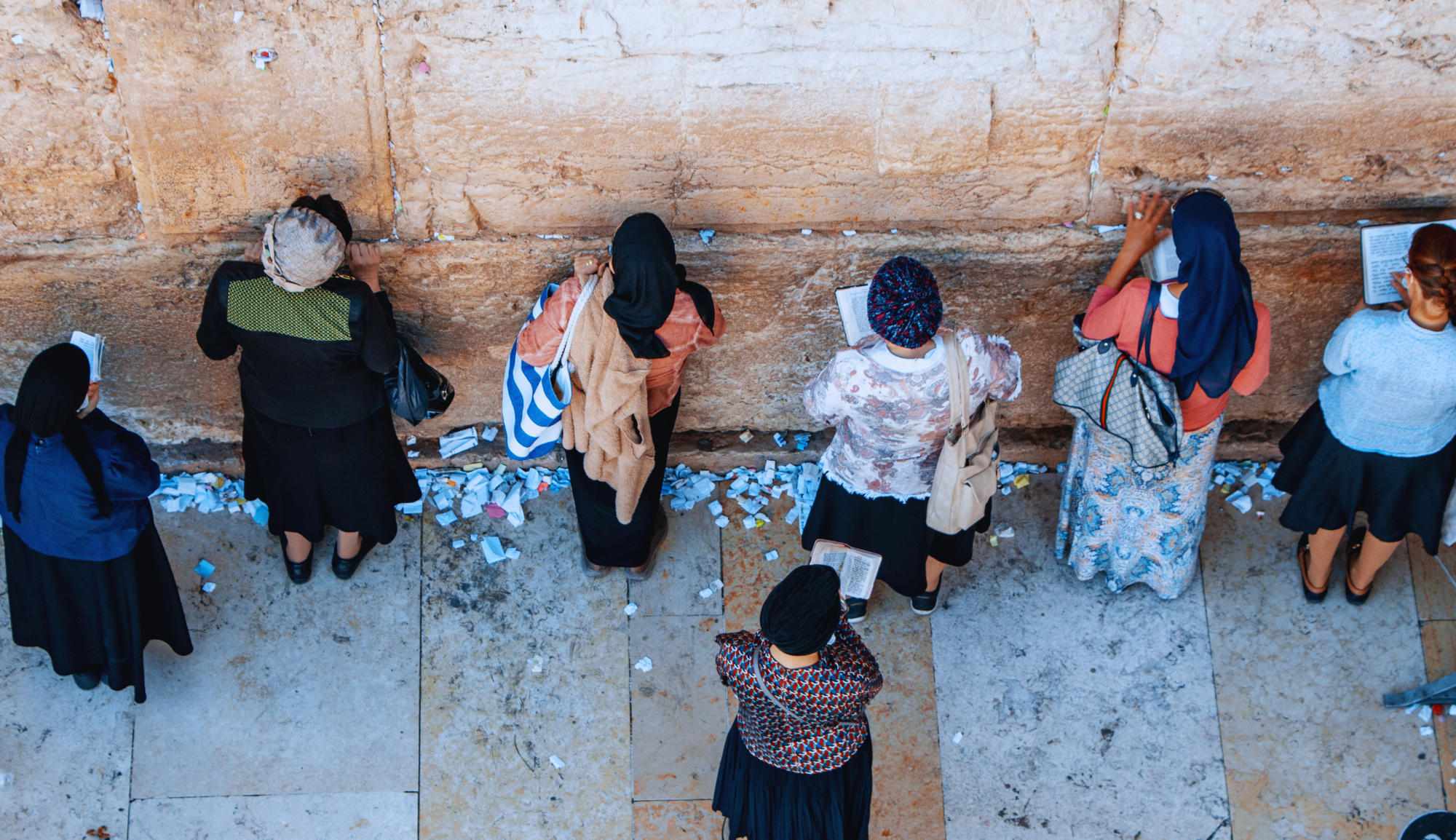
Daniel Gordis: Kotel? I’m talking about specifically regarding the Kotel. I mean, I think the Kotel, you know, I’m not a huge Kotel goer. I live like a 15 minute walk from the Kotel, 20 minute walk maybe from the Kotel.
I don’t think I’ve been to the Kotel in 15 years, 20 years. I mean I really have not been there in a very, very, very long time. I have my issues. Just it’s, I go to shul every day, but I don’t go to the Kotel, not on a matter of principle.
We got a bar mitzvah, I go, unless it’s in the heat of the summer, in which case I figure out a way to say that I’m not in the country. But I mean really, you can’t shvitz that much for a bar mitzvah. But, no, but seriously, I I think people made an issue out of the Kotel, which I understand its symbolism. But I think there’s other issues.
I I learned something really interesting from a talk that I gave in Canada once. Like a parlor meeting in in Canada. It probably goes back six, seven, eight years ago. And there was a woman there who had converted Reform in Canada.
She was in her late sixties. She was not moving to Israel. She was not, I don’t think from the way she spoke, particularly personally observant. But when she spoke about the fact that Israel does not recognize her conversion, she started to cry.
And yarad li asimon at that moment as we say, you know, the sort of the token, the phone token went into the machine, you know, hear the click. I understood something that I’d never understood before, that she wanted to be validated by the Jewish state. I think we don’t think enough about how when we want to be able to call on Jews around the world to give us money, to support us, to give us political support, to do whatever we want, that people care deeply that the Jewish state validate who they are as Jews. I think the government needs to remember that this is the state not of Israeli citizens, this is the state of the Jewish people.
Now, Israeli citizens are going to get to vote and non-Israeli citizens are not going to get to vote. Israeli citizens are going to pay taxes and non-Israeli citizens are not going to pay taxes. But the role of the government in religion, I think, should be to safeguard the Jewishness of the state and to protect the rights of all people to worship however they want. We you know, again, obviously you can find an extreme example and then we’re going to, you know, whatever, somebody able to put a Christmas tree at the Kotel? Well, obviously not.
I mean there’s we can always find, you know, ridiculous, extreme extreme examples. I think we need, we need a chief rabbinate, which is a very different kind of chief rabbinate. We’ve gotten to a point, I mean, don’t forget Rav Goren was not Haredi, Rav Herzog was not really Haredi. I mean, we had Zionist rabbis, openly, unabashedly Zionist rabbis for a very long time, and over the course of time the chief rabbinate shifted, and for a very long time you had distinctly non-Zionist rabbis, to say nothing of people who went to jail for graft, which is not so great when he’s a chief rabbi.
But I mean really, chief rabbi should not be getting sent to jail for dishonesty. It’s it’s a chillul Hashem. It’s a desecration of God’s name. But we ought to get back to a place where the chief rabbinate is a source of inspiration for Israeli Jews.
When Israeli Jews hear the chief rabbi speak, they say, even if they’re totally secular, wow, that was a really fascinating point about Chanukah that I’d never ever thought of before. It makes me want to do Chanukah differently. Or this chief rabbi said something about the Pesach seder that I’d never thought of, and even though my family doesn’t work its way through the Pesach Haggadah, you know, page by page by page, he made a point that I really want to make sure that I bring up with my family when we get together for the seder. Now, really, I mean, how many times has that happened in Israel in the last 50 years? Probably basically zero.
So I think the chief rabbinate here ought to be a rabbinate that makes Judaism appealing to Israelis and not see itself as, you know, Mishmara Gvul, that they’re the border patrol to make sure that certain red lines don’t get crossed. Having said that, there has to be some agreement about who’s a Jew and who’s not a Jew, and we have to have certain standards for conversion. None of this is simple. And that’s why anytime anybody has a kind of a a bumper sticker response, I know how to do that, or I know how to do that, what I basically know is they haven’t thought about it enough.
Whether it’s what you should do with non-Israeli citizens or how you should treat Israeli Arabs or what the role of the rabbinate should be. All of these things are really, really complicated. And I think what Israel never was really great at, but is really now lost the ability to have is a national conversation about these things. And one of the things that I would like to see, you asked before about a leader, one of the things that I would love to see about an Israeli leader is somebody who can actually engender that kind of a conversation.
Say, let’s talk. Let’s just talk to each other. And then we can have a conversation about what the law should be, whatever. But you can think about all these kinds of issues now if you just even raise the issue.
Sruli Fruchter: Reminds me of the Reva, I think it’s Reva Revayon, the fourth quarter movement in Israel.
Daniel Gordis: Right, right, right. Ha-Revona ha-Revi’i. Right.
Ha-Revona ha-Revi’i is about that. To a certain extent Yozma Atma’a is about that. It’s actually two spouses. He runs the one, and she runs the other.
Oh really. It’s an incredible family. But yes, there are a lot of Israeli groups that are sort of ground up. But you need bottom up, but you also need top down.
You need in an ideal world, let’s go to America for a second. Think about the the the major times when America, America made huge changes in its society through political leaders who brought a new vision, but who were also in a certain degree able to engender a national conversation. So Andrew Jackson is a horrible human being and a complete racist, and I mean, he’s just horrible. People forget how bad he was.
But he’s followed by Lincoln. And Lincoln at the Gettysburg Address, but in all of his work as a human being, creates a new vision for America. He reminds America we can be better than what we were. And we can have a conversation here now.
That doesn’t get rid of racism in America? Obviously not. You get Jim Crow. But Abraham Lincoln was such a person. I think that FDR, for all of his many faults, and he was not a lover of the Jews, and he kept the Jews out of America.
I mean it was Cordell Hull who worked in his administration mostly did it, but FDR kept the Jews out of America. The St. Louis came to outside of America’s territorial waters and was sent back to Germany and those Jews, a third of them, went up chimneys in Europe. I mean, he didn’t bomb, he didn’t bomb any of the tracks to Auschwitz, which we’ll never really fully understand why he didn’t want to slow down the transport of Jews in cattle cars.
I mean there’s a lot of things about FDR that are very, very, very problematic. But he gave America a new sense of a vision of what it could be. So did Lyndon Johnson. Lyndon Johnson stole his Senate seat.
He bought it. He stole his Senate seat in Texas. But by the time, and he was a racist. But by the time he becomes president, he inaugurates this new revolution in racial theory, the new generation, the great generation, and all of that.
These people who were very flawed, I know less about Lincoln’s flaws than about FDR’s and Johnson’s, but I’m sure he had them. But these people who were very flawed somehow were leaders that enabled the country to have a serious conversation after massive crisis, after the Civil War, after the attack of Pearl Harbor and getting sucked into the Second World War, after the Civil Rights issues of the 1960s. We need a leader here who everybody looks at and says, she or he actually wants me to be part of this society.
Sruli Fruchter: Now that Israel already exists, what’s the purpose of Zionism?
Daniel Gordis: Zionism is the national liberation movement of the Jewish people.
So Zionism was, I mean you can make an argument, well, we exist, you don’t need Zionism anymore. We’re a country like France or Morocco or any country. We exist. And I think there’s something by the way, very obscene about the conversation, does Israel have a right to exist? About what other country on the planet does anybody have that conversation? North Korea, whatever.
So I don’t really think that I know people think we should stop using the word Zionism. I don’t think it’s a huge issue, but I don’t really think we should, because I think the word Zionism reminds us what the purpose of the state was. This state is the product of a national liberation movement.
Sruli Fruchter: Is opposing Zionism inherently anti-Semitic?
Daniel Gordis: Is opposing the right of the Jewish people to have a state of their own fundamentally an attack on the Jewish people? Yes.
Does that mean that I think that everybody who opposes Israel’s right to exist thinks of themselves as an anti-Semite? I don’t think that they do, necessarily. I think a lot of them do. But anti-Zionism has become a very convenient way of manifesting your anti-Semitism. But I think when one looks at Jewish history, and you even look at what’s happening in America now, we don’t know where it’s going.
I think it’s very unlikely the Jews are going to get put on trains and taken anywhere. But you have Jew hatred from the right and you have Jew hatred from the left. And you now live in in Israel, but you went to college in America. If you were to have stayed in America and your children would have grow up there, are they going to, would they feel comfortable on an Ivy League campus in 25, 30 years? I don’t think you and I know the answer to that question.
And is it going to still be comfortable to be a Jew wearing a kippah on Wall Street or in Silicon Valley? I don’t think we know the answer to that question. What we do know is this: that no diaspora, even the best, which is America, has ever been entirely tolerant of Jews being overtly Jewish. Jews changed Judaism a lot in America to become accepted. The Jews need a state.
The Jews need a state to call their own. They need a place that can be their home. And if you know anything about Jewish history and you still oppose the right of the Jews to have a state of their own, given what the world has always done to the Jews, always done.
Sruli Fruchter: Are there other reasons to oppose Zionism rather than it being a specific focus of the Jews? Meaning, one of the things that listeners had emailed us about to try and specify and to ask is for somebody to say that theoretically, the Jews having a right to a state, no issue with, but the way that Israel has manifested whether, you know, someone’s views on historical wrongs towards Arabs and Palestinians and so on and the function of a nation state, are those illegitimate reasons to oppose Zionism?
Daniel Gordis: I think one can have a conversation about the things that Israel’s done right and the things that Israel’s done wrong, and reasonable minds can differ as to whether Israel has conducted itself correctly in the conflict.
But let’s imagine the conflict goes away. People could still have issues with how Israel addresses the rights and roles of Israeli Arabs. People will have an issue perhaps with how Israel blends or meets or draws the line between tradition and being part of a Western economy, part of a Western world, and so on and so forth. People are going to criticize that.
Now by the way, there are a lot of countries that are designed to serve a specific religious community, right? I mean, there are Scandinavian countries where you have to be a member of a certain church to be the leader of the country, to be, you know, part of the royalty or whatever. There’s a lot of Arab countries where obviously they they exist for the purpose of Islam. The reason that Israel gets slammed in ways that they don’t is because the expectation of those other countries is so low, because they’re not democracies, and so therefore nobody asks to what extent is Saudi Arabia treating other countries or other religions fairly, or Egypt or Jordan or whatever.
Sruli Fruchter: Wasn’t that also because of their role in relation to the United States, which is which is usually where these conversations originate, or in Europe?
Daniel Gordis: You mean because the United States is such a good ally of Israel’s, therefore we should be complaining?
Sruli Fruchter: No, no, meaning that Israel’s role relative to the United States is different than Saudi Arabia or—
Daniel Gordis: Well first of all, I don’t know how different it’s going to be, how different Saudi Arabia’s relationship with the United States is going to be come whenever.
I I really don’t know that it’s going to be all that different. But look, every every relationship like that between Israel and the United States, it’s it’s a bear hug. In other words, it’s a hug but you’re being hugged by a bear. And, you know, being hugged by a bear is fun until the claws, you know, reach around.
And and that’s the same thing here. We’re not we’re not a Hebrew-speaking, falafel-eating version of the United States of America. The United States of America, whether you’re a Christian, Muslim, Jewish, Buddhist, Baha’i, whatever, doesn’t make any difference, the country in theory, not in reality, but in theory is just as much for all of you. That’s not who we are.
We weren’t created to be that. We were created to be the national home of the Jewish people. That’s what Herzl spoke about and that’s what the Balfour Declaration was about. And that’s what the United Nations created in 1947.
They said a Jewish state and an Arab state. Now the fact that the Arab state never came to be is because they attacked us as opposed to saying yes. But everybody’s always understood that there was going to be a Jewish state. And the minute you’re a Jewish state, you are a different kind of animal from all of the other Western countries or nation states that exist.
And that’s okay. But the world has to understand that we’ve undertaken something here that most Western states haven’t undertaken. If we routinely horribly abuse Israeli Arabs, that’s a perfectly legitimate complaint against Israel, and I could see countries saying, well until you change X, Y, and Z, we’re going to do A, B, and C. Okay.
But if Israeli Arabs are not as central to the narrative of this country and their symbols are not the symbols of the country and Arabic is an important language but not a national language and all of that, that’s okay, because we’re not trying to be what America says or said.
Sruli Fruchter: But are those the issues that people take or do my understanding is that people usually are taking issues specifically with issues of land and rights and the West Bank and so on. Do you understand it differently?
Daniel Gordis: That’s the issue with the conflict. I mean that’s the whole issue is the conflict.
Sruli Fruchter: But is that also, does that also tie in with their view of the state of Israel? Meaning, I hear less complaints about the Jewish stars on the flag for the state of Israel, more so than how the limited rights of non-citizens in the West Bank, Palestinians, their relation to Israel and the inability to annex it because then it will no longer be a Jewish state and that type of complication.
Daniel Gordis: Right, that’s all part of the conflict. That’s what I’m saying. It’s, look, how many people counted how many how many people America killed in Mosul when it was going to wipe out ISIS? How many people can tell you how many innocent German civilians were killed in the Second World War? Somewhere between three and four million.
How many people can tell you how many innocent Afghanis were killed when America had its military in Afghanistan? I don’t even know the number. Because nobody cares. Nobody cared how many people Assad put in prison for decades and decades and torture and no visits and no nothing. Nobody cared.
Everybody knew, the information about Assad’s prisons was perfectly available on the internet. But the people on Columbia’s campus and on Penn’s campus and on Harvard’s campus, they didn’t care what Assad was doing to his, and that he gassed his own people. Hundreds of thousands, that he gassed these poisoned gas. And Barack Obama said there was a red line in the sand and then all of a sudden there was a sandstorm and there was no red line in the sand.
In other words, there’s a way. thing which I just don’t take this critique seriously anymore because it is so unilaterally projected at Israel. So I want Israel to be much better at a whole bunch of things than it is. And the situation on Judea and Samaria, West Bank, call it what you want to call it, is very problematic, and there are no good solutions there.
But when the world starts to get all bent out of shape about Israel doing this and that in the West Bank, but why didn’t you say anything about Assad gassing hundreds of thousands of his own citizens? Why didn’t you say anything about Hamas killing women who had sex outside of marriage? Why didn’t you say anything about Hamas throwing Christians off of roofs?
Sruli Fruchter: Does that mean that that that they should care less about Israel or they should care more about those other things?
Daniel Gordis: Just stop being hypocritical. That’s all. In other words, I think a lot of this will go away if one day there’s not a conflict, then and that might sound pie in the sky, but I’ll tell you why I think it’s not pie in the sky in a second. But if one day there’s not a conflict, I think a lot of that will go away.
But even until it goes away, let’s just look and see how unbelievably two-faced it is. It’s unbelievably hypocritical. By the way, including on the part of Jews who are deeply critical of Israel about all of those issues. They don’t talk about what Assad’s doing to his people, or or to say nothing of Korea and whatever other kinds of things.
Look, the reason I say pie in the sky, and I don’t think it’s entirely pie in the sky. We’re not anywhere near, this is not, peace is not around the corner. You know, peace is not going to start blooming in the Negev when spring comes. But on a lark, just a complete lark, with zero preparation, virtually zero forethought, and no planning, I just, like two or two weeks ago, joined a kosher trip to Vietnam.
I saw it advertised on Facebook. I said to my wife, let’s go. And she said, we have a son who gets in and out, called in and out of the army. She goes, he could get called up, I’m not leaving.
I said, no Lebanon’s winding down, he’s not getting called up. Let’s just, let’s just go. So in the end, she said, I can’t go, but I get that you want, you need to get out of here. Go.
Now, if you grew up when I grew up, I was in 10th grade when the United States pulled out of Vietnam, 1975. If you had said to me when I was in 10th grade, one day, you’re going to live in a war-torn place, and to relax, to go to a place where it’s totally peaceful, you’re going to go to Vietnam. I I would have literally laughed. But Vietnam’s totally peaceful.
I didn’t see a single soldier. Most of the policemen don’t have pistols. Now, and they’ve more or less gotten beyond it, and it’s the wars are different. I’m not making any analogy between the situations except to say that you wouldn’t have said in 1973 that Israel’s going to be a war-torn place and Vietnam is going to be not idyllic, to be sure, but that it’s going to be a place where you can go and relax.
I think that when I was in Vietnam, all of a sudden, in a kind of crazy way, it gave me hope. It’s not out of the question here that with everything shifting the way that it is, this conflict could look very, very different in a relatively short period of time. I don’t know that it will, but it could. I think if the conflict is gone, most of people’s complaints about Israel will disappear.
And until the conflict is gone, people should just ask themselves, was I as critical of America’s conduct in Iraq or in Afghanistan as I am about Israel’s conduct in Gaza? And if I wasn’t, why is it the Jews that always interest me more?
Sruli Fruchter: Is the IDF the world’s most moral army?
Daniel Gordis: Does that mean, I I saw a ranking recently that El Al was one of the world’s worst airlines. I actually fly El Al all the time and I actually find them quite fine. I don’t know, is there a ranking of morality of armies? I don’t know if there’s a ranking. I guess you could ask AI.
But I think the IDF is an army that takes morality very seriously. I mean, I know from my kids who were in the army in sadir back in the day and now reservists, they take, they take the moral stuff very seriously. And they do abort missions because there’s civilians there. And now I’ll say something that will probably annoy a lot of our listeners.
I think the day is going to come when Israel is going to have to ask hard questions about what happened in Gaza. That is not the same thing as saying that I know that what Israel did was not okay. So that before everybody gets all in a huff, I think that asking questions is a very Jewish thing to do. So for example, during the war, we have lots of friends who have kids in.
And we invite them for Shabbos lunch. And then all of a sudden they call us Friday morning, our kid’s getting out for the weekend. Sometimes they’ll say, so we’re just not going to come, which is totally fine. Or they’ll say, can we bring our son, he’s just out of the army.
He might not stay the whole time because he’s exhausted. Of course you say yes. Then the kid comes and he stays because food’s good, the conversation’s interesting. And he talks about he did this, this, this, and he goes we tiharnu et habinyan, you know, we we cleaned out the building from whatever that means.
And then we leave and then Cheil Handasa comes in, the engineering corps, and they blow up the building. So in a couple of cases I’ve said to this kid, why? He goes, why what? I said, why’d we blow up the building? And in the two cases that I’m thinking of, they both said, I don’t know. That’s just just how we do it. Now, there’s maybe a very good reason.
And it may be that some of it was right and some of it was wrong. It may be that all of it was legitimate in terms of its fundamental policies, but there were obviously errors in execution, there always are. You know, people accuse Israel of having attacked a hospital, when it’s clear Israel did not attack a hospital. When Israel finally did go into a hospital, it found hundreds of Hamas guys in the basement.
When Israel’s taken on UNRWA, we found that these educators were really actually Hamas people. It’s very foggy and we’re in the middle of the war right now. But I think that any society should ask itself hard questions about things that it’s done, not knowing what the answer is going to be. I think there’s going to be a reckoning.
We’re going to have to look very carefully at what happened. And I know exactly as much as you do. We read the same newspapers. So neither of us knows.
Neither of us actually knows if every building that was taken down needed to be taken down. We just don’t know. But I think that Israel is going to have to ask questions, and I would love to hear that yeah, we made a mistake here. Of course we made a mistake there were that many bombing runs, of course you’re going to make mistakes.
But by and large, yes, Israel is a very moral army. Israel could also find that it did things in Gaza that we’re not proud of. That doesn’t completely pull the carpet out from being a moral army. I couldn’t care less if somebody calls Israel the most moral army in the world.
I mean, I’m not in a I’m not in, you know, I’m not in public relations for Israel. But I care very deeply about Israel being a moral army. And I so far have no reason to suspect that it’s not.
Sruli Fruchter: So I find it very interesting that you’re bringing up this point.
But the one question I have, I mean I have many questions, but the one question I’ll choose is when you speak about the things that we may or may not know, maybe in Israeli society those types of questions haven’t necessarily been explored so thoroughly. I know Haaretz has its own reporting and people have their own views on Haaretz. But let’s say the New York Times. And I referenced this a few weeks back on a different interview that we had with someone else where the New York Times reported on, they used the title Israel using human shields.
By that they meant Israeli soldiers bringing Palestinian civilians or Palestinian detainees and sending them into certain areas where to see if there were terrorists there, if there were bombs, or whatever the situation is. Not for this type of case specifically, or this reporting that they did in this investigation, but for that kind of reporting that there has been extensive reporting in general about the war, about different cases, and so on, in the Times and other papers as well. How do you view those things when you’re considering the things we do or do not know about what’s happening in Gaza? How do I view that reporting? That type of reporting. Like not specifically that that case that I cited or that that article, but in general, the things that we do or don’t know.
Maybe Israeli society or the IDF hasn’t done its own investigations, but journalism in general, not necessarily in Israel as extensively, but in the more of the Western media does have reporting on the on the things that have happened in Gaza, right, wrong, questionable, whatever the views are. Are those things you take into consideration for what you think the IDF has done right or wrong, or are those things that you dismiss?
Daniel Gordis: I don’t take the Times that seriously. Not I mean not anymore. I grew up on the Times.
I mean literally, I mean, you know, there was like, there was a a Shas and the New York Times. I mean that was in our house, you had to do both. I think the New York Times has become reprehensible and it’s very, very, very slow to correct itself.
Sruli Fruchter: When you say you don’t take it seriously, meaning that you don’t even know if it’s true.
Meaning you believe that they they fabricated it, it’s a misrepresentation.
Daniel Gordis: I don’t know if they, they got a report from somebody. But I’m saying if Israel, look, it’s against, if I understand, it’s against international law to send civilians as the Times described.
Sruli Fruchter: Yeah, I don’t mean that specific case, I mean more generally.
Daniel Gordis: If Israel did that, that’s completely wrong and the people that ordered that have to be, you know, have to be dealt with. But the fact that the New York Times said it happened does not lead me to think that it happened. It doesn’t mean it didn’t happen. I just don’t know.
Look, there’s going to be a lot of unearthing of stuff that’s gonna have to take place. I’ll give you an example. I mean this is how crazy it’s gotten. The New York Times ran a piece this past weekend about all of the Syrians flocking to this notorious prison outside of Damascus where Assad, you know, tortured, killed, and people.
This is not a story about Israel. It has nothing to do with Israel. And several times in the article, at least twice maybe three, the only interruption of the sounds of people wailing was Israeli warplanes overhead continuing to bomb Syrian assets. Okay, maybe that’s true.
But did they talk about the other sounds, the birds chirping, the cars backfiring? It’s just, it’s relentlessly hostile, relentlessly hostile to Israel. And this is not about the New York Times specifically, but you know, everybody believes, everybody believes rape stories unless it’s October 7th. And everybody is opposed to kidnapping people and holding six-month-olds hostages and Holocaust survivors, unless it’s involving with Israel. So look, we have to do a serious accounting and I would like to believe that this is a country that has the capacity to do that, to look into all of these allegations, and if people did that sort of thing, they have to be punished because otherwise we can’t continue to claim that we’re a moral army or as moral an army as we can be.
But just because the New York Times or Le Monde or the Washington Post say that it happened, no longer makes me assume that it happened. I just don’t know.
Sruli Fruchter: If you were making the case for Israel, where would you begin?
Daniel Gordis: For Israel as a country?
Sruli Fruchter: However you understand it. Make the case for Israel.
Everyone hates when I say that, but I have to give that since we’re in the space.
Daniel Gordis: I would start with a couple of different things. I would start with first of all, I would ask why does the Jewish people matter? So the Jewish people disappears, so what? I mean, other peoples have disappeared. The Jewish people matters, not only because I happen to be part of the Jewish people and my parents, my grandparents raised me to care deeply about it, but because I think the Jewish people has always had what to say to the world that really matters.
We may be on a low ebb of that. I think if you were to say to most people, have a conversation at your Seder table that is not about tikkun olam and doesn’t mention Israel, they wouldn’t really know what to talk about. And because we don’t know very much about Judaism anymore, we find it harder to talk about things that we could say to the Western world about all kinds of things. But first of all, you have to start with the premise that it’s important to the Jews and to the world that the Jewish people survive.
It’s a it’s a moral wellspring for the world. Not the only one, not the best one, not the most moral one. But it’s an important moral wellspring for the world. Then I would say, given what’s happened in Jewish history, what have we learned? And what we’ve learned is what I said before in our conversation, which is that I don’t think that Jews have the luxury of allowing themselves to be naive and to assume that they’re going to necessarily be safe anywhere.
They might be, but they might not be. And what we’ve learned over thousands of years of history is that we need a place where we can be the guarantors of our own future. Further down on the on the, but not as important, I would say, also then then state building is actually a really important laboratory for Jewish ideas. In other words, it’s one thing to sit in, you know, Mir or wherever and to study Talmud and to say, yeah, we’ve got all these great ideas in Masechet Sanhedrin or Hilchot Melachim or whatever from the Rambam, Maimonides.
You know, we have all these ideas about running courts and states and rulers and kings and this and that. And it’s another thing to have courts and governments and populations who don’t agree about everything and some of whom are Jewish and a few of whom are not Jewish and so on and so forth. So I think that this is actually an important laboratory for the Jewish people to test thousands of years of ideas and to try to, you know, sort of have them be hardened in the fires of the furnace of reality. But my main starting point for making the case for Israel is, the Jewish people deserves to exist no less than any other people, and Jewish history makes it clear that if Jews do not have a home of their own, their existence is in question.
Sruli Fruchter: Can questioning the actions of Israel’s government and army, even in the context of this war, be considered a valid form of love and patriotism?
Daniel Gordis: On the part of Israelis or non-Israelis?
Sruli Fruchter: However you want to qualify it.
Daniel Gordis: I think it’s always legitimate to question the actions of a government or of an army. That’s always legitimate. I mean, it’s always legitimate to question.
I mean, if there’s anything that Judaism is about, it is about the idea that it is always legitimate to question. I think that there is a, there’s a sensitivity in any meaningful relationship about when one questions certain things, right? So God forbid, a couple has a kid that’s sick. Long-term sick. I don’t mean the flu.
Kid’s got a real health issue. Now, they have other things in their lives too. They have a normal relationship with its ups and its downs and its complexities. But are you really going to raise that issue sitting at your kid’s bedside in the hospital? I don’t like that you leave your socks outside the hamper and throw them on the floor, or, you know, you’re not doing enough of the shopping or we need to rethink our budget or whatever.
Those are all legitimate issues, but you’re probably not going to raise them with your kid in the hospital while you’re sitting by her bed or his bed. It’s just, it’s off. It’s cruel. Is it wrong to ask your spouse, why do you respond this way or respond that way? No, you can ask your spouse anything.
Ask your spouse. But not in not not there, not at that moment. I think that people who understand the horror that Israel has gone through in the last year and a half, not quite a year and a half, a little bit more, a little bit less, I mean. It’s okay to ask those questions, but we’re so bruised, we’re so bloodied, we’re so hurting.
You know, I think people that, we just had this past Shabbos, we had dinner with two other couples. One couple, at a certain point in the war, had five kids in. five kids, and whether it was either their sons or their daughter or their sons-in-law. But everybody was in.
Everybody was in. One lost an eye and is okay-ish. But they still have kids in. They still have kids.
This one comes in, this one goes out. They’re at the point now where the woman of this couple, who is a very strong, an incredibly impressive person in many ways. She’s unbelievably talented and she’s strong, and she’s an amazing mom, wife, whatever. She’s amazing at what she does professionally.
You could see she’s starting to crack. Just six grownups at a table, all their kids are out of the house. She’s starting to crack. And I don’t blame her in the least.
We only have one who keeps, who gets periodically called up and it’s enough to make you, it’s just unbearable. So it’s okay to ask those questions, but if you’re if you plan to be asking them out of love for us, or patriotism for us, then why are you asking it that way now? Now look, Haaretz, which we’ll take as sort of the Israeli New York Times of sorts, right? They ask a lot of really important questions. And their little notifications that I get from Haaretz that pop up on my phone literally make my blood boil. I want to say the same thing, like, really now? That question, now, seriously? Yes, it’s an important question.
But we just, we got all these widows. We have so many widows who are twenty-something years old, and they’ve got a kid or two kids, and they had a whole life to make of themselves. And this couple that I mentioned Friday night, one of their kids went to a different city in Israel. The army sent a whole bunch of couples where the where the man had been wounded.
And she’s just describing who was sitting on the airplane where they flew them to this place in Israel. This one’s missing a leg, and this one’s missing a chunk of his part of this body part. Like, that’s what we’re dealing with here. There’s so much pain, there’s so much anguish, there’s so much fear still.
Of course you can ask all those questions. And it doesn’t surprise me that an American congresswoman is going to ask those questions or an American reporter from the New York Times is going to ask those questions. It’s fair. It’s legitimate, if you also ask them of Syria and the United States and France and all that.
It’s legitimate to ask those questions. What I would say to my Jewish friends who are mostly on the left, whether they’re in Israel or, we’re we’re swimming in a pool of pain. We’re just dripping with pain. You really want to ask that question now? Go ahead.
It’s legit. But it doesn’t feel like it’s coming from a place of love.
Sruli Fruchter: What do you think is the most legitimate criticism leveled against Israel today? On that note.
Daniel Gordis: No, but let’s take the United States.
What’s the most legitimate criticism of the United States?
Sruli Fruchter: How how much time have we got here? Do we have, we’re serving breakfast tomorrow, right?
Daniel Gordis: A lot? Dinner tomorrow night? I mean, France, even Canada. Whatever. Any country that has to deal with taxes and people and… Well, the reason I ask that question is because I think in the context of criticism of what’s said out there.
And obviously we’ve spoken a lot about the biases, antisemitism, and how those how those intersect with that question. I’m curious from everything you hear and at your discretion what you do or don’t decide to choose, what do you think is the most legitimate in either 100%, 50%, 12%? So I’ll just say for me what I think are the questions that I think Israel, where Israel’s failing or failed. First question is, you have to have the, you have to have the day after conversation, which for whatever reason, Bibi doesn’t want to have or hasn’t wanted to have. Ironically, Trump may make him have it, but who knows.
You have to have a conversation about that. What do you mean we’re not, are we staying in Gaza forever? Ariel Sharon may have been right to pull out in 2005. He may have been wrong to pull out in 2005. But he didn’t pull out because he became a Palestinian nationalist.
He pulled out because too many soldiers were coming back dead. And if we stay in there, soldiers are going to keep coming back dead. How many soldiers a year is it worth? It’s a cost-benefit analysis. What can we get done by looking from the sky and then going in and going in and going out? I don’t know, I’m not a military guy.
But I think the refusal to have a conversation about what’s the what’s the day after, a national conversation. Bibi, get on the television and say to Israelis, here’s the five options. And here’s why they all stink. But here’s what my government’s wrestling with.
Just that he hasn’t been willing to say. If you want to be Smotrich, and you want to say, okay, we’re going to have Huckabee now as the ambassador, and is the time ever ripe for annexing Judea and Samaria? Okay. Now tell me, what are you doing about the democracy here? Are you making them Israeli citizens, those several million people that live in what the world calls the West Bank, or… are they just going to be non-citizens in this thing which then begins to look a lot like second-class citizens at best and apartheid at worst.
Have that conversation. But if you say to Smotrich, talk to the Israeli people about those questions, he won’t have that conversation. So I think the main, the main issue that, which goes back to your earlier point of that national conversation for, I think it’s a huge issue. I think it’s a great irony that people that are are schooled in traditional Jewish life know this, people who are not schooled in Jewish life may not know this.
What you study in Yeshiva is not Bible. I mean, you open it up periodically, but it’s not the main thing. You study Talmud. The Talmud’s more or less in its traditional printing, it’s a 20-volume account of arguments in the Beit Midrash.
I find it very sad that the people that is the product of that tradition can’t even have a national conversation. Just ask the questions. Right, I mean, most Talmudic discussion obviously doesn’t tell you the Hilchata K’Rabbi. It doesn’t tell you the Halacha follows Rabbi X.
We we’ve gotten really bad at having national conversations and we need them more than most countries need them. And it’s more core to who we are as Jews than it is to most people, whatever. I don’t think Christianity is fundamentally about asking questions. I don’t, I mean, and I don’t know as much about Islam as I know about Christianity, but I don’t think it’s fundamentally.
I mean, Islam means subservience. I mean, that’s what it’s about. And Kol Hakavod. That’s that’s okay.
It’s their way of of of making sense of the world. But we’re really fundamentally about asking questions. So why is the Jewish state the state that refuses to have questions in a national conversation? That to me is much more important than we do annex this little piece, we don’t annex that little piece. It is Hamas, it isn’t Hamas.
We end the war, getting the hostages back is critically important to me. But I think our major national, moral, religious, cultural, identity issue is, can we learn to talk to each other?
Sruli Fruchter: Do you think peace between Israelis and Palestinians will happen within your lifetime?
Daniel Gordis: Who who who knows? I I just interviewed in my podcast, I just interviewed Rabbi Yitz Greenberg, whose book The Triumph of Life just came out a long time. I’ve always had a tremendous amount of, I mean, reverence for Rabbi Greenberg. But I remember at a conference, probably in the 19, early 1990s, when his wife Blu, who was an incredibly accomplished woman in her own right, said at this conference, there’s going to be Orthodox women rabbis in my own lifetime.
And somebody leaned over to me and said, oh, she thinks she’s immortal. But she’s alive and well, thank God. And there are women Orthodox rabbis. Some people approve of it, some people don’t approve of it.
Some people call them rabbis, some people don’t, but there are women Orthodox rabbis. The Vietnam thing that I mentioned before, you know, you’re going to leave a war zone and go to Vietnam to calm down. My dad has this joke where I ask where afterward I ask them if not in your lifetime, then in my lifetime. Okay, fine.
Yes, so I’m I’m a lot older than you. My dad’s joke, he takes. But if you would have asked me two years ago, do I think that there’s going to be a resolution of the Israeli-Palestinian conflict in my in my lifetime, I would have said absolutely not. And if you would ask me six months ago, I would have said absolutely not.
And if you ask me now, I would say, we just know so little about how things are going to unfold here. Would we have imagined that Assad would be gone, Hezbollah would be gone, Iran would be backtracking, Trump is coming in? Whether I’m not a huge Trump fan, don’t get me wrong, but at the moment, things might be aligning for Israel’s major enemies to be completely uprooted. And and if that’s the case, at what point will Palestinians who are no longer under the thumb of Hamas, say, just, we want a different future. We sound, we want to sound like those Syrians who’s talking now now that Assad has gone.
We’re just free. We just want to live our lives. And maybe destroying Israel isn’t the most important thing about being a Palestinian. Is that possible? It may be that six months from now things have gotten so bad that I’ll be mortified that I said this to you and it was recorded and I’ll say like, We’ll have the date on the interview.
What was I thinking on that Sunday, post-Shabbat morning when everything was looking, I don’t know. But I I really, I’m more hopeful than I was. Wow. Two years ago.
And I’m even more hopeful than I was six months ago. But again, things could go very south very quickly. But had you said to me, now I remember the day that the Abraham Accords were announced. I was sitting at this desk right here and I heard about the Abraham Accords and we have peace with the UAE.
And I’m like, that’s amazing. Where is it? And I had to quickly Google map the UAE and then I see it’s right across from Iran, this little like, now I I get it. But when I went to Dubai, I mean, how many kosher, there’s more kosher restaurants in Dubai than in Boston by a factor of many, many. In Boston, there’s basically two, they’re kosher, they’re quasi-restaurants.
They’re all right. But in Dubai, there was gorgeous restaurants. And in Abu Dhabi, there’s gorgeous kosher restaurants. And my waiters, by the way, at these kosher restaurants, in both cases when I went in Abu Dhabi, were Egyptians.
And it’s surreal. Now would you have said to me five years, 10 years ago, One day you’re going to go to Abu Dhabi and you’re going to go to a kosher restaurant, wear your kippah around town without having any problem whatsoever. Oh, and the waiter’s going to be Egyptian, he’s going to sit down because there’s nobody else in the restaurant, it’s like having in the middle of the afternoon, he’s going to sit and chit chat with you about life in Israel, life in Egypt. I’d say you you really have to get help.
But that’s exactly what happened. So I’m actually more optimistic at this moment than I’ve been in a long time. It may be because I just need some optimism right now and it may be because I’m reminded about how fast things can change. And it may be that if we bump into each other in the street in Jerusalem six months from now, I’m going to say to you, please cut that out and delete that part.
But right now I I don’t I don’t know. But it’s not as impossible as I used to think it would be.
Sruli Fruchter: What do you think should happen with Gaza and the Palestinian-Israeli conflict after the war?
Daniel Gordis: I don’t know. I really mean that.
I I don’t know. We can’t allow Hamas to rebuild. You know, people say, well obviously we’re not going to build settlements there. Now, I’m not a settler guy.
That’s not my that’s not my thing. But I just want to remind all of those people that why do we have Carmiel, which is smack in the middle of the Galilee, right? Which was not included in the United Nations 47 map. But we accepted the map and then they attacked us and we captured land and we built there. A lot.
And Carmiel and all sorts of other places that we take for granted are part of the Jewish state. Zionism’s always been, we want peace, but if you attack us and we capture your land, we’re going to build there. So I I have I used to back in the day when I did a lot more taking groups around, American groups and this and that, we would go meet with people in various yishuvim over the green line. And young women, some of them religious and some of them not, would say my parents are so mortified by what I do.
I moved here, I moved to this yishuv and, you know, they’re they’re mortified. They think I’ve lost my mind and my moral compass. She says, but I remind them, I’m only doing what your parents did. How is what I did by moving to a place that we captured in 67 different than what your parents did by moving into a place that we captured in 48? What’s the difference? So again, I want us to remind our listeners, oh my god, to build Jewish settlements back in the north of Gaza, on a certain level that sounds insane.
But on another level, we’ve always built settlements as part of protective walls. And that’s what Zionism has always been. We don’t want to have a war, but if you start one and we capture your land, we’re going to build there. I just say that to make everybody understand again how complicated this is.
Because if it’s totally illegitimate to build in North Gaza now and it’s totally illegitimate to have settlements over the green line, then why was it okay to build in Carmiel in the middle of the Galilee?
Sruli Fruchter: We’ll cut the entire interview and just use these two and a half minutes.
Daniel Gordis: Okay, that’s fine. We’ll release that. Okay.
So I really I really don’t know. You have to be more of an expert into what’s really going on in Palestinian society. You have to have a really you have to be much more of an expert than I am in what’s really left of Hamas and what’s not really left of Hamas. You need to know more about what can we find out in time.
So I don’t know how to get there, but we need to get to a place where we don’t rule them and where they don’t threaten us. It would be much easier if they decided to turn a new leaf and say, yeah, we want to live side by side with you. Is that going to happen so fast? I have I just don’t know. I just don’t.
I don’t speak Arabic, which is a huge problem, I think, for Israelis because we we we’re in this intimate, at worst, war and at best, bear hug with the claws of a people that we really can’t read their social media. And we can’t read and of course you can upload one to Google Translate, of course you can, but we don’t read their op-ed pages the way we read, we don’t read their Facebook postings and so forth. So, I don’t know. But I know we can’t rule them and I know they can’t threaten us.
Sruli Fruchter: Do you think Israel is properly handling the Iranian threat?
Daniel Gordis: I don’t know what Israel’s doing. So it would be very hard for me to assess what they’re whether what they’re doing is right if I don’t know what they’re doing. I would have to bet that they’re not exactly ignoring the fact that we sent a hundred airplanes over Iran and they flew back in formation. They didn’t just get back.
They flew back in formation after taking out a lot of those defenses and nobody shot at them and whatever. They’re clearly much more vulnerable than we are. I’m assuming I’m not the only guy that’s thought about the possibility that being desperate might make them move towards a bomb more quickly, so maybe this is the time to actually do something. And the people that run the the military, thank God, are much smarter than me.
So I’m I cannot be the only person thinking about that. So I can’t judge if Israel’s doing the right thing about Iran, because I don’t know what Israel’s doing about Iran and that actually is appropriate. In other words, it’s amazing. There are certain things that are actually secret in this country and that’s that’s quite fine.
So I don’t know what we’re doing, but I do believe, again, being a amateur for a second here, that if two years from now that regime still exists and is in a nuclear quest, then we’ve missed the moment. I don’t think we’re going to miss the moment. But how we’re not going to miss the moment, I have no idea.
Sruli Fruchter: Where do you identify on Israel’s political political and religious spectrum? And do you have any friends on the quote-unquote other side?
Daniel Gordis: Well, first of all, if I’m in the middle, which I am, I have friends on both sides.
Sruli Fruchter: Right, so you’re in the middle both politically and religiously?
Daniel Gordis: Yeah, I think so. What does that mean? I mean, it means that if you do one more mitzva than me, then you’re a fanatic,
Sruli Fruchter: and you do one less mitzva than me, then you’re a goy. It’s a good place to be. But no, what do I, how do I define myself? Um, well, politically, I define myself as a, as a centrist.
You know, people like to say, a lot of smart people like to say, Daniel Hartman says, and Yossi Klein Halevi says, and Michael Oren says, Michal Goodman says, all these people, and Michal Goodman says, 80% of Israelis agree about 80% of the things. And I think that that’s probably sort of true. And I’m part of that 80%. In other words, I want Israel to be Jewish, I want it to be democratic.
I think that Israeli Arabs and Haredim have to take their role in in in becoming part of the economy and defending the state and and and so on and so on and so forth. I’m not left because I’m in no way, in no way embarrassed about Israel being a Jewish state. I’m not conflicted about that. I’m in no way embarrassed about Israel having to use massive force if it needs to defend itself.
So I’m not left for all of those reasons and many, many others. I’m not right because I’m not in favor of annexation, because I don’t want the Jews to be a minority in the Jewish state and I don’t want us to be an apartheid state. That does not mean that I think we should take out every Yishuv over the Green Line, don’t get me wrong. But I’m just saying why I’m not I’m not a Smotrich or a Ben-Gvir.
I’m also, I don’t hate Arabs. I don’t hate Muslims, I don’t hate Arabs. I hate our enemies. And there’s a big difference.
And so an Arab or a Palestinian can certainly be not my enemy. A lot of Israeli Palestinians, which they want to call themselves very often Israeli Arabs, who I know and who I’m friendly with, I don’t consider to be my enemy and I hope I’m not being naive. So, but so politically, I think I’m pretty much in the center. As I said at the beginning, I’ve never voted for ever, and I’ve voted in a lot of elections here.
I’ve never voted for the party that actually came out on top. But I tend to vote center. I tend to vote center. Some of those parties still exist, some of those parties don’t exist anymore.
Religiously, I also, I also see myself very much as a centrist. So just to give people a sense of where I come from, I was raised in a family that unabashedly called itself conservative, but always davened in Orthodox shuls. So my grandfather was a conservative rabbi, but when he retired from his pulpit, he davened in an Orthodox shul. So we were, we we sort of straddled that line.
My parents were and my grandparents were all very committed to the notion that Judaism, it’s different now, it wouldn’t force them out of Orthodoxy now, but back then it did, that Judaism had to be open to the academic world and the academic questions about where texts come from or whatever. That’s no longer an issue. I mean at YU that stuff is flat on the on the table completely, but it wasn’t the case when my parents were growing up, and my grandparents were raising them, and my parents were raising me. So we were kind of this hybrid.
We we, we were told we’re conservative Jews, but I went to Orthodox day school, and I went, we always davened in Orthodox shuls, and so on and so forth. Today, we daven at a community called HaKel in Yerushalayim. But that’s where I am. I I I personally observant, personally shomer mitzvot, you know, kashrut, all that.
And you have friends on the other, quote-unquote other side.
Daniel Gordis: Oh, totally. I have I have tons of friends on either side. I mean, first of all, my kids are not exactly like me.
They’re in different places. But yeah, we have tons of friends who are totally secular. We have friends who are like half-kosher homes but are not shomer Shabbat. We have friends, we have friends of all different sorts, and we have a lot of friends to the right of us also.
And what’s interesting is we had a few friends, the first time that Trump ran, because a lot of us were kind of American expats, that was an issue that people didn’t talk about because it felt like it could break a friendship. Our politics about Israel now during this war are sometimes also very different. But we just talk about it. Because everybody understands that what they’re saying is born out of not really knowing.
This is what I think, but I don’t really know. So we have people who are much more to the right about us on this war, maybe much more to the left of us on this war, but not a single friendship has even had a hiccup. But yeah, we have friends all over the spectrum. I mean, do I have, you know, friends who are like Ben-Gvir types? I don’t think I have any friends who are Ben-Gvir voters.
Although I might. I mean, but you know, that wouldn’t shock me if they voted for Ben-Gvir, but I don’t I I can’t really name anybody. Well I can name people, but they’re in my, they’re in my second or third circle, but not the people that we get together for Shabbos usually. But tons of people who are totally secular that we see for Shabbat all the time.
Sruli Fruchter: And our final question of the 18.
Daniel Gordis: Hopefully hopefully we were counting.
Sruli Fruchter: We I wasn’t counting. There were there were follow-ups so those don’t count.
Daniel Gordis: Okay. I I lost count, but I trust you.
Sruli Fruchter: I hope so. Do you have more hope or fear for Israel and the Jewish people?
Daniel Gordis: Yes.
Look, I mean, it’s it’s it’s so interesting to me how I would have answered this question differently six weeks ago. I’m very, very worried. I’m very worried about Judaism in America. I’m really worried.
I think it’s much worse than people think. I think the Jew hatred in the left, has become part of the left’s DNA, and the left does control academia, and academia has always been the gateway for Jews to success in America. The left does control a lot of the press that Jews see as their home base in terms of the New York Times, the Washington Post, the LA Times, whatever. And I think that you have one of these crazy moments where the right and the left agree about one thing, that the Jews are the problem.
So, you know, Trump isolationists, Trump white supremacists, you know, the Charlottesville people, and the people on the left. I’m very worried about Judaism in America, and I think, by the way, that while on one hand, you know, the Trump presidency offers all sorts of opportunities with Israel and Iran, and maybe even pushing back on the campuses, it also runs the risk of eroding some of those protections that have protected minorities and individual rights and so on and so forth. So again, I don’t want to get into the whole Trump thing, but it’s a complicated story. It’s a very complicated place.
I’m I’m worried about Judaism in America. Look, this has been a roller coaster this past 15 months. Just been a roller coaster. I, on October 14th, 2023, which is the week after, by which point we knew basically what had happened.
It was the next Shabbat. And I was still saying Kaddish for my mom, who’s actually, whose yahrzeit is today. Interestingly, but her second yahrzeit, her second yahrzeit was today. But I was saying Kaddish for my mom.
And you know, people in shul knew me. And at one point, I was the only person there, maybe it was Mincha. I don’t remember, but I was I was the only person there saying Kaddish. And and we all knew already.
I mean, we didn’t know the gory, gory details, but we had a pretty darn good idea about what the horror of what had transpired. And I started to say Kaddish, and then I, my I I couldn’t talk. Now I was obviously still very sad about my mom, but my mom lived a long life and she was ready when she died, she was ready. I mean, so it was, we missed her, but it wasn’t a tragedy in that sense.
But I really I at a certain point in Kaddish, you know, everybody just waited. They understood he’ll get it together and then he’ll finish Kaddish. And then somebody came up to me afterwards, and he said, I was at a different minyan this morning. And two of the people saying Kaddish couldn’t speak.
And he said, I thought it was, he said it was the first time that I’ve been to Shiva on Shabbat. Because we don’t sit Shiva on Shabbat. He says, but going to shul felt like being in Shiva. Because people were trying to say Kaddish and they couldn’t, which is what you have at a Shiva minyan, not normally in shul.
So it’s been such a roller coaster. I’m I’m I’m not, I’m not optimistic in the short run that we’re going to develop the kind of political leadership that we need to bring out the best in this country. But I am optimistic about what I saw in the am, in the people of this country, and how where they’re going to meet, I don’t know, is the Ribuanim shel achim which you mentioned earlier, or is Yozma amamit which are these things to try to get people to take more political roles. Are some of those guys that talked about it in the tanks that came out of Gaza, and they said, you know, we were with a yeshiva guy and this and that, and we all got along together, and maybe.
I’m very worried about the internal divisions in this country and our inability, as I said a couple of times already, to have those conversations. But if you had said to me five months ago, we’re going to have wiped out Hezbollah, Saad’s going to be gone. It’s going to look very ripe for getting rid of the regime in Iran, and Hamas is going to be so defeated that it looks even like a deal might even get through the government here now, might? I would have said to you, what are you drinking? So I don’t know, I’m very, and I think Jews don’t have the right to despair. Jews have a right to worry, and Jews have every right to cry.
But Jews don’t have the right to despair. Our people has been through very, very, very dark times before. And not everybody lived to see what was going to come out. The people that lived during the destruction of the Second Temple did not necessarily live to see the grandeur of rabbinic Judaism.
The people who died during the Shoah did not live to see the grandeur of the state of Israel or the enormity of the American Jewish experiment, which is in still many, many, many ways unbelievable. So you can’t look and ask what is it going to be before I go to, you know, my eternal resting place. I don’t know what’s going to be by then. So I am very worried and I’m very optimistic, and I think that’s a Jewish place to be.
Sruli Fruchter: Well Daniel Gordis, thank you so much for answering our 18 questions. How was this for you?
Daniel Gordis: It’s fun to just talk to smart people. So, thank you for the great questions and thank you for the opportunity to share these thoughts, many of which I’ve never thought about before.
Sruli Fruchter: Amazing.
Thank you so much for tuning into another episode of 18 Questions, 40 Israeli Thinkers. I hope you enjoyed, and we want to hear from you. Shoot us an email at info@18Forty.org with any feedback, comments, or criticism. And as usual, if you have questions that you want us to ask or guests that you want us to feature, please write to us.
And thank you as always to our friends Elliot Brownstein and Josh Weinberg for editing and recording the podcast episode. So until next time, keep questioning and keep thinking