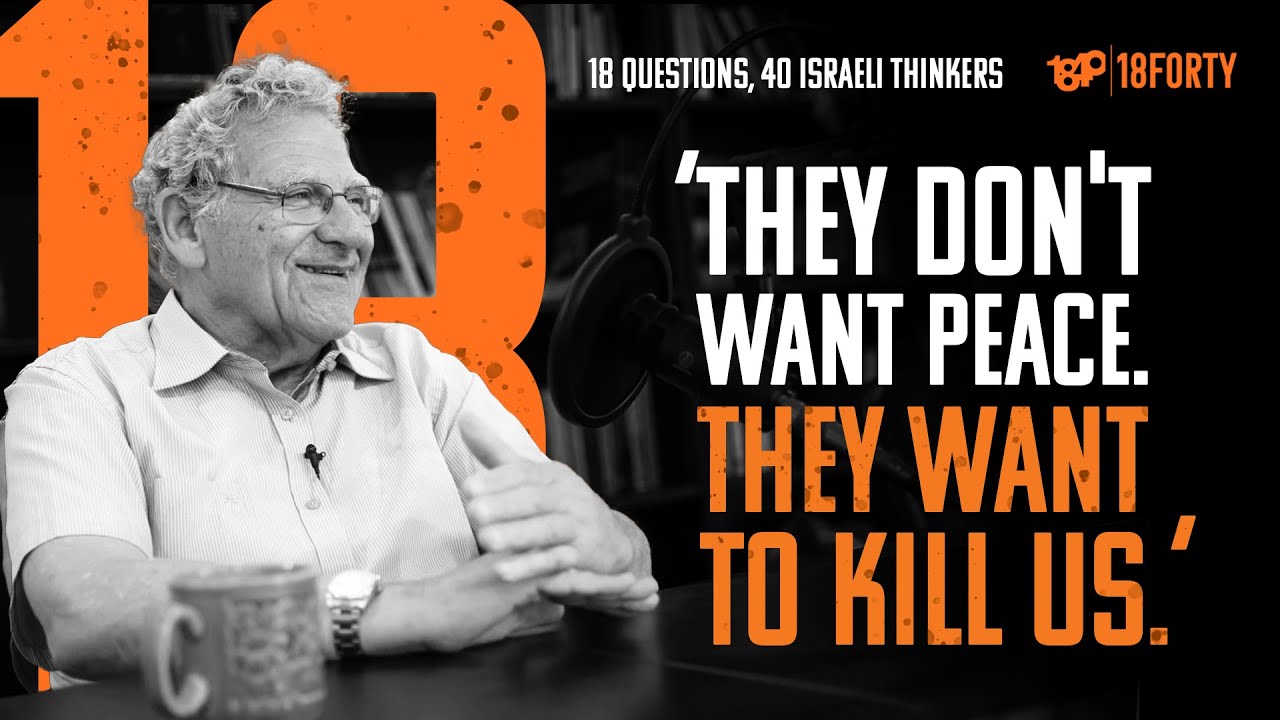



Everyone has found their media refuge of choice for feeling, thinking, and working through the Israel-Hamas war.
Some seek traditional media outlets—say, American and Israeli newspapers—while others welcome more contemporary avenues—I’m thinking Instagram, TikTok, Twitter. Each medium has its benefits and drawbacks (some more than others), but this search for content consumption is ubiquitous.
We are here to offer you something different.
In line with 18Forty’s goal of democratizing education, we are sharing four of our conversations that will empower you to delve further into questions and topics related to Israel, the war, and the future—within Israel and beyond.
1. How To Read Media About Israel
Debates about “good” and “bad” media sources are universally present—which publications are “reliable,” which are “biased,” which are “fair.” In the context of Israel, the history of the Jewish state’s relationship with the media—and, more relevantly, how that relationship is perceived—dates back to its foundation. Lahav Harkov, formerly with the Jerusalem Post and now with the Jewish Insider, discussed the challenges inherent to those learning about Israel abroad (i.e. not being on-the-ground journalists themselves). She explores fundamental principles for media and for distinguishing between Israel and America—a topic Matti Friedman wrote about in the Atlantic. Lahav lays down all you need to know.
Listen here: “Lahav Harkov: How to Read Media About Israel”
2. How To Learn About Israel’s Story and History
Saying that issues relating to Israel are “complicated” has become a resented pastime expression. But the truth is that it is complicated. Even before Israel’s founding in 1948, the history is saturated with dates and events and nuance that, save historians by trade, people are not privy to. Especially in the context of the Israel-Hamas war, self-educating is anything but easy. Noam Weissman of Unpacked joined us to practically and theoretically understand education and indoctrination—how we can train ourselves for in-depth, nuanced learning and build authentic connections to Israel. Proper education is something desperately needed, and Noam helps guide us through.
Listen here: “Noam Weissman: How to Unpack Israel’s Story”
3. How To Engage with the Palestinian-Israeli Conflict
There is nowhere less desirable to discuss the Palestinian-Israeli conflict today than an American college campus—but that’s exactly where Jonathan Gribetz goes. A professor of Near Eastern and Judaic Studies at Princeton University, Jonathan teaches about the history of Israel and Palestine, emphasizing the early Zionist-Arab encounters. Taking a step back and peering into this vast wormhole allows us in 2024 to think about the future of Israelis and Palestinians now and after this war. Is reconciliation possible? Plausible? These aren’t new questions, but they reverberate with new resonance in the context of the Israel-Hamas war. Jonathan comes to share insight and wisdom on how to engage.
Listen here: “Jonathan Gribetz: Teaching About the Palestinian-Israeli Conflict”
4. How To Create Jewish Unity Despite Division
Polarization is an overused word in basically every sense of how it’s used. But that doesn’t mean it’s not accurately applied. Before October 7—before the Jewish People were, in some sense, forced to unite—division ran rampant among us. The “two Jews, three opinions” adage rang true with a disquieting tension in all arenas: religion, American politics, societal norms, and most relevantly, Israel. Such unrest as it relates to Israel is, currently at least, really only found among the minority of anti-Zionist Jews. But when, inevitably, disagreements re-emerge from future issues, what will we do? Samuel G. Freedman, a professor of journalism at Columbia and author of Jew vs. Jew: The Struggle for the Soul of American Jewry, explores how the ugliness of dissent can be reunderstood in the beauty of unity. For the sake of Jewish peoplehood, this is a national imperative. Samuel is here to explain it all.
Listen here: “Samuel G. Freedman: Can Jew v. Jew Ever Become Jew With Jew?”