

I Read This Over Shabbos is a weekly newsletter from Rivka Bennun Kay about Jewish book culture, book recommendations, and modern ideas. Receive this free newsletter every week in your inbox by subscribing here. Questions, comments, or feedback? Email Rivka at Shabbosreads@18forty.org.
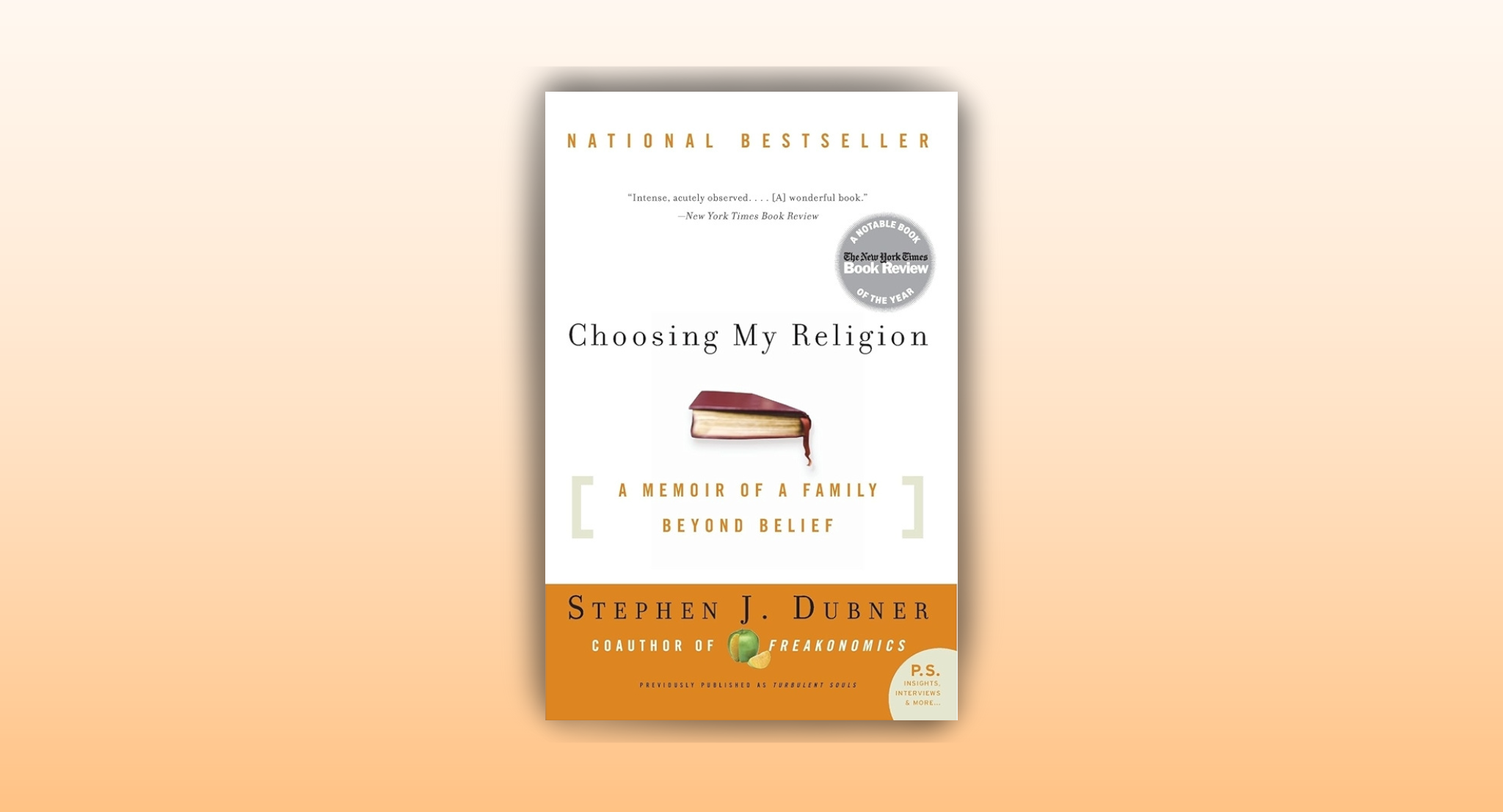
Whenever someone asks me for my favorite book, I tell them that the memoir Choosing My Religion by Stephen Dubner (who also co-authored Freakonomics) indeed helped me choose my religion.
It was my introduction not only to Judaism, but also to a whole world of Jewish books. It mentioned Pirkei Avot, so I knew I had to read that. The same with Heschel’s The Sabbath, Buber’s The Way of Man, Maimonides’ Guide for the Perplexed, and (past 18Forty Podcast guest) Simon Jacobson’s Toward A Meaningful Life.
In Choosing My Religion: A Memoir of a Family Beyond Belief (originally published as Turbulent Souls: A Catholic Son’s Return To His Jewish Family), Dubner tells of how his parents, both born Brooklyn Jews, became fiery converts to Catholicism (independently of one another) before getting married and raising eight children on a poor farm in upstate New York. Dubner, when he grew up, felt called back to his Jewish roots and wrote this book, detailing his family’s history and his own journey.
I, being the Jewish product of four intermarriages (between both sides of my family) and a Catholic education, have felt a sense of kinship with Dubner ever since I became familiar with his story. So, recently, I re-read his book—five years after it changed my life.
But, as I started, I kept feeling nagged by something Dubner said on a podcast about how the book was born: “It began when I wanted to make an oral history, literally just an audio recording.”
On that podcast, Dubner was suggesting that everyone, just as a fun experiment, try a similar project. “Sitting down and asking questions,” he said, “whether it’s a parent or a kid or strangers or whatever, it is incredibly—I don’t know if liberating is the right word, but it’s enlargening.”
With this in mind, I decided that, over Thanksgiving, I would sit down with my grandparents and get to the bottom of my family’s Jewish story—of the intermarriages and conversions that were shamefully and seldom talked about, of the Jewish traditions and anecdotes that were nearly forgotten, and of anything my grandparents, who are in their 80s, wanted me to know but never got to tell me.
I learned from my grandmother how her mother made her deeply afraid of God, how her father never went to shul because “I have shul in my heart,” and how when her mother, as a child, had purchased a pocketbook on Shabbos, her mother’s mother took it and threw it out the window.
What struck me most of all, though, was hearing my grandmother’s Jewish regrets.
“I wish I had been more religious,” she said, “I wish my mother would have taught me more … The holiday rituals, the songs, things like that.”
“It’s not very easy, and it makes me sad at this age,” she added. “I didn’t do enough, because I didn’t know enough. I regret that, not knowing enough.”
“In your next life, you’ll be religious,” Poppa Dave, my grandfather, chimed in.
I reminded my grandmother that it’s not too late in this life, that, as she approaches age 82, she could think of herself as having a second bas mitzvah.
“The matter of our having been Jewish was half footnote, half secret,” Dubner wrote in the 1996 New York Times piece that blossomed into the book.
Previously, that was how I also thought of my family’s own Jewishness. But, sparked by re-reading Choosing My Religion—still having unanswered family questions five years after choosing my own religion—I learned that our Judaism was so much more: not a footnote, but the invisible undercurrent carrying us from the Old Country to my generation and beyond.