

Reading Jewish History in the Parsha is a weekly newsletter from 18Forty, where guest writers contribute their insights on Jewish history and its connection to the weekly parsha. Receive this free newsletter every week in your inbox by subscribing here. Questions, comments, or feedback? Email Rivka Bennun Kay at Shabbosreads@18forty.org.
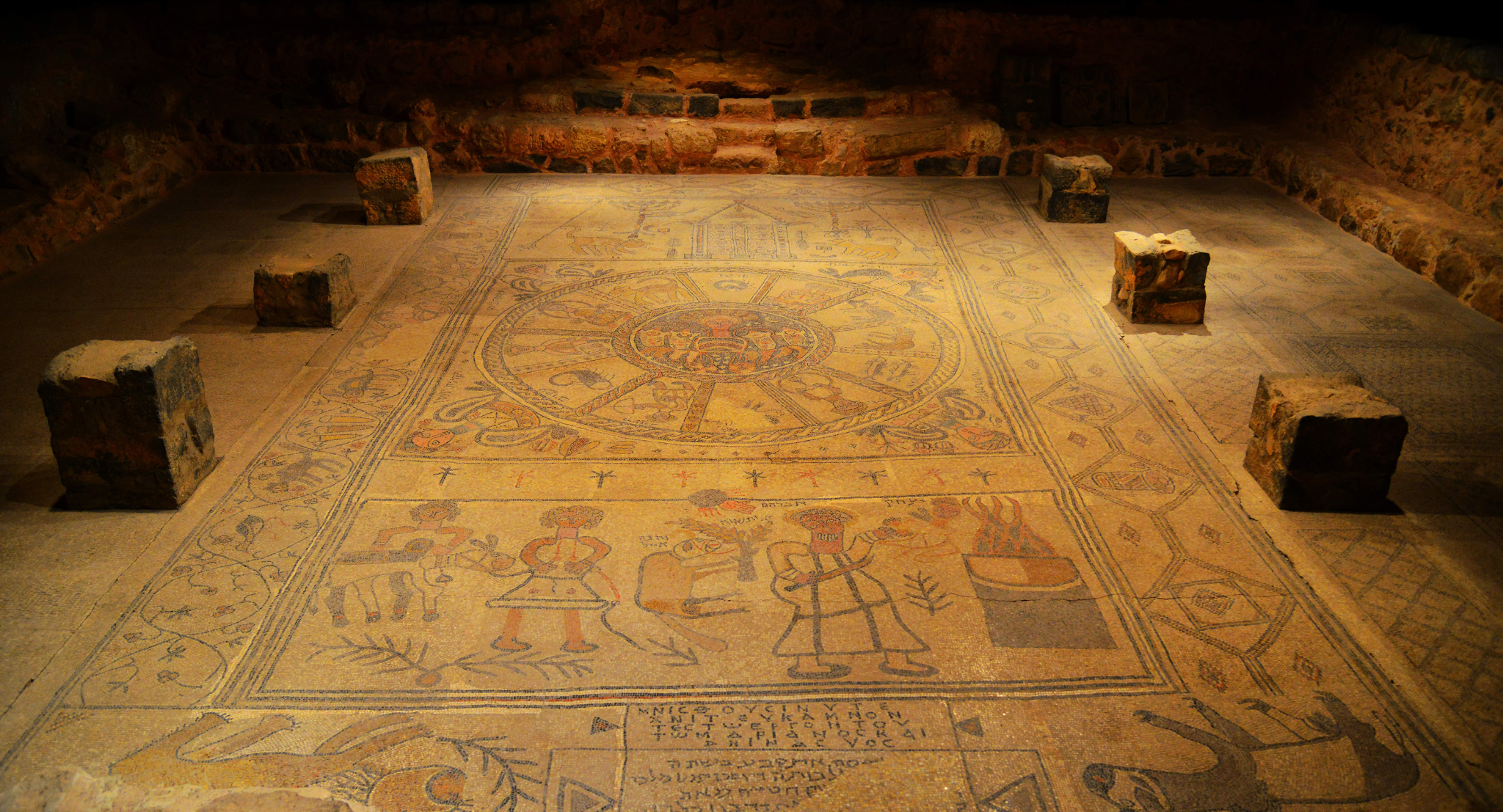
President Isaac Herzog once remarked that archeological discovery in Israel is “a story that reflects the many voices that make up our social tapestry and the many textured layers of history that contribute to our collective human story here in the Holy Land.” One such example of bridging Israel’s past with its future are the bikkurim murals found in the Beth Alpha synagogue, located near Beit She’an in northern Israel. Beth Alpha was built in the Byzantine period (sixth century CE), and is most famous for its magnificent mosaic floor, uncovered in the 1920s. One of the art motifs found in the mosaic design of the floor is a depiction of the bikkurim ceremony, which the Torah elaborates upon in Devarim 26:1–11.
In the most basic way one can encapsulate this special mitzvah, the Torah requires the first ripened fruits of the Seven Species (wheat, barley, grapes, figs, pomegranates, olives, dates) to be brought to the Beit Hamikdash. The Mishna (Bikkurim chpt. 3) describes how residents of villages in Israel would sleep in the streets overnight and in the morning set out with music, oxen decorated with gold-plated horns and wreaths of olive leaves, leading the way to Yerushalayim. The joy of this mitzvah was so great, the incoming entourage to the Temple would proudly proclaim: “Our brothers from such-and-such a place, come in peace!” The passages from Devarim 26:5–10 are then read by the altar, which relate Israel’s embittered origins as slaves and nomads, becoming slaves, and ultimately being redeemed by Hashem’s mighty hand by bringing us to the Land of Israel.
On a macroscopic level, unlike all other forms of tithing, such as terumot, ma’aserot, etc., bikkurim connects the fruits of the land to Hashem’s promise of success in harvest, upon our entry into the Land, which, according to the Abarbanel (commentary to Devarim 26:10), merits some level of celebration. However, the ultimate question that is asked by many of the mefarshim is that of relevance: What does a simple first fruit offering have to do with being on a synagogue mosaic, to Israel’s enslavement, redemption, entry into the land, and so on? One approach, I believe, lies in the very essence of offering bikkurim: performing mitzvot, especially in the Land of Israel, for their own sake, with joy.
Through a careful examination of this middah of fervent joy to perform directives—mitzvot of the Creator—throughout the Torah, Prophets, and in rabbinic literature, I believe we may learn how the Torah makes use of the term “joy,” and how joy ties into Beth Alpha’s bikkurim mosaic. In one example of analysis, our Sages praise Moses our Teacher for appointing Joshua as his successor, and also when he is directed by Hashem to fight Midian, even after he was sentenced to die before entering the Land of Israel (Bamidbar 27:22;31:2). The Midrash teaches that Moshe Rabbeinu was quick to act according to Hashem’s instructions in both these instances, even though he would not see the fruits of his labor (Sifrei (Num.) subsec. 141:2; 157:2). By virtue of the fact that Moshe had the opportunity to perform a mitzvah, “he went about and did so with joy.”
Likewise, Rabbi Baḥye b. Asher astutely notes that serving Hashem with joy is not just an enhancement of doing mitzvot—it is an integral and necessary component of performing them (commentary to Num. 4:22; Deut. 28:47). In a sense, says R. Baḥye, one may say that there is a separate mitzvah to perform other mitzvot with a sense of great happiness and pride. It is this sense of joy that comes from the mitzvot that is indicative that they are performed by us with full intent.
Put simply: One who observes the mitzvot of the Torah will organically be led to a fulfilling and happy life. Conversely, one who doesn’t practice the mitzvot with full intent will consequently miss out on the element of joy that accompanies them. It is this passive and incomplete manner of observance that, unfortunately, is one of the consequences of Israel’s exile. Therefore, when the Jewish farmer recounts that his ancestors were nomads, lost to Egyptian slavery, oppressed by Egypt, redeemed by Hashem with might, and brought by Him to the Land “flowing with milk and honey,” we, as Jews, must understand that we have been gifted the Land of Israel not only for its physical bounty, but in order to perform its native mitzvot (and other mitzvot) within it.
The Gemara (Sotah 14a) uses the famous words to sarcastically ask why Moshe Rabbeinu wanted to enter the Land of Israel so desperately, despite God’s wishes:
Is it because he needs to eat from its fruits, or for the need to fill up on its goodness? Rather, Moses said the following: “Israel is commanded to perform many mitzvot, and they are inoperable unless one is in the Land of Israel. I will enter the Land so that they will all be fulfilled by me!”
From the Gemara’s response, we see that Moshe Rabbeinu did not wish to enter the Land because of its physical and delightful resources—he was not begging for a resort stay at a Dead Sea spa. Rather, Moshe Rabbeinu is teaching us that ultimate joy and fulfillment in one’s life stems from fulfilling the mitzvot of our Torah—especially one like dwelling in the Land of Israel, which, according to our Sages, is akin in merit to performing all the other commandments of the Torah (Sifrei (Deut.) subsec. 80:4).
Finally, Rabbi Naftali Tzvi Yehuda Berlin (1816–1893), known widely by acronymic name, the Netziv, is also widely known for his commentary on the Torah, Ha’amek Davar. In his remarks regarding bikkurim, the Netziv notes (Ha’amek Davar: commentary to Deut. 26:11) that true “joy,” in the biblical sense, is a hybrid of the Divine and physical, just as bikkurim is a hybrid of Divine gratitude and providence, and physical reward and delight in one’s hard work to yield crop. In his own words, the Netziv remarks:
“And you shall rejoice in all the good”: Of the soul and of the body, together. “That which Hashem your God has given you”—that you sense the greatness of the soul’s Divinity (which is a joy and vitality greater than anything else, as I wrote above [ibid 4:1], see there). “And to your household”—this means the ever-expanding needs of the home.
We may conclude our discussion by noting that the lesson of bikkurim may appear to be like any other mitzvah, however, its unique elements relating to the uniquely Jewish concept of happiness sets it apart from almost every other commandment. Offering the first of our crops to the kohen, in the presence of the Almighty, at the Beit Hamikdash, really does show us the “many textured layers of history that contribute to our collective human story here in the Holy Land,” as President Herzog once said. It is an act of proudly telling the world that true joy comes from enjoying the physical world’s bounty through the prism of Hashem’s mitzvot, that through the mitzvot, one will naturally be led towards happiness and success, and that the ultimate enabler of the mitzvot—the Land of Israel—is the ultimate source of the Jewish nation’s sense of collective joy, as it is through the Land that we are able to perform all other mitzvot of the Torah.
It is perhaps for this reason that the revered 13th century sage, Rabbi Solomon ibn Aderet (the Rashba), held that “joy and jubilance,” as described by the Prophet Zechariah (Zac. 8:19), when referring to the eventual redemption of the Jewish people from exile, will happen when we have “peace,” as stated in the Talmud: “When there is peace, those [fast days commemorating our exile] will be days of joy and jubilance” (Rosh Hashanah 18b). The Rashba clairvoyantly notes that peace, in this context, has a specific definition: “The meaning of “when there is peace” refers to when Israel is situated in its land” (Ḥiddushei ha-Rashba: commentary to Rosh Hashana, ibid, s.v. bizman sheyesh) .
As we conclude the year and stand before the King of all kings in judgement, let us all strive to have the level of mental clarity to truly observe mitzvot with joy, to be grateful for the Jewish people returning to their homeland in numbers that defy all odds, and to make use of our return to the Land of Israel in order to fulfill all the mitzvot that are enabled through residing within the Land, which, as noted by the Rashba, is the truest source of joy that we have as Jews. May we always merit to practice the mitzvot with joy and fervor, and merit to witness the bikkurim brought again, in the presence of our third Temple, amen.