

This piece explores Rabbi Soloveitchik’s perspective on whether religious emotions should be expressed or kept private. The next piece will be the counter-perspective.
A few years ago, my family had the privilege of hosting my then-90-year-old grandmother for the High Holy Days. Her limited mobility correspondingly limited the number of synagogues accessible to her, and it soon became clear that we would all be praying at the local “Carlebach Minyan.” And so, for the first time in her long life, my grandmother, the scion of a traditional Lithuanian rabbinic family, spent Rosh Hashanah and Yom Kippur in a synagogue permeated with joyful song and dance.
My grandmother was an outspoken woman, and her sharp reactions to this new cultural experience dominated the discussion at our holiday meals (and beyond). I can write a series of essays describing what she found odd about her temporary place of prayer. One point she made, highlighted the Jewish tradition’s multivocality regarding an aspect of the world of emotions.
Bubby told us that her European parents had ingrained in her that during prayer, she was to stay still with her head tilted downwards, buried in her prayer book. The only permissible movements were those prescribed by the rhythm of Jewish prayer—sit when directed to sit, stand when directed to stand, but all in the same spot. Joyful hymns and sorrowful solicitations were recited with an identical physical posture. She learned to pray like a stoic soldier in the presence of the king, no matter the range of emotions pounding in her heart. A dignified sense of emotional privacy defined prayer.
“These people,” she continued about her temporary prayer-partners in a tone tinged with curiosity and criticism, “cannot stay still.” They clap, they shake, they dance, they jump, and they hug and cry like they are at a circus or a ballgame. She noted that they wore their emotions on their sleeves, something she deemed improper in general and certainly when in the presence of the Almighty.
This attitude of emotional privacy that my grandmother imbibed from her home was not limited to expressing religious emotions in a synagogue setting. Rather, it extended to other areas of life as well. Children were generally not taught to discuss their internal world. Feelings were generally not open topics for conversation. Deeply held emotions were present but rarely named.
What was the basis for this sort of upbringing? Why would people who clearly felt love for God, and love for their fellow Jews hardly externally express it? Conversely, is there a religious basis for wanting to talk about one’s feelings and to demonstrably express religious joy, fear and love? Is this merely a question of cultural preferences? Are there Jewish values that this question of emotional expressiveness or privacy hinges upon?
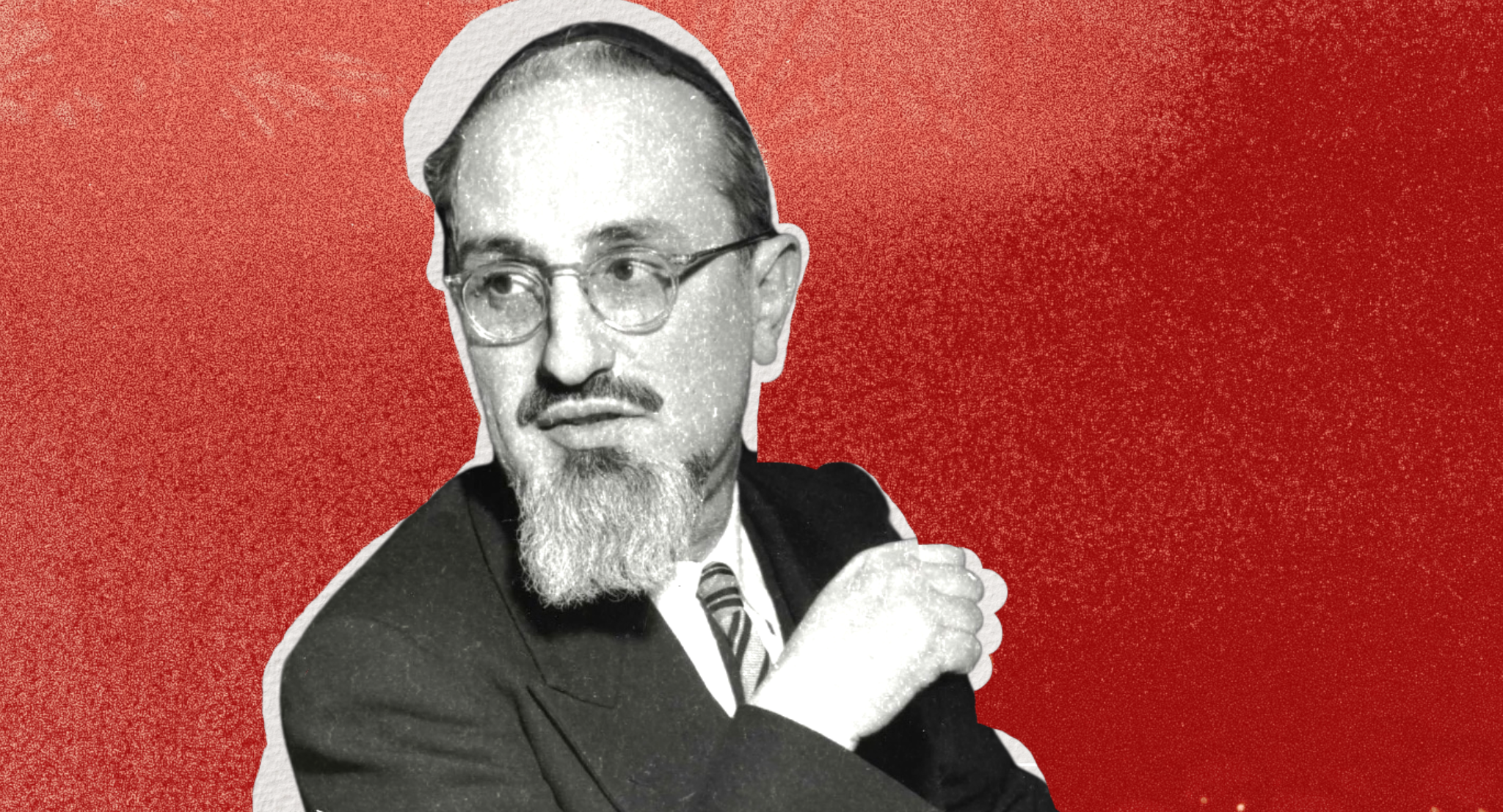
Rabbi Joseph B. Soloveitchik—the 20th-century Jewish thinker—helps to understand this attitude of emotional restraint. (A follow-up essay will, God willing, explore the value that other contemporaneous Torah giants saw in emotional expressiveness.)
Rabbi Soloveitchik was an heir of one of the foremost European rabbinic dynasties. He grew up in a traditional Eastern European community but became a leader in the shores of America. As a transitional figure who had encyclopedic knowledge of Torah and unique explanatory and oratory skills, he took it upon himself to explain and translate aspects of his upbringing to a younger generation of American Jews.
By his own admission, Rabbi Soloveitchik was raised in an emotionally non-expressive environment. In several speeches, he emphasized that while he and his father were extremely close, his father never hugged him or said “I love you.” Similarly, his parents never spoke openly about their love for God, His Torah and His people, despite clearly embodying all three. While this might have been common among Lithuanian society at the beginning of the 20th century, Rabbi Soloveitchik argued that this sense of emotional privacy was not merely the result of a general socio-cultural trend, but a deeply rooted religious value.
Piecing together segments of various speeches and essays, it seems that Rabbi Soloveitchik saw two connected religious values being expressed in emotional-non-expressiveness: (1) Imitating God and (2)The Privacy of the Holy.
Imitating God
Rabbi Soloveitchik taught that God is ever-present and yet hidden. God permeates all of existence and is yet so concealed that His own existence can be denied. While the kabbalists were interested in developing a metaphysical explanation of this paradox, Rabbi Soloveitchik pivoted the discussion into the realm of ethics and values. God, so to speak, “sacrifices” His self-expression and self-revelation for the sake of concealment and privacy.
Similarly, Rabbi Soloveitchik argued, we are bidden to follow in God’s ways:
The Master of the World, so to speak, offers an even greater sacrifice – his anonymity… Everything belongs to God – he is found everywhere – “the world is filled with his glory” … and yet his hides himself and is concealed like no other and does not appear to his creations as the Master of the World … comes Judaism and demands a level of anonymity from a person, a Jew needs to restrain himself and focus on fulfilling his mission … it is forbidden for a Jew to stand out.
This, Rabbi Soloveitchik said, is the source of emotional self-restraint within traditional Jewish life. God, the ultimate source of values, constricts Himself and does not reveal all. So, too, we are meant to follow in God’s ways and therefore tzeniut or privacy about our internal world is a true Jewish value.
Emotions as The Holy of Holies
Rabbi Soloveitchik also highlighted another Jewish value in being emotionally reserved. He noted that in the halachic system, the holier the object, the more hidden it is from public view. The Holy Ark is cloaked behind a multi-layered concealment, only to be seen by the High Priest on Yom Kippur. Similarly, our own Torah scrolls are kept hidden in an Ark except when in use. This hiding of the holy protects sanctified objects from desecration or being pedestrianized by disrespectful and unseemly observers.
What is true regarding sanctified objects is also the case regarding aspects of the human being. A human being’s intimate emotions—whether towards God or other humans—are the holiest part of the psyche and therefore must remain hidden:
The sanctuary of the human person is his emotional life, not his logical life. The Ark is with us in each person’s emotional life, concealed behind the curtain. This aspect of the human being is protected from the eye of the cynic, the glance of the skeptic, the ridicule of the so-called practical and realistic man.
The Holy Ark is the center and sanctifier of the entire Temple. Emotions can have a parallel role within a human being. It is precisely due to the significance and sanctity of certain emotions that they must remain concealed within.
This second theory of Rabbi Soloveitchik goes beyond his first. Rabbi Soloveitchik’s first idea places emotional privacy under the rubric of imitating God. But other than the need for privacy, we are not told anything per se about the nature or significance of emotions in one’s religious life.
Rabbi Soloveitchik’s second idea, though, relates directly to the significance and role of emotions in the life of a religious Jew. Sublime emotions are the Holy of Holies of the human psyche. It is specifically due to their inherent sanctity that they should not be visible on the outside. As we will see in a later essay, several Hasidic thinkers agreed with Rabbi Soloveitchik’s description of emotions as being connected to the sanctified soul of a person, yet reached the opposite conclusion regarding emotional expressiveness.
The Caveats
Within this fundamental approach of emotional privacy, there are at least two caveats that bear mentioning.
First, Rabbi Soloveitchik emphasized on several occasions that this favoring of emotional privacy should not be confused with an abandonment of the emotional sphere entirely. The Torah makes it clear that God makes demands on our emotions just as He commands our behaviors and cognitions. Rather, God wants us to deeply feel certain emotions but to not externalize them.
As Rabbi Soloveitchik wrote in Halakhic Man:
Halakhic man is worthy and fit to devote himself to a majestic religious experience in all its uniqueness, with all its delicate shades and hues … Perhaps these experiences are devoid of flashy and externally impressive bouts of ecstasy or stychic enthusiasm. However, they are possessed of a profound depth and a clear penetrating vision … Halakhic man will not dance in the streets on the Passover night, nor will he shout out his prayers on the Days of Awe; but this is not to say that he is not inspired and excited by sacred time or that he is lacking in a powerful religious experience.
Rabbi Soloveitchik even argued that a bottled-up and internal emotion can be more profound and deeper than an emotion that bubbles over to the outside world.
The second caveat is that Rabbi Soloveitchik did not always follow his own teachings. Any surveyor of Rabbi Soloveitchik’s corpus knows that some of his most powerful passages are descriptions of deep emotional experiences. For example, in a speech analyzing the nature of Torah study he digresses to describe how he was saved from depression through the cathartic experience of pouring himself into the pages of the Talmud with the accompanying a feeling God’s presence in his life:
If not for the study and teaching of Torah, I would have lost my sanity in the year of triple aveilus in sixty-seven — I was on the verge of mental collapse and breakdown. I did not. I emerged victorious, and this is due to one thing only — I would say my mad dedication to Torah. I am not trying to brag or to boast; I am telling you the truth. I was [hit] that year and the following years; I felt somehow that I was not alone, that I had somebody; there was somebody invisible but whose presence I felt, to confide in; there was somebody on whose shoulder I could cry; there was somebody from whom I could almost demand words of solace and comfort.
These poignant words were said to a large audience and have been read and reread by thousands of people. But what about Rabbi Soloveitchik’s notion of being circumspect about sharing one’s inner emotional life?
Rabbi Soloveitchik himself related to this seeming inconsistency and noted that he was, indeed, deviating from the path of his parents and community. His essential explanation is that times have changed, but not necessarily for the better. The Jewish ideal would be to perpetuate the environment of emotional privacy of yesteryears. However, due to certain historical and cultural factors, this is unsustainable for the Jewish youth of today. Therefore, Rabbi Soloveitchik argued that a concession must be made, such that parents and teachers should open up about their emotions to the younger generation.
Rabbi Soloveitchik himself noted that the approach of emotional privacy—which he asserts is ideal—seems to create a problem of continuity. In a setting of extreme emotional privacy, how are emotions supposed to be taught and transferred to the next generation? How can children and students understand the proper emotional life of a Jew if their parents and teachers never discussed it openly?
To this, Rabbi Soloveitchik argued that, traditionally, the younger generation intuitively understood proper religious emotions even without explicit communication:
In the past, this great experience of the tradition was not handed down from generation to generation through the medium of words. It was absorbed through osmosis; somehow through silence. We used to observe…
Jewish life was so thick and so rich that the children picked up on proper Jewish emotions simply by observing their parents, teachers and those around them.
In modern times, however, this unbroken chain of transmission has been frayed. The home and communal environments are no longer incubators of proper religious emotions due to the inroads of secularism. Therefore, Rabbi Soloveitchik argued, it becomes incumbent upon those who have deep religious emotions to talk about them openly with their children and students.
While practically Rabbi Soloveitchik did advocate for a limited sharing of the inner world of the parent and teacher, he felt that this was a concession to modernity. The ideal situation gave primacy to emotional privacy for the reasons delineated above.
My Grandmother and Authenticity
My grandmother grew up in a world where emotions were expressed and discussed to a much lesser degree than today. Nowadays, radical authenticity and public confessions are in style. Many in our contemporary milieu might think of my grandmother’s childhood environment as a breeding ground for emotional callousness and mental health issues. Someone might look at my grandmother and her peers in a synagogue or elsewhere and think that it was unfortunate that they cannot express themselves.
Yet, we should not be so quick to judge. While foregrounding emotional privacy may not have been ideal for everyone, this attitude can be constructed from traditional Jewish sources and values. Even if we opt to adopt an attitude of emotional expressiveness, the values articulated by Rabbi Soloveitchik regarding emotional privacy and the dignity that emerges from such a posture should be part of our internal conversation.