

In the darkness of the Hamas tunnels, some hostages turned to Jewish ritual to endure. For those raised observant, this may have been a continuation of a spiritual life they already knew—a familiar wellspring in unimaginable circumstances. But others, with little religious background, reached for ritual too: an improvised Kiddush recited over water, a piece of pita bread saved for days to serve as challah, a menorah made out of aluminum foil.
What makes a secular Jew, with no religious life to fall back on, reach for ritual instead of despair? What enables Jewish resilience under sustained pressure?
1,000 years ago, in Northern France, Rashi was asking a version of the same question.
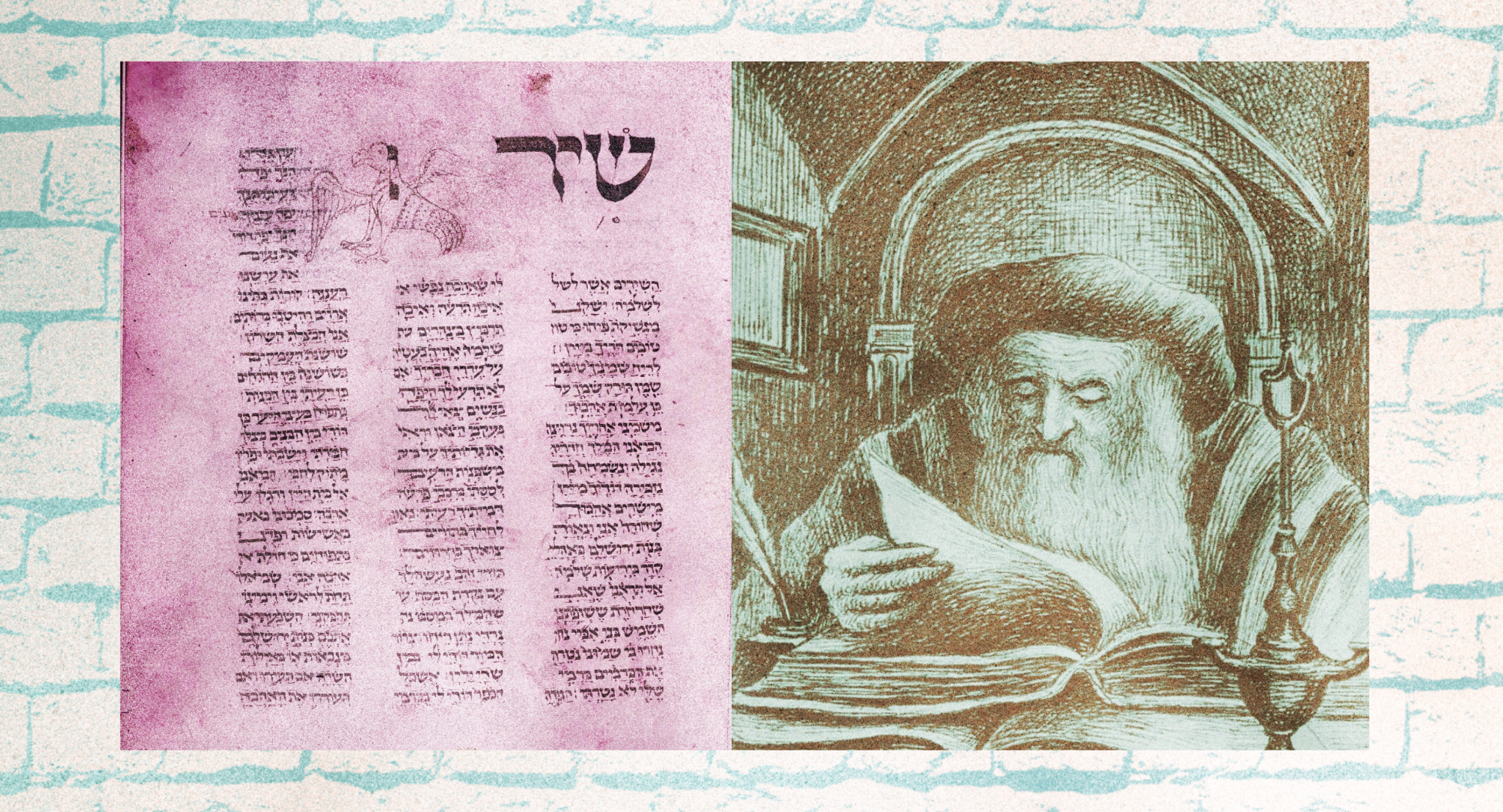
He found his answer in an unlikely place—not in law or history, but in Shir HaShirim (Song of Songs). And in Rashi’s reading, it’s a map of exactly how the bond between Israel and God survives a world working to pull them apart.
A Love Story and an Allegory
Shir HaShirim is undoubtedly the strangest book in the Bible. It vividly depicts the budding relationship between two lovers: the Shulamite (the female beloved) and her unnamed male counterpart. The text celebrates their physical beauty through rich imagery—likening her hair to a “flock of goats” and her teeth to “a flock of ewes,” while his eyes are compared to “doves, evenly set and bathed in milk,” and his lips to lilies “dripping with flowing myrrh.” Beyond these descriptions, the poem portrays moments of intimacy, such as embracing and his lodging between her breasts. Given its sensuous nature, why was such a seemingly secular work incorporated into the Tanach?
Drawing from rabbinic sources, Rashi posits that the answer lies in the mechanism of allegory. Through this lens, the narrative of human love represents the cosmic relationship between the Congregation of Israel (the Shulamite) and God (the male lover). Rashi reads the Song’s verses as a chronological timeline of Jewish history, one that charts the indissoluble bond between the two—spanning the Exodus and the entry into the Land, through the long cycles of exile and return, and ultimately culminating in a fervent plea for the final redemption.
The Song’s protagonists are undoubtedly the female and male lovers. Yet other actors also frequent the narrative stage, such as the “daughters of Jerusalem,” who serve a supporting role. Who is this female chorus sharing the limelight? According to Rashi, they symbolize the nations of the world. On three distinct occasions, the Shulamite binds them with a solemn oath: “I adjure you, O daughters of Jerusalem, by gazelles or by hinds of the field: Do not wake or rouse Love until it please!” What is the nature of this oath? Rashi explains:
“Do not wake or rouse Love”—the love of my beloved from me through seduction and verbal enticement, to forsake Him and to turn away from following Him.
The nations, through seductive speech, seek to drive a wedge between the lovers—the Congregation of Israel and God. However, they do not rely on verbal persuasion alone; they also resort to more extreme measures. When the “daughters of Jerusalem” later ask, “How is your beloved better than any other?” Rashi elucidates the true meaning of their questioning:
“How is your beloved better than any other?”—What is it about your God that distinguishes Him from all other gods, such that you allow yourselves to be burned and hanged for His sake?
Thus, we see that the nations resort to physical violence as well. What nations is Rashi referring to? The following glosses clarify his intent:
“I adjure you”—The nations, today, while I am exiled among you. (Commentary to 3:5)
“I adjure you”—Now the Congregation of Israel addresses the nations: “Even though I complain and lament, my Beloved holds my hand, and He is my support in my exile; therefore, ‘I adjure you.’” (Commentary to 8:4)
Rashi’s use of the terms “today,” “now,” and “in my exile” makes it clear that he is addressing the nations of his own era. In the following gloss he alludes to their identity (based on the Talmud in Eiruvin 21b):
“Let us lodge in the villages” (kefarim)—Among the disbelievers (kofrim). Come and I will show You the descendants of Esau, upon whom You have bestowed prosperity, but who do not believe in You.
Esau is a code name in Rashi’s Bible commentary for the Roman Empire and its Christian successors; thus, “the descendants of Esau,” mentioned here by the Congregation of Israel, are the Christians in whose midst they reside.
From Exile to Antisemitism: Rashi’s Historical Context
Rashi’s commentary was not written in a vacuum. Residing in 11th-century Northern France, Rashi was acutely aware of the pressure exerted by the Church on Jews to abandon their faith, a challenge which—as noted above—manifested in two distinct ways.
First, there was the mobilization of “seductive speech”—the promotion of Christological readings of the Hebrew Bible as the sole “truth,” while dismissing Jewish interpretations as erroneous. At times Jews were coerced into participating in these “inter-faith discussions,” a polemical tactic that would culminate in the public disputations later in the Middle Ages, where Jewish texts were effectively put on trial. Second, the Jewish community faced sporadic acts of physical violence that reached a catastrophic peak during the First Crusade (1096), which occurred nine years before Rashi’s death. Rashi had spent his formative years studying in the preeminent Rhineland yeshivas of Mainz and Worms—communities that were subsequently decimated by the Crusader armies
This two-pronged strategy of “the daughters of Jerusalem,” combining speech and violence, became the prototype for the antisemite over the course of history. This approach is employed to sever the unique bond between Israel and her God or to isolate Israel from the international community, rendering her a pariah among nations in preparation for her destruction.
The Nazi regime, for instance, systematically utilized rhetoric centered on disease, parasitism, and corruption to dehumanize the Jewish People. By framing Judaism as a “contagion” that required quarantine and eradication to “save” the German people, Nazi propaganda desensitized the public through the relentless repetition of slurs. This “war of words” ultimately paved the way for the Final Solution: the physical annihilation of European Jewry.
Today, militant Islamic groups and their global cohorts utilize the same dual tactics—verbal and physical—to target and delegitimize the Jewish People and Israel.
Under the guise of “free speech,” these groups spew a false narrative that frames Israel as the sole aggressor and oppressor, even levelling baseless accusations of genocide. They champion free speech only when it suits their agenda, yet they work tirelessly to silence Jewish students, bloggers, and influencers on university campuses and online.
They also resort to physical brutality. The atrocities of Oct. 7, the Tree of Life shooting in Pittsburgh, the attack on a Manchester synagogue during Yom Kippur, and the pogrom at the Bondi Beach Chanukah lighting are all part of the same grim pattern. Spanning the globe, these forces resort to rape, torture, and murder in an attempt to break the spirit of the Shulamite—the eternal Congregation of Israel.
The Foundations of Jewish Resilience
Returning to the text of Shir HaShirim, how does the Shulamite respond to the dual pressures exerted upon her? She declares, “I am a wall,” signaling that she does not buckle under external pressure, but instead remains steadfast in her love and loyalty to God and His values. But how is such ironclad resolve possible? What are the secrets to her enduring strength?
Rashi’s commentary offers us two essential keys to understanding her resilience.
The first is found in the continuation of the Shulamite’s words: “I am a wall, and my breasts are like towers.” Rashi, based on the Talmud in Pesachim, interprets this metaphor, explaining: “And my breasts are like towers—these are the synagogues and the study halls.” Throughout his commentary, Rashi repeatedly emphasizes these institutions as the vital sources that nourish the Jewish soul and forge Jewish identity. In his view, these centers of learning and prayer provide the spiritual fortitude necessary to withstand external pressures. For Rashi, Jewish education is far from a luxury; it is the very foundation upon which the “wall” of Jewish resilience is built.
A contemporary Jewish leader, William Daroff, CEO of the Conference of Presidents of Major American Jewish Organizations, draws a conclusion strikingly similar to Rashi’s. He notes that while the Jewish community long prioritized external alliances—investing heavily in ties with various groups in the hope of support during crises—the aftermath of Oct. 7 proved this strategy insufficient. Daroff argues that the community must now shift its focus inward, stating: “The last two years have shown that organizations should pour more resources into ‘doubling down’ on Jewish education to strengthen people’s identity and resilience.”
Just as Rashi viewed the study hall as the “tower” that enables the “wall” to withstand external pressure, Daroff recognizes that in the contemporary reality, internal identity—built through education—is the only reliable foundation for Jewish resilience.
The second key to resilience building, according to Rashi, lies in the vivid descriptions of the Shulamite’s body in Shir HaShirim. Rather than mere physical attributes, Rashi interprets her body parts as symbols of ritual performance. For instance, her head is likened to Mount Carmel, symbolizing the phylacteries (tefillin) which sit prominently atop the head just as Carmel towers above the surrounding landscape. Similarly, “the locks of her hair” represent the braided hair of the Nazirite, beautified with commandments as braided purple wool. Furthermore, “her feet in sandals” are identified with the pilgrimage festivals (aliyah leregel), evoking the Israelites’ journey to Jerusalem. To Rashi, these physical metaphors form a spiritual map of Jewish commitment; they are the vital components necessary for the cultivation and preservation of Jewish identity and strength.
This connection between ritual and resilience remains profoundly relevant today—as seen with the former hostages. Ritual became a spiritual lifeline whether or not it was inherited, sustaining their internal strength and preserving their sense of self under the most harrowing conditions. In a similar sense, we are also aware of the contemporary phenomenon of the “Oct. 8 Jew,” the surge of previously non-affiliated Jews who are seeking more active Jewish engagement with their heritage.
Rashi’s “two keys,” education and ritual, demonstrate that true resilience is not merely a defensive reaction to external pressures like antisemitism. Instead, it is a proactive cultivation of the self and a deepening of national identity. That is what prompted a hostage with a foil menorah to reach for ritual instead of despair—not a crisis response, but a wellspring built long before the crisis came.
By nurturing internal Jewish values and expressing them through the “world of action,” individuals transform abstract beliefs into a tangible source of strength. Ultimately, this framework teaches that endurance is built from within, rooted in one’s heritage and the lived practice of its traditions.