

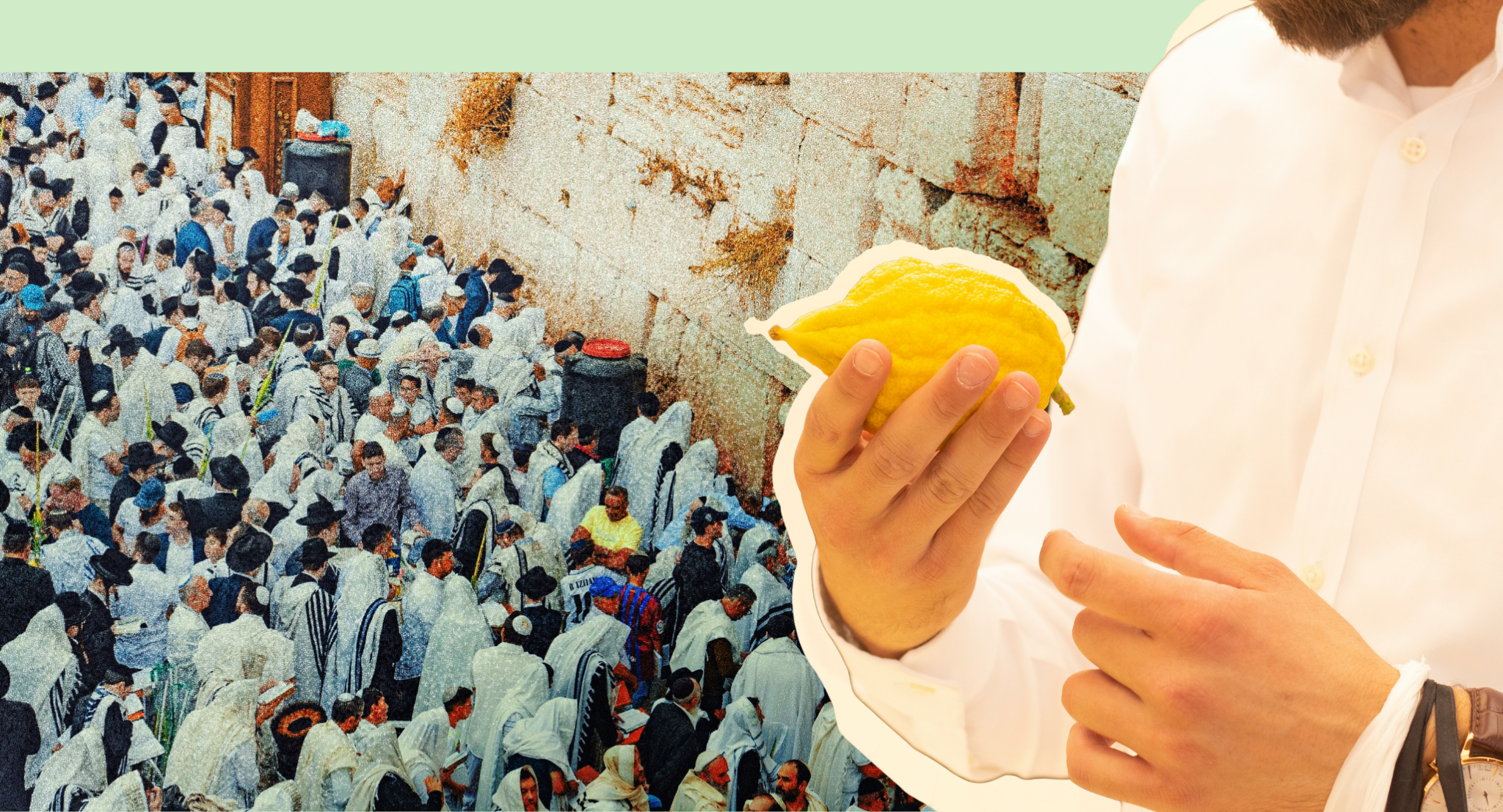
Your 18Forty Holiday Guide explores the meaning and relevance behind each of the holidays in the Jewish calendar. Receive this newsletter in your inbox by subscribing here. Questions or feedback? Email Rivka Bennun Kay at Shabbosreads@18forty.org.
You got through the two hardest holidays on the Hebrew calendar. Yom Kippur ended a few days ago, you are back at work, and you received a text from a friend, cousin, or someone from the shul you no longer go to, asking whether you will come for a meal in their sukkah this week. You will probably answer “maybe.” Sukkot is the holiday you stopped thinking about years ago, if you ever kept it at all, because it asks for things the other two never did: a hut in a yard where the neighbors can see it, a “lemon” and a palm branch in your hands, and a week of being told to be happy. For many it can feel like a minor holiday at the end of a heavy month, and plenty of people treat it that way.
The Torah does not treat Sukkot that way. Devarim 16:16 names three festivals of pilgrimage to Jerusalem: the Feast of Unleavened Bread, the Feast of Weeks, and the Feast of Booths, which puts Sukkot, the Feast of Booths, at the same level as Pesach and Shavuot. Sukkot is also one of the few holidays whose reason the Torah gives specifically. Vayikra 23 commands seven days in booths “in order that future generations may know that I made the Israelite people live in booths when I brought them out of the land of Egypt.” The command was written for the generations that came after the generation in the desert, and the further a generation stands from the original story, the more it needs the reminder, which includes a person holding a smartphone and deciding whether to type “maybe.”
But merely knowing why the holiday exists does not get you to the sukkah, and you might easily raise at least three objections. Take these objections one at a time and think them through with an open mind. First, your house or apartment is a perfectly fine dwelling that does what you need it to do, and a week of meals in a shack can look like play-acting without meaning in the modern world. Second, the mandated “lemon” and the branches can look like the superstition of a primitive religion. Perhaps the hardest of all is that the Torah orders you to be happy, even when your life may be filled with difficulties. Joy is not an emotion you can summon on command.
Why should I leave a perfectly good house to eat in a shack?
The Torah provides an answer to this question, enhanced by the commentators, but the question for you is whether you accept that answer and whether it applies to your life in the modern world. For seven days, the Torah says, you are to live in a sukkah, a temporary hut with a roof made of cut branches. Over the centuries the tradition has settled that living in the sukkah essentially means eating your meals there. In practice you eat your dinner outside under the roof made of branches, while your own house, or apartment, stands a few steps away with the lights on and the heat working. If the whole purpose is to remember that your ancestors once lived in shelters like these, you might reasonably ask why a story told at the table would not do the same job, without the cold, the bugs, and the neighbors watching.
The Sages did not agree on what those original shelters were, but whichever opinion you accept, the people who came out of Egypt lived for 40 years under a covering that nobody had built to last, and they survived the harsh desert life without the physical protections we enjoy today. The law makes that memory tangible to you in a very practical way. The Shulchan Aruch reads the law as calling, at least as the preferred way, for a roof of branches thin enough that you can see the larger stars through it at night. This interpretation tells you that the hut’s true purpose is to allow you to understand what it means to be exposed to nature’s harsh elements without the physical protection of a modern dwelling.
What actually protects me?
The people you come from were protected for 40 years by something other than a strong building. And once a year you sit under a see-through roof that cannot protect you from nature’s elements and ask yourself what actually protects you in your daily life, whether you call it God, your hard work, luck, or the people sitting at the table with you who provide you with comfort and a sense of belonging to something larger than yourself. Sebastian Junger, a war reporter, came to a similar conclusion, with no religious purpose at all, in Tribe, his book about modern American life. “A person living in a modern city or a suburb can be surrounded by others and yet feel deeply, dangerously alone,” he writes, and “independence can lead to isolation.” A modern house does its job by keeping the world outside, and Junger’s point is that the same walls that keep out the weather also keep out other people. For one week a year the sukkah takes the walls away, and the law’s next instruction is about who should be sitting under the roof with you.
Why was I invited?
The hut was never designed for one person. Rabbi Eliezer Melamed, in his Peninei Halakha, writes that “the Torah commands us to include the poor and lonely in the festivities and to invite them to share our meals.” He further writes that these people, before anyone else, “are the guests (ushpizin) whom it is a mitzva to invite into the sukka.” But “poor” does not just mean those of limited financial resources. It extends to people without close family or friends with whom to share the holiday, so that they can discover its full meaning and enjoy the warm embrace of the Jewish community.
In practice, then, the week is full of people asking other people over, and the ones who build a sukkah want it full, because the law tells them to look first for the people who have no sukkah of their own. The text on your phone is a result of this rule put into modern practice, to bring in those who might not otherwise feel part of the community and enjoy the warmth of the holiday even in a rickety shelter. Whoever sent it is not counting you among the poor. They have a sukkah, and the tradition tells them that their table does not provide the meaning the holiday is meant to have, for them or their guests, until someone who has no one with whom to share the holiday is sharing theirs, which is a different thing from a courtesy or a charity.
What if my Jewish life came apart?
There is one more answer to the first question, and it is for the person whose own Jewish life came apart somewhere along the way, which may be you. In an essay for Tablet, Rabbi Dovid Bashevkin cites the Maharal of Prague, explaining that a collapsed house is no longer a house. A sukkah, though, “is made to take apart and rebuild,” and a Jewish identity built like a sukkah rather than like a house is one that “even when it collapses it still endures.” Bethany Mandel, a writer and editor, said on the 18Forty Podcast that for her children “Judaism to them will never be a rabbi, it will never be a synagogue, because Judaism is the thing that they grew up with in their homes.”
A sukkah is that kind of Judaism. It is a table under a temporary roof, it goes back up every year whether or not you sat under it last year, and it does not require you to have kept anything else. The part of Jewish life that is centered around a Shabbat or holiday table with friends and other members of the Jewish community can therefore be resumed this week or next, even if your observance has lapsed for years, because the sukkah is the one Jewish structure built on the assumption that it will be taken down and rebuilt every year.
So you leave your modern home to sit under an open roof in a rickety structure to try to internalize that the people you come from depended on something other than a modern shelter and survived. And because the people who build sukkahs look for someone who has no one with whom to share the holiday, there is a table for you this week. When you come into the sukkah, someone will hand you the lulav and a “lemon,” and that may lead you to a second question about what Sukkot means to you.
Why am I holding an expensive “lemon,” shaking a palm branch, and walking in circles?
The answer to this question is harder, because the Torah gives a reason for the hut and gives none for the four plants or the “lemon.” Without articulating any rationale, Vayikra 23:40 tells you to take the fruit of a beautiful tree, palm branches, boughs of a leafy tree, and willows of the brook, and to rejoice before God for seven days. It does not say why these four plants, and it does not say what to do with them. All the rituals using these plants came from rabbinic tradition, and if no one ever explained any of it to you, that is not your failure. To many people in the modern world, the whole thing looks like a primeval ritual you would expect to see in a documentary about a primitive tribe. So the question you may ask yourself after learning more about the holiday is whether the tradition’s own account of what you are doing changes that simple view.
Who is in the bundle?
The tradition’s most important answer about the bundle is about the people holding it rather than the plants themselves. The Midrash reads the four species as four kinds of Jew. The etrog, the “lemon,” has both taste and fragrance, like the Jew who has both learning and good deeds. The palm, the lulav, has taste and no fragrance, like the person with learning but no good deeds. The myrtle has fragrance and no taste, like the person with good deeds but no learning. The willow has neither, and the Midrash says that these are the “people among them who do not have Torah and do not have good deeds.” Then the Midrash asks what God does with all these different Jews, and answers that getting rid of any of them “is not possible.” Instead, “Let them all be bound together in a single bundle.”
The Shulchan Aruch follows the same principle and rules “these four species are all mutually necessary,” and that if any one of them is missing no blessing is said over the rest. Rambam rules the same way about a Torah scroll, which is disqualified if “even a single letter was omitted.” Rabbi Jonathan Sacks wrote a whole book, A Letter in the Scroll, on the Baal Shem Tov’s image that the Jewish People are a living Torah scroll and every individual Jew is a letter within it.
The tradition is extremely inclusive and calls the whole of the Jewish People Klal Yisrael, the whole community of Israel, and Klal Yisrael is less than whole if any one of them is missing. The bundle you are handed is, therefore, a statement that you, the questioner who is not sure where he belongs, count exactly as much as the most learned person in the room who keeps every commandment, and that the blessing cannot be said if you are missing. The community carried on while you were away, but according to the Midrash and its corresponding law the community counts itself less than whole while you are missing. You are not a visitor in that room. The room is not complete without you.
Why plants, and why in my hands?
But why do we need a bundle of plants at all? Rambam, in the Guide for the Perplexed, gives the plain reason: “the four species are a symbolical expression of our rejoicing that the Israelites [ex]changed the wilderness,” a place with no seed, figs, vines, pomegranates, or water, for “a country full of fruit-trees and rivers.” The people who had spent 40 years living in the hut as they wandered through the desert took the most pleasant fruit of their new land and its best-smelling branches and held them up in thanks. The joy the plants stand for belonged to everyone who came out of that desert, the learned and the unlearned alike.
Why the plants are held in the hands, rather than simply spoken about, is a question the Sefer HaChinuch, the 13th-century work that gives a reason for every commandment, answers directly. “A man is impacted according to his actions that he constantly does.” Its model is tefillin, the commandment that everyone who says the Shema twice a day reads aloud, to “bind them as a sign on your hand and let them serve as a symbol on your forehead,” an act that increases the spiritual connection by doing something physical along with prayer. The lulav, the Chinuch says, comes “from this root.” The four plants were chosen because “it is the nature of all of these four species to gladden the hearts of those that see them,” so that at the harvest, the happiest time of the farming year, a person holds something beautiful and remembers that the joy is for God’s sake. The ancient claim is also a modern one. A person is changed by what he does with his hands, and the tradition puts the land’s joy into everyone’s hands—the scholar’s and yours.
Why with a whole room?
The shaking and the circling are done with words and with other people. The words are “Lord, please save us,” a short and plain request made by the whole room at once, with the body as well as the mouth. But why a whole room, rather than each person at home? Scott Wiltermuth and Chip Heath of Stanford found across three experiments that moving in synchrony with other people “can increase cooperation by strengthening social attachment among group members.” A room of Jews shaking the same bundle and walking the same circle is being bound into one people by the movement itself, and nobody in that circle is asked whether he belongs there. Many people who keep the holiday every year still look at the bundle in their hands, think that somebody must be kidding, and do it anyway.
Why the expensive “lemon”?
The last thing in your hands is the “lemon,” and its price also has an explanation. The etrog, the citron that the tradition identifies as the fruit of a beautiful tree, can cost a great deal, and much like anything else meaningful to people, the more beautiful and unblemished, the greater the cost. The Talmud reads a verse from the song at the sea as a call to “Beautify yourself before Him in the performance of the mitzvot.” So the man with the magnifying glass studying an etrog is bringing the best example he can find to a commandment, and the money he spends is his own expression of how much it matters to him. Modern research explains why someone spends hard-earned money on a ritual. Dimitris Xygalatas, an anthropologist at the University of Connecticut who studies costly rituals, reports in an essay for Aeon that people across cultures who put more into a ritual take more from it, a pattern he calls “effort justification.” You can read this either as a bias the tradition takes advantage of or as something most people recognize in themselves. But the price is not part of the obligation. What is left is the hardest demand of the week: that you be happy.
How can anyone command me to be happy?
Devarim 16:15 ends its law of the festival with the words “you shall have nothing but joy.” You can be told to eat outside and to hold the branches. But nobody can tell you what to feel, and a command to be happy sounds like asking for something that is not humanly possible, least of all from a person whose life may be filled with difficulties. The tradition’s usual answer is that you act first and the feeling follows, but it still does not tell you how to get from a text on your phone to joy at somebody’s sukkah table on a Tuesday night.
Whom does the joy depend on?
But in the command itself the Torah does not leave “nothing but joy” hanging on its own. Verse 14 says to rejoice in your festival “with your son and daughter, your male and female servant, the Levite, the stranger, the fatherless, and the widow in your communities.” The command to be happy comes at the end of a guest list, and Rabbi Sacks read the guest list as the key to this joy. Simcha, the Hebrew word the Torah uses for joy, “is not a private emotion,” he wrote. “It means happiness shared. It is a social state, a predicate of ‘we,’ not ‘I.’ There is no such thing as feeling simcha alone.” In a companion essay he drew the line between the two words English runs together: “Happiness is something you pursue. But joy is not. It discovers you,” and in the Torah’s account it discovers you at a table with other people.
Rambam essentially rules the same thing more than 800 years earlier. In his laws of the festivals he writes that a person who locks the gates of his courtyard and eats and drinks with his own family “without feeding the poor and the embittered” has only “the rejoicing of his gut.” You could have a good dinner with friends any night of the year without any of this. What the command adds is the guest list, the people nobody would otherwise have invited. The Torah never asked you to manufacture a feeling alone in your living room. It told the people with sukkahs whom to invite, and it defined their joy by whether the person with the least reason to expect an invitation is sitting at the table. This week that person may be you, and if it is, the host’s joy depends on you as much as yours depends on him. Your presence is what makes the meal count as the joy the Torah commanded.
What if I do not feel it?
The tradition also expects that the joy will not always be there, and it says so. By a custom the Rema records, “on Sukkot, Kohelet is read,” also known as Ecclesiastes, which opens with the words “All is futile!” Rabbi Hayyim Angel reads Kohelet as teaching that joy is possible precisely because human life is limited. Kohelet confronts mortality and the uncertainty of life, yet repeatedly urges us to enjoy the good that God gives us: food, work, companionship and the ordinary pleasures of daily life. For Rabbi Angel, this joy is the religious response of accepting life as a divine gift, appreciating what we have while we have it and continuing to live responsibly before God despite everything we cannot understand. Rabbi Sacks said the same thing about the hut itself: “Every Succot we leave the security and comfort of our houses and live in a shack exposed to the wind, the cold, and the rain. Yet we call it zeman simchatenu, our season of joy.” A meal outside, in a shack, with people who wanted you there, is the joy the verse means. It is available to the person who has been away for 20 years on the same terms as to the person who never left.
This project is made possible with support from the Simchat Torah Challenge and UJA-Federation of New York. Learn more about the Simchat Torah Challenge and get involved at their website.