

This piece first ran on our Substack, Reading Jewish History in the Parsha. We’re pleased to share it here on our website.
Rabbanit Chana Henkin, founding dean of Nishmat Center for Advanced Torah Study for Women, is one of the great teachers and revolutionary builders of Torah in our generation. 11 years ago, her son, Rav Eitam—a brilliant and accomplished author, talmid chacham, and doctoral student—and his wife, Na’ama—a talented artist and poet—were murdered by terrorists. The terror attack also involved four of their children who were miraculously spared.
It was the week of shiva, and the entire Jewish community was plunged into mourning. Rabbanit Henkin, ever the educator, slowly surveyed the room packed with people who had come for nichum aveilim and asked, “Tell me, how many sefarim are there in Tanach?”
The room fell silent, unsure if it was a rhetorical question or if she was actually interested in an answer at a moment like this. Someone finally said, “Rabbanit, there are 24 sifrei Tanach.” Rabbanit Henkin nodded and replied, “That was correct; indeed there are 24 books in Tanach … and now we are writing the 25th.”
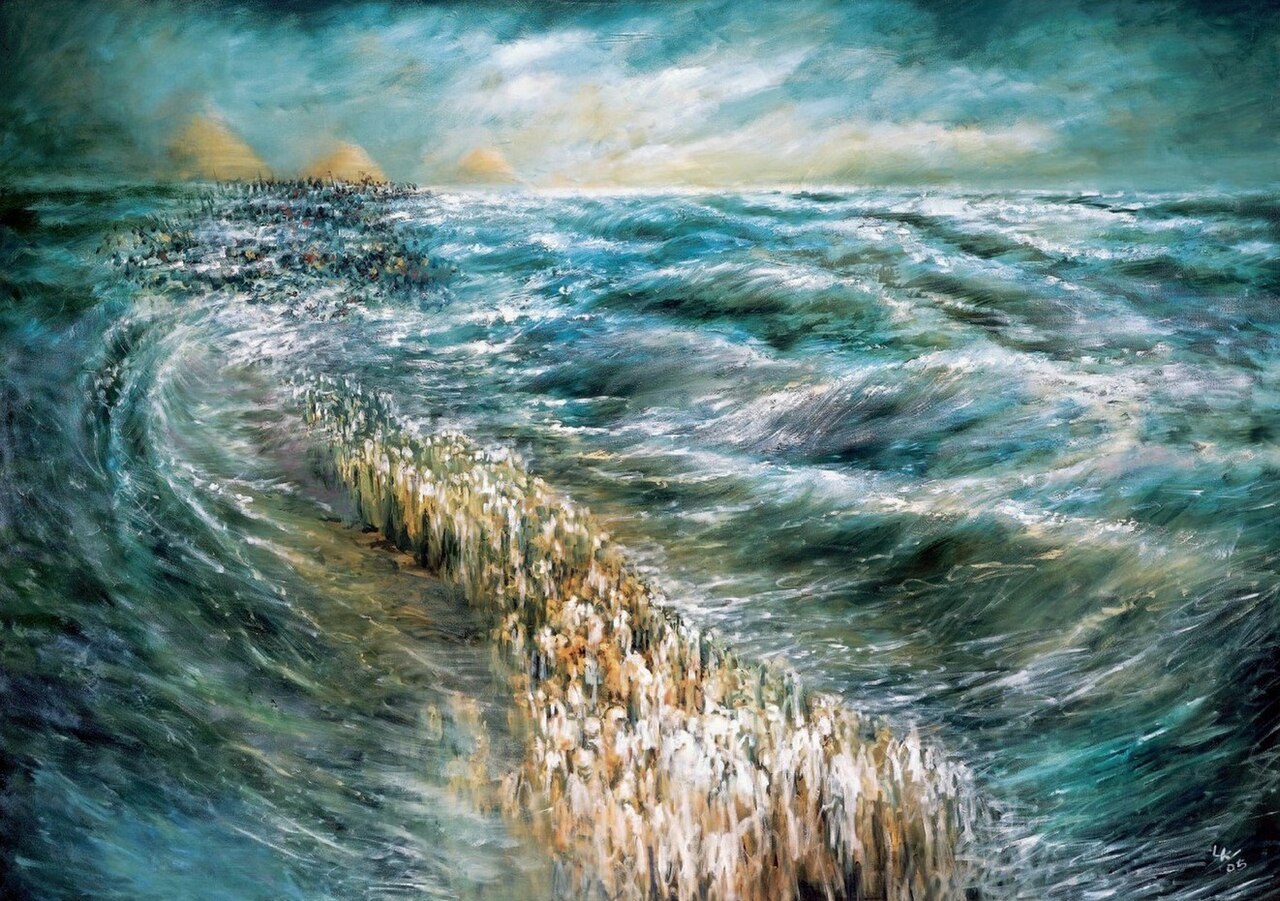
Following the Exodus from Egypt, we arrived at the shores of the Yam Suf. Our parsha recounts the next steps in the redemption of Am Yisrael.
We thought we had finally made it out. But then, we looked back and saw Pharaoh and his mighty army, horsemen and chariots chasing us down. Dogs terrorized us with their barking and we were surrounded by darkness and unspeakable cruelty. Before us stretched the Yam Suf, the sea of fear, the sea of yei’ush (despair). The trauma of exile was still within us; sadly, we had become accustomed to constant demoralization.
The elders of the generation, Moshe, Aharon, and the leadership, gathered to propose different strategies: Maybe we should daven, maybe we should go back to Egypt, maybe we should fight the Egyptians, or maybe it’s better just to throw ourselves into the sea, for what can we realistically do at this point? Indeed, there was no conceptually viable way forward. Engulfed by our enemies, we stood there frozen, gazing out at the ominous sea of stuckness. The weight on our shoulders was almost too much—our hearts sank and our faces fell.
Nachshon ben Aminadav had stood by, however, listening intently to the other leaders, and now he stepped forward. He did not propose a new strategy or opinion, nor did he present a calculated plan based on the facts at hand. Youthful in his openness, he set forth a completely new narrative, a fresh vision beyond all formulaic thinking and precedents.
Generally, we look toward our elders—parents, grandparents, and gedolei Yisrael—for guidance and direction. They have learned from experience and are cognizant of what is realistic and what is not. Nachshon didn’t base his insight solely on accumulated data, a log of past assumptions and experiences, nor even “realism.” There are moments when geula depends on bena’areinu uvizekeneinu neileich—going forward with our youth (first) and our elders (second). This means prioritizing our fresh, youthful, intuitive thinking, and yet joining this with the emunah and accumulated wisdom of our elders, teachers, parents, and grandparents.
Breaking through the stuckness of conceptzia, our fossilized, detrimental state of consciousness—and simply moving forward—depends primarily on the na’ar, our youthful point of view stepping forward. In other words, there is a place inside every single one of us called na’ar, a childlike place that hasn’t been tainted or broken, and that hasn’t given up or become glazed over. This aspect of our soul sees the world, and even overwhelming dilemmas, without calculation, cleverness, or the burden of old narratives, but rather with simple faith, open imagination, and innocent joy. This inner child is also called nishmas Yisrael, the soul of Israel. When we feel stuck, exhausted, or up against the wall, we need to let our nishmas Yisrael step forward and proceed with holy naivete, coupled with holy chutzpah, into the sea.
The obstinacy to remain with the same outlook and to use it as an excuse for sins that have become entrenched in one’s nature, be they actions or thoughts, is a sickness that derives from slavery. It does not allow or hacheirut (the light of freedom) to illuminate us. Teshuva strives for creative and true freedom, hachofesh haEloki (Divine freedom), which contains no slavery.
— Oros haTeshuvah, 5:5
Nitzachon doesn’t only mean a partial military victory, symbolic vengeance, or just pushing enemies back to buy time before the next time they attack. For Klal Yisrael, nitzachon includes teshuva and returning to our land, restoring our sovereignty, and standing on our own two feet. The only way to attain this is hisna’ari me’afar kumi, to wake up the na’ar within, to arise from the dust of exile—and go forward into redemption.
Torah provides an insight into how this looks when we are accomplishing it: “And the children of Israel went out (of Egypt) with an upraised arm.”
Targum Onkelos translates beyad ramah, “an upraised arm,” as bereish geli, literally “with head held high,” implying that they left Egypt with a sense of holy pride, empowerment, and confidence. This uplifted posture is later contrasted with the constricted, collapsed, disempowered posture and constricted state of the slaves in Egypt, bent under the heavy yoke of oppression: “I am Hashem, your God, Who took you out of the land of Egypt from being slaves to them; and I broke the pegs of your yoke and led you upright.”
Rashi quotes Midrash Toras Kohanim: The word komemiyus, “upright,” means bekoma zekufa, “with an upright, straightened posture,” having been relieved from the weight of our bondage. After generations of suffering and slavery, Hashem delivered us from exile—not just geographically, but posturally, empowering us to stand tall in the true stature of our soul.
Rebbi Meir interprets the word komemiyus as “two komos” or levels, implying that in the future, the Jewish People will have the stature of 200 cubits—two times the height (komos) of Adam haRishon, who was 100 cubits tall. Beyond this change in our physical height and stability, the Gemara teaches that in the End of Days, Am Yisrael will transcend even the exalted level of existence that we had when mankind was created.
Sefas Emes continues to unfold this insight. Each of us is made up of two “komos:” a komah ruchanit and a komah gashmit, a physical level and a spiritual level. Our physical body, whose height we can measure on the outside, is the vessel. Our spiritual soul, the light within the vessel, has its own kind of stature. Although there is a tension between the priorities and needs of our physical and spiritual aspects, by observing mitzvos and committing to living Yiddishkeit with passion, we can achieve a balance of these two komos, embody the fullness of our potential, and stand tall. We can assume our ultimate form and express our inherent spiritual level of greatness. This is the essence of our komemiyus: standing in the noble posture of our inner greatness, with uplifted pride in our identity and our observance.
This week, in 1951, the Lubavitcher Rebbe assumed the mantle of Jewish leadership. In the shadow of the Holocaust, he began to breathe new life, hope, and confidence into a broken nation, one that had just been on the brink of decimation. In this way, every 10th of Shevat is a day on which we can emerge from darkness into light on a new level.
Throughout more than half a century of leadership, the Rebbe created campaigns designed to stimulate a massive return of souls to Jewish practice, values, ritual, and tradition—by encouraging the most natural way for a Jew to express his or her identity: by “doing Jewish.” He referred to this mission as Gaon Yaakov—authentic Jewish pride. Gaon Yaakov manifests not only personally, but also geopolitically, as a national sense of self-respect, empowerment, and joy. He called to a downtrodden, beaten nation to stand tall once again. He envisioned public expressions of Jewish life across the globe flourishing, openly celebrating Yiddishkeit without compromise or apology.
The Rebbe’s spiritually radical model of “mitzvah campaigns’’ still challenges our community to step out of our comfort zones and share our wealth of knowledge, opportunities, and blessings with others. From going out onto city streets to ask men to lay tefillin and women to light Shabbos candles, to holding massive Lag Baomer parades and public menorah lightings, the Rebbe made it his mission, and every Jew’s mission, to reach out and reveal the greatness, the treasure, of every Yiddishe neshama—to sing, unabashedly, the song of a nation reborn.
And they had emunah in Hashem and in Moshe, His servant.
At the Yam Suf, not only did we awaken to emunah in Hashem, but also to emunah in “Moshe, His servant,” meaning all the tzadikim and true leaders of the Jewish nation in every generation. Such luminaries restore our faith in ourselves, and redeem us from our personal enslavements, allowing us to emerge from our particular exiles standing tall and confident. In their fresh outlook and often radical confidence, they guide us to live bereish geli, with our head held high, striding through life in our full komemiyus stature. As we celebrate the spectacular leadership of the Lubavitcher Rebbe, we are celebrating all of the tzadikim, past, present, and future. And we are celebrating our own nekudas hatzadik, our innermost point, the pure soul that we really are.
Everything has an appointed season, and there is a time for every matter under the Heavens.
In our days, a continuous et milchama (time of war), we are witness to a miraculous restoration of numerous komos, essential physical and spiritual levels in our development as a nation in our homeland. The awesome bravery of our soldiers has led to an awakening and rejuvenation of faith, identity, national spirit, and pride. Our brothers and sisters in the army madim (uniform) have answered the call to protect and serve, and are redeeming and elevating the language of mitzvah—of obligation and zechus—the sacred duty, necessity, and privilege to be in service of one’s people and land. Indeed, their selfless dedication to others, their responsibility for Am Yisrael, is the highest expression of Torah ideals, and the highest level of the Jewish soul.
Even through all the pain and suffering, loss, and confusion, of this unwanted war, there is an awakening of authentic Jewish gevurah (heroism) and mesiras nefesh—loving self-sacrifice. There is a new cascade of expressions of faith and renewed identity, courageous acts of holiness, expansive consciousness, and exquisite holy pride. Whether by choice or by having been “chosen” for this, Jews around the world have been activated. We are asserting our peoplehood, pushing back against rampant antisemitism, and standing tall for Am Yisrael and Yiddishkeit.
Sgt. Maj. Aviad Cohen, Hy”d, a young father and soldier in the Etzioni Brigade, was killed while fighting jihadists on October 7. A couple of months later, in advance of Purim, his wife posted the following notice on the door of their home: “Happy Purim! You are asked to enter this home with your head held high and standing tall! Fill yourself with strength and happiness; only then may you knock on our door. We are the family of a hero who spread light and hope during his life and with his death. We are proud of all of you.”
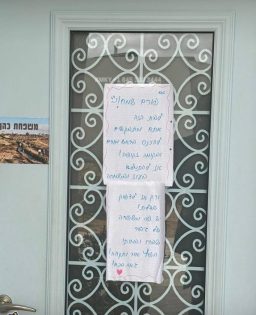
Each year, as we relive Kriyas Yam Suf through studying Parshas Beshalach, we receive an invitation to heed the call of our national inner na’ar: “Hisna’ari me’afar kumi—wake up, people! Now is not time to wallow in the dust, but to stand up straight, confident, and faithful! Come, let’s step forward and split this sea of stuckness, break through this glass ceiling of galus-thinking, and resurrect ourselves along with all the goodness in the universe!”
We are living through, and shaping, extraordinary times, a tekufa gedola, a period of great historical importance. War shakes the foundations of the world. In the wake of October 7, as our sense of security crumbles and so much of what we assumed to be dependable has toppled, the infinitely deep and powerful force of nishmas Yisrael, the soul of our nation, is nevertheless emerging, in the process of being reborn from within the rubble. We are being redeemed.
Not since the founding of the State of Israel and the War of Independence have we been engaged in such an existential struggle on so many fronts. Prime Minister David Ben-Gurion’s name for the War of Independence was Milchemes Hakomemiyus—“the War of Standing Up,” as it were—since it empowered us to arise as a nation, defend ourselves, fight back, and recover great portions of our promised land. As we witness over and over the faith and sacrifice of our soldiers and their families, we are now standing up again, taller and stronger than ever before. We are writing the final chapter of history, the 25th book of Tanach.
Rabbanit Henkin, upon arising from shivah, straightened up, and with a piercing look of determination told those gathered:
I believe that things have never been better for the Jewish People than they are right now—possibly since the earlier years of King Solomon’s reign. But it’s important we know that despite the price, we are experiencing a great period of history. It is also a period that is very, very far from simple.
But despite everything, I believe with all of my being that the miracles which we are experiencing now in history, including the establishment of the State of Israel and the ingathering of the exiles from across the globe, dwarf the miracles of our Exodus from Egypt.
We are all being tested … times are hard. Yet we must know that we are marching forward, we have a role, and we will fulfill that role. Your main role right now, dear students, is to learn Torah, to grow in your midot, to grow in ahavat Yisrael …
May we be blessed to see miracles as at the Yam Suf, and to emerge from all our personal and national challenges standing tall, unapologetically confident in our unfolding redemption. May all our exiles return home to our land with heads held high in holy pride — in fulfillment of the holy words we have faithfully davened for so many hundreds of years: וּשְׁבוֹר עוֹל הַגּוֹיִם מֵעַל צַוָּארֵנוּ וְתוֹלִיכֵנוּ מְהֵרָה קוֹמְמִיּוּת לְאַרְצֵנוּ, כִּי קל פּוֹעֵל יְשׁוּעוֹת אָתָּה, “And please break the yoke of the nations from upon our necks and quickly guide us upright to our ךand, for You are the God who enacts salvations.” Amen.