

I Read This Over Shabbos is a weekly newsletter about Jewish book culture, book recommendations, and modern ideas. Receive this free newsletter every week in your inbox by subscribing here. Questions, comments, or feedback? Email Rivka at Shabbosreads@18forty.org.
Everyone knows that three-minute Brene Brown clip about empathy.
I always think of empathy as this sacred space; when someone’s in a deep hole, and they shout out from the bottom and they say, “I’m stuck.” “It’s dark.” “I’m overwhelmed.” And then we look and we say, “Hey. I know what it’s like down here. And you’re not alone.”
Sympathy is, “Ooh! It’s bad … Want a sandwich?”
Empathy is a choice, and it’s a vulnerable choice, because in order to connect with you, I have to connect with something in myself that knows that feeling. Rarely, if ever, does an empathic response begin with “at least.”
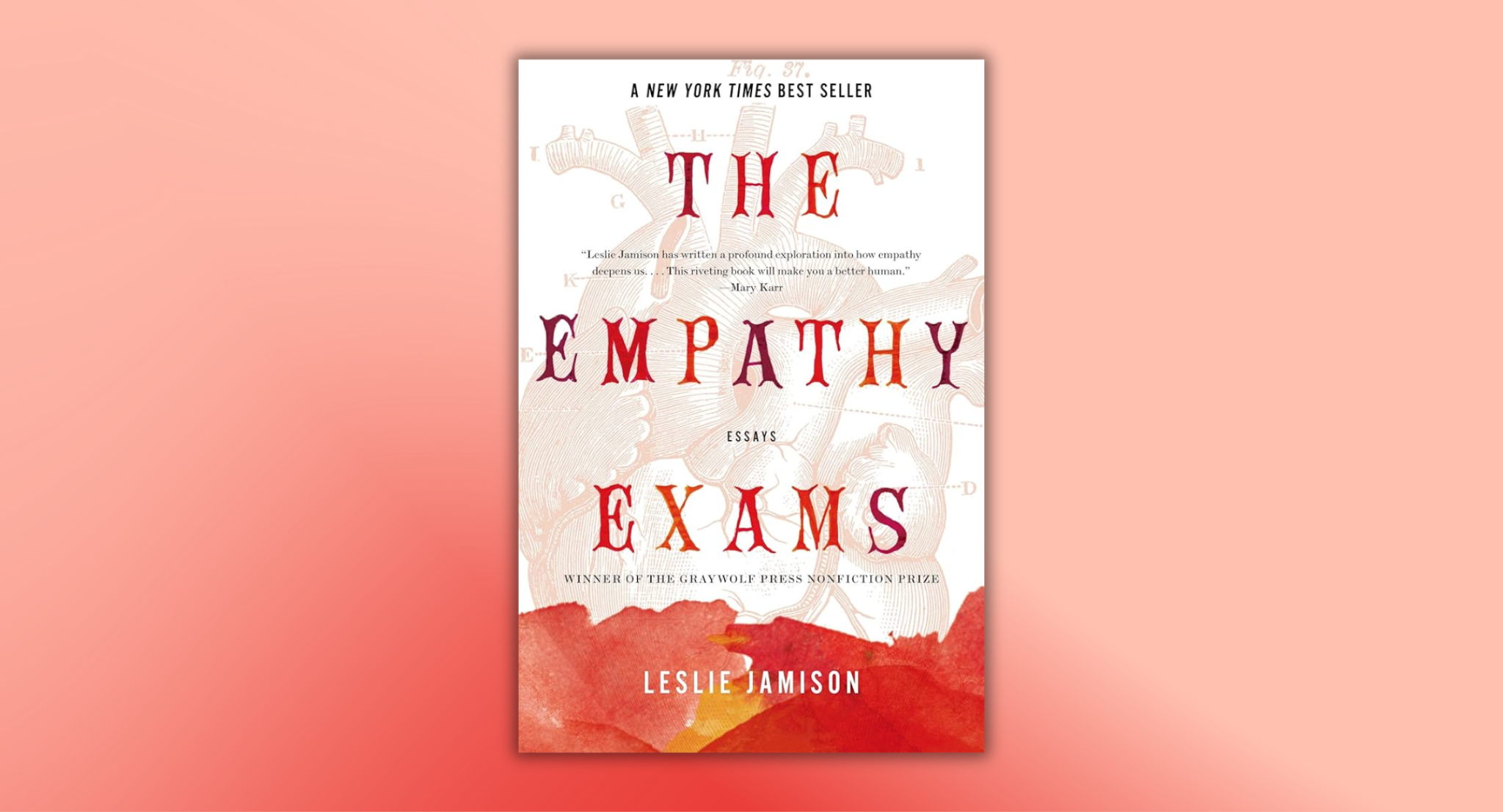
It’s the video I’ve always referred to in my understanding of empathy. That is, until I was introduced to Leslie Jamison’s The Empathy Exams. Brown’s model works when suffering is comprehensible, but what about suffering that resists our categories?
On Sunday, Tatiana Schlossberg published an essay in The New Yorker revealing her terminal cancer diagnosis—at 35 years old with two children, she’s been given a year to live. What do you say to someone facing that? How do you climb into that hole? This is the kind of necessary empathy Jamison prepares us for.
You don’t need to know the science behind pain to understand Jamison’s explorations of it. Her focus is the lived texture of suffering and care.
In the title essay, Jamison writes about her time as a medical actor—hired to perform symptoms while students diagnose her—and explains that they are graded not just for medical accuracy, but for whether they “voiced empathy for my situation/problem.”
It isn’t enough to sound kind or concerned; the students must say the sanctioned phrases. This opens Jamison’s central question: What does it mean to actually show empathy? Is it the script—“that must be really hard”—which she finds “aggressive in [its] formulaic insistence”? Or can compassion come through the humility of good questions? For Jamison, this is where empathy becomes active work:
Empathy isn’t just listening, it’s asking the questions whose answers need to be listened to. Empathy requires inquiry as much as imagination. Empathy requires knowing you know nothing. Empathy means acknowledging a horizon of context that extends perpetually beyond what you can see…
Empathy comes from the Greek empatheia—em (into) and pathos (feeling)—a penetration, a kind of travel. It suggests you enter another person’s pain as you’d enter another country, through immigration and customs, border crossing by way of query: What grows where you are? What are the laws? What animals graze there?
Empathy can be defined the way it classically always was: putting yourself in someone else’s shoes. Except Jamison demonstrates just how difficult that can be. Where’s the line between feeling others’ pain and projecting it onto yourself?
In one of many instances of radical honesty and unabashed self-awareness, Jamison admits, “When bad things happened to other people, I imagined them happening to me. I didn’t know if this was empathy or theft.”
After describing her brother’s diagnosis with Bell’s palsy, she confesses:
I spent large portions of each day—pointless, fruitless spans of time—imagining how I would feel if my face was paralyzed too. I stole my brother’s trauma and projected it onto myself like a magic-lantern pattern of light. I obsessed, and told myself this obsession was empathy. But it wasn’t, quite. It was more like inpathy. I wasn’t expatriating myself into another life so much as importing its problems into my own.
This question—of how much of someone else’s pain we can truly feel—haunts much of Jamison’s writing. She weaves personal experience into the essay, recalling an abortion, a heart surgery, an ex-boyfriend. But her radical self-exposure isn’t an end unto itself; it’s a vehicle through which she can explore and understand the pain of others, all the while questioning whether this is even a valid method for practicing empathy. Although her transparency feels uncomfortable at times, it speaks to the human experience of trying to connect with others’ pain.
One of the most striking examples of this tension—between wanting to understand and recognizing the impossibility of fully doing so—is in Jamison’s essay “Devil’s Bait.” In a fascinating and slightly disturbing piece, Jamison attends a conference on Morgellons disease—a medical condition whose very existence is disputed by the medical establishment.
Morgellons—often dismissed by doctors as delusional parasitosis—is characterized by the sensation of crawling insects and fibers emerging from underneath the skin. The conference Jamison attends functions as a support group for Morgies, and here, empathy becomes not only difficult but ethically fraught. What does it mean to validate someone’s suffering when you cannot validate their explanation of it? What does it mean to listen closely when the story you’re hearing is one you cannot endorse? As Jamison writes:
They didn’t know what this matter was, or where it came from, or why it was there, but they knew—and this was what mattered, the important word—that it was real.
Jamison attends the conference neither as believer nor skeptic, but as a witness—someone who wants, desperately, to do right by the people who invite her into their narratives. Morgellons patients describe fibers emerging from their skin, unexplained lesions, and the deep loneliness of not being believed. Jamison does not share their symptoms; she cannot fully inhabit their experience. But what she can do is sit with them, listen, and—most importantly—examine her own discomfort.
Jamison describes the time she went to the ER because a worm was growing inside the skin on her ankle—and how doctors looked at her “kindly and without belief.” She uses this story to help herself—and us—understand what it is to be in pain and not believed. “I tell myself I can agree with a declaration of pain,” she writes, “without being certain I agree with the declaration of its cause.”
This is where “Devil’s Bait” becomes more than a piece about a fringe medical condition; it becomes a meditation on the ethics of witnessing. Jamison suggests that empathy doesn’t require perfect alignment of belief, nor does it demand that we solve or verify another’s pain. Instead, it asks us to stay humble, curious, attentive—even when the story unsettles us.
Yet Jamison acknowledges that even this interpretive move—reading Morgellons as a metaphor for some universal human ache—can itself betray empathy. Metaphor, she warns, can blur the distinct contours of real suffering:
My willingness to turn Morgellons into metaphor—as a corporeal manifestation of some abstract human tendency—is dangerous. It obscures the particular and unbidden nature of the suffering in front of me.
Ultimately, Jamison leaves us with a version of empathy that is far less stable—and far more honest—than the one we tend to celebrate. Empathy becomes neither identification, nor metaphor, but a disciplined refusal to look away. It is the work of attending to another’s suffering without translating it immediately into our own.
This makes empathy harder than Brown’s animated parable suggests, but also more expansive. Jamison shows that to care for someone is to accept the limits of our comprehension, to resist the comfort of clean explanations, and to honor the specificity of someone’s pain—even when we can’t name its cause.
Perhaps this is the uncomfortable truth Jamison offers: Empathy is not about fixing someone’s pain, but about staying close to it—even when we don’t understand it.