

I Read This Over Shabbos is a weekly newsletter from Rivka Bennun Kay about Jewish book culture, book recommendations, and modern ideas. Receive this free newsletter every week in your inbox by subscribing here. Questions, comments, or feedback? Email Rivka at Shabbosreads@18forty.org.
I’m not an olah who claims America is no longer her home—quite the contrary. America is my home in the sense that it raised me, educated me, and, in many ways, shaped who I am. To echo something David Bashevkin recently wrote, I’m eternally grateful for the American upbringing I had. I was exposed to literature, art, Torah learning, a whole world of culture and education.
July 4 has taken on less meaning the longer I have been in Israel. It’s not that I don’t celebrate out of anger or protest, rather it’s sort of just another day here. Then I remembered that I once loved American poetry, and a 250th birthday felt like enough of an occasion to go back to poems I used to love, and see what they still had to say.
As I revisited these poems, what struck me was how much of the American story is really, through the eyes of these poets, a story about wanting. It’s a country people want to belong to, a version of themselves they want to become, a version of the country itself they’re still waiting for.
So here are five short, unintimidating poems for your Fourth of July weekend—just a small sample of what some American writers hoped for, and how they said so.
Walt Whitman, a self-described “American bard,” believed a nation could be heard in the sound of its people at work. “I Hear America Singing” is a celebration of everyday working Americans—ordinary people who make up the nation.
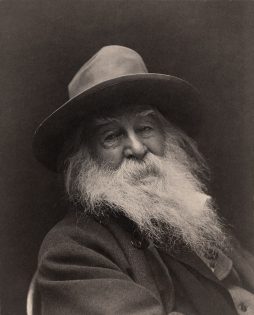
“I Hear America Singing” — Walt Whitman (1860)
I hear America singing, the varied carols I hear,
Those of mechanics, each one singing his as it should be blithe and strong,
The carpenter singing his as he measures his plank or beam,
The mason singing his as he makes ready for work, or leaves off work,
The boatman singing what belongs to him in his boat, the deckhand singing
on the steamboat deck,
The shoemaker singing as he sits on his bench, the hatter singing as he stands,
The wood-cutter’s song, the ploughboy’s on his way in the morning, or at noon intermission or at
sundown,
The delicious singing of the mother, or of the young wife at work, or of the girl sewing or
washing,
Each singing what belongs to him or her and to none else,
The day what belongs to the day—at night the party of young fellows, robust, friendly,
Singing with open mouths their strong melodious songs.
Emma Lazarus, a Jewish-American poet and activist, is best known for the sonnet on the Statue of Liberty. In “Long Island Sound,” she’s not writing about the nation at all, but about one afternoon, entirely her own.
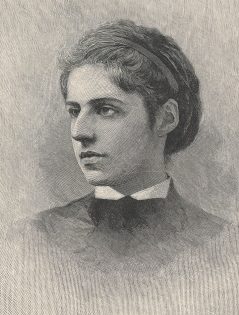
“Long Island Sound” — Emma Lazarus (1888)
I see it as it looked one afternoon
In August,— by a fresh soft breeze o’erblown.
The swiftness of the tide, the light thereon,
A far-off sail, white as a crescent moon.
The shining waters with pale currents strewn,
The quiet fishing-smacks, the Eastern cove,
The semi-circle of its dark, green grove.
The luminous grasses, and the merry sun
In the grave sky; the sparkle far and wide,
Laughter of unseen children, cheerful chirp
Of crickets, and low lisp of rippling tide,
Light summer clouds fantastical as sleep
Changing unnoted while I gazed thereon.
All these fair sounds and sights I made my own.
Whitman again, but this time he writes about how a single tree, standing alone, becomes a way of admitting what he can’t live without.
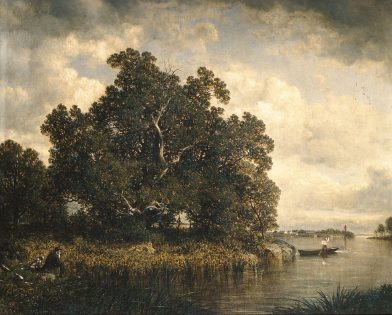
“I Saw in Louisiana a Live-Oak Growing” — Walt Whitman (1860)
I saw in Louisiana a live-oak growing,
All alone stood it and the moss hung down from the branches,
Without any companion it grew there uttering joyous leaves of dark green,
And its look, rude, unbending, lusty, made me think of myself,
But I wonder’d how it could utter joyous leaves standing alone there without its friend near, for I
knew I could not,
And I broke off a twig with a certain number of leaves upon it, and twined around it a little moss,
And brought it away, and I have placed it in sight in my room,
It is not needed to remind me as of my own dear friends,
(For I believe lately I think of little else than of them,)
Yet it remains to me a curious token, it makes me think of manly love;
For all that, and though the live-oak glistens there in Louisiana solitary in a wide flat space,
Uttering joyous leaves all its life without a friend a lover near,
I know very well I could not.
I couldn’t help but include Robert Frost’s “Stopping by Woods on a Snowy Evening,” especially because I read it differently now that I’ve read Rav Aharon Lichtenstein’s take on the poem. If the last time you read this poem was in middle school, try it again now and see where it meets you.
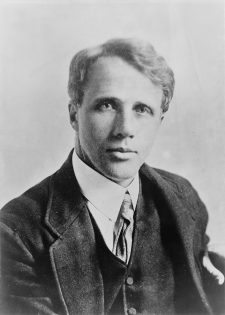
“Stopping by Woods on a Snowy Evening” — Robert Frost (1923)
Whose woods these are I think I know.
His house is in the village though;
He will not see me stopping here
To watch his woods fill up with snow.
My little horse must think it queer
To stop without a farmhouse near
Between the woods and frozen lake
The darkest evening of the year.
He gives his harness bells a shake
To ask if there is some mistake.
The only other sound’s the sweep
Of easy wind and downy flake.
The woods are lovely, dark and deep,
But I have promises to keep,
And miles to go before I sleep,
And miles to go before I sleep.
In response to Whitman’s American singing, we’ll end with Langston Hughes’ wanting. It’s not a wish so much as a claim: I, too, am America.
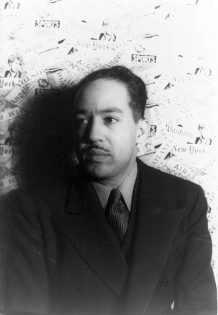
“I, Too” — Langston Hughes (1926)
I, too, sing America.
I am the darker brother.
They send me to eat in the kitchen
When company comes,
But I laugh,
And eat well,
And grow strong.
Tomorrow,
I’ll be at the table
When company comes.
Nobody’ll dare
Say to me,
“Eat in the kitchen,”
Then.
Besides,
They’ll see how beautiful I am
And be ashamed—
I, too, am America.