

I Read This Over Shabbos is a weekly newsletter from Rivka Bennun Kay about Jewish book culture, book recommendations, and modern ideas. Receive this free newsletter every week in your inbox by subscribing here. Questions, comments, or feedback? Email Rivka at Shabbosreads@18forty.org.
I don’t know about you, but I needed this last long string of holidays and Shabbosim.
At 18Forty, we love to focus on Pesach as a time for family. But this Passover season also gave me ample time to spend with friends—time to farbreng, time to casually but intentionally gather over food and drinks to talk about life and spirituality.
Ahead of Pesach, I received a text in a group of my close friends saying, “We need to do Judaism together more … I feel good when I am doing Judaism with you guys. Some of the best times I’ve had.”
These previous “best times” refer to when we ran a Moishe House, where we hosted Jewish events for our peers. Over our years together, we’d walked with people through conversion, aliyah, the taking on of mitzvos, the trauma of October 7, and countless Shabbos dinners followed by long Shabbos nights on the couch.
There was something about living in a center for Jewish life that made every day a chance to grow Jewishly together, whether we set out to or not. After we split up, we realized continued development required dedicated time.
So we made a point over Pesach to farbreng again, the way we used to.
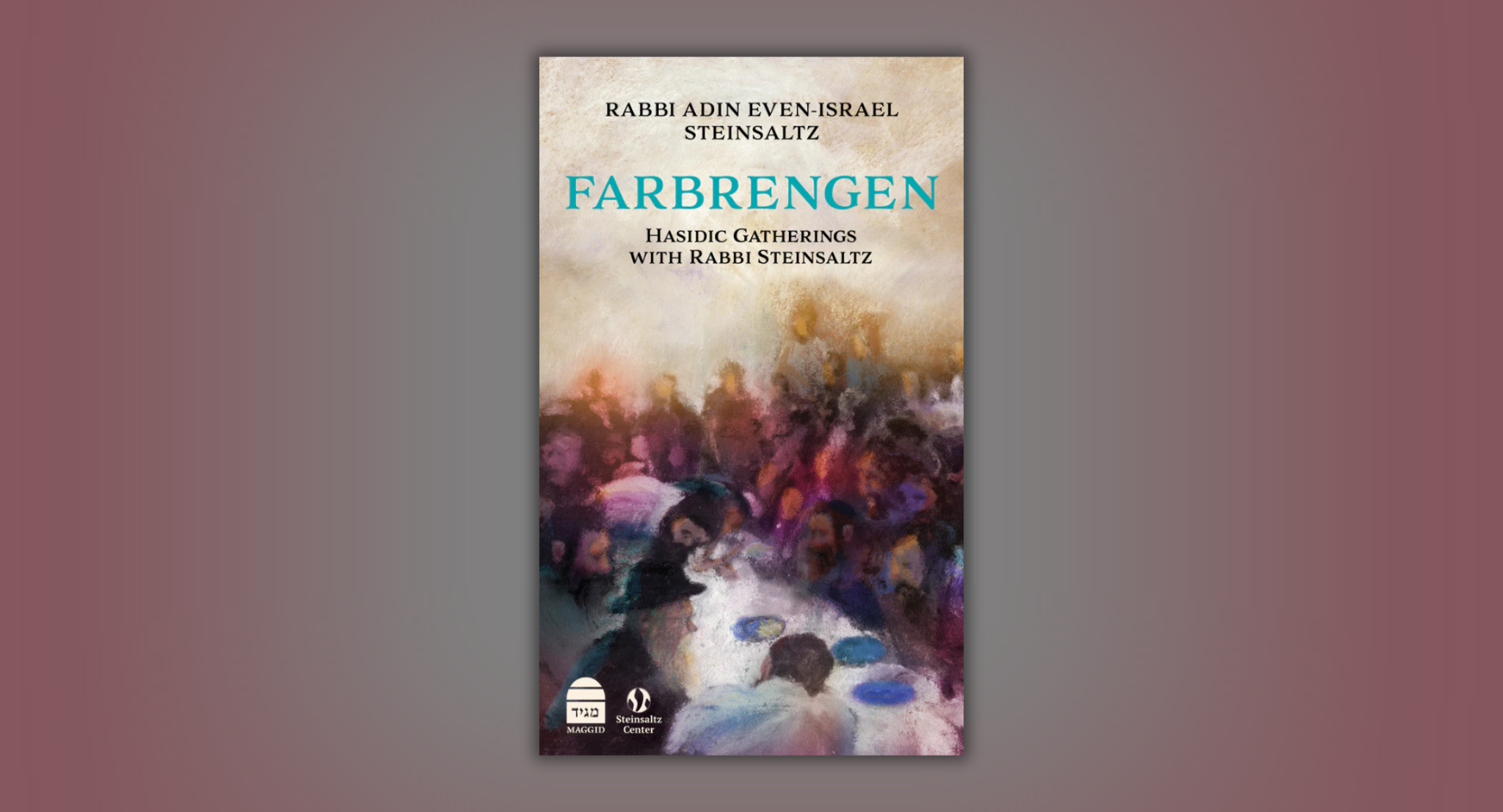
Luckily, I’d also been getting some tips for farbrenging from the legendary Rabbi Adin Even-Israel Steinsaltz z”l, via his book newly available in English, Farbrengen: Hasidic Gatherings with Rabbi Steinsaltz, which contains teachings from 21 of Rabbi Steinsaltz’s farbrengens.
They’re arranged mostly according to dates on the Hebrew calendar, marking birthdays and yahrzeits of essential Hasidic figures, from the Baal Shem Tov to the Kotzker Rebbe to three Chabad Rebbeim. Throughout, the reader is struck by the theme of loving one’s fellow Jew, especially in the farbrengen at the end for Rabbi Steinsaltz’s own birthday. The book doesn’t replace farbrenging, but it does serve as a time capsule of Rabbi Steinsaltz’s teachings, and as inspiration for our own gatherings.
With this book in mind, I met up with others on Shabbos Pesach to hang out in an apartment over matzo and charoses.
We’d invited so many differing personalities that it was difficult at first to gel. But this, I learned from Rabbi Steinsaltz, is part of the beauty of the experience. We learn in the opening section, “What Does One Do at a Farbrengen?”:
The sense of togetherness at a farbrengen is, to a large extent, similar to that of soldiers in a tank. The soldiers didn’t choose each other, and they may have little in common. But after being together for a long time in extreme proximity, a connection is formed; an experience is shared.
By the end, we were bonding over the challenges with dating, mental health, and living up to our own career expectations. These are things that we wouldn’t get to in our everyday conversations, certainly not unpack fully. It’s just too hard. This, I again learned from Rabbi Steinsaltz, is part of the point:
The essence of the farbrengen is Jews being together, seeing one another, connecting with one another, trying somehow, to the best of their abilities, to remove all veneers, all masks, most of which are false. The essence of the farbrengen is to exist in absolute brotherhood. In this way, perhaps, they can attain a sense of life at the level of Knesset Yisrael.
This was such a success that we’d have an even bigger gathering for Mimouna, the traditional Moroccan celebration following the end of Pesach. This time, we enjoyed malawach and Dr. Brown’s soda.
But the refreshments, of course, are merely a means to an end. In Farbrengen 11, held in honor of the hilula of the sixth Lubavitcher Rebbe, Rabbi Steinsaltz reminds us:
What a person ate or drank at a farbrengen isn’t important; whether or not he paid attention is also not critical. What matters most is whether anything of the essence of the farbrengen will be retained.
We’d felt we’d escaped our own Egypts, by getting the mental-health help we needed, by being patient with ourselves in times of anxiety, and by realizing that our lives are, indeed, worthwhile despite the obstacles in our way.
However, coming out of Shabbos, I realized I wasn’t at all done with the inner work I did over the Pesach season. I let little things make me angry, I was short with a family member, and I had lost any newfound faith in myself.
“The only objective of a farbrengen,” Rabbi Steinsaltz says, “is to change people’s lives. The farbrengen must provide some new perspective, or at least cause them to feel a little twinge.”
And so, whether this recent farbrenging has been beneficial remains to be seen.