

Your 18Forty Parsha Guide is a weekly newsletter exploring five major takeaways from the weekly parsha. Receive this newsletter every week in your inbox by subscribing here. Questions or feedback? Email Rivka Bennun Kay at Shabbosreads@18forty.org.
He came to America from the Soviet Union in 1990, a teenager with almost no Jewish education and no synagogue he was allowed to enter. Now in his early 50s, he learns a page of Talmud most mornings while his three children daven the words without thinking. He married into an observant American family and is raising those children inside a practice he is still learning himself. He was not there at the founding his children take for granted, and one verse in Parshat Nitzavim is written for exactly that kind of person, someone who came along late and was never part of the original count.
Most of us did not come the way he did, from the outside with nothing to inherit. A man who had to build his Judaism from scratch knows exactly what it is worth, which is why he calls it a gift. The person most likely to call it a burden is the one who got all of it for free. Nitzavim was written for everyone who was not at the founding, however they arrived, and it ends by asking what each of us will pass on to our own children.
Nitzavim and Vayelech share this Shabbat because of the calendar, not because they tell one story. Nitzavim opens with Moshe gathering the whole nation to enter the covenant, and then he turns from the people in front of him to include those who “are not with us here this day.” Moshe’s decision to include the people who were not standing there is the place to begin.
1. The Covenant Was Written for the People Who Weren’t There
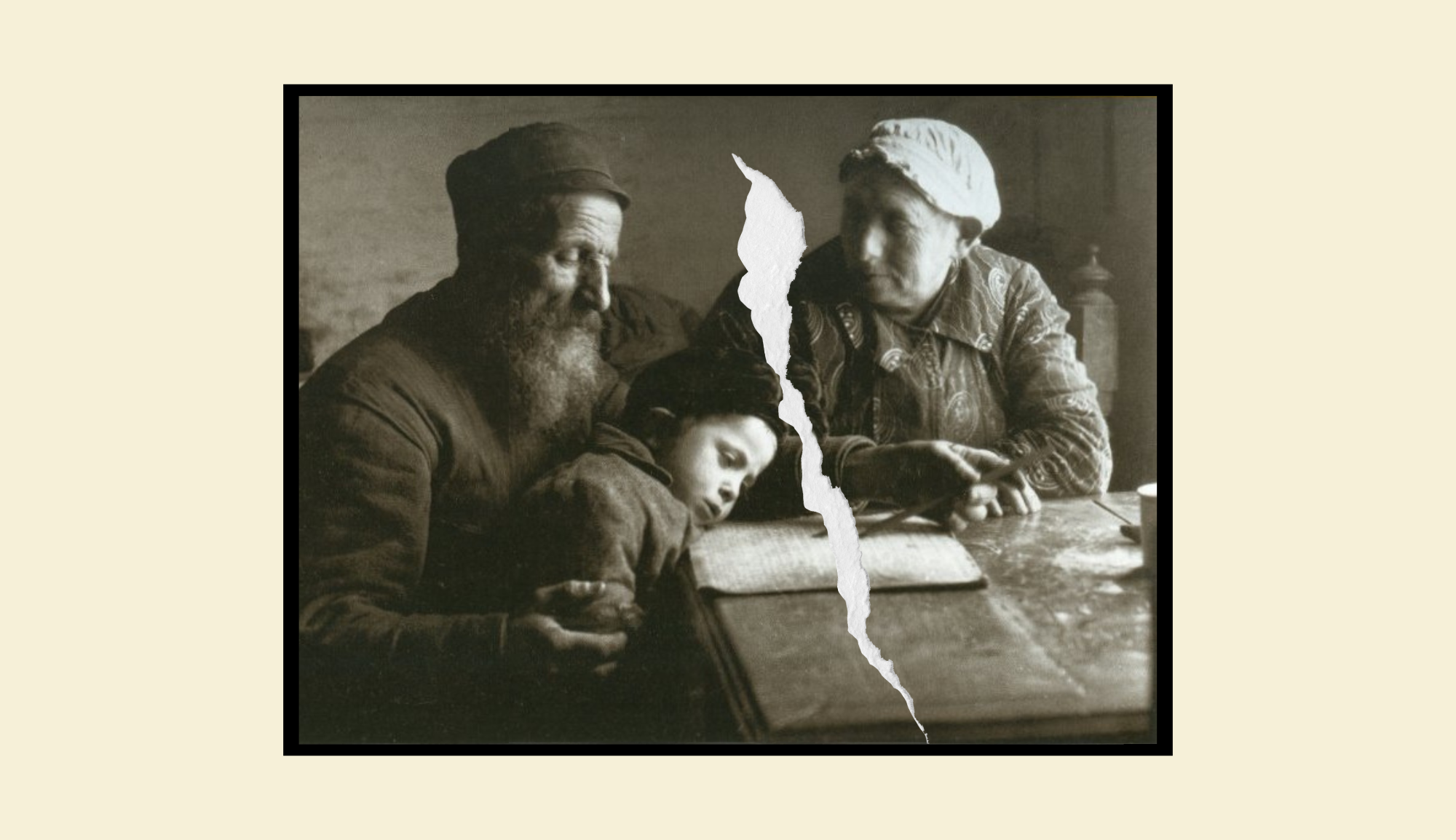
Moshe gathers the whole nation at the edge of the land to enter the covenant, every person in front of him, from the heads of the tribes down to the woodcutter and the water-carrier. Then he goes further than the crowd he can see, making the covenant with the people standing there that day and also with the ones who “are not with us here this day.” Rashi reads that second group as the generations not yet born—so Moshe binds generations that did not yet exist, including yours. The Talmud goes further and derives from the same phrase that even converts who had not yet joined the Jewish people are bound, which makes the question unavoidable, how a covenant can bind a person who was never there to agree.
RELATED: Why Judaism?
You might fairly object that a covenant made at a desert gathering 3,000 years before you were born has nothing to do with you, that an agreement you never signed cannot bind you. In Zakhor, historian Yosef Hayim Yerushalmi focuses on that question, and his answer is that Jews have never kept their past alive mainly by writing history. They re-enact a few founding events, year after year, until each generation experiences those events as its own memory. At the Seder you are told to see yourself as if you personally left Egypt, and Moshe does the same thing for future generations when he writes them into the covenant. The agreement stays binding because every generation takes it on again as its own. Natan Sharansky, the former Soviet refusenik and prisoner of conscience who became an Israeli statesman, put it bluntly on the 18Forty Podcast, warning that a Jew who passes down neither faith nor Zionism is unlikely to have Jewish grandchildren. The harder question is how many generations the covenant can be passed down before it stops feeling like your own, and your own family probably already shows you the answer.
2. The Distance You Feel Is Real
Most American Jewish families contain both extremes. At one end is the great-grandmother who carried an unbroken connection across the Atlantic and sang a niggun she never once had to decide to keep, because in her world losing it was not yet a real possibility. At the other end is the cousin who lights Chanukah candles and makes a Pesach Seder and keeps little else, who never stopped being Jewish but stopped practicing day to day. You probably live somewhere between those two relatives, near enough to the first to want what she had, and near enough to the second to see how quickly the daily observance can disappear.
The sociologists Steven Cohen and Arnold Eisen measured this in their study The Jew Within, finding that by the fourth generation American, Jews tend to treat their Judaism as a personal choice rather than an inherited duty, with shared practice growing thinner at each step. If you wonder whether your grandchildren will keep what you keep, you are not being dramatic—you are describing the same decline Cohen and Eisen documented. Bethany Mandel, who has written widely about American Jewish life, described on the 18Forty Podcast how hard it is to stay seriously Jewish when much of the communal infrastructure that ordinarily supports Jewish identity has fallen away. It is better to admit that distance than to pretend it is not there, because Nitzavim speaks directly to the person who feels farthest from Sinai.
RELATED: What Happens When Assimilated Jews Start Searching?
A few verses later in Nitzavim, Moshe insists the commandment is not too hard or far off, not up in the sky or across the sea, but very near, in your mouth and in your heart. The verse assumes a reader who suspects the opposite, who feels that everything important happened to other people, long ago. The Talmud takes the phrase “it is not in heaven” and reads it to mean that the Torah was given over to human beings to study and decide, and not even a voice from heaven can overrule their decisions. On this reading the Torah is near whenever its words are in your mouth, however many generations separate you from the people at Sinai.
That still leaves your sharpest fear unanswered: the fear that a Judaism received at this distance is a thinner, weaker version of the real thing.
3. You Can Carry What You Did Not Live
That fear assumes the founding generation had something the rest of us only get secondhand, but Moshe had already promised in Nitzavim that the revealed Torah belongs to “us and our children” forever. Vayelech then turns that promise into a standing command called Hakhel, the gathering, where every seven years the whole people—men, women, and children—comes together to hear the Torah read aloud. Moshe says plainly why they gather: so that the children who do not yet know it will hear and learn to hold God in awe. Rambam ruled that even children too young to understand a word must be brought, which means the law was built around the children who arrive with no memory of their own, and teaching them is the whole point.
Marianne Hirsch, who teaches at Columbia, studied the children of Holocaust survivors and called what she found postmemory. A generation that never witnessed the events still carries them, absorbed from old photographs, repeated stories, and family habits weighty enough to shape a life. Hirsch is careful to say that this inherited connection is real in its own right, not a faded photocopy of the original. You can carry your great-grandmother’s niggun without ever having sat in the kitchen where she first sang it, and the song is just as much yours at that distance. Rabbis Haskel and Josh Lookstein talked on the 18Forty Podcast about finding your own footing inside a tradition you were handed rather than chose. The worry that a secondhand Judaism is a weaker Judaism assumes that only the people who stood at Sinai ever had the real thing, and both the Hakhel command and Hirsch’s research say otherwise, that the tradition was always built to be carried by the generations that followed.
RELATED: Intergenerational Divergence: A Story of Unchanging Change
None of this guarantees that what you keep will always feel alive, and Vayelech itself predicts the times it will go quiet.
4. When the Connection Goes Quiet
Near its end, Vayelech does not finish on a reassuring note, because God tells Moshe that the people will stray after other gods and break the covenant, and that He will then turn away and hide His face. The name for this is hester panim, the hiding of the face. Rashi explains the hiding to mean that God acts as though He does not see their distress, responding to a people who left Him first. So the silence is part of the covenant, not a sign that it has ended, since you only hide from someone who is still in the room. You are not the people who strayed, though, so the quiet you sometimes feel in your own davening is not that punishment. You keep showing up, and still some mornings the words you have said 10,000 times give back nothing, no lift and no sense of being heard, only the familiar phrases and the sound of your own voice. What you are really asking in those moments is not whether God is there, since you already believe he is, but whether your own practice still connects you to him or has worn down into routine.
Eliezer Berkovits argues in Faith After the Holocaust that the hidden face is what makes human freedom possible at all, because a presence that fills every room would leave a person no real choice. He offers this as an account of where faith can survive, not as an excuse for suffering, and that difference matters for anyone who has stood at a grave. Kayla Haber-Goldstein describes rebuilding her faith after the answers she grew up with stopped holding, staying inside the practice while she worked out what she actually believed. If Berkovits is right, then the mornings when nothing comes back do not mean the covenant has failed you. They mean your davening is voluntary, since no answer is compelling you to return. The covenant never promised you a feeling every time you open the prayer book. If you cannot make the feeling come on command, then the covenant must be asking for something within your control, and the final lines of Nitzavim describe exactly that kind of decision.
RELATED: Rebuilding Faith as a Frum Person
5. Choose Life at Your Own Table
At its very end, Nitzavim sets life and death, blessing and curse, in front of the whole people, and then Moshe tells them outright to choose life, that you and your offspring may live. Rashi reads the command the way a parent talks to a child, pointing the child toward the better portion. The verse ties your life to your children’s in a single phrase, which means the choice was never yours alone. It does not ask you to feel certain or to have settled every question, only to decide what your children will find on the table when they are old enough to ask.
The Pew Research Center’s 2020 study of American Jews put numbers to what families already sense, that what reaches the next generation depends far more on what the last one actually did than on what it believed. Those numbers are not a prophecy, they are the sum of 1,000 small decisions about what a household actually does on a Friday night. Rabbi Shais Taub, distinguishes between two kinds of teshuva: the return of a person who never really left and the return of a person coming back from real distance. Whichever kind describes you, a person who comes back usually comes back to something specific, a practice a parent once kept at home. The choice Moshe set before the people, then, comes down to the most ordinary decision a parent makes, repeated week after week.
That brings us back to the man who landed here in 1990 with nothing to inherit and chose all of it, page by page. He started farther from the covenant than you ever will, and it included him completely, so the fear that you were born too many generations late does not survive his example. He treats as a gift what someone born to it might treat as a weight. And both Nitzavim and Vayelech leave you with the same practical question: what you will hand to your own children. On Friday night at your table you will teach your children one niggun and let another lapse. No one passes on the whole inheritance at once. You hand a child the next piece, one Shabbat table at a time, and that ordinary act is what Moshe meant when he told the people to choose life so that their children would live.
Questions for Reflection
- Where do you stand on the line between the great-grandparents who never questioned their practice and the relatives who have drifted out of it entirely?
- When you weigh the distance between your own Judaism and the Judaism of the immigrants in your family, does that distance feel like a loss, or like something the covenant always expected?
- Which one practice would you most want to teach your children to carry, and which would you choose to let lapse?
This project is made possible with support from the Simchat Torah Challenge and UJA-Federation of New York. Learn more about the Simchat Torah Challenge and get involved at their website.