
Smoltification and the Art of Living: A Reader

Yehuda Fogel
Share
×

Share

Your faith was strong but you needed proof…

– Leonard Cohen 

Chanukah comes at a particularly vulnerable point in the cycle of time. It’s a time of lengthening nights and shortened days, and it’s not surprising that we celebrate at precisely the point in which we have the least of it. Our bodies are catching up to the new reality of winter coats and our hearts to the diminished sunshine of the new regime. For many of us, winter hits harder at precisely this point. We are all immigrants of sorts at this juncture, memories of summerland fading in our minds but still alive enough to make us resent the coming cold. 

We are immigrants to the sea, the salty waters of our lives still stinging, and we are immigrants to the freshwater as well, shocked by how sweet life can be at times.

In the natural world—for those of us imprisoned in concrete jungles and suburban hinterlands—there is a meeting point that parallels this phenomenon: the estuary. Estuaries are where freshwaters meet the sea, the sea receiving the new bounty, always unsatisfied. When salmon move from the freshwater to the sea, they go through a process of inner change called smoltification. You’ll read more about this process in the reader, but it is my humble opinion that Chanukah helps us with our own smoltification of sorts, as we too adjust to the new reality that we are. 

This is part of the story of rationality as well, as we emerge from the clear sun of summer into the heady nights of winter, the mythological power of light and dark become more powerful than ever. As our most recent guest, Rabbi Dr. Sam Lebens, the brilliant heart and mind himself, points out, it’s a mistake for us to conceptualize myth and rationality as enemies. More often than not, myth, mysticism, and rationality are close neighbors and lovers, not the enemies we often assume them to be. As we think about this relationship, and the relationship by which we can more comfortably move between the world of light and summer to the dark world of winter, we turn also to an original rationalist, Plato, and consider the complex ways that myth, rationality, and meaning all come together in his long literary afterlife.

We are all immigrants in this era, immigrants to Spaceship Earth and to whatever land and lore in which we currently find ourselves entangled. We are immigrants to the sea, the salty waters of our lives still stinging, and we are immigrants to the freshwater as well, shocked by how sweet life can be at times. As we try to make sense of it all, and find light in astounding layers of darkness, we turn to three articles for a sense of meaning. “The Psychological Immigrant”, “A Healing Estuary,” and “Why Philosophy Needs Myth.” Let us turn to these teachings with an open heart, and like a lonely Jew before a lit menorah, let’s open our eyes a bit more to the light—together.


Recommended Essays

Essays

A (Talmud) Page is Worth a Thousand Worlds

Beyond the words of the page, the Talmud teaches just as much Jewish history as it does Jewish law, revealing new insights…

Essays

‘It’s Not Great’: What’s the Deal With Jewish Education?

Jewish students, parents, and educators weigh in about what helps, what hurts, and what we need to do.

Essays

‘The Crisis of Experience’: What Singlehood Means in a Married Community

I spent months interviewing single, Jewish adults. The way we think about—and treat—singlehood in the Jewish community needs to change. Here’s how.

Essays

3 Questions To Ask Yourself Whenever You Hear a Dvar Torah

Not every Jewish educational institution that I was in supported such questions, and in fact, many did not invite questions such as…

Essays

American Judaism is Falling Apart. We Have Ourselves to Blame

Until recently, I too found myself almost entirely estranged from Jewish tradition. My return is showing me what we need to do…

Essays

Benny Morris Has Thoughts on Israel, the War, and Our Future

We interviewed this leading Israeli historian on the critical questions on Israel today—and he had what to say.

Recommended Videos

videos

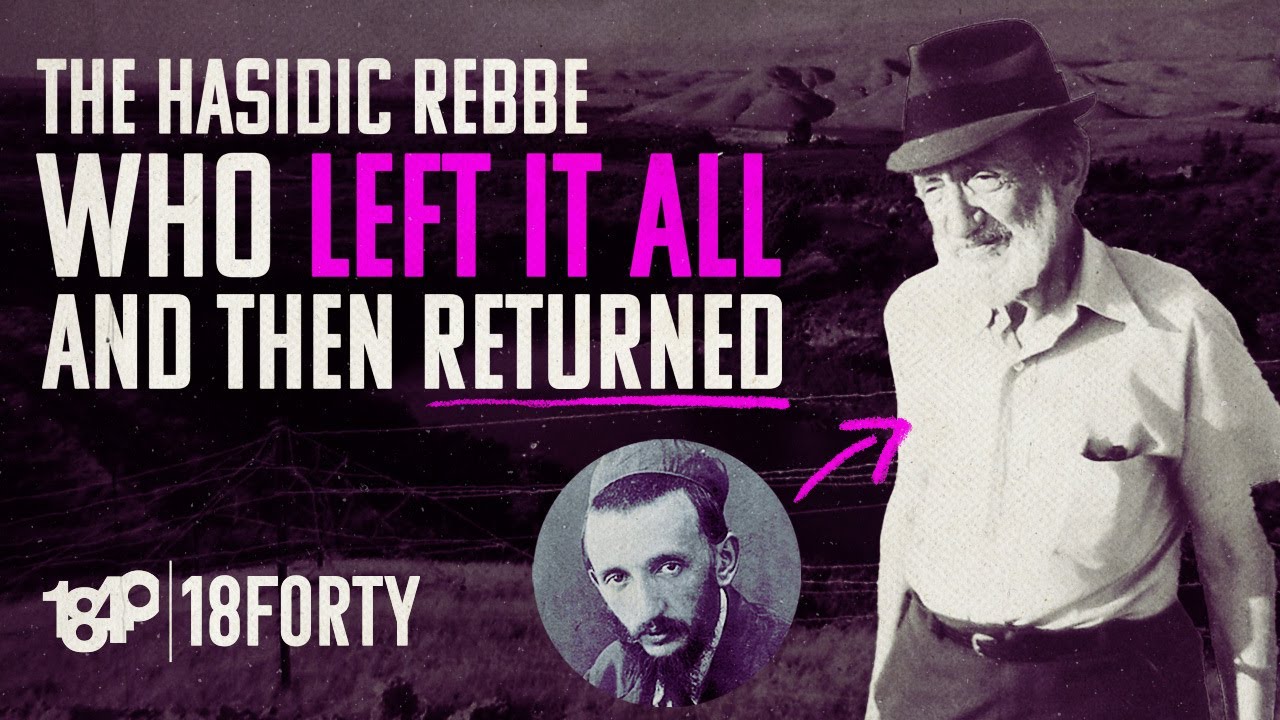
The Hasidic Rebbe Who Left it All — And Then Returned

Why did this Hasidic Rebbe move from Poland to Israel, only to change his name, leave religion, and disappear to Los Angeles?

videos

An Orthodox Rabbi Interviews a Reform Rabbi | Dovid Bashevkin & Diana Fersko

In this episode of the 18Forty Podcast, we speak with Diana Fersko, senior rabbi of the Village Temple Reform synagogue, about denominations…

videos

Joey Rosenfeld: What Does Jewish Mysticism Say About This Moment?

We speak with Joey Rosenfeld about how our generation can understand suffering.

videos

Mysticism

In a disenchanted world, we can turn to mysticism to find enchantment, to remember that there is something more under the surface…

videos

Jewish Peoplehood

What is Jewish peoplehood? In a world that is increasingly international in its scope, our appreciation for the national or the tribal…

videos

Suri Weingot: ‘The fellow Jew is as close to God as you’ll get’

What does it mean to experience God as lived reality?

videos

Why Naftuli Moster Left Haredi Education Activism

We speak with Naftuli Moster about how and why he changed his understanding of the values imparted by Judaism.

videos

Moshe Weinberger: ‘The Jewish People are God’s shofar’

In order to study Kabbalah, argues Rav Moshe Weinberger, one must approach it with humility.

videos

A Reform Rabbi Interviews an Orthodox Rabbi | Dovid Bashevkin & Diana Fersko (Part 2)

In this episode of the 18Forty Podcast, David Bashevkin answers questions from Diana Fersko, senior rabbi of the Village Temple Reform synagogue,…

videos

Moshe Gersht: ‘The world of mysticism begs for practicality’

Rabbi Moshe Gersht first encountered the world of Chassidus at the age of twenty, the beginning of what he terms his “spiritual…

videos

Sarah Yehudit Schneider: ‘Jewish mysticism is not so different from any mysticism’

Rabbanit Sarah Yehudit Schneider believes meditation is the entryway to understanding mysticism.

videos

What Do Love and Romance Mean in a Modern World?

Love is one of the great vulnerabilities of our time. Can we handle it?

videos

Matisyahu: Teshuva in the Spotlight

We talk to Matisyahu, who has publicly re-embraced his Judaism and Zionism.

videos

Torah Study and ChatGPT: How Should Jewish Education Respond to AI?

On this 18Forty panel, we speak with Alex Jakubowski of Lightning Studios, Sara Wolkenfeld of Sefaria, and Ari Lamm of BZ Media…

videos

18Forty: Exploring Big Questions (An Introduction)

18Forty is a new media company that helps users find meaning in their lives through the exploration of Jewish thought and ideas.…