

I Read This Over Shabbos is a weekly newsletter from Rivka Bennun Kay about Jewish book culture, book recommendations, and modern ideas. Receive this free newsletter every week in your inbox by subscribing here. Questions, comments, or feedback? Email Rivka at Shabbosreads@18forty.org.
The horrific events of October 7, 2023 and the ensuing war in Gaza have been put to paper by some of the most gifted and striking voices in contemporary Jewish nonfiction. Amir Tibon’s memoir The Gates of Gaza narrates his experiences surviving terrorist attacks on the kibbutz where he lived with his family. Lee Yaron’s 10/7: 100 Human Stories turns the keen eye of an investigative journalist on the devastating and overwhelming impact of that day on Israelis. Eli Sharabi’s Hostage, a New York Times bestseller, tells the story of the harrowing ordeal the author faced after his abduction by Hamas. Rachel Goldberg-Polin’s When We See You Again is a testament to a mother’s grief over her son’s captivity and murder. These stories have been produced with astonishing skill and devotion as their authors attempt to find meaning in the midst of the horrors they experienced, and they have made an indelible mark on Jewish literature.
Less common, however, is the portrayal of October 7 in works of fiction. Part of this may stem from the fact that Jewish fiction writers are facing steeper obstacles to publishing work about the Jewish experience than their counterparts in nonfiction. Author Meg Keene gathered data from Publishers Marketplace and discovered a 76% decline in fiction deal announcements to large presses that mentioned Jews, Judaism, or Israel between 2023 and 2024, as well as an 82% decline in fiction deals mentioning Jewish content in early 2026 compared to 2023. The Anti-Defamation League has also published Missing Chapter, an extensive report of antisemitic trends in the publishing industry, including the circulation of a list of novelists to boycott for their perceived status as Zionists.
Apart from antisemitism, the dearth of fictional narratives about this tragedy may be expected for other reasons: We are only a few years removed from that horrible day and the hostage crisis and war that followed. The Jewish world is still processing the enormity of what occurred, and there is significant demand for nonfiction that can help audiences wrap their minds around these events. Perhaps it is natural for fictional narratives that tackle this subject matter to feel less appealing or urgent.
But any author can tell you that fiction also plays a critical role in helping readers process tragedy. Writers of fiction can often penetrate deeper into the human psyche than nonfiction writers are able. Novelists can write characters that reveal more about themselves, willingly or unwillingly, than nonfiction writers can ethically reveal about their subjects. There is an intimacy between readers and characters in fiction that is almost impossible to replicate even in the most sensitive journalism or memoir, where legitimate concerns about privacy and reputation can place limits on what a subject is willing to reveal to a reader.
Perhaps this is why several Jewish short story writers have started incorporating October 7 and its aftermath into their work. In The New Yorker, Joshua Cohen’s “My Camp” and David Bezmozgis’s “From, To” feature protagonists grappling with the impact of the war in the American Jewish diaspora. In his collection Autocorrect, Etgar Keret includes a brief and surreal story about a religious man’s struggle to reconcile the horrors of October 7 with his belief in God. In Paper Brigade, the literary magazine published by the Jewish Book Council, Nicole Hazan’s “The Hotel” features a protagonist staying in a hotel surrounded by the ghosts of victims of Hamas’s terror.
At the time of this essay’s publication, I have only been able to track down three English language novels that directly tackle the events of October 7 as major plot points. One is available from a major publisher; the other two are self-published. Whether these books will remain outliers or represent the first of a burgeoning literary genre will only be revealed with time. Each of these stories leverages the intimacy of fiction writing to convey the emotional impact of the day that forever changed our Jewish world.
We Will Dance Again by Aviva Gat
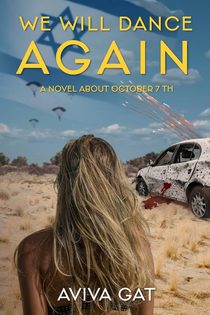
We Will Dance Again is a sprawling multi-POV epic about the impact of October 7 on Israelis, diaspora Jews, and Palestinians. The book follows six characters—a mother living on a kibbutz, a young woman attending the Nova music festival with her boyfriend, a former counter-terrorist soldier, a politician, a Palestinian woman in Gaza, and a Jewish American college student—and explores the ways their lives are thrown into upheaval by these events. The scope of the book is immense, and Israeli-American author Aviva Gat takes care to render her characters with the utmost compassion and humanity.
Written in spare, matter-of-fact-prose, the novel pulls no punches in describing the violence of the terror attacks in Israel. Gat’s hyperrealistic renderings of the gruesome murders and sexual assaults that occurred are almost unbearable to read, and her attention to every excruciating detail creates a moving and immersive portrait of her characters’ plights. Many of Gat’s readers will have gained their information about the war from untold numbers of news articles and video clips, and it seems as though she is attempting to echo that style in the way she delivers information, albeit with more narrative structure and emotional detail. It creates a reading experience that is intriguing while also being jarring and disjointed in several places.
In addition to portraying the devastation experienced by Israelis and Palestinians, Gat captures the agony of Ethan, a Jewish college student at Harvard witnessing his peers embrace antisemitic hatred. Gat may be the first novelist to capture the perception gap between Jewish parents and children confronting rising antisemitism in the diaspora. The parents, who largely have not seen a rise in antisemitism among their peers, don’t understand why their son can’t just keep his head down and finish his degree, while Ethan struggles to communicate to them just how radicalized and dangerous his fellow students have become.
The novel was released while hostages were still being held in Gaza, and the writing feels raw with the immediacy of the Jewish world’s pain and fear during that time. Ultimately, Gat approaches her subject matter with the goal of portraying just how far the devastation of this conflict reaches, and how deeply the lives of its victims are entwined.
Howl by Howard Jacobson
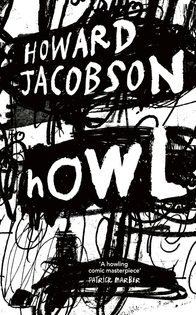
There’s dark humor, and then there’s this novel. Following a Jewish primary school headmaster who descends into madness as he encounters escalating antisemitic absurdity, Booker Prize-winning author Howard Jacobson turns his eye for social satire on the moral depravity of post-October 7 London. His protagonist, Ferdinand Draxler, witnesses a relentless torrent of Jew hatred, from mobs of social justice warriors marching through the streets in support of Hamas to students claiming Jews are worse than Nazis to professors appearing on television to justify the murder of Israelis via the logic “it was morally allowable to kill a colonialist and, since Jews were colonialists, it was morally allowable to kill a Jew.”
Like Alice falling through a horrific looking glass, Draxler is so destabilized by the explosion of violence and hatred around him that the boundaries of his reality begin to blur. He sees things that cannot be real, like pelicans with grenades in their beaks, in addition to things that, in a morally sane world, should not be real, like self-identified feminists justifying rape.
Draxler’s relationships with his mother, a Holocaust survivor, and his daughter, an anti-Zionist, seem to serve as the backbone for his despair. Despite promising “Never Again,” Draxler must watch as the world releases violent mobs baying for Jewish blood less than a lifetime after the camps destroyed his family members and traumatized his mother. And this madness is cheered on by his own flesh and blood, the descendent of a survivor, whose reaction to the murders at the Nova festival is to decide that the Palestinians are the true victims of the violence and eventually tear down a poster depicting a Jewish hostage. The dysfunction and misunderstandings of these familial relationships anchor and echo the dysfunction and misunderstandings Draxler sees taking over the world.
Jacobson’s approach to the events of October 7 and the ensuing moral rot revealed in Western countries is to point out the tragic absurdity of antisemitism and how relentlessly it divorces people from logic and reality. He quips through a bigoted commentator that “the Jews had asked for whatever hadn’t been done to them.” Readers will notice similarities between Jacobson’s voice and the acerbic, witty social novels of Jane Austen (Jacobson has in fact referred to himself as a “Jewish Jane Austen”), only the stakes for Howl’s Jews are a bit higher than getting invited to balls and marrying wealthy landowners.
Son of Sasha by Sophie Panzer
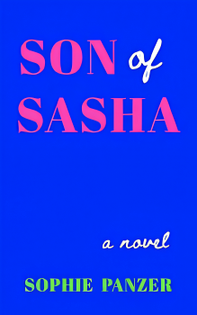
Set in the months before the events of October 7, Son of Sasha follows Ollie, a 29-year-old Jewish woman trying to decide whether she should have children. Her thoughts on this subject are mostly influenced by her Holocaust survivor grandparents, her Second Intifada victim father, her unbearable mother, and her loving but overwhelmed best friend. Ollie also remains obsessed with Sasha, her college ex-girlfriend, who broke up with her following a religious awakening and a decision to pursue an Orthodox lifestyle. The two women manage to maintain a friendship cobbled together from residual love and lingering guilt, a bond that becomes even more complicated when Ollie unwittingly creates a golem child in response to news that Sasha is struggling to have children of her own.
It’s difficult to write about one’s own work objectively, but I will do my best to situate my debut in the fledgeling October 7 novel canon. Although the events of the seventh only impact the narrative at the very end of the book, they cast a shadow over the whole story, similar to a book set in the early 1930s in Germany. The reader knows some of what is coming as the characters stumble towards it, and this knowledge colors perception of Ollie’s experiences and decisions, namely her struggles with the bone-crushing pressure that genocidal violence places on women of the impacted group to reproduce.
Similar to Nicole Hazan’s aforementioned short story “The Hotel,” Son of Sasha uses fantasy elements to process the existential horrors of antisemitic violence. Ollie becomes the creator and the protector of a golem infant, experiences ibbur (benevolent possession) by her murdered ancestors, and has run-ins with the biblical beast the Ziz and the Angel of Death. The legend of the golem is the main focus of the book—I have always been fascinated by this fairy tale and how it explores Jewish vulnerability and power. Instead of the traditional hulking monster offering physical protection to a Jewish community, Ollie’s golem is an infant whose vulnerability brings her to a greater understanding of herself, her people, and her place in the world.