
This Rosh Hashanah, Let’s Find New Words

Yehuda Fogel
Share
×

Share

For last year’s words belong to last year’s language

And next year’s words await another voice.”

 — T.S. Eliot (Four Quartets)

How do we find the words for a new year? Each year has a set of words, a language, that we use to speak to the moment that we are living in. In the narrow sense, we can find these words in headlines and trending tweets, the words that we will forever remember as being a part of the fabric of our lives this past year (vaccine, insurrection, variant). In the broader sense, the words and the way we use them form a broader fabric, a language of the year. We often don’t realize how the words we use constitute the language we speak until it’s all over, and beginning again, as the year ends. And as we reach this juncture, as we try to mind the gap between what was and what will be, we find ourselves between “last year’s words” which “belong to last year’s language” and “next year’s words” which “await another voice.”

We can turn back and think about the way we spoke this past year, the way we communicated, and the people that we were, and we can also think about the voice that we will have this coming year. How will we use our voice, our platforms, to build a better self, a better world inside and out? How will we magnify and support those whose voices we believe in? And on the other side – how have our words come together to form a language that we aren’t comfortable with? So many times, the words we string together, one after another, seem divorced from the person we are, until we find at the end of the year that the words became a language and the language became a self – our selves. 

… the tendency towards shame, guilt, and self-blame is not just a symptom of self-reflection, but an occupational hazard.

So readers, fam, let’s mind the gap. Let’s think together about our words and our language, and maybe even our voice (in all honesty not sure how to work that part into this pseudo-sermon, please say hello at yehudafogel1@gmail.com or @yehudahamaccabi if you have any suggestions).

But how, we wonder? If the words and language are as slippery, as ephemerous, as they so often feel in our mouths, taking an honest accounting of them is no easy task. It’s my humble, biased, and yet deep belief that writing helps. Whether you fashion yourself a ‘writer’ or not, putting words on paper or screen helps us see parts of ourselves, and parts of our language, that are often less visible. Writing about your year, perhaps with a prompt (What am I proud of this past year? What pains me from this past year? What gives me hope for the coming year? Who was I this past year?), may be able to help you put to words some of the wordless feelings that bubble up during this time.

But remember, sweet reader, above all, that the tendency towards shame, guilt, and self-blame is not just a symptom of self-reflection, but an occupational hazard. Be kind with yourself. Forgive yourself, if only to show God how it’s done. The writer Anais Nin once said that she believes that “one writes because one has to create a world in which one can live.” As we put this past year to words, let us be kind in the world we construct, in the way that we look back, and forward, and inside.

 To start this season of reflection on the words and language that we all use, I’m including in this Rosh Hashanah reader some of the words that I’ve used this past year to create a more meaningful world, along with one article on the communal nature of gratitude, as we come together in a community of prayer this holiday. The first was writing for this Rosh Hashanah, the second for the secular Rosh Hashanah of this past year, and the third is eternally interesting. I hope that we can all look together at the words we used, the language that we’ve cultivated for ourselves, as we build a world of kindness, together.


Recommended Essays

Essays

A (Talmud) Page is Worth a Thousand Worlds

Beyond the words of the page, the Talmud teaches just as much Jewish history as it does Jewish law, revealing new insights…

Essays

‘It’s Not Great’: What’s the Deal With Jewish Education?

Jewish students, parents, and educators weigh in about what helps, what hurts, and what we need to do.

Essays

‘The Crisis of Experience’: What Singlehood Means in a Married Community

I spent months interviewing single, Jewish adults. The way we think about—and treat—singlehood in the Jewish community needs to change. Here’s how.

Essays

3 Questions To Ask Yourself Whenever You Hear a Dvar Torah

Not every Jewish educational institution that I was in supported such questions, and in fact, many did not invite questions such as…

Essays

American Judaism is Falling Apart. We Have Ourselves to Blame

Until recently, I too found myself almost entirely estranged from Jewish tradition. My return is showing me what we need to do…

Essays

Benny Morris Has Thoughts on Israel, the War, and Our Future

We interviewed this leading Israeli historian on the critical questions on Israel today—and he had what to say.

Recommended Videos

videos

The Hasidic Rebbe Who Left it All — And Then Returned

Why did this Hasidic Rebbe move from Poland to Israel, only to change his name, leave religion, and disappear to Los Angeles?

videos

An Orthodox Rabbi Interviews a Reform Rabbi | Dovid Bashevkin & Diana Fersko

In this episode of the 18Forty Podcast, we speak with Diana Fersko, senior rabbi of the Village Temple Reform synagogue, about denominations…

videos

A Reform Rabbi Interviews an Orthodox Rabbi | Dovid Bashevkin & Diana Fersko (Part 2)

In this episode of the 18Forty Podcast, David Bashevkin answers questions from Diana Fersko, senior rabbi of the Village Temple Reform synagogue,…

videos

Joey Rosenfeld: What Does Jewish Mysticism Say About This Moment?

We speak with Joey Rosenfeld about how our generation can understand suffering.

videos

Mysticism

In a disenchanted world, we can turn to mysticism to find enchantment, to remember that there is something more under the surface…

videos

Jewish Peoplehood

What is Jewish peoplehood? In a world that is increasingly international in its scope, our appreciation for the national or the tribal…

videos

Moshe Weinberger: ‘The Jewish People are God’s shofar’

In order to study Kabbalah, argues Rav Moshe Weinberger, one must approach it with humility.

videos

We Asked Jews About AI. Here’s What They Said.

This series, recorded at the 18Forty X ASFoundation AI Summit, is sponsored by American Security Foundation.

videos

Why Naftuli Moster Left Haredi Education Activism

We speak with Naftuli Moster about how and why he changed his understanding of the values imparted by Judaism.

videos

What Do Love and Romance Mean in a Modern World?

Love is one of the great vulnerabilities of our time. Can we handle it?

videos

Sarah Yehudit Schneider: ‘Jewish mysticism is not so different from any mysticism’

Rabbanit Sarah Yehudit Schneider believes meditation is the entryway to understanding mysticism.

videos

Suri Weingot: ‘The fellow Jew is as close to God as you’ll get’

What does it mean to experience God as lived reality?

videos

What are Israel’s Greatest Success and Mistake in the Gaza War?

What has been Israel’s greatest success and greatest mistake?

videos

Moshe Gersht: ‘The world of mysticism begs for practicality’

Rabbi Moshe Gersht first encountered the world of Chassidus at the age of twenty, the beginning of what he terms his “spiritual…

videos

Matisyahu: Teshuva in the Spotlight

We talk to Matisyahu, who has publicly re-embraced his Judaism and Zionism.

videos

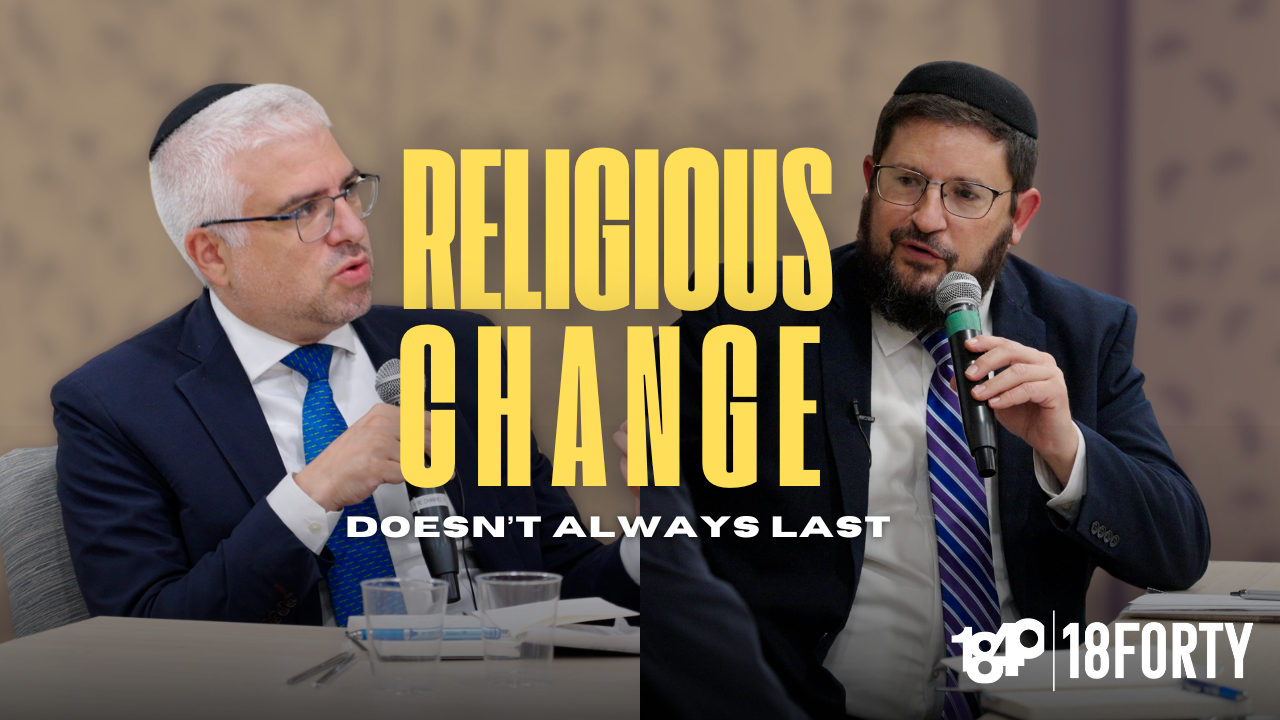
Moshe Benovitz: Why Religious Change Doesn’t Always Last

In this episode of the 18Forty Podcast, recorded live at Stern College, we speak with Rabbi Moshe Benovitz, director of NCSY Kollel,…