

This piece first ran on our Substack, Reading Jewish History in the Parsha. We’re pleased to share it here on our website.
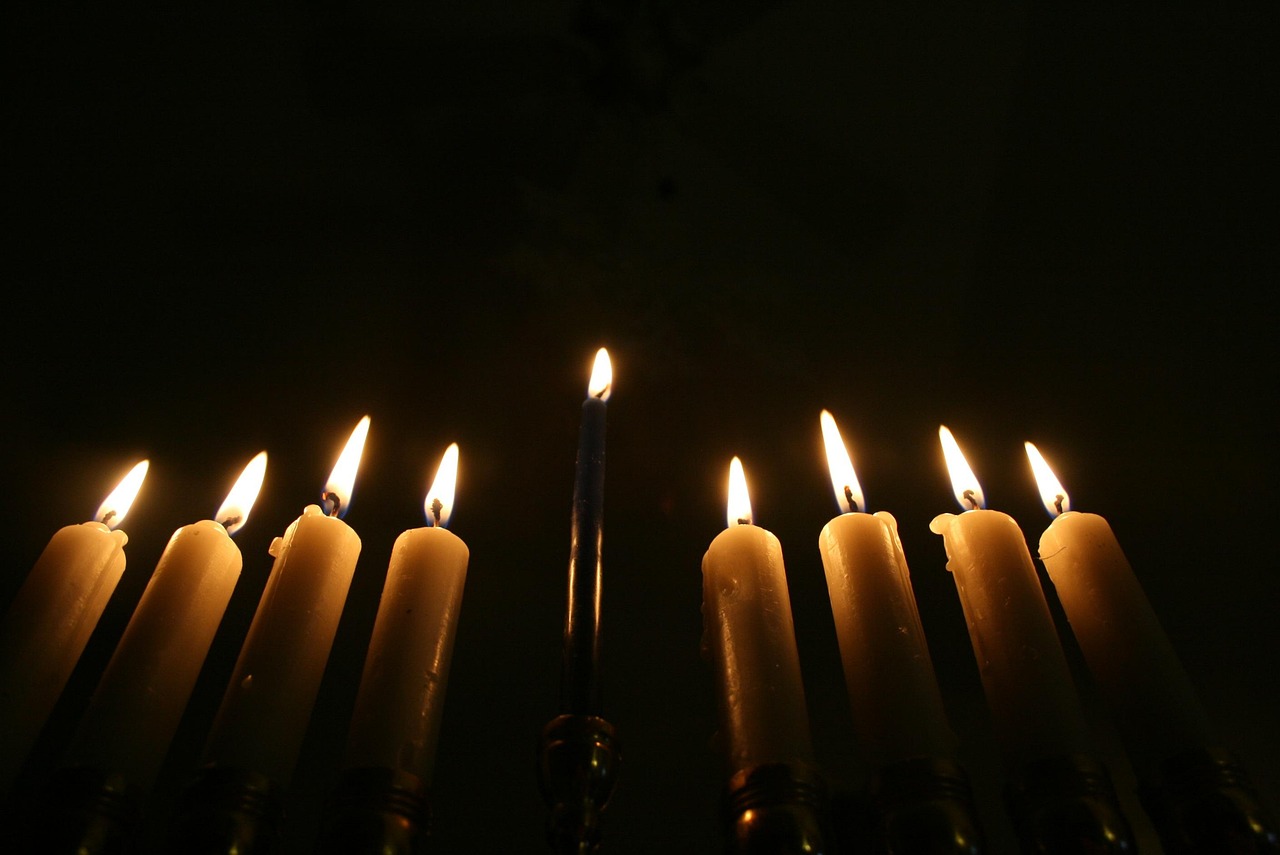
Ask anyone on the street, in a city such as New York, Jewish or non-Jewish, what a menorah is, and you will receive an easy answer: It’s a candelabra that Jews use for their holiday of Hanukkah. Every night throughout the festival, they add one candle, starting with one candle on the first night and culminating with eight candles on the last night. Everyone knows that!
Everyone, except the Talmud. A quick glance at the Talmudic passage describing the obligation to light candles on Chanukah turns up a far more limited mandate: Only one candle, per household, every night of Chanukah, no matter which night it is. There is an additional level, which the Talmud describes as voluntary, for the “Mehadrin“—those who seek to fulfill the commandments with extra devotion and commitment. But here again, no menorah is involved – The mandate shifts from one candle per household to one per person, with no variation to reflect what night of Chanukah it is.
It is only when moving to a third level, above and beyond—for the “Mehadrin within the Mehadrin,” the best of the best, the most pious of the pious, the most devoted of the devoted, just back from Israel—does a menorah come into the picture. Those in this rarified category can opt into a plan, the platinum deluxe version, that involves a progression from one to eight candles throughout Chanukah (in fact, this is only the dominant of two opinions on the Talmud; another view maintained that eight candles should be used on the first night, counting down to one on the last night).
And yet, as far as anyone knows today, no semblance of the Talmud’s hierarchy remains. Everyone, Jew and non-Jew alike, believes the menorah to be mandatory; this even extends to the code of Jewish law, the Shulchan Arukh, which similarly teaches the laws of Chanukah: one candle the first night, progressing to eight on the eighth night; no mention at all of various levels of optional participation.
Chanukah, a rabbinic holiday of a lesser pedigree than the three Biblical festivals of Passover, Shavuot, and Sukkot, and certainly the Days of Awe—Rosh HaShanah and Yom Kippur —punches above its weight in terms of place in public awareness. Some see this as due to its proximity to Christmas, and Jewish parents seeking to give their children a comparable celebration; others may prefer to see Divine providence nudging along the festival’s elevation. Either way, the menorah is an enigma within a mystery—how did this voluntary aspect of a rabbinic holiday become elevated into what is arguably one of the most indispensable, widely observed, recognized, and practiced elements of contemporary Jewish life?
There may be a parallel—and a clue—rooted in Parshas Vayetzei. At the very beginning of that Torah reading, we learn of Jacob’s journey. On the run from his angry and vengeful brother Esau, he heads toward Haran, and “encounters” a “place” (vayifga ba-makom). The rabbis of the Talmud inform us that this encounter was actually with God—in other words, a prayer. Like his father and grandfather before him, he was creating a model for generations, establishing a new category of prayer that future Jews could draw upon at that specific time of day. His innovation—the nighttime prayer—would be known as Maariv, or Arvit.
However, for some reason not immediately explained, his prayer would not be treated in the same way as that of his ancestors. The morning prayer, created by Abraham, and the afternoon prayer, the innovation of Isaac, would ultimately be instituted as daily obligations by their rabbis. When it came to Maariv, however, the rabbis were deeply divided. There were those among them who felt that this too, should be treated as mandatory, just as the other two prayers are. The opinion of Rabbi Joshua, however, was different. His opinion was that Maariv should be seen as a “reshut“, a word normally translated as “voluntary.” Not only that but according to most authorities (although there is some dispute on the matter) Rabbi Joshua’s opinion actually prevails; Maariv is indeed categorized as a reshut (Mishneh Torah Tefilah 1:6; Tur, Orach Chaim 236).
This is surprising on multiple levels. Jacob was no less important than the other forefathers—in fact, the Midrash calls him bechir ha-avot, the greatest among them. Various attempts are offered to deal with that tension (See Rif; Netziv, Ha’amek Shealah; P’nei Yehoshua to Berakhot; Torat Chaim, Chulin 91, expanded in R. Moshe Halberstam, Resp. Divrei Moshe, 16).
Not least, however, is the fact that, in practice, Maariv is simply not treated as optional. As anyone who drags themselves out of the house at 10 p.m. can tell you, as can anyone who pushes away sleep after a long day to add the words of prayer, or any rabbi or gabbai pushing for a nightly minyan, especially when the clock changes and seasonal variations throw off the schedule—Maariv can be a heavy responsibility.
Authorities offer other practical implications of the reshut designation: We are not precise about the time of Maariv (i.e, praying before dark; Rambam, Hil. Tefilah 3:7, although other authorities understand this practice differently, see Tosafot Berachos 2a s.v. me-eimatai; and Tosafot, Berakhot 26b s.v. Ya’akov); there is no cantor’s repetition (Rambam, Hil. Tefilah 9:9; see Resp. Shoa’lin U’Dorshin, I, p. 105); some allow minors to lead the congregation (Beit Yosef, Orach Chaim 53; see alternatively Magen Avraham); and we are more lenient in interruptions in the service (R. Amram Gaon, Tosfot Berakhot 4b s.v. d’amar). Rabbenu Yonah (Berakhot 2b bi-dapei ha-Rif) notes that historically, there may not have been an amidah prayer included as part of Maariv, which the abbreviated section of “Baruch Hashem l’olam” standing in its stead —explaining why today, when Amidah is recited, many leave out that section.
And yet, none of the authorities suggest that in practical terms “reshut” means we can choose to abandon Maariv. Some suggest it is optional only in relative terms, meaning it shouldn’t be passed up lightly, without a good reason (Tosfot, Berakhot 26a s.v. ta’ah; 27b, s.v halakhah; Shabbat 9b, s.v le-ma’an d’amar). The more common attitude is that even if historically Maariv was optional, it has been accepted as an obligation (Behag quoted in Tosafot, Yoma 87b, s.v. vi-ha’amar; Rambam Hil. Tefilah 1:6). There are two possible versions of the “acceptance” theory: Either the whole Jewish People have accepted it (Rif to Shabbat, Rambam); or individuals accepted it on themselves (Behag and others; see Teshuvot HaRashba, III, 288 and R. Yitzchak Kulitz, Resp. Minchat Eliyahu, I. 9).
This “twilight zone” status (no pun intended) of both obligated and not obligated seems unusual, and there are continuing debates as to how the character of Maariv is affected by it (see Rambam and Raavad, Tefilah 10:6, with Kessef Mishneh, and Chiddushei Rabbenu Chaim HaLevi, and R. Mordechai Karlbach, Chavatzelet Ha-Sharon al ha-Torah, Bereishit).
For some reason Maaariv has emerged as an entity obligatory in practice, yet voluntary in theory. The Zohar (Parshas Terumah) comments cryptically that Maariv is a reshut because “no one can do it like Jacob.” R. Tzvi Hirsch Frimer, the Kozaglover Rav (Derashot Eretz Tzvi p. 46) commented that Jacob reached a level of hidden and private behavior impossible to imitate.
If so, what is left for us? It seems that Maariv is meant to be, for all of us, a personal encounter —a “pegiah.” Thus, whether or not we all take it upon ourselves as an absolute responsibility, it cannot be labeled “obligatory.” It has to be personal.
R. Eliyah Bakshi Doron (Resp. Binyan Av, IV, 3) notes that there is a difference between the history of the three prayers—Jacob prayed as night approached, at a time of crisis, in contrast with Abraham who prayed at the beginning of the day with Shacharit, and Isaac who connected with God in the middle of the day with Mincha.
Shacharis and Mincha have to be obligatory, because during times of “daylight”—times when everything is going smoothly—one may be overconfident in his abilities and forget about prayer. But one does not forget to pray in a time of crisis. At night—in darkness, isolation, and anxiety—one reaches out to God for a uniquely personal connection that cannot be commanded but will not be ignored.
The unusual status of Maariv—optional, but universally performed—may be comparable to the Chanukah menorah. R. Meir Tzvi Bergman (Sha’arei Orah, I, 59-60) explains, based on a comment of the Maharit, that true gratitude—the core message of Channukah—cannot be mandatory, it must be voluntary.
On Chanukah, the rabbis mandated that the miraculous salvation of the Jews from spiritual annihilation be acknowledged and publicized, ensuring its power and significance could be drawn upon in the future. The Jews, however, recognized that this mandate had to be merged with a contribution from their inner will. Even if what they chose to do would become the standard, just as Jacob’s prayer would, the fact that it originated as a matter of choice would always define its character. When darkness threatens to obscure the Jewish spirit—whether it is that of the individual or the nation—it is that indomitable will that comes forward and speaks loudest and shines the brightest.