

Elisha ben Abuyah entered the Orchard a rabbi and left a heretic.
In this Talmudic story, he ventured with three devout colleagues into “Pardes”—an unknown place of metaphysical and mystical significance—and all but one suffered a devastating loss: Shimon ben Zoma lost his mind, Shimon ben Azai his life, and Elisha ben Abuyah his faith. Rabbi Akiva alone left whole.
Imagining a sage of Elisha ben Abuyah’s stature abandoning belief is jarring. He accompanied the greatest rabbis on this mystical voyage, thoroughly educated the acclaimed Rabbi Meir, and was a master of Talmud. What remains of the pious when their piety is carved out? It evokes the imagery of death depicted in T.S. Eliot’s “Eyes That Last I Saw In Tears.” Eliot describes the body of a loved one that is hollowed of its soul, mocking him.
I see the eyes but not the tears
This is my affliction
…
The eyes outlast a little while
A little while outlast the tears
And hold us in derision.
The eyes are empty without their tears. The body is empty without its soul. Elisha Ben Abuyah is empty without his belief. In a way, Elisha ben Abuyah lost more than his faith in the Orchard. He lost himself.
Belief is like a state of being. A life dedicated to a relationship with the Creator shapes your vision of the world. It defines your interpersonal relationships, professional aspirations, moral calculations, and goals. To lose that is to lose your life. You go on living as someone else, someone who sees Saturday instead of Shabbos, resources as humanly owned as opposed to borrowed from God, the world as lost in history instead of unfurling towards redemption. Life continues without its sense of direction. Your body remains but someone else lives inside.
The Orchard was not the only incident that tested Elisha ben Abuyah’s faith. Once, he witnessed a boy follow his father’s instruction to scale a tree to shoo away a mother bird before taking her eggs—two commandments said to prolong one’s life—before the boy fell and died. Another tradition recounts that in the aftermath of the Roman execution of 10 prominent rabbis, Elisha ben Abuyah watched a pig drag the bloodied tongue of the deceased Hutzpit HaMeturgeman, an eminent scholar killed in the massacre. These episodes subverted Elisha’s religious and moral expectations and ruptured his personhood in the process.
On a larger scale than Elisha ben Abuyah, fallout with God can cause upheaval on a societal level. In Nietzsche’s “Madman,” a one-page metaphor for Western society’s reaction to secularization, the speaker who is freed from religion is terrified by the prospect.
“Whither is God?” he cried; “I will tell you. We have killed him–you and I. All of us are his murderers. But how did we do this? How could we drink up the sea? Who gave us the sponge to wipe away the entire horizon? What were we doing when we unchained this earth from its sun? Whither is it moving now? Whither are we moving? Away from all suns? Are we not plunging continually? Backward, sideward, forward, in all directions? Is there still any up or down? Are we not straying, as through an infinite nothing? Do we not feel the breath of empty space? Has it not become colder? Is not night continually closing in on us? Do we not need to light lanterns in the morning? Do we hear nothing as yet of the noise of the gravediggers who are burying God? Do we smell nothing as yet of the divine decomposition? Gods, too, decompose. God is dead. God remains dead. And we have killed him.”
The man Nietzsche writes about experiences profound abandonment and disjunction from the world on a cosmic level. Though the madman explicitly attributes this to the death of God, what has really died is Europe as it once was. By knocking down the theological pillars of society, its entire structure collapses. Even the simplest expectations of the sun rising in the morning and the basic laws of physics are no longer reliable. For Nietzsche, if God is dead, then society is left deconstructed and hollowed. And all the madmen are stranded in its ruins.
A society anchored in God is destabilized when the holding power weakens. As societies are conglomerated individuals, they mirror the individual experience.
Like Nietzsche’s portrayal of how the Enlightenment uprooted society, the traumatic experiences recounted in the Talmud uprooted Elisha Ben Abuyah. When he walked away from them as a non-believer, he became a shell of himself and, quite literally, someone else: “Acher,” or “the Other.”
He was first given that name by a prostitute, who rebuked such a pious rabbi for soliciting her. In response, Elisha Ben Abuyah plucks a radish to violate Shabbos and hands it to her. The prostitute is corrected. This is not Elisha Ben Abuyah, she realizes. “He is Other.”
This name change is the final nail in Elisha Ben Abuyah’s coffin. Throughout the passages of his fall from faith, the Talmud finds opportunities to repeat the phrase, “Return, my sons, except for Acher.” It is like a refrain. Once a man of God, Elisha Ben Abuyah is trapped in rebellion, with no way back. His fate is to suffer as Acher.
But is this type of loss really irredeemable?
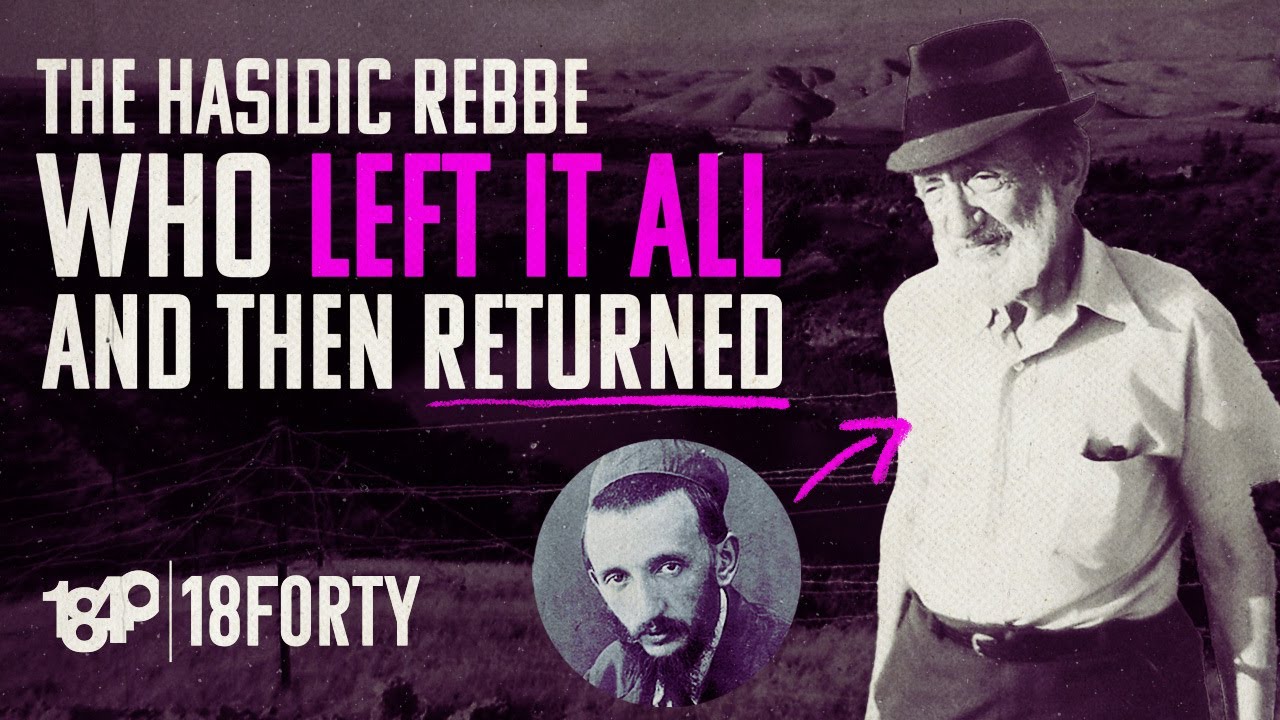
Rav Yechezkel Taub, known as the Yabloner Rebbe, suffered much guilt after a challenging attempt to transport a religious European community to Israel ended with many of his Chassidim in Poland during WWII. While not a direct victim of the war (he was in America at the time), the Yabloner Rebbe felt responsible for the death of his followers, who returned to Europe from Israel by his reluctance to join a recovery agreement with the Jewish Agency and the Jewish National Fund. Guilt, mixed with anger, confusion, and disillusionment towards God for the Holocaust’s atrocities, led him to fade into the background of American life. He shaved his beard, clipped his payot, and adopted the name “George Nagel.” The Yabloner Rebbe spent decades in Los Angeles as an everyday Californian, with few connections to his family or past life.
Like Elisha ben Abuyah, losing his faith meant losing himself. Except his story did not end there.
Decades later, despite extended pain, isolation, and religious disengagement, Rav Yechezkel Taub made his return to his original plot of land in Israel, Kfar Hasidim. The community that survived the war had missed his guidance and leadership, and they welcomed his return with open arms. George Nagel once again became the Yabloner Rebbe—Torah observance and all.
Maybe, despite the Talmud’s seeming decree that Elisha ben Abuyah is forever cast aside to live as Acher, hope remained for him after all. Maybe he did not live like a hollowed corpse as Eliot describes, but in an ongoing relationship with who he was and who he is, as Isaac Bashevis Singer writes:
the dead don’t go anywhere. They’re all here. Each man is a cemetery. An actual cemetery, in which lie all our grandmothers and grandfathers, the father and mother, the wife, the child. Everyone is here all the time.
Despite physical disconnection, the emotional relationship persists. If this can be said for those existing in infinitely distant realms from mortals, then it may even be true for the lost pieces of ourselves.
Elisha ben Abuyah never stops wrestling with his old self. His righteous past and heretical present are locked in active conflict. He continues to teach Torah law to Rabbi Meir, despite a brazen disregard for its authority; he follows Rabbi Meir to countless yeshivot, and sees the students’ lessons as rebukes against himself; he is trapped between heaven and hell even after death, unable to ascend due to his rebellion, but too knowledgeable a scholar to descend.
By another reading, perhaps Elisha ben Abuyah was never destined to be Acher. Perhaps, by his own choices, he chose to exile his past self from who he was. Even the supposed divine decree against him—“Return, my sons, except for Acher”—is said by both medieval and modern commentators to have been, at best, something to be ignored and, at worst, a physical manifestation of his own insecurities. Return was impossible for Elisha ben Abuyah because he never believed it possible.
Elisha ben Abuyah’s old self was never truly gone. The possibility of dialogue between the different parts of his identity—the scholar, the scared, the heretic—always lay before him. In some ways, Elisha ben Abuyah constantly engaged in that conversation. But in other ways, he neglected the possibilities that lay in store for who he could become. That is the loss he never recovered from.