Transcripts are produced by Sofer.ai and lightly edited—please excuse any imperfections.
David Bashevkin: Hi friends and welcome to the 18Forty Podcast where each month we explore a different topic balancing modern sensibilities with traditional sensitivities to give you new approaches to timeless Jewish ideas. I’m your host, David Bashevkin, and this month we’re exploring teshuva. Thank you so much to our series sponsors, Daniel and Mira Stokar. We are so grateful for your friendship and sponsorship.
This episode is a bonus episode to our normal teshuva series, so buckle up, you’re in for a real treat. This podcast is part of a larger exploration of those big, juicy Jewish ideas, so be sure to check out 18Forty.org, that’s 18Forty.org where you can also find videos, articles, recommended readings, and weekly emails. There’s this video online which you may or may not have seen, but it really struck me. It’s a professor teaching his class and he has an empty jar in front of him, and in front of the jar, he has a bunch of like rocks. Bear with me.
He has this empty jar and he puts all these rocks in the jar and they fill up the entire jar. And it looks like the jar is full and he turns to the class and says, is the jar full? And the class is like, yeah, it’s, it’s full. It’s filled with rocks. So then he takes out a bunch of like little pebbles and he pours the pebbles and they find a way and they like have a place that in the crevices in between these larger rocks, the pebbles do have a place.
He’s able to pour in all of these pebbles. And then he turns to the class again and says, is the jar full? And the class is like, yeah, now it’s definitely, definitely full. And then for the final act, the professor takes out like a big pile of sand. And then the professor pours this sand into this jar that’s already filled with rocks and pebbles and the sand because it’s so small and is able to really take the shape of the container, does find the place in those really small crevices, those really tiny empty spaces, and then it’s able to truly make the entire jar completely full. Why am I bringing this up now? I was actually having a conversation, I was at a JLI retreat.
JLI is I believe called the Jewish Learning Institute, and it’s run by Rabbi Mintz. It’s this incredible gathering and program that I’ve gone on. I’ve been merited to be invited to come the last two years, and I was having a conversation with somebody, we were walking outside and I was talking about how I sometimes feel that different forms of Torah are represented by each of these three rocks, pebbles, and sand in this jar experiment. That sometimes you have Torah that are like the rocks of your daily experience.
For me, maybe that’s your relationship to like your daily halachic routine, getting up in the morning, praying, you know, the things that we do instinctively that are like they fill up most of our jar. And different people have a different, you know, large rocks that fill up their so to speak, that empty jar of soul, of divinity, of transcendence and you put rocks inside and that’s your kind of daily schedule. Maybe you say Modeh Ani and give gratitude in the morning. Maybe, I don’t know, maybe you daven, maybe you daven three times a day, you pray three times a day.
Maybe it’s daily learning, maybe it’s Daf Yomi, maybe it’s Amud Yomi, maybe it’s a Mishna, maybe it’s learning parsha from Rabbi Sacks. Maybe it’s, I don’t know, giving a little bit of charity every morning. But everybody has those large rocks and that’s the daily routine and the habits that kind of fill up most of our jar.And then we also pour in all of these like pebbles, and the pebbles is like the inspiration that we hear that’s also a part of our routine. Maybe the friends that we have conversations with, maybe a weekly chavruta, chavrusa, we’re learning together, maybe it’s the rabbi’s sermon, maybe it’s some class you go to on Shabbos, and like those relationships make it feel even more full.
And very often, there are people whose jar, it is still, it looks all the way full. They have their big rocks, they have their pebbles, but there’s still in their life, in their experience, there is an empty space. Now, not everyone notices that empty space. To the naked eye, if you were looking from a distance, it would look like the jar is completely full, your daily routine, and then you have these like little bursts of inspiration that you have.
So what other room is there? And this I believe is the type of Torah, the form of Torah that really only reaches the discerning eye who is able to feel that vacuum and that emptiness even in the smallest of spaces, even when our day feels incredibly full, even though when we have so many daily obligations and routines that kind of fill ourlives up. There are some people who are so kind of acutely aware of those little pockets of emptiness that they feel in their life, those doubts, those questions, that abyss that still manages to feel like an entity in their very sense of self. And for many of you describing this, I’m sure is like, we have no idea what you’re talking about right now, and God bless you. I hope it helps someone.
But there are people, and I am one of them, who even when the jar seems full, even when you have all the daily obligations and routines and you have people who you can turn to to get little friendship and inspiration and sermons and all of this stuff, etc, etc. There is a gift and I look at it as a privilege that you still are aware of little pockets of emptiness. You still feel the abyss of existence and that desperate seek, that desperate need for purpose, for meaning, to know what life and existence is all about. People who will not stop anything short of filling up every nook and cranny, every single crevice of life with meaning and with purpose and with transcendence.
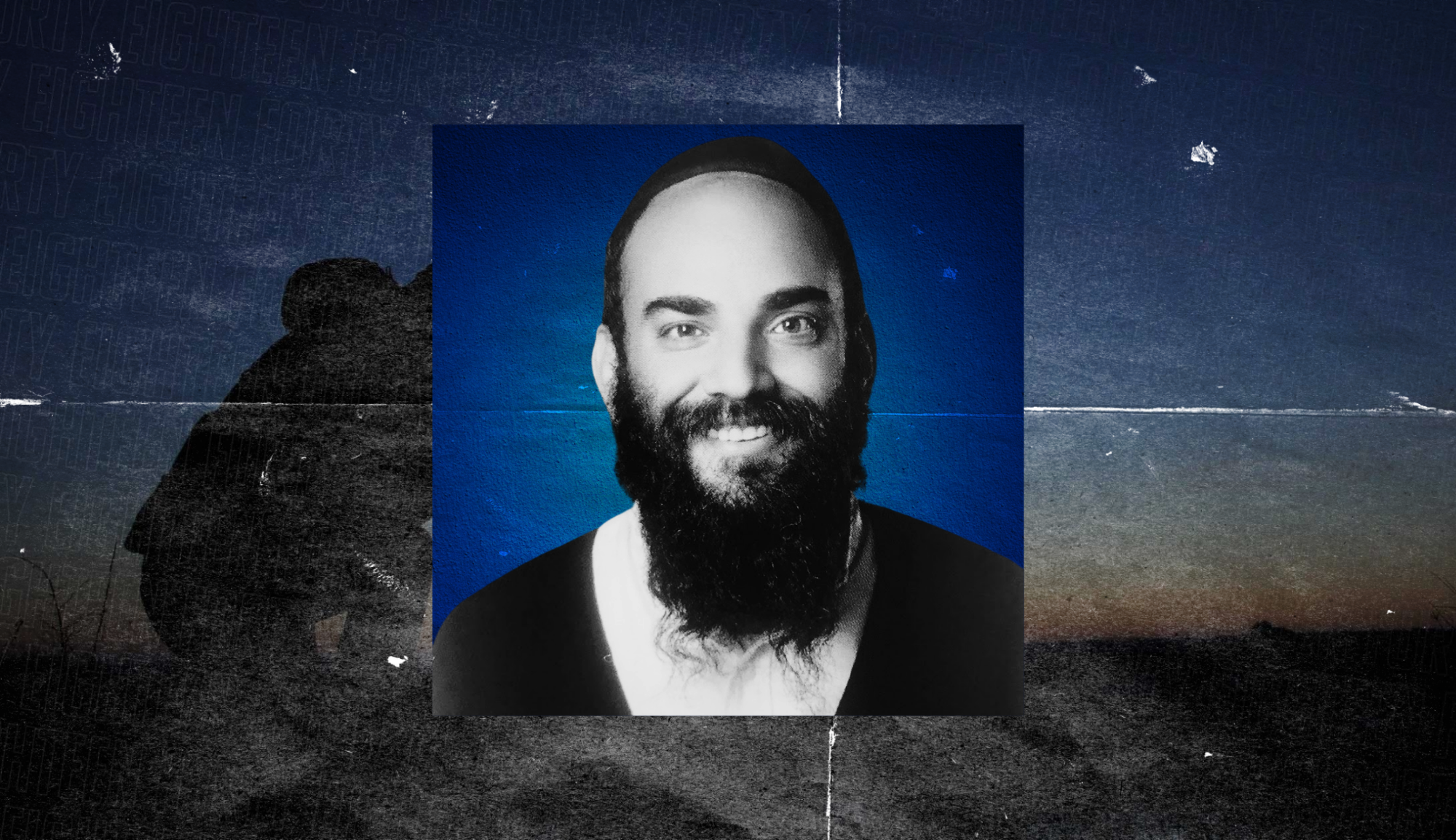
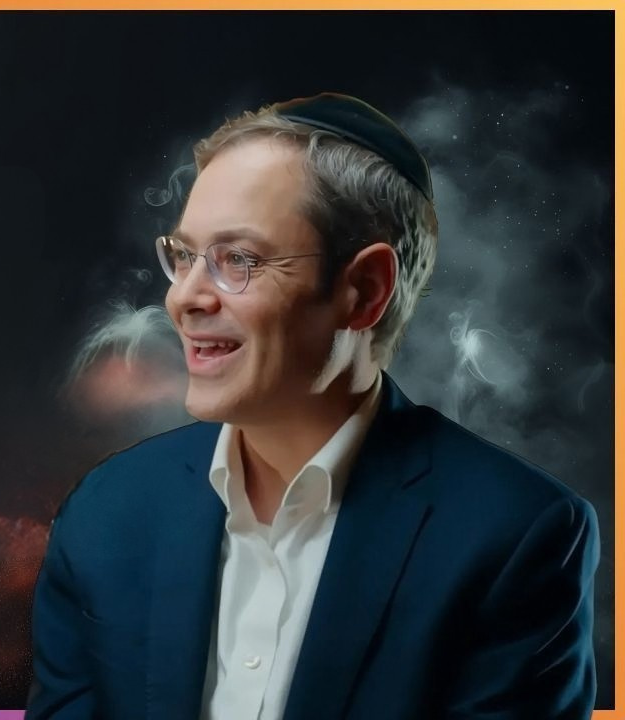
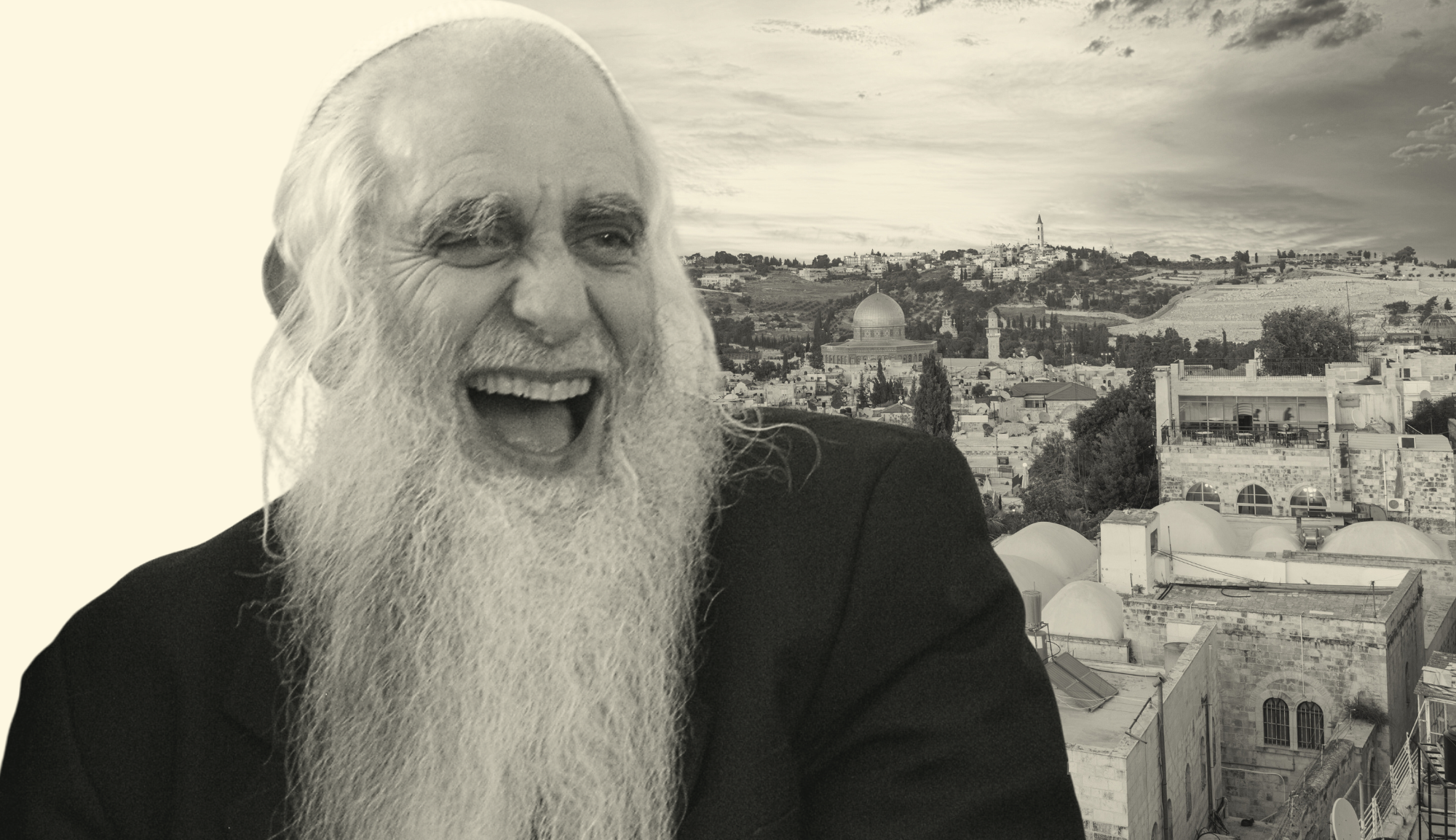
And it’s with that introduction that I want to introduce our conversation. It’s a returning guest to 18Forty, and someone who I consider not only an incredibly dear friend, but someone who I consider a teacher. And that is my dearest friend, Rav Joey Rosenfeld. Rav Joey Rosenfeld, if you are not familiar with his Torah and his approach in general, is a gifted translator of Kabbalah, mysticism, and Chasidut, of the Torah that addresses the ultimate interiority of our lives.
I call him a translator not because though he does render these texts, which were originally written in Aramaic and in Hebrew, he does render them into English. That is not why he calls himself a translator. And you can go on his Academia page, and if you look at what his bio, what’s his professional description, he describes himself as a translator. That is not because he spends his entire life rendering words from one language to another.
Though that is something he is quite capable of doing. The real reason why I believe and I see him as our generation’s translator is that he is able to speak the language of mysticism through the generations, and yet render that experience that mysticism seeks to address into the language, into the experiential language of our generation, of this very moment. There is a command of language that I admire in Joey that I don’t think I’ve ever seen in anyone else. It’s a command of language of the language of mysticism and philosophy and life and difficulty and suffering and joy and pleasure and pain, someone who is able to render the essential experiences of humanity and wed them to their conceptual mystical foundations, where you feel that your life is not a mistake, it’s not errant, but you are able to see the loftiest concepts, the loftiest mystical truths resonate and be embodied within your very life.
And it is for that reason that I’m not only incredibly privileged and excited to introduce Joey as our guest today, but I feel a debt of gratitude as a friend of somebody who I have turned to, somebody who I, you know, when it’s two o’clock in the morning and you want to send a voice note to somebody to share a feeling, to share a concern, to share a question, to share just like looking up at the void and wondering, ayei mekom kevodo, where do we find transcendence? Where do we find eternity in this seemingly empty world? Rav Joey has been an incredible mentor, an incredible translator, and most of all, an incredible friend to me. So it is my absolute privilege and pleasure to introduce our conversation with Joey Rosenfeld. It really is a privilege and pleasure to introduce somebody who I consider both a friend and a rebbe in many ways. Somebody who I’ve learned a tremendous amount of Torah from my dearest friend, Rav Joey.
Joey Rosenfeld: Hey, Dov. What a treat to be here.
David Bashevkin: So I was struggling a lot of like where to start from in a conversation with you. Like the starting point because I could start from my own brokenness, what I’m feeling in this moment, what, you know, conversation that we’ve been having probably for years now.
And I could start like collectively. And what I think makes your Torah so beautiful is that I think the individual and the collective really are able to see each other one in the other. So it doesn’t really matter where we start from, but I want to start with a collective question. We’re standing now, it’s like post-October 7th.
We had this like moment where we felt beyachad nenatzei’ach, like this is it, we’re all coming together. And there’s this like upswell and awakening of Yiddishkeit that you see around the world. And now things are starting to like get more realistic where a lot of the old debates are coming back to the fore in the Jewish community about what the role of the State of Israel should play, should we be participating in the army. We’re wondering wondering whether or not, you know, you have this awakening, but like is the whole world going to become frum now and Orthodox? And I think my starting question is what is the change we need in this moment in order to actually bring about real change? Meaning, it feels like we are slipping back into the regular flow of time where like we’re going to be back in like it’s going to feel like 1994 again.
We’re just waiting that it’s like, we’re out of the news, there’s no more antisemitism, you know, we kiss and make up with the Ivy League colleges, and the Orthodox community gets strong again, and we start, you know, support our yeshivas and the non-Orthodox world, you know, goes back and you know, this becomes never again, and you know, and we all go back to our corners. And it’s just like, what was that for? And I’m wondering specifically from your point of view because I feel like what I’m struggling with is almost the inevitability that this isn’t the end and that this isn’t going to bring about that ultimate change. And I’m already feeling the disappointment coming down into this very moment where it’s like, “Oh, I thought this could maybe be the catalyst to help us.” And we’re going to be just like every other generation, the generation that had the Lubavitcher Rebbe, the generation right after the Holocaust, the generation right before the Holocaust, and we’re going to be like every other generation who came close, who had an awakening, and then went back to business as usual. I don’t think there’s a question in there, but like, I guess what I’m asking is like, we’re both frum.
So like, I guess the most general way I could put it is like, what is the avoda right now? Where should our spiritual work be channeled?
Joey Rosenfeld: The answer to what you’re asking is the word shalom. Peace. Peace which is associated with the etymological root shlemus and wholeness. That’s the end of Torah Sheba’al Peh.
At the end of the last mishnah in Masechet Uktzin, lo matza Hakadosh Baruch Hu kli shemachzik bracha ela hashalom.
David Bashevkin: There is no vessel.
Joey Rosenfeld: There’s no vessel that can hold blessing like shalom. And so the task always has to be shalom.
Peace. But we have to reevaluate what that means. So the question is, what happens when we see that that ideal of unity slips back down into fragmentation? And when that very loose grip on what seems to be a clean and neat ending of history seems to slip slide back into kind of that dialectical sway of just this and that and the ups and downs. When instead of getting the end of the dialectical process,
David Bashevkin: We’re just another shalavin a thesis prior to an antithesis.
Joey Rosenfeld: Yes. And so shalom is not synthesis. Our problem with the inability to conceive of actual shalom arriving in our lives is because we don’t know what shalom means. Peace is not uniformity, peace is not singularity, peace is not self-sameness.
Peace is an urgent need that is born out of something that is by very definition at war with itself, and learning to make peace with both elements of that side. That if we think the ideal of history and we think the ideal of Judaism and we think the ideal of changes and growth is ultimately to bring to some plateau where everything is tied about neatly and it’s all revealed to have been, surprise, everything is unified, then we’re missing out on the _yichud_ that’s found within the process of confronting confrontation and disagreement and separation of ideas. We have to lean into the very simple fact that we’re not meant to ever look like a singular thing. We’re not meant to operate in one fell swoop of expression.
Rav Kook, zechuso yagen aleinu, wrote that klal Yisrael is made up of all different shades and colors. The Tikkunei Zohar Hakadosh explains that Yiddishkeit is made up of all different zramim. There’s a differentiation at the heart of the unity that is revealed in Yiddishkeit. So when we see moments of externalized peace, which as a result of being part of the world, we see as uniformity and self-sameness, where everybody is marching to the same drum, so then of course we’re not going to be able to taste that in any lasting way because that’s the opposite of this world.
This world is a world of milchamah. It’s a world that’s at war with itself. Everything is at war with itself. At the core of it, it’s expansion and contraction.
There’s a dual impulse at the heart of all things. So to try and make semblance out of that is obviously going against the very basic root of what existence is.
David Bashevkin: There’s a core impulse at the heart of all things. That core impulse being
Joey Rosenfeld: the expression and the repression that are always operating together.
Meaning to go back, let’s go back. Let’s go back to how Hakadosh Baruch Hu created the world, because if we want to figure out what to do with the world, we have to understand how Hashem created the world. God created the world by an act of concealment, an act of concealment that is at the very same moment an act of revelation. And so the concealment of godliness, the concealment of Hashem’s absolute presence, which we can identify as this unity that we imagine, in truth, that’s not where the world gets created.
The world gets created specifically when Hashem relinquishes that perspective, where Hashem says, “I’m going to allow this thing to break and splinter into a million little pieces.” And that’s the emergence of the building that we need. So every ounce of our experiences in this world, whether it’s with family, whether it’s with loved ones, whether it’s on a communal level between us and God, is amixed bag. Everything is both containing itself and revealing itself, containing itself and revealing itself. That there’s building and there’s breaking inherent in every action that a person does.
When I decide to open this book, I’ve also decided not to open this book. When I decide to drink water, I’ve decided not to drink Sprite. That by definition is the nature of existence, that it’s a place of choice, it’s a place of differentiation, it’s a place of fragmentation, and our goal is to find peace within that, to make shalom within the differentiation. And so when we accept the fact that things are changing and there’s all these different types of colors and chords that seem so dissonant with each other, yeah, if I have this infantile belief in this uniform wholeness, then that’s going to bother me.
And then any political notion that can create, you know, a promise that everyone wants a piece of, so that’s going to be our best hope. But we know those are false promises. What we have to lean into is the fact that, no, we’re meant to find peace within the differentiation.
David Bashevkin: Let me ask you the following.
You know, I’ve been saying for a long time, the purpose of Judaism is not to fight antisemitism. We fight antisemitism in order to focus on the purpose of Judaism.
Joey Rosenfeld: Not to be distracted by the nations of the world.
David Bashevkin:Yeah, and antisemitism is an important and urgent battle, but we can’t confuse that with we were not placed on this earth in order to fight antisemitism.
And that obviously leads to the very obvious question, okay, so what is the purpose of Judaism? I know that’s a strange and almost a very basic formulation.
Joey Rosenfeld: No, it’s a great formulation, but we have Chazal. Ba Chavakuk vehe’emidan al achas, tzadik be’emunaso yichyeh. The base line and the core of what this is all about is cultivating a space of faith.
Faith which is not rooted in knowledge, faith which is not rooted in intellectual grasp, faith that is not rooted in certainty, faith that is not rooted in even stability, but rather a faith that denies the reality of all of those things. A faith that is independent of anything. A faith that is so strong that it can’t be dislodged because it’s based upon nothing other than faith. Rav Aharon Lichtenstein has a title to an essay which I think really summarizes it, “The source of faith is faith itself.” And Dovid Hamelech explains this, that derech emunah bacharti.
I have chosen the path of faith. I have chosen the path of faith, which means that it is not based on accumulation of knowledge. It’s not based on a rational approach to this. It’s not based on the fact that this is the most reasonable approach to life.
It’s simply based on the fact that I choose to live in this lane because it provides me with the only semblance of comfort available to the neshama. Emunah. The elasticity of emunah is that it has the ability to extend itself to any perimeter that the thinking individual falls to. Emunah is always extended beyond the self.
And so to find a position of comfort in this world, which is the opposite of comfort, that gives us the ability to place our trust and relieve some of the burden of being so individualized and self-sufficient, which creates an unbearable sense of responsibility, and to actually lean back into the fact that I am in fact not driving the car. I’m not driving the car. That God is, and that means that I don’t know. When I say God is driving the car, it means that my limited grasp on reality is not the end all be all.
And I have to lean into something that gives me hope.
David Bashevkin: I actually love that formulation because it really helps me understand why there’s such an emphasis on halachic observance. It’s very interesting, you and I, and I don’t want to group us in the same category, but I don’t know if anybody would, the top of their association would be associate us with, you know what, I don’t even want to put you in this analogy. I don’t think they would put me in an analogy and say, what do you associate with Dovid Bashevkin? They’d be, dikduke halacha.
The detail. It’s not something that comes naturally to me. It’s not something that I find particularly energizing, even to learn learning halacha could be a little exhausting for me. I want to cut to the end, okay, just tell me what I should do.
What the ideas I don’t find as attractive. And yet, there is a majesty in the idea that explains why halacha and shmiras halacha is the most sublime expression, the notion of commandedness, meaning the notion that there is something that, help me find the word.
Joey Rosenfeld: What? Bonds us. Bonds us to something beyond ourselves.
To believe in a command implies the belief in a commander. And when Chazal say that the merit of a mitzvah is a mitzvah, it means that when a person performs a ritual act that is based in an obedience to a system that they place their trust in, what we’re pulling at is the chain of commands that we believe goes all the way, all the way, all the way back up to the unfathomable and ineffable will of God who wanted to reveal himself in this thick place. Halacha by definition is rooted in this-ness, the haecceity of the world, the physicality of the world. And again, people have to reread Halakhic Man.
Rav Soloveitchik was giving us a frame of the purpose of halacha. Halacha, as the Tikunei Zohar say, stands for the acronym, Hariu laHashem kol ha’aretz, that I raise up all of this worldliness to God. This world is chaos. This world appears like a jungle.
And no matter how much we hear the Lubavitcher Rebbe promise us that it’s no, it’s not a jungle, it’s a garden, it still looks like a jungle more often than not. And what does one do in a jungle? What does one do when there’s no charted path for them to function whatsoever and there’s beasts abound, and there’s terror and all I want to do is stay where I am. The halakha allows a person to draw down the transcendental ideal into the lived experience of right here, right now in accordance with these measurements and in accordance with this time constraint.
And what it does is it valorizes the opposite of Godliness, this world with a spark of purposefulness, of meaning, of attachment to something that is real, not real because I know why it’s real. We’re not dorish ta’am ha’krav. The mitzvah act itself is the truest secret, that I can compel my body, that I can do something that my mind doesn’t necessarily need to do, that my emotions don’t need to do, but I’m doing it because the meaning embedded within it is what I so desperately need.
David Bashevkin: That was genuinely such a beautiful formulation, and to me, it’s so cosmic being able to make peace with halakhic observance in this moment, because the reason why I think halakha is so important, and it’s like a strange thing for me to center especially in conversations…
Joey Rosenfeld: I love that we’re talking about this.
David Bashevkin: is because I feel like in the cosmic battle of the world, what do you think’s going to happen next? Like what’s the world fighting about? The battle between west and east, but certainly the battle between Judaism and Christianity and the models of what they have is the question of whether or not there is still a law in place. Whether or not God revoked the law that He gave to the Jewish people as the way to find divinity. And Christianity forwarded this model which looks at the law as oppressive, as divisive. They basically frame themselves as saying, look, we’re not going to have to go through the window of commandedness because we’re going to cut to the end of the story and basically say, God loves all his children, loves all of humanity.
And to me, the idea of Judaism that it’s trying to make peace with and grapple with and tell me, I want to get cosmic, I want to understand this. Like what is the battle that we’re seeing right now? I don’t look at this as political, there’s you and you can, there are other podcasts you can listen to to talk about that.
Joey Rosenfeld: The battle is simple, and I and I love that you bring it up. The battle is simple.
Yiddishkeit is the guardian of deficiency. Yiddishkeit, Judaism is the prophetic impulse to maintain the singular truth at the heart of all things which is that creature cannot be creator. That there is an ontological divide that can never be traversed, that separates creator and creation. Which means to say no matter how high along the rungs of spiritual growth that I ascend, no matter how great the illumination, no matter how great the revelation, in the end of the day, one returns back to themselves to realize that what I thought was the ending or the perfection was perfect in relationship to where I was coming from, but imperfect in relationship to where I’m going to.
The reduction of God’s infinitude and the impossibility to live in the paradox that true infinitude brings to the table, is the attempt to wrestle some element of perfection from this world because if I can’t understand God’s perfection, or if I can understand God’s perfection, that means I could become perfect. And if I could become perfect, then there’s a certain point at which I have perfected my task. Law and the need to be tethered to a system of development, which is what halakha is, it comes from the language of walking, it implies that one is perpetually on the road and not quite at the destination yet. That guards the notion that the human being is always and will always be a work in progress.
Even when Mashiach comes and there’s a shitah in Chazal that says mitzvot are going to be mevutal l’asid lavo, which would lead us to think, well maybe we’ll become perfect then. So the Rebbe Rashab and what Chassidus comes to explain is that it doesn’t mean that mitzvot are going to be nullified. It just means that they’ll be nullified from the time and spatial confines that we limit them to now. But there will always be a notion of commander and commanded.
Kedushasi l’ma’alah mi’kedushaschem is the thing that we’re fighting for. To perpetually remind the world that perfection is not here and in fact it’s inaccessible until God chooses to reveal his perfection. And even then we won’t be perfect. Christianity had a belief in the perfectibility of the individual.
And that already is a domestication of the infinite, because if I can grasp the infinite, that means that I have a certain element of equal infinitude with the infinite. And so if that’s the case, then I can be God. And if I’m God, then I’m perfect. And if I’m perfect, there’s no need for effort.
And if everything is perfect, then redemption has come already. Ah, everything is still broken? Okay, we can make a footnote about why things are still broken and then maybe later on. But Yiddishkeit says, no, nothing is perfect. Mashiach has not yet come.
There’s still infinite work to be done, day in, day out. But here’s a very important piece, and this is where I think Lacan, Jacques Lacan, kind of this third generation of a return to Freudian thought becomes most significant. When we’re told that we’re imperfect, and we’re told that ki p’lacha because you have to guard yourself and you have to manage your life by way of minutia because you’re imperfect and you’re not God. So our natural tendency is to fall back into the traumatic lines of education that we’ve received, which is that be perfect.
If you’re not perfect, you’re not manifesting your potential. If you’re not manifesting your potential, you’re wasting time. Utilize all of your God-given strengths to perfect things. so what we’ve come to see is imperfection as a deficiency, as a symptom of a fall away from a prior perfection.
What Lacan came to do and ultimately lehavdil what Chasidus is revealing and what Kabbalah is ultimately revealing and Torah Sheba’al Peh and Moshe Rabbeinu is that no, the imperfection is not a symptom, it’s not a post-traumatic reality. It’s the very nature in which the human being was created. That the human being is meant to be created to reach that one place of knowledge that all I can do is have emuna. Emuna is not perfection.
Emuna is where I say I don’t know. Wisdom would give me the sense of perfection. Emuna is that at the end of the day, I just don’t know. And that’s okay, that’s bittul.
David Bashevkin: I want to draw you a little bit into my own life because one thing that we share in common, we both share Torah in different frames and to overlapping but different audiences. I listen to a great deal of your Torah. I really, really do. And we both come from the same world.
We both have the same memories and, you know, not literally the same memories, but the same context and, you know, we went to the same high school, you knew my brother, and now we’re in this place where each of us, respectively, in different ways has our own platforms where we’re sharing advice and guidance and Torah ideas. Torah ideas that I think are beautiful. I think I say that both about your Torah and my own. I’m very proud of the Torah that I’ve been able to share.
And yet, I have times, and I’ve had times even quite recently, where I feel the heaviness of just like, I don’t know about you, I’m I’m not a real tzaddik. You know what I mean? But like—
Joey Rosenfeld: I’m not I’m not either. I know real tzaddikim though.
David Bashevkin: But like and then sometimes I’m like, but maybe I am.
I don’t know, maybe I have some maybe I have something to say. But I think what really haunts me is, you start to become reliant on, I’m talking about myself, not 1840 or not like, you start to become reliant on what you are able to accomplish. You start to become reliant on what makes you unique. And I think what sometimes really is difficult for me, and I don’t know if I’m articulating this well, but I’m reaching out as almost like guidance, is how do you ground your life in something that is stable and real and really you, not the YouTube channel, not even the ideas that you share, but that is what makes you unique.
But how do you ground yourself in something that is not going to feel like every second your very sense of self can be taken away from you? That’s the hard thing for me. Let me drill it down because this gets to the piece of what draws me to Lacan and the Lucian. What I have been struggling with probably my entire life is to feel as if I have finally arrived and I am no longer have to earn my sense of self, to be able to feel fully embodied. And that can be particularly hard when such a large part of yourself you are giving over to a public where now you’re being measured, you’re being evaluated.
Did this go? Did did this work?
Joey Rosenfeld: Tracking the progress, right?
David Bashevkin: Tracking the progress, you know, pretending that there isn’t a camera, you know what I’m saying?
Joey Rosenfeld: We’re lucky. We’re we’re lucky in the sense that the Torah and God never demanded from us radical authenticity. Never. The big joke of Pshischa was that the notion of radical authenticity was a possibility.
Because if we begin to believe that I can be truly authentic, then maybe I’ll yearn to become a little bit more authentic. But the self needs to prove absolutely nothing to itself, nor does it need to prove anything to the rest of the world. Chazal have a really simple but really poignant statement that there’s two types of love. There’s a love that is independent of things and there’s a love that is dependent on things.
The difficulty with the love that is dependent on things is that when those things fall apart and the center cannot hold and mere anarchy is unleashed upon the world, then the love falls away. But unconditional love and unconditional positive self-regard and the unconditional place that I have perpetually in the face of Hashem is built upon choosing something beyond reason. If I connect to God because A, B, or C, if I connect to God because dalid, hei, vav, then those things can fall away because my faith is based on that and my belief in self is based on that and my worthiness is based on that. But if I come to a place of accepting myself unconditionally, and the only way to do that is to fake it until you make it because there’s no difference between faking it and making it.
There’s no blockchain authentification of saying you’ve reached it because the billionaires are not feeling it either, right? And the addicts who have gone out and tried every physical pleasure in the world, they’re waving their arms saying, chevra, it’s not by objects that you’re going to find it, which is why everyone says, no, don’t tell us that, we want to enjoy our hamburgers. It’s not our fault you went to the last object. But the whole world is announcing to us that there is no closure. There is no final say until Hashem decides that there’s a final say.
So we have to choose to validate the self internally, and then go into the world. The Kadmonim describe the way that Hashem created the world, not as a tzimtzum, but himtzia et atzmo me’atzmo. He emerged from within himself. That HaKadosh Baruch Hu decided, so to say, that wanted to emerge from within himself.
David Bashevkin: A self that emerges from a self.
Joey Rosenfeld: An autogenesis. An autogenesis where the awakening of desire to express externally is no longer dependent on an external stimuli, but rather there’s an inner playfulness that is taking place between the back and forth of the self. That there’s already, at the very beginning, there’s the war going on.
And we have to model that. We have to be mamtzsia et atzmenu. We have to become our authentification. Why is my day going to be significant? Because I’m choosing that today is going to be a significant day.
Why am I going to maintain a semblance of calmness and self-acceptance? Because I’ve decided that I’m going to accept a sense of calmness. If I wait for the world or reality or people or accomplishment or money or anything to be what I need in order to enter into that space, so then it’s an ahava shetluya badavar. Our generation has never been more ripe to receive this message of unconditional bond to the creator, unconditional bond to our faith. Because never has there been a generation that feels so fragmented and so far and so undeserving of the level of faith that we actually feel we need.
But it’s because we have to learn how to bypass the whole spiritual system. We have to learn how to radically affirm faith, goodness, absolute goodness, and from there work on our productivity.
David Bashevkin: What is the difference between the way you articulate self-acceptance and that understanding of self and the psychological world of, you know, self-validating that sometimes leads you to like the abyss. There’s especially now emerging the last like two, three years, there’s such a emergent like skepticism of like
Joey Rosenfeld: Toxic positivity.
David Bashevkin: Not just toxic positivity, but like, have we over-psychologized everything? Should we just, like just like, I don’t know, like it’s a scrape, like keep going, like don’t worry about it so much. I don’t know what it is. There’s a skepticism of where almost self-knowledge can lead to or self-validation can lead to.
Joey Rosenfeld: We assume it will lead to inactivity.
We assume that it will lead to either more sinning or inactivity if we accept ourselves. Now, part of the issue with this is that we have to go back to where modern psychology decided to draw its recent toolkit from. And a lot of it is Eastern spirituality. You know, there was a certain shift where Eastern spirituality made its way into the mainstream Western psychological model.
We can trace it. Jon Kabat-Zinn is an important individual, but it happened beforehand. But let’s remember when Schopenhauer felt that Eastern spirituality should make its way into the Western world, the only way that he could translate it properly was the pessimistic science. The Eastern spirituality is a spirituality of emptiness.
It’s a spirituality that’s rooted in the non-permiance of things. And it’s rooted around the void. And if everything is a void, then time is a human construct that tries to domesticate the void, and attachments are the all-too-human attempts to kind of make some sense of space in my life. But in the end of the day, all I really have is this moment right now, as part of this eternal reoccurrence of meaninglessness, and all one can do is lean into the nothingness.
David Bashevkin: And that’s the Eastern view.
Joey Rosenfeld:That’s the Eastern view.
David Bashevkin: And psychology’s kind of built…
Joey Rosenfeld: Psychology has taken tools from the Eastern view because they were the ones who were not stuck within this Cartesian mind-body separation. So they have a long history of tools of mindfulness and meditation.
But without scrubbing the tools properly, you’re also drawing the content that those tools were used to engage in back into our culture. Yiddishkeit, forget Western, Yiddishkeit is the polar opposite of theology of emptiness, the actual polar opposite. It’s a theology of saturation. That we believe that tzimtzum einah kipshuto.
And in spite of the fact that appearances dictate God’s…
David Bashevkin: Tzimtzum einah kipshuto, meaning that the…
Joey Rosenfeld: That God’s contraction was not literal. It’s just a hiddenness.
And so the emptiness that we encounter, and this is a very important piece, and you’ve heard me say this over and over, the emptiness we encounter is not the absence of presence. It’s something far more similar to the presence of this sheath of absence, which is also a revelation from God. That all of the emptiness that we encounter is ultimately just an encounter with God’s concealment. So now, when I don’t find God, instead of saying, oh, all is nothing and all is empty, I’m attaching myself to the fullness of God that hides within this sheath of emptiness that He revealed.
This is rooted in all of the Kabbalists. This is what tzimtzum is. Tzimtzum in the language of the Leshem is the gilui of a koach ha’helem me’ein sofiyuto, the revelation of a concealing particle or a power of concealment that now becomes the garment that shields the true absolute infinitude of Godliness. So, the concealment and emptiness in our lives is not empty.
We believe radically in the affirmation of meaning. We believe radically in doing mitzvos, in doing more good, in doing good things for other people. And so, A, we’re traumatized, and therefore, when we’re given permission to kind of feel calm, we might actually relax on the couch for a little bit longer, and people might say, oh, laziness, because they were taught like this Protestant ethic and late-stage capitalism. But the the truth of the matter is that the natural desire of the soul is to grow.
And Shabbetai Tzvi came and made the whole world crazy because he did come and say that pnimiyus haTorah can lead to letting go of responsibility, and it can lead to destruction. And so everybody’s terrified that if I accept myself, then I’m just going to languish, I’m not going to do anything. But I don’t think that’s the case. I think we’ll want to do more, but from a position of enoughness rather than from a position of scarcity. Does that make sense, that distinction?
David Bashevkin: Deeply. Deeply, and I want to come back to us. You are much more immersed than I am in the language of kabbalah.
In the language of kabbalah. You you have a much vaster body of knowledge and scholarship. And I’m trying to understand what your immersion, because I’ve always been fascinated by you as you as the knower. Like you seem to know secrets.
I’m a very discerning, discriminating, you genuinely say things that I find incredibly profound and you’ve read books and I know that you’ve grasped ideas that I don’t fully understand or you’ve grasped ideas that it took me much longer to actually confront. And I wonder, is the difference between me and you language or is the difference between me and you, do you have more access to Hakadosh Baruch Hu than I do? Like, do you understand God better than I, like, differently? Is there something you know that I don’t know? Do you have access?
Joey Rosenfeld: Yeah, I have, I do have access, and that’s to the fact that I can’t know. The more a person learns kabbalah, the more they realize that knowledge is a false flag. And that the ultimate truth of all things is tachlis hayediah shelo neida, that I don’t know.
And that God is unknowable, and as such anything that comes forth from God is unknowable, and the process in which something other than God comes forth is unknowable, and the way and the shape in which things unfold is unknowable, and the soul is a layered unknowable thing, and mitzvos are unknowable technologies, and the Torah, in spite of its intelligibility, is ultimately guarding its unknowable secret. And so when a person kind of accepts that, then we stop chasing the validation so much because we’re the validation. The fact that we’re choosing to engage with this process with the deep knowledge that it will not lead to a consummation, it will not lead to completion, it will not lead to fulfillment. The fulfillment, the consummation is within the process itself.
That’s what kabbalah teaches. Kabbalah teaches the fact that, you know, we have to forget about the desire to reach back to some ideal perfection that was lost, and we have to understand the unfolding process of history as a slow and steady process of coming to grips with our fundamental chisaron, with our fundamental lack that rests at the core of our selves. So kabbalah teaches a person that. It gives a person comfort in not knowing, in not being able to reasonably convey why I believe this, and not being able to necessarily answer the hypocrisies that a person feels in their lives.
There’s complication in me, of course, I contain multitudes, meaning the notion of a semblance of a unified self, of a unified world, they’re the wrong ideas that we were we were poisoned with this notion of perfection. And kabbalah goes a long way in in taking that away. God’s initial act of revelation was constriction. The original act of building was a constitutive trauma.
Every attempt at rectification is kind of trying to limit light so that it can be manageable. It’s not in the loud noise, it’s not in these radical affirmations, it’s in the silent humility of knowing that, Ribono shel Olam, I have no idea what you want from me. I have no idea what you want from me, but I’m going to rely on the books of your tzaddikim. So I do know more, but that the knowing more is that I don’t know anything.
David Bashevkin: The experience that I think both you and I in many ways are reacting to, which is, I think, the experience of being alive. Meaning, I’ve always felt from a young age, I could feel the sensation of my own consciousness. I could feel the angst of existence, like my own aliveness, my own thoughts. I had trouble falling asleep always, but it used to make me very nervous, like I couldn’t quiet my mind.
To me sometimes, I wonder, I didn’t study to have that. I was born that way. And that allows me because every waking moment when you feel or more it’s more easily accessible, the sensation of existence, the discomfort of aliveness that like you can almost feel it like it’s a jacket.
Joey Rosenfeld: It’s an itch.
David Bashevkin: Yeah, you know it. It has a fabric to it. Like you become sometimes aware of your own vantage point. Like I’m like, I see the frame of my glasses and like, my question is, not everybody feels that, and not everybody has access to that.
And to me, that is the foundational question that all of, not just Yiddishkeit, but all of religion is coming to address. So what do you do when someone’s like, I’m just like, I’m fine.
Joey Rosenfeld: So this is a really, really, really good question. It’s a really good question, and it comes back to exactly what we were just talking about about why the birth of kabbalistic thought as it comes down through kind of as the origin of modernity, because the Arizal, as Rav Steinsaltz zichrono livracha said, is arguably like the one working theology that Judaism has.
And we can really trace the impact that the Arizal had on every form of modernized or modern iterations of Judaism in one way or another. And what it starts with is a sense of lack. That every person lacks. Every person is aware of the heaviness of being a human being.
Not every person has been given the tools or the capacity to acknowledge that feeling. So, if I sense that deficiency or that aliveness or that kind of itch or being separate, this notion of being something outside of the flow of unity, a person comes to that consciousness when they begin to feel the pain of that, when they begin to feel the heaviness of that, when they begin to feel that, you know, I’m not necessarily flowing, and there’s something that has blocked me. It’s only when I can look at the blockage and say, oh, there’s something missing, that a person develops an appetite for wisdom that’s no longer just, let me know more. It’s about how do I live.
A person needs to cultivate an urgency to the degree that when I’m learning the books of the tzaddikim, it’s not, oh, let me see another piece of information that Rebbe Nachman says so that I can develop a better understanding of his worldview and his teachings. It’s, I’m not going to make it for another few minutes if I don’t have a download from righteous, holy people that I choose to believe in their soul rather than their wisdom. And when I read those words, it becomes a medicinal salve. And it’s only in accordance with one’s openness to deficiency and one’s willingness to feel uncomfortable, and one’s willingness to admit that they feel uncomfortable, or to admit that something is missing, and that there’s a big void in my life, that the desire for knowledge shifts from an arrogant kind of information collection and it begins to be a Toras Chaim.
It begins to be life-giving. The words of the tzaddikim, the words of theology, the words of Yiddishkeit are no longer there to answer a curiosity. They’re there to give me stability in the next moment, because what they’re offering over and over is that it’s okay not to know.
It’s okay not to know. So everybody feels it. And some people might be privileged enough to never have to pay attention to the deficiencies in their lives because there’s enough money to cover over that, or because the symptoms or have not reached peak place that I have to grapple with it. My bias about addiction is that we all live in a spectrum of addiction.
We’re not all addicts, but we all live with the potential of becoming addicted to something. And an addict is just someone who has become far more aware of the deficiency at the core of the self, and they need something that’s going to solve that problem. So thankfully, we don’t have to suffer from the symptoms of addiction, but we need to cultivate that sense of longing and yearning for something that I need. Not to accept the dizzying existential quandaries of life to be, you know, the baseline.
That’s not it. That’s just the opener. That’s the kashe that comes before the terets. And so we need to reorient ourselves towards urgency, and that’s hard when we live in a time of affluence.
And we live in a time of, in spite of the fact that everything is out of control, the floors of our homes and our houses and our cars and the tuition and the systems that work, they have built in shock absorbers. They’ve built them shock absorbers. We have the best built-in shock absorbers. And as long as those shock absorbers are working, then a person doesn’t really have to pay too much attention to that which is wrong.
You hear what I’m saying?
David Bashevkin: 100%.
Joey Rosenfeld: But instead of saying, oh, so does everyone have to have a trauma? And do we have to have everybody experience rock bottom for them to come to the truth? I used to think that. But then I’ve been thinking a lot about the fairy tale of the Princess and the Pea, right? That the Princess and the Pea is ultimately like this king and queen want to determine a princess who’s worthy to marry their
David Bashevkin:Yeah, can sense a pea underneath her mattress.
Joey Rosenfeld: Right.
So Chazal give us the healthiest perspective of what it means to be one who suffers. We all suffer in this world. But suffering doesn’t necessarily mean that it has to be a quantifiable form of suffering. Chazal say, what is the measure of someone who is a suffering individual? And the language of Chazal here is the matbeah shetavu Chazal, right? as Rav Hutner would say.
And the sting that comes out of their choice of words is that ad heichan tachlis yisurin. Where is the quintessential amount of yisurin? What’s the lowest measure of yisurin that it can be considered that one has still tasted the full measure of yisurin? Meaning, what’s the bare minimum?
David Bashevkin: To reach.
Joey Rosenfeld: To reach that level. And it’s I have, I put my hand in my pocket, I want 100 and I take out 99.
That’s enough. If something goes slightly ajar in my life and something goes the way I don’t want it, that’s enough a reason to pause and say, wow, the hester panim is great. There’s a lot of hester panim in this world. God, where are you? Ayei mekom kvodo.
And so, the moment we feel uncomfortable, that’s enough to reorient the mind to the fact that there’s a deficiency and to run searching for God. We don’t have to bring the bottom. The world is the bottom. The world is the dirah b’tachtonim, and we’re at the bottom.
Self-consciousness is the bottom of all the bottoms, as the Baal HaTanya says.
David Bashevkin: Self-consciousness is the bottom of all the bottoms.
Joey Rosenfeld: Tanya in perek lamed vav. The 36th chapter in Tanya that the Baal HaTanya asks, why did God create this place?
David Bashevkin: Yeah.
Joey Rosenfeld: And Rav Yerucham describes it in a different way. He says, God created a hospital. A hospital. The world is a hospital with each person in pain more than the others.
Rebbe Nachman said, Olam Haba, I believe in, but Olam Hazeh, where? I see Gehenom. The question is why? Like, why, Hashem? Why did you do it this way? So the Baal HaTanya, basing himself in Chazal, says that the main purpose for the creation of the world is that God desired to express himself in the lowest imaginable place. And the language of Chazal, which gets censored a little bit, it’s like a mashal, l’mah hadavar domeh, a king who decided to build his palace on a dung hill. That God decided to build his palace in a garbage heap, this world.
The pain, the suffering, the difficulty, it’s enough to tear the world asunder when a person sees one person suffering. But what’s the tachlis? The tachlis is to reveal Hashem in the place that he’s most absent, in the place that he’s most concealed. And where is that place? What the Baal HaTanya refers to as a place that’s lower than all possible places, a darkness that’s doubled over itself, which is just like, let’s think about what that metaphor is. The Rebbe used to scream, choshech kaful u’mechupal.
I’m in darkness. Everyone’s telling me, just climb out of the darkness. Climb out of the darkness and you’re going to see the light. I climb out of the darkness, I put all my efforts in and then what do I meet? Another lay of darkness.
Right? The need of strength to not be beaten and to give into the darkness at that point is unfathomable. But where does this concealment of concealment reveal itself most? To the degree that there can be creatures who conceive of themselves as being separate and apart from the never-ending influence and vitality of divine sustenance that comes from above.
David Bashevkin: The bottom is that like…
Joey Rosenfeld: The mind that questions.
That is where Hashem wants to be revealed. Hashem wants to be revealed in the territory where we’re like, what, God? The possibility of meaning, the possibility of order, the possibility of a clean kind of closure to all of this. It’s when we feel ourselves most potently and most intensely that we have to be mevatel ourselves. The secret to all things is bittel.
David Bashevkin: Bittel you translate as…
Joey Rosenfeld: Becoming translucent, becoming more translucent.
David Bashevkin: I like that. I like that.
Joey Rosenfeld: Allowing ourselves to, allowing ourselves to shine.
David Bashevkin: I like that you didn’t drop the N word.
Joey Rosenfeld: Negation.
David Bashevkin: Or like nullification.
Joey Rosenfeld: Nullification, right. Those are the ways towards it. But nowadays that takes a lot of work. A person has to be willing to do the work.
We become more translucent. This is what I get from my Rebbe the most, from Rebbe Itche Meir. There’s a model of bittel that’s conveyed, let’s say in Lubavitch, which is that there’s ayin, there’s the nothingness of the Godhead, which represents the fact that I don’t know anything and I’m just a blip on the radar. And then there’s the sense of ani, which is individualism, ego, my needs, my cares, my attachments.
And that the goal is to take the ani, the self, and to bring it back into ayin.
David Bashevkin: Yeah.
Joey Rosenfeld: But what we see in that process is a slaughtering of the ani, that the self must be sacrificed for the sake of reaching transcendence. And what that leads to is a stomach ache, right? Because like, that’s not, we’re we’re real, we exist, we’re here right now.
Even though we don’t really exist, we exist by way of non-reality. Like we’re real. Like I feel it, it’s real. And so instead of looking at it as a binary opposition or contradiction between nothingness and selfhood, the highest level is to go from nothingness into selfhood, and then come to find that the self is just an index that reveals nothingness in a new way.
That my personality and my neshama and all of the various parts of me are a merkava to reveal the rotzon of Hashem.
David Bashevkin: A chariot.
Joey Rosenfeld: I become a chariot. I become the vehicle to reveal divine wisdom, divine desire, the light of godliness in the territories that infinite can’t find.
I become a shliach of the infinite. I become a messenger of the infinite. And at that point, my selfhood is no longer contradictory to the mission. The more I thicken myself, the more I take ownership over my selfhood, the more I’m going to be measuring my success.
I’m going to be saying, oh, I didn’t do it right, I didn’t do it there. But the more I relinquish the control of my identity and I say I am a reflection of God, and my role is to reveal the rotzon Hashem, so whatever I’m doing, whatever my life circumstances have brought me to, I’m revealing godliness. And that’s what becoming translucent means. That there’s still a shape, there’s still me, but it’s less about me than it is…
I’m a talking piece.
David Bashevkin: Rav Tzadok has a beautiful Torah where he talks about the different experiences of why we sometimes refer to God in first person, second person, and third person. Sometimes with God, we refer to God as ata baruch ata, it’s you. It’s like it’s almost standing in front.
Sometimes God is is hu, is he. He’s not in the room. Like we’re talking about him like he’s elsewhere. And then sometimes God is the ani.
Like sometimes we read psukim where we’re reading so to speak, God’s parts, not just our parts.
Joey Rosenfeld:That’s prophecy. The prophet is someone who becomes the flow of godly revelation in the world. And we all have access to that, especially in hisbodedus.
David Bashevkin: Hisbodedus meaning…
Joey Rosenfeld: Speaking to God through our own language, through the most self-orientation that we can possibly have. By speaking to God and allowing ourselves to become translucent, we become witness to the things that we’re saying to God. And suddenly we come to realize that the flow of language, and the flow of thought, and the flow of emotional expression, those are not things that started here.
Those are things that started here, and they’re being transitioned through this. And so my experience of selfhood, ultimately, and Rav Tzadok is the one who reveals this to us most, ultimately, if you’re thinking a thought as a yid, you’re part of the ruach hakodesh process.
David Bashevkin: That’s such a beautiful framing and I’m sure it’s explicit in Rebbe Nachman’s sforim. I’m not as…
but that’s such a beautiful framing of what spending like alone time is. It’s learning how to channel God through self.
Joey Rosenfeld: Rav Soloveitchik hinted to this that the prayer experience is part of partaking in the prophetic community again.
David Bashevkin: I don’t know if this is a tangent, but it’s something that I thought of once and I want to share it with you.
I was one time talking to somebody, to a non-believer, and I asked them like, why is there something rather than nothing? You know, it’s like the foundational question. So he showed me an article from Sean Carroll, who is a physicist. It was really, it was profound, and Sean Carroll said that the best response of physics is that there was always something. Like there was just always, there’s no beginning.
Then you die and then there and then it’s an end. And it hit me how it’s so interesting how in like this is kind of a more atheistic framing where there’s no beginning but there’s like an end to life and to reality, while the religious framing is almost the exact opposite wherethere’s a beginning without an end. We talk about a Bereshis as the opening world and then there’s a chayei olam, there is some eternal. And I’ll be real with you, I’m not making an argument for God based on this.
I find both of them terrifying. I don’t know if one is more comforting than the other. That’s just me being real. But what I find interesting is those two perspectives are really like the inverted frame of one another.
Joey Rosenfeld: Absolutely, absolutely. I love that. Ein reishis v’ein tachlis.
David Bashevkin: Exactly.
Joey Rosenfeld: God holds both. God has no beginning and God has no end. But nothingness is frightening because somethingness is what enables us to remain attached to our attachments that feel so cherished to us.
David Bashevkin: You know the opening question that Rav Yonasan Eibschitz, allegedly, assuming he was the author, asks in Avoah Ayom Elyon is about this.
Is why do we talk to God as without an ending and not as without a beginning?
Joey Rosenfeld: This is the Ramam MiPano. The Ramam MiPano was ultimately the one who had this language most robustly. It was the emergence of Kabbalah from within the realm of Italy, which we see most pronounced in the modern project, so to say, of the Ramchal, which we’re still drinking from, of grappling with questions like this. It’s both frightening, they’re both frightening.
Bli reishis, bli tachlis, v’lo ad olam v’ad. What it does is it enables us to lean into the joke that Hashem is telling. Hashem is like, I know comedy is something that’s very big for you. Hashem is the teller of a joke.
And the teller of a joke is the one who’s also going to say the punchline. Once the Baal Shem Tov came along and the Gra and the Rashash and the Ramchal and Rabi Shimon bar Yochai, Hashem revealed to us that we’re in a joke. It’s a joke. It’s a joke.
And it’s not so funny, but it’s a joke. And we’re waiting for the punchline, which is vatis’chak l’yom acharon.
David Bashevkin: I want to talk about that punchline. There’s a friend, I’m going to say his name.
You may remember him, you may not. His name is Yitz Kopel. They used to call him the DOGG. And he davens in the same shul as my brother-in-law.
You know, he’s gone through his, we we learned together, b’chavrusa in Shaar Yashuv, and and he’s gone in a different direction. And he one time came up to me and he like very bluntly, in a very Yitz Kopel. Should I do the voice? I won’t do the voice. He’s like, so Dovid, do you think Mashiach‘s coming in your lifetime? Do you still think Mashiach is coming in your lifetime? And then he paused, then he walked away, and it was like we’re at a kiddush, and I was like, the adding of in your lifetime was very jarring to me.
He was the first person who posed that to me. I want to talk a little bit about that ending and that punchline because I think the more that I taste or the more that I explore Chasidus and Kabbalah, the more you see that it is reflecting or imagining different punchlines, what that ending, and a lot of it is rooted in a messianic idea, what we are reaching towards. And I’m not asking you whether or not you think Mashiach is going to come in your lifetime.
Joey Rosenfeld: I do.
David Bashevkin: Thank you for clarifying. But one of the things that I want to understand is like, what are we really hoping for with that? Do you believe that there’s a person who’s going to come and reveal themselves as the Messiah and do what? And and build the third Beis HaMikdash and bring karbanos back? You think there’s going to come a time where there are going to be no religions other than Judaism? Where Christianity and Islam, everyone’s going to say, you know what? Five billion people are going to be like, the Jews had it right the whole time. We’re done. We’re going to take down the Vatican and we’re going to take.
Like, is that what we’re waiting for for that real like the whole world coming together through a messianic figure who’s what? What Yeshiva did the Mashiach learn in? And I know that’s like an old joke like…
Joey Rosenfeld: It’s not an old joke.
David Bashevkin: But like it’s not conceivable. And the way the Rambam, the one thing that we have in Halacha is that the Rambam says it is conceivable.
And to me, the impossibility of Mashiach is that on one hand, the only thing that is keeping the notion of Mashiach alive is my commitment to Halacha because if there’s no Halacha, then Mashiach could have come 2,000 years ago or could have come 400 years ago. Like it’s what preserves it, that there is a halachic system that I still find viable.
Joey Rosenfeld: Halicha olam, meaning that there’s a process.
David Bashevkin: There’s a process and we’re not yet there on the one hand.
And then on the other hand, like the Rambam says it’s not going to be miraculous. It’s not going to be the sky opening up and God blinking because that would be the eradication of self, we wouldn’t even need a world. It’s going to be within this world. So how can within the natural world, there is going to be a human redeemer that what, I assume you believe he’s going to be an Orthodox Jew?
Joey Rosenfeld: I follow the Rambam.
Whatever the Rambam says, I’m with him. But I hear the question you’re asking.
David Bashevkin: What’s difficult to me about the notion of believing in Mashiach coming in my lifetime. Believing in Mashiach I can do because then you can believe anything.
Then then that’s like…
Joey Rosenfeld: Like like the weak Messianism of Kafka and Salon and all of the beautiful…
David Bashevkin: But believing that Mashiach, a person, is going to come in my lifetime and reveal himself as the redeemer of the world is inconceivable. And I don’t know, therefore, how I can be waiting for something that is inconceivable when I’m being told…
by the Rambam that it is conceivable.
Joey Rosenfeld: The Rambam is leshitaso, and I want to say this clearly.
David Bashevkin: Meaning he’s going according to
Joey Rosenfeld: is going according to his typical line of reasoning with regards to how we relate to that which is unknowable. And that there’s something that’s unknowable.
And let’s look at his relationship with the infinitude of God. There’s something that’s unknowable, and any attempt to know it is to minimize its unknowability and to confine it into measure.
David Bashevkin: You’re saying a very good Torah right now. You brought a smile to my face.
Joey Rosenfeld: And so what the Rambam introduces that instead of sheer ignorance in the face of the rigid truth of the unknowability of the infinite, so there’s a middle path referred to as hasaga b’derech shlila, grasping God by way of negating the possibility of grasping God.
David Bashevkin: You know, like negative theology.
Joey Rosenfeld: What some might call negative theology.
David Bashevkin: Negative theology, saying what God is not.
Joey Rosenfeld: Yes. Because anytime I try and say what God is, so then I’ve already limited him. But the Rambam again, and and Chasidus and Chabad Chasidus and Rebbe Nachman, they were both utilizing from the Rambam that fine, hasaga b’derech shlila. We can only grasp him by way of not knowing.
For the Rambam that wasn’t an active participation in knowing that which can’t be known. The intervention of Chasidus, which is a furthering of the revelation, is that when you come to the limit point of knowing what you can’t know, you are somehow, some way, by way of spooky action at a distance, actually tasting that thing which remains unknowable. By way of acknowledging the unknowability of it. So it’s not just hasaga b’derech shlila like, I don’t know and therefore I can’t know.
I know when I come to realize that I can’t know. We do the same thing with regards to being a Jew. So many people walk around thinking our identity is based on who we’re not. Shelo asani goy, that you have not made me a nation of the world.
I think, aderaba, a person can’t define what being a Jew is. A person can’t define the soul just like they can’t define God. And therefore all we can say is what we’re not. I don’t know what being a Jew is, but I’m thankful for not not being a Jew.
And sometimes that’s the only way I can access. And the same is true for Mashiach. That waiting and the patient waiting which the Rebbe Rashab says is tied up with other emotions like hopelessness and patience, is ultimately the only vessel strong enough to draw down that which is unknowable. And it’s b’hesech hadaas.
Mashiach comes when we relinquish the attempt of trying to understand how or what. Peta pitom, we have to prepare ourselves. Rebbe Nachman says if you learn to talk to me privately in hisbodedus, you won’t be as bewildered when Mashiach arrives.
David Bashevkin: I have to be real with you, I have to be very impressed and I love that response.
And it gives a poetry to Mishneh Torah because Mishneh Torah begins with a negative theology and it’s kind of like what you’re saying is there’s a negative theology to the ending also.
Joey Rosenfeld: But it’s an apophatic teleology, meaning we don’t know what the future is going to be. And that’s the truth. There is no future at which point we could say the future has arrived.
The notion that there’s 6,000 millennia and then a 7,000th millennia, the Ramchal based on an ancient text called the Bris Menucha, which profoundly says there’s a shita that says who’s the author of the text? The reader is the author of the text.
David Bashevkin: No.
Joey Rosenfeld: Yeah, I’ll send it to you. It describes there’s an eighth millennia and there’s a ninth millennia and there’s a 10th millennia.
And that 10th millennia is not the end of history. There’s never an end of history because it’s aliyos ain ketz. God is always one step beyond history. God is always one step beyond limitation.
So there will always be teleological gains to be gained. The biggest ending is to realize that kedushasi lemaala m’kedushaschem, which means that there’s no actual ending. The only ending is when Hashem reveals to us tastes of microdosings of the endings, which is Shabbos and a siyum and moments of feeling okay in myself. Those are all microdoses of whatever it is that’s going to emerge when Hashem decides to reveal the next shlav of history.
And we have to trust.
David Bashevkin: Joey, that was incredibly beautiful and really quite profound. And you kind of ended where I wanted to almost start in the beginning, which is that’s what drew me and what I found so powerful about the philosophy of Lacan. And I think you have even stronger and more theological language, but the question that Lacan is dealing with is what are we doing when we desire? The same question that René Girard deals with in all desire is a desire for being.
And it struck me a lot because I desire. I can be jealous at times. I can desire things that, you know, food, sexuality, all these things. You we are people of desire.
Joey Rosenfeld: Endless, endless desire.
David Bashevkin: And what I tried to figure out is like what am I doing when I want something? Not when I’m thirsty, not when I’m famished, but like, I’m like, I want that. Like, you know, like that creepy voice.
Joey Rosenfeld: Ratzon.
David Bashevkin: Ratzon.
Joey Rosenfeld: Yeah, yearning. That yearning.
David Bashevkin: And that theology that is at the heart of Judaism of yearning.
Joey Rosenfeld: That’s why the Baal HaTanya asked for spicy food when he came out of prison.
David Bashevkin: Is that a true story?
Joey Rosenfeld: Yeah, even though he said he couldn’t taste anymore.
David Bashevkin: That what?
Joey Rosenfeld: There’s a certain, there’s two types of pleasures in this world. There’s a pleasure that satiates and there’s a pleasure that pushes the self beyond itself to experience kind of that wince-like experience which is the hiskavtzus of the self, the retraction into self which is always a contraction for the sake of an expression again.
And that’s what the Baal HaTanya desired. He wanted something spicy even after he had transcended the need for taste because the ikar is that pivot point where I have to uncover more. Tov me’od. Me’od means that good can becomemore than itself. And the only way that something comes more than itself is when it encounters a prevention against itself and it has to uncover more strength, a hitherto unrevealed strength that it now has to overcome this prevention. As Rebbe Nachman says that the menia, all preventions are only there to be magdil cheishek, to awaken yearning and desire. So the yearning and desire is one way of the relationship.
It’s how we relate to God. Acknowledgement of deficiency, which means yearning for something that is above me. In Kabbalistic language, it’s referred to as mayin nukvin or feminine waters that awaken arousal from below, yearning for fulfillment. It represents isarusa de’letata.
It represents the acknowledgement of my deficiency. And what that does is it brings down an effulgence which is just the recycled acknowledgement of lack that I have what I need. And there’s a fullness inherent within this. And that gives birth to what the Ramchal describes as the fundamental purpose of existence, which is tainug, pleasure.
And pleasure is not a physiological dopamine thing. Adrabah, the only pleasure left to be found is by the reduction of dopamine nowadays. But the pleasure is all rightness. I’m here.
I’m here by dint of the fact that I am here. Im ani kan, hakol kan. It’s the self identifying its core self which is that I’m nothing but a reflection of the breath of God. And then we begin to loosen our grip.
And then we begin to be a little bit easier with ourselves and less angry at our neighbors, and less bothered by the hot takes that each person has because why not let that person have their hot take? Everyone’s just stuck in a playful thing. The only thing that we can’t tolerate anymore is Jewish suffering. I heard an amazing, and this is off, but I just heard this and I want to share this story, is that there was someone who came to the Rebbe and said, you know, everything is created for a purpose. So then why did God create kfira? Why did God create the denial of himself?
David Bashevkin:This is which Rebbe?
Joey Rosenfeld: I don’t know.Whichever tzaddik we wanted to be.
And the tzaddik answered, he says, when another Yid is in front of you and they need something and they need your help, you have to be a shtickel koifer for a little and and act as if God doesn’t exist in this context and I have to help.
Then I heard a really sad but powerful story in Bal Harbour on Thursday night that there was a Yid who came from Europe in the ’40s and he was tzebrochen as all tzebrochen can be, broken as all broken. And he took out an ad in a last ditch effort for The Forward, and he wrote, a Yid darf hilf. A Yid needs help, and he left his phone number there. And he got one phone call back.
And it was the Rebbe Rayatz. That’s the avodah of the tzaddikim, to help a Yid when they need. That’s how we bring Mashiach. Putting aside all of the theological things and looking at each and every Yid in our…
A Yid darf hilf … and it was the Rebbe Rayatz, the sixth Lubavitcher Rebbe who called and gave him money.
David Bashevkin: And the ad kdei kach that there’s people, Lubavitchers, when they go to visit the resting place of the Lubavitcher Rebbe, where the Rebbe Rayatz is also buried, they feel bad, so, you know, they’re going to be by the Rebbe but they’re forgetting that the Rebbe Rayatz is there. So what they say is, a Yid darf hilf. A Yid needs help. It’s the same thing with, you know, the story of the Mitteler Rebbe, the Tzemach Tzedek and his grandfather the Alter Rebbe.
Like where is Zeidy? Where is Zeidy? Where is Zeidy? Is is this no, that’s Zeidy’s beard. That’s Zeidy’s nose. Where’s Zeidy? And then the Tzemach Tzedek was walking out and he like got hurt by the doorway and he cried out and the Alter Rebbe got up for him and he says there’s Zeidy. That’s where Zeidy is.
So that’s the avodah. The ikkar avodah now is to help other Yidden and to alleviate the suffering of other Yidden. And that comes about by way of clarifying, you know, confusing elements of faith and more importantly to know if I can sell one item, it’s the words of the tzaddikim. Trust the words of the tzaddikim.
You don’t have to believe in ourselves. We have to believe in Rebbe Nachman, the Baal HaTanya, the Gra, Rav Soloveitchik. As human as they all were, we have to draw down strength from the words that our souls are built upon. And when we do that, then we have the blockchain authentification, and all I have to do is live according to their technologies.
I don’t have to know how they work.
David Bashevkin: Rav Joey, I cannot thank you enough and I feel a little bit of tainug right now. Honestly, I think you can see it on my face. It’s good. I really, I I so enjoy talking to you. It’s just like it’s a confluence of worlds. I feel like I could sit and talk to you for hours.
If you’ll allow me, I usually wrap up my interviews with more rapid fire questions.
Joey Rosenfeld: Go, I’m here.
David Bashevkin: I’ve asked you this before. I want to ask it a little bit in a different way. It’s very hard or I find it very difficult to find Torah in English that captures the beauty of what we’re able to find in the original sources of the tzaddikim.
But why do you always call them tzaddikim? I’m so curious.
Joey Rosenfeld: It’s a belief that Hashem places tzaddikim in the world. That there are certain souls that have the capacity to convey a wisdom that is not only inspiring but authentic. And so to validate the fact that there were, I’m only interested in reading books that were written by individuals whose souls survive within their text because where does joy come from? Where does joy come from? What’s simcha? Rav Shimshon Fol Hirsch in his post-traumatic linguistic system that, you know, the only reaction to modernity was like, okay, we have to just create our own ways of thinking.
And so in phonetic similarities, the sin smalit and the samech are interchangeable. So joy is ultimately smicha, reliance, the capacity to rely. And we say about Rebbe Shimon bar Yochai, k’dai lismoch alav b’shaas hadchak. All we’re searching for is reliance.
I want to be able to rely on something and the validation of those ideas so that I don’t have to deal with validating them, so that the fact that I don’t believe in them doesn’t make a difference because they’re validated already. And then I could just benefit from it. So the tzaddik is the one
David Bashevkin: The human blockchain, that’s what you’re saying.
Joey Rosenfeld: Yeah, there’s an authentification of the neshamos of the tzaddikim.
David Bashevkin: What would you recommend in English? I am a lover of the written wordand I’ll be honest, I don’t find much of what’s written by at least what’s coming in the frum world, in the Orthodox world.
Joey Rosenfeld: in English. We have, there’s emerging.
We have Rav Judah and we have Rav Dovid’l, and we have the new books that are coming out based on the tzaddikim and their words that are speaking to a more particular mind.
David Bashevkin: You’re referring to Rav Judah Michel?
Joey Rosenfeld: Rav Judah Mischel and Rav Dovid’l Weinberg. I’m just looking at the the books on the shelf.
David Bashevkin: Both former guests who we love, yeah.
Joey Rosenfeld: And so there is that work of translation that’s coming through the modern sensibilities of uncovering the nuance and the gentleness in which the words of the tzaddikim and the words of our thinkers are conveying themselves. It’s hard. I mean, we were talking about Avivah Gottlieb Zornberg before. She’s a woman who in her own writing has conveyed a certain idiom.
I like that. That she has an idiom to her writing. There’s a voice within her writing. Translation very often loses that.
David Bashevkin: I know her writing is unique because I feel like I’m struggling with text. I don’t feel like I’m just like reading a dvar Torah. I feel like I’m, she’s pulling me in and you have to pause.
Joey Rosenfeld: And the ideas are there and there’s a seriousness that’s given to the ideas.
I think that Betzalel Naor is a master translator in many aspects. I think Yaacov Dovid Shulman. There’s a lot being worked on and a lot that’s coming to light now, but a person might not ever find a translation that’s going to convey the impact of reading an original text. So what we have to begin to believe in is that the mind is a worthy translator.
The mind is a worthy translator. So the ideas that we feel are being intimated through the texts in their most redemptive way, in their most comforting way, we have the right to choose to accept those as the correct meaning. We do. Lulei Torascha sha’ashua’i az avad’ti b’oni.
If it were not for your Torah which was my play thing, I would be lost in destitution. The prerequisite of ensuring the Torah becomes our play thing is that we know that we’re lost in destitution without it. So a drowning person is not worried about, you know, how is it being conveyed in such a way that keeps the mind active, but rather, okay, this piece of information I now need to download into my psyche.
David Bashevkin: I’m always curious, you’re working on a lot.
The way I usually frame the question is if somebody gave you a great deal of money and allowed you to go back to school to get a PhD. I’m just curious, what do you wish you had the time, funding, space to write about?
Joey Rosenfeld: Meaning if it was instead of just giving more shiurim and sitting in my tefillin and…
David Bashevkin: Yeah, exactly. And you had to write on something and you get clear slate as much money, time, focus as you need. I mean, you are the rebbe of abandoned writing projects.
Joey Rosenfeld: So we’ll break through. We’ll break through.
David Bashevkin: We can tell, we can tell your life story based on… what what writing project did you…
Joey Rosenfeld: It would be, it would be Sippurei Ma’asiyos from Rebbe Nachman. I would write about Sippurei Ma’asiyos.
I think Sippurei Ma’asiyos, the world that Rebbe Nachman opens for us with opening us up to the possibility of narrative restructuring and taking ownership over interpretation and and seeing ourselves in a world that has lost meaning and is frightening and has all sorts of different kochos and strengths that are at war with one another, to kind of trace the moods and the modalities and the crisis that is always just averted and to kind of show how Sippurei Ma’asiyos is ultimately kind of the text that is the best one that prepares us for kind of an incoming redemption because it’s going to be like you said, as we interpret it, as we interpret it. Hayinu k’cholmim. And I think Sippurei Ma’asiyos is a technology. There’s a future Torah that will be revealed and that’s no different than the current Torah, but in its new iteration.
Sippurei Ma’asiyos is like a microdosing of that. It offers the mind freedom to enter into the heart and bypass the mind. I don’t have to be right for it to be true, it has to be true for it to be true. And the Wikipedia, talking about translation, there’s a Wiki text of Sippurei Ma’asiyos.
I don’t know who did it. I think it was like an intellectual na’nachar. It is in my humble opinion the best translation out there.
David Bashevkin: For real?
Joey Rosenfeld: Yeah.
I think it’s more precise than Rav Aryeh Kaplan’s. Rav Aryeh Kaplan gives us kind of the the flow, but if a person wants to go into the nuance of the stories and feel every pain of the character and getting lost and then getting found, these are what I’ve always cherished.
David Bashevkin: Rebbe Nachman is so fascinating to me because so much of his innovation was not in the idea but the way he got you there. Was in the method rather than the…
Joey Rosenfeld: It was also in the method.
He was holding secrets. He was a guardian of secrets. He knew the story. He knew where we were going to and what we would need.
The raya is that he was right. He says, basof kulam yihyu Breslov. In the end, they’re all going to be Breslov. Doesn’t mean that in the end everyone will know who Rebbe Nachman is, or that what Likkutei Moharan is, but it means that there’s not going to be survival if we don’t utilize the tools that he draws out of experience, which is that talk to God in your own private language, meaning develop your own language games with Hakadosh Baruch Hu, where you develop a personal bond in spite of the theological incomprehensibility of that.
Forbidding sadness. Forbidding sadness not because happiness is so good, but because he understood that the moment one tends to veer off course into sadness, we’re lost. And that there’s no hopelessness and that even when we feel we’ve lost hope, we must return to the truth that there is no hopelessness. So when we have those three principles in our life, to talk to God and develop a personal relationship, to fight against sadness, and to perpetuate
David Bashevkin: My final question Rav Joey.
Always curious about people’s sleep schedules.
Joey Rosenfeld: I’ve gotten much better.
David Bashevkin: What time do you go to sleep at night? What time do you wake up in the morning?
Joey Rosenfeld: Much better. Much better.
I walked into a doctor, I’m like a hypochondriac, so I walked into the doctor complaining about a slew of symptoms, and he asked me how long I sleep. I said, well, I fall asleep on the couch for like an hour and a half, two hours a night. And he’s like, get out of my office. And I said, but why? He says, you cannot deprive your body of an essential need and then ask why it feels like something is not working properly.
And I was like, even the anxiety? And he’s like, how could it not be influenced by lack of sleep? So I now try and go to bed by 12:00. And most importantly, I sleep in a bed now, and it’s changed my life because the body needs to relax.
David Bashevkin: What time do you wake up? You’re an early riser or?
Joey Rosenfeld: When my kids wake up, I wake up. So that’s somewhere in the area of 5:30 and 6, and then we’re off to another day.
But that’s a whole another story about what a day is in Eretz Yisrael. A day in Eretz Yisrael is a lifetime. So by the end of every day, even if I’ve done nothing, I can make a Siyum Hashas.
David Bashevkin: Joey, I love you so much.
Thank you so much for doing this with me today.
Joey Rosenfeld: We’ll continue.
David Bashevkin: Okay, yasher koach.
Joey Rosenfeld: Okay.
David Bashevkin: There is a beautiful quote that I think of every time I speak with Joey, and it’s a quote not from Joey, but a quote from one of our mutual teachers, and that is the poet and musician Leonard Cohen, an incredible Jewish thinker in many ways. Somebody who through his song and through his music, you hear the cry of desperation of seeking a Jewish identity that can nourish and speak to the very moment that he lived. Leonard Cohen has a beautiful song where he sings, forget your perfect offering, there’s a crack in everything, that’s how the light gets in.
Leonard Cohen: Ring the bells that still can ring.
Forget your perfect offering. There is a crack in everything. That’s how the light gets in.
David Bashevkin: And I think of this quote when speaking with Joey to return to the imagery that we began with of that empty jar that seems to be full, full with rocks and then full even more with pebbles, but yet somehow, there are still little pockets of emptiness, little cracks.
And some of us look at those moments and when we notice those pockets of emptiness in our lives, we feel an almost a Sisyphian fatigue, like we’re pushing up a boulder up a mountain and we’ll never be able to ever feel completely full in this world. And then there are people like Joey who remind us that every single crack and every single crevice and every single pocket of emptiness is really a new point of revelation, in that darkest, deepest place in our lives is really a moment and opportunity for the greatest revelation. It is those very cracks that don’t need to bring depression and frustration and exhaustion, but it’s in those very cracks, that’s how the light gets through. So thank you so much for listening.
Our Teshuva series once again is sponsored by our dearest friends Daniel and Mira Stokar. We are so grateful for your friendship over all these years. This episode was edited by our friend Denah Emerson. If you enjoyed this episode or any of our episodes, please subscribe, rate, review, tell your friends about it.
You can also donate at 18forty.org/donate. It really helps us reach new listeners and continue to put out great content. You can also leave us a voicemail with feedback or questions that we may play on a future episode. That number is 212-582-1840.
Once again that number is 212-582-1840. If you’d like to learn more about this topic or some of the other great ones we’ve covered in the past, be sure to check out 18forty.org, that’s the number 18 followed by the word forty F O R T Y, 18Forty.org, where you can also find videos, articles, recommended readings, and weekly emails. Thank you so much for listening and stay curious, my friends.