

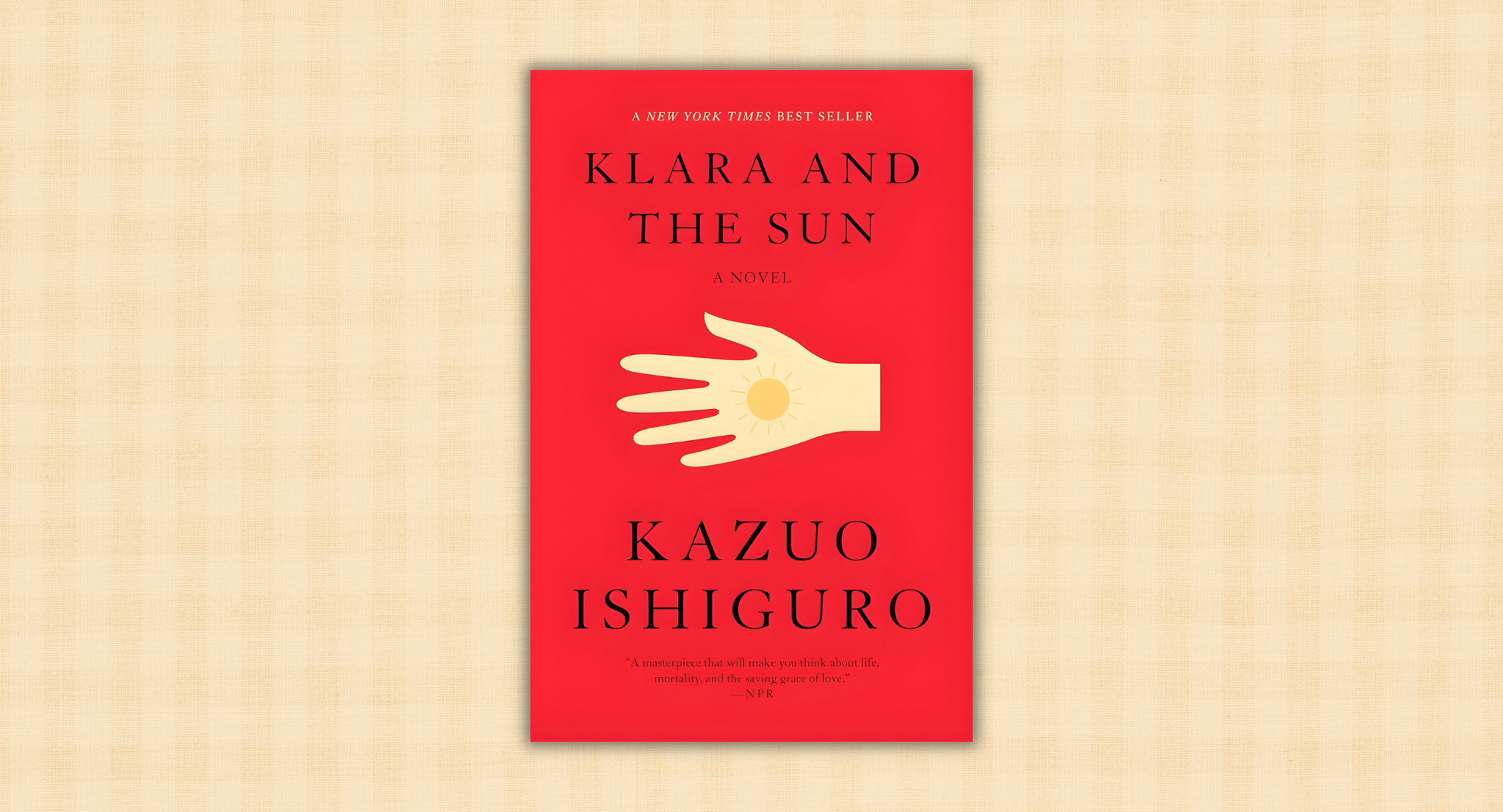
I Read This Over Shabbos is a weekly newsletter from Rivka Bennun Kay about Jewish book culture, book recommendations, and modern ideas. Receive this free newsletter every week in your inbox by subscribing here. Questions, comments, or feedback? Email Rivka at Shabbosreads@18forty.org.
I often think about my role as a human being. In a world where AI can do everything better than me, my humanity is on the defense. Putting aside the great fear that a robot will replace me at work someday, what does it mean to articulate my thoughts if AI can do it just as well, if not better?
As a human, I have the capacity to feel; I have a heart, something which AI, for all of its analytical capabilities, does not have. But when I picked up Klara and the Sun, my distinctions between human and machine became blurred.
The award-winning author of the 2021 novel, Kazuo Ishiguro, is known for his exceptional work exploring the search for meaning in a changing world. In Klara and the Sun, he tackles love, loneliness, and what it means to be human—all through the eyes of a non-human.
Klara is an artificial friend, or an AF, whose sole purpose is to keep her human—in this story, a frail teenager named Josie—company. Set in a near distant future, Josie has a mysterious chronic illness and lives with her mother, who in turn lives with the regret of a choice that caused Josie’s suffering.
With her exceptional observational qualities, Klara offers us a window to the human world, and prompts us to consider whether humanity could truly be replicated by machines.
We enter a world where expert engineers have been replaced by machines, children are “lifted”—a fictional term for a genetic modification process that makes kids smarter—and they are educated remotely from home. Children acquire AFs and host social interaction meetings to ensure their social skills are up to par. The human world Klara is a part of is lonely.
Klara understands this. “Perhaps all humans are lonely,” she says. “At least potentially.” Her premise, that humans are lonely, is followed by another assumption: that all humans wish to escape loneliness. She learns this is not always the case: “Until recently, I didn’t think that humans could choose loneliness. That there were sometimes forces more powerful than the wish to avoid loneliness.”
To see the world through the eyes of a robot is to consider the state of our world—and what it ought to be. When Ishiguro was awarded the Nobel Prize in Literature in 2017, he was described as an author “who, in novels of great emotional force, has uncovered the abyss beneath our illusory sense of connection with the world.” His critically acclaimed 2005 novel, Never Let Me Go, is narrated by a clone who is raised to donate her organs to the noncloned population. Once again, we are invited to view a dystopian world through the eyes of a nonhuman, only to realize that her outlook and experiences are not much different from our own. As New York Times reporter Giles Harvey wrote in his 2021 profile of Ishiguro: “Time and again in his work, what looks like the face of an alien creature contorted with pain turns out to be a mirror.”
Klara understands loneliness, to the extent that she believes human beings despise it. It is unclear if Klara herself experiences loneliness, as her story ends with her “fading out” in a junkyard, where she is content to be alone with her thoughts and memories. When it comes to her perception of love, however, Klara tells a different story.
When she watches a man and woman reunite, she observes, “I still couldn’t see the Coffee Cup Lady’s face, but the man had his eyes tightly shut, and I wasn’t sure if he was very happy or very upset.” Her manager explains to her that “Sometimes, at special moments like that, people feel a pain alongside their happiness.” This is a significant moment in Klara’s development, where she observes that people and feelings are complex.
Klara learns to read love from the outside, but observation is not the same as experience. As Klara watches humans navigate love, we’re left to wonder: Does she herself feel it?
Her devotion to Josie suggests something remarkably close. When Josie’s illness worsens, Klara acts with what can only be described as sacrificial love. She bargains with the sun, whom she believes has healing powers, and offers to destroy a machine in the barn that produces pollution, the sun’s enemy. Whether this is love or sophisticated programming becomes, in Ishiguro’s hands, a distinction without a clear difference. Klara behaves as though she loves. Perhaps that is enough.
Yet the novel’s most unsettling question comes not from Klara but from Josie’s mother. In her grief and desperation, she has commissioned Mr. Capaldi, a portrait artist and engineer, to build a replica of Josie—one that Klara would inhabit if Josie dies. The premise is simple and horrifying: If Klara can observe Josie closely enough, learn her mannerisms and memories, she can continue Josie. The mother could keep her daughter, in some form, forever.
Klara takes this task seriously. She studies Josie with care, believing she can capture her essence. But when she speaks with Josie’s father, a man who has lost much and sees the world with weary clarity, he challenges her: “Do you believe in the human heart? I don’t mean simply the organ, obviously. I’m speaking in the poetic sense. The human heart. Do you think there is such a thing? Something that makes each of us special and individual?”
It’s the question at the center of the novel—and, perhaps, at the center of our current moment.
At the end of the novel, Klara, ever the careful observer, offers a response that feels like the novel’s quiet thesis: “There was something very special, but it wasn’t inside Josie,” Klara reflects. “It was inside those who loved her.”
People, Ishiguro suggests, are not self-contained units but relational beings, made real by the people who hold them in their hearts.
I picked up the novel looking for reassurance—proof that there is something in humans that a machine could never replicate. Klara gave me an answer, but not the one I expected.
She concludes that what makes Josie special is located in those who love her. It’s a moving insight, and I think she’s seen something true. But I also think she’s seen only part of it. Klara is an observer—perhaps the most devoted observer in the novel—and she can only perceive what’s visible from the outside: how people relate, how love is expressed, how grief reveals what matters. What she can’t access is whatever it is inside Josie that calls forth that love in the first place.
Maybe that’s the difference. A machine can learn to recognize love. It might even learn to offer something that looks like it. But the question of whether there’s something essential within us—something that makes us worthy of love before anyone loves us—might be a question only a human can ask, because only a human lives it from the inside.
Klara watches, learns, and loves as best she can. But she never wonders whether she is worthy of love herself. That question—the one we carry quietly and can’t put down—might be the surest sign of the human heart.