

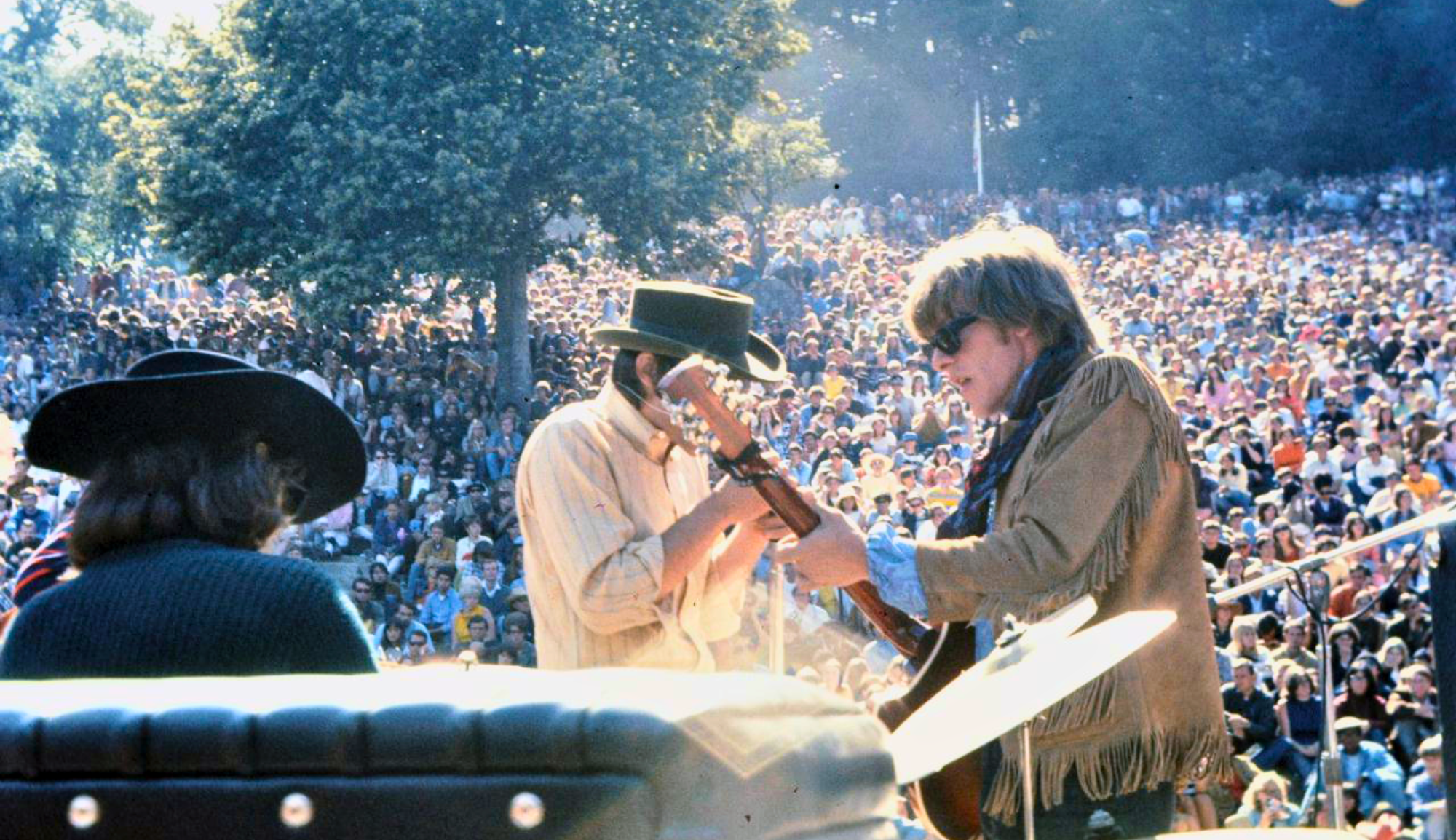
The American mainland was divided into two countries for the better part of 1967: San Francisco’s Haight-Ashbury district and everywhere else. Affectionately dubbed the “Summer of Love,” the months between January and October saw tens of thousands of young hippies flock to Haight-Ashbury to escape from mainstream society. They inaugurated this “summer” with a Human Be-In: a space of just being, centered around individual expression and enjoyment, rife with psychedelics, sexual experimentation, and public nudity. All they wanted was that “everything would be free,” as British playwright and critic Neil Norman put it in a documentary about the event. That captures not only the Summer of Love’s culture and environment but also its underpinning ideology: that humanity is at its best when at its freest—its most open, permissive, and untethered.
The Summer of Love reminds me of my own stints of free time throughout high school. There was the Summer of No Plans in New York Between School and Camp, the Winter Break of No Plans in Florida, the Summer of COVID, the Winter Break of COVID, and the list goes on (you get the idea). But I don’t remember those periods fondly. I instead remember abysmal spirals of time, endless activities of nothing in particular, and elongated mealtimes to fill my day. I loaded this current summer with Zoom Gemara classes and internships to steer clear of that unbearable boredom. The Summer of Love sounds torturous to me.
For its attendees, however, it was euphoric. Anne Nightingale, a BBC Radio DJ, described her experience in 1967 as a “party,” and she “didn’t want it to end.” Doing nothing but feeling good became a sort of modus operandi for the tens of thousands of Americans on those San Francisco streets. It begs the question why.
The 1960s were a notoriously tumultuous decade for America: Between the Vietnam War and the struggle for civil rights, young Americans felt disenchanted with Western society. On top of that, many felt repressed by and opposed to post-WWII exorbitant consumerism, as well as the rigid gender roles, familial expectations, and professional expectations of the American Dream. They longed to escape. LSDs, the sexual revolution, and rock music offered them a way out. In Northern California, the hippies were determined to build a utopia where peace, love, and humanity flourished, unencumbered by the world’s harsh conditions.
To be clear, the hippies of Haight-Ashbury were not activists. The psychologist and proponent of psychedelics Timothy Leary branded the movement with the famous phrase: “Turn on, tune in, drop out.” Turn on with psychedelics, tune into the music, and drop out of life. As a leader of the movement, Leary was far more interested in promoting psychedelics as a means of exploring consciousness and defying social norms than in activating any global activism. Writing on hippie culture and LSD use in 2011, Donald R. Wessan, a psychiatrist who, himself, conscientiously objected to the Vietnam War, illustrates this well:
Hippies, while opposed to the Vietnam war, were not necessarily antiwar activists nor pacifist. The slogan “make love not war” and the circular peace symbol were ubiquitous within the hippie subculture, but for many, their primary objection was that they were subject to a draft and could be conscripted into military service by “the establishment…”
In a word, activists aimed to create change through action, while the Haight-Ashbury hippies aimed to create utopia through being.
I wonder in what ways the Summer of Love still lingers. With endless streaming services and “doom scrolling,” shutting out the world (and our responsibilities toward it) has never been easier. Stressed about your career? Scroll through TikTok. Burdened by familial obligations? Open up YouTube. Ruminating about World War III? Turn on Netflix. Maybe the Summer of Love would promote dropping out of social media as well, or hail it a form of self-enjoyment? I don’t know. Humans live in constant tension with the question of how we ought to spend our time. For ourselves? For others? Something else entirely?
This question makes me think of Rabbi Aharon Lichtenstein, the late rosh yeshiva of Yeshivat Har Etzion, one of the prominent hesder yeshivot in Israel. Rabbi Lichtenstein believed that a life committed to overcoming one’s “undisciplined psychological and biological self” allows one to reach their ideal state. For Rabbi Lichtenstein, a classically trained Orthodox Rabbi for whom study of Jewish legal texts is religiously paramount, halacha colors religious life, not despite its normativity and demand but because of them. Those obligations are a spiritual calling, and give structure to the relationship with God—what he says humans ought to ultimately desire.
“In and of himself, man is simply a part of the natural world and, as such, of little ultimate consequence,” Rabbi Lichtenstein writes. “However, inasmuch and to the extent that he relates to God, he assumes immense significance.” He sees halacha as not simply the alternative to naturalism but “the Jewish alternative.” To live in service is to actualize human freedom, because it actualizes “the potential inherent in Zelem Elokim,” our worth as a creature made in the image of God.
Halacha is a full-time job. The alarm clock is a call to wake up and pray. Every meal or snack begins and ends with a blessing. Regulations dictate business deals and require charity donations. And even that grossly fails to capture its gravity: Every worldly phenomenon has a parallel halachic concept, both practically and conceptually. Contrast this with a fluctuating sleep schedule, freedom to experiment with any food item one pleases, and complete authority over one’s resources. It’s different, to say the least.
What appears to hippies as an enslaved life that stifles the individual is to Rabbi Lichtenstein an existence of the highest caliber and freedom. Within ethics, morals, and the law, a free human emerges—that is, a human free to realize themself in relation to the Divine.
In essence, the relationship between 1960s hippy ideologies and Rabbi Lichtenstein’s conception of humanity rests on the definition of terms. The debate is not over humanism but over what kind. The Summer of Love idealized the natural state of humanity, while Rabbi Lichtenstein venerated humanity only for its spiritual potential. Both sides of this ideological spectrum seek freedom but in different forms. For the hippies, a release from societal pressures was worthwhile unto itself. For Rabbi Lichtenstein, a release from our animalistic selves was worthwhile insofar as what we decided to do with that newfound freedom. Or, as the psychoanalyst Eric Fromm posits, it is a question of whether one is free “from” or free “to” – the former is about breaking chains, and the latter is about what one does once released. Did the 1960s hippies achieve freedom from society, or freedom to become something better?
In a way, the Summer of Love is a story of radical idealism anchored in the question of what humanity ought to be and how it ought to become that. But how successful can the hippie movement be when it only has an answer to half of the question? They were clear on what they did not want to do, but less disciplined in building a productive outcome. Inaugurating their time with a “Human Be-in” says it all. Being is enough.
The technological explosion in the current era offers modern society all the same opportunities—a way to avoid everything one agonizes over doing. Door-to-door delivery service replaces homemade meals. Cashing a check from your couch replaces visiting a bank. Inputting this article into ChatGPT replaces actually reading it. These are all time-saving tools, designed to make one’s life easier, and society glorifies it. But how productive is a constant pursuit of free time, with nothing particular or meaningful to do with it?
On October 6, 1967, the Summer of Love died. Not ended, but died. A funeral procession was held, including carrying a coffin filled with flowers, hair, and hippie memorabilia. The hippie’s decision to dismantle Haight-Ashbury’s mini-society, and to do so in this manner, had what to do with economic and security issues in the city, much more so to do with the commercialization and media distortion of the hippie movement, and a whole lot to do with the negative effects of mass usage of psychedelics. (Ironically enough, the procession was also a protest against the stigma held against LSD, as the funeral was held one year after the State of California banned its use.)
The Summer of Love was somewhat a failed experiment: a society built without boundaries that crumbled on Californian streets. In trying to free humanity from this world, they left them existentially homeless. Maybe freedom, and free time, doesn’t have to feel like a burden at all, but rather an opportunity. An opportunity to, in Frostonian terms, rededicate oneself to the “promises” of one’s life and clarify to whom they’ve been made. An opportunity for one to take on divine responsibility in a manner that is self-driven, and therefore embracing of humanity’s highest calling.