


Your 18Forty Parsha Guide is a weekly newsletter exploring five major takeaways from the weekly parsha. Receive this newsletter every week in your inbox by subscribing here. Questions or feedback? Email Rivka Bennun Kay at Shabbosreads@18forty.org.
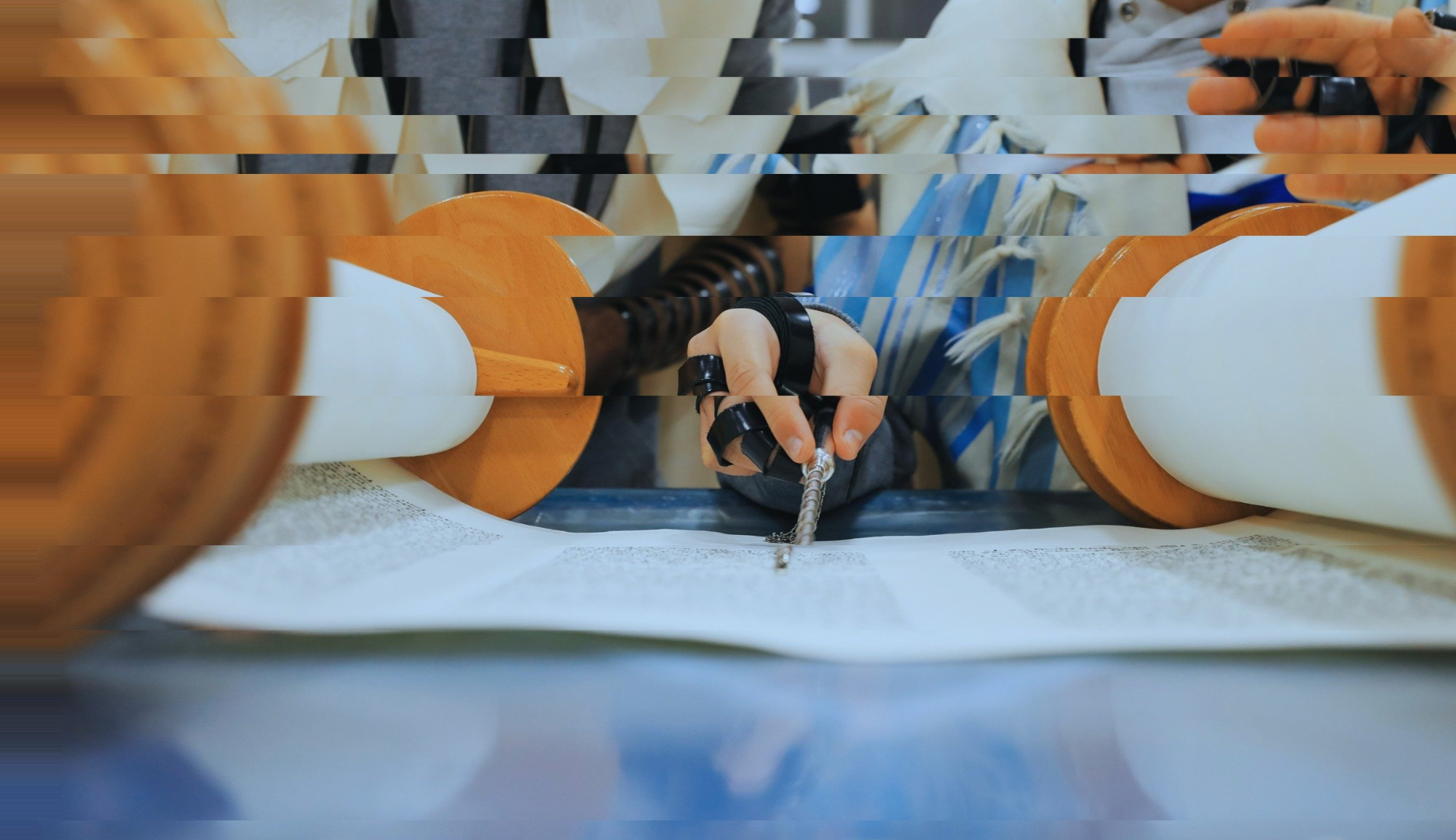
He started keeping Shabbat at 51, the year after his father died, and he has been a baal teshuva for 10 years. On Simchat Torah he stands in shul and watches the gabbai roll the heavy parchment from the last column of Devarim back to the opening of Bereshit in a few seconds. He reveres Moshe the way a person reveres someone he will never meet. On this day he feels the absence of a grave to visit, because no one can say where the greatest leader the Jewish people ever had lies buried.
Scripture could have closed at Moshe’s grave, yet it hides the grave and sends the people walking on under Yehoshua into a land Moshe never reached. The closing chapter records three facts and stops cold. Moshe dies at God’s word, no one knows his burial place, and the final verse of the whole scroll ends on the word Israel, the name of the people. Put those three together and one reading fits them all: that the Torah belongs to the whole people and not to a single leader, so a Jew born into the covenant who came back to observance late belongs as fully as one who kept it from childhood.
1. The Grave the Torah Hides
In Devarim 34:5-6, Moshe dies in Moab at God’s word and is buried in the valley opposite Beth-peor, and no one knows his burial place to this day.
Where the text leaves a blank, the Sages supply a reading rather than a location. Rashi takes the passive “he was buried” in verse six to mean that God Himself buried Moshe, drawing on Sotah 14a, which casts the burial as God’s own kindness. The Sages never say why the place stays hidden, and the likeliest reason is the one the missing grave suggests, that a marked tomb would have drawn pilgrims and hardened into a shrine this people would not build.
Most nations build the very thing Scripture withholds here. The historian Pierre Nora, in Realms of Memory, called the monuments and founders’ tombs the sites where a nation remembers itself, the most natural of them a founder’s grave. Jewish memory runs the other way, and Yosef Hayim Yerushalmi argued in Zakhor that Jews have carried their past mainly through ritual and reading aloud rather than through monuments, which is why one generation after another read Moshe’s words and never hunted for his bones.
RELATED: 5 Lessons from the Parsha Where Moshe Disappears
Rabbi Jacob J. Schacter asked on the 18Forty Podcast whether a community should ever censor its history, treating what a people leaves out as a force as shaping as the stories it keeps. Jews do visit graves often, from Rachel’s tomb outside Bethlehem to the Patriarchs at Hebron to their own parents before the High Holy Days, yet none of those is the founder’s grave.
2. No Founder Cult
Set that missing grave beside the way other traditions treat their founders, and the closing verses draw the comparison themselves. In verses 10-12, Scripture says no prophet ever again arose in Israel like Moshe. Ramban reads the opening of this final chapter as the point where Moshe’s life and the book end together.
The traditions a Modern Orthodox American lives among took the other road. Christianity built its worship around the person of its founder and the claim that he rose from the dead, venerating the empty tomb at the Church of the Holy Sepulchre and his birthplace at Bethlehem, and it grew into the largest religion on earth. Islam, close behind, draws millions to Mecca every year and reaches every continent. Both faiths thrive and long outlasted their founders, so the point cannot be that a tradition built around a founder is doomed.
Christianity and Islam mostly spread as majorities, holding power and carrying the faith to new peoples, and the Jews almost never held that position. They lived as a minority inside a host culture, often in peace for generations, until the host periodically turned on them with persecution and expulsion, and that position shaped where each tradition could afford to place its center.
The sharpest difference has nothing to do with buildings. Judaism rests its claim to truth on mass revelation, the whole nation standing at Sinai and hearing God together, and Rambam grounds Jewish belief on exactly that public event, where our own eyes saw and not a stranger’s. Christianity rests instead on a single figure, and its institutional religion was built after his death by Paul and the church-builders who followed. Max Weber describes in Economy and Society how a founder’s personal hold survives only when it hardens into something steadier, and the two faiths hardened it into different things. Christianity routed that authority into a central church and a line of bishops, while Judaism routed it into a scroll every household could copy and into the whole nation that stood at Sinai.
RELATED: 5 Perspectives on Sinai in an Age of Empiricism
A center that lives in a portable book in every home shows itself in something ordinary. Rabbi Gedaliah Zlotowitz, Matthew Miller, and Altie Karper, who run ArtScroll, Koren, and Schocken, spoke on the 18Forty Podcast about a faith that moves forward by putting its text back into ordinary hands, in print runs and translations rather than relics, with no central shrine and no editor to revere. A book reproduced in 100,000 homes cannot be seized or burned out of existence.
3. How the People Carried It
Moshe arranges the succession before he dies, not after. While he is still alive, in Numbers 27, God tells him to take Yehoshua, lay hands on him, and place some of his own authority on the younger man. The transfer takes full effect only once Moshe is gone, which our parsha reports in its last verses, where Yehoshua is full of the spirit of wisdom and the whole people obey his lead. Yehoshua’s authority rests on the law he has received, not on any power of his own, and the opening of his book has God charge him to keep the whole Torah and meditate on the scroll. Human leadership then falters for centuries, as kings turn to idolatry, the 10 northern tribes break away, and the people go into exile, yet the scroll Yehoshua is charged to keep outlasted every leader who fails.
The people did have a fixed center of worship for a time, and losing it twice tested the design. Shlomo’s Temple, which by tradition housed the Ark and the Shechina (the divine presence), fell to Babylon in 586 BCE, and the Second Temple that rose under Cyrus and was expanded by Herod held neither the Ark nor the Shechina when Rome burned it in the year 70 CE. A house of worship no family could copy or carry could be destroyed, and twice it was. Seeing the second catastrophe coming, Rabban Yochanan ben Zakkai had himself smuggled out of the besieged city and won from the Roman general Vespasian the promise of Yavneh and its Sages, rebuilding Jewish life around Torah before the Temple fell. The center had moved from the portable Mishkan to a fixed Temple, and after the year 70 it became the portable Torah, carried into every exile that followed.
With authority lodged in the scroll and the people, the people themselves became what had to survive. Salo Baron, in A Social and Religious History of the Jews, traces communities expelled from England in 1290, from Spain in 1492, and from one country after another, who rebuilt each time while other uprooted peoples were absorbed. Christianity and Islam carry sacred books too, so a book alone is not the whole difference. What set the Jews apart was that a community could live its full religious life anywhere, because its functional center was the scroll every household already held.
What the families carried out of each expulsion was a page. Michelle Chesner, Columbia’s librarian for Jewish studies, traced on the 18Forty Podcast how a single page of Jewish text traveled across centuries, from scribes copying by hand, to printers after Gutenberg, to families who carried their books onto the ships when the expulsions came.
Survival on those terms came at a brutal price. Each expulsion Baron records left graves the families could never visit, the forced conversions of Spain and Portugal tore baptized children from their parents, and massacre followed the Jews from the Crusades through the pogroms. Some who could not bear the cost drifted from observance and were lost to the people altogether. The Jews who carried the scroll through all of that handed it down anyway.
4. The Project in the Present
Moshe states the principle outright in the opening words of the parsha. In Devarim 33:4, he calls the Torah “morasha kehillat Yaakov”, the inheritance of the whole congregation of Yaakov, deeding it to the entire people and not to Moshe or any single leader. The Sages press the word further, hearing morasha, inheritance, as me’orasa, betrothed, so every Jew is married to Torah rather than left it as a passive heir. Rabbi Jonathan Sacks builds a whole account of Jewish endurance on that ownership in A Letter in the Scroll, arguing that the people outlasted the loss of land and power because each Jew was a letter in the same scroll, charged with carrying the shared text and story forward.
Yossi Klein Halevi shows what that marriage looks like in living memory. In Like Dreamers, Halevi follows seven Israeli paratroopers from the 1967 battle for Jerusalem into the settlement movement, the peace movement, and the arts, men who disagreed about nearly everything and still built one country. What every generation inherits is Moshe’s Torah and a way of being one people, not a relic in a glass case. Jews then argue over how to live that law, what shape Jewish peoplehood should take, and what the national mission in Israel demands.
That argument runs across the denominations too, and it binds Jews together more than it drives them apart. Diana Fersko, a Reform rabbi, spoke on the 18Forty Podcast about what keeps Jews who would not pray in one another’s synagogues inside one people. The betrothal holds even where the practice splits.
RELATED: What is Jewish Peoplehood, and Why Should We Care?
5. The Last Word Is “Yisrael”
The book ends on the people, and its closing word, Yisrael, proves the case. In verses 10-12, Moshe gets one last line of praise, and then the scroll closes on “before the eyes of all Israel.” Even that praise reaches us through another hand: The Sages note that Moshe could not have written his own death, and the Talmud holds that either Yehoshua wrote the closing lines or Moshe wrote them in tears at God’s dictation.
Jewish life runs in a cycle that never closes, ledor vador (from generation to generation). On Simchat Torah the congregation reads “before the eyes of all Israel” and then, with no closing ceremony, rolls the scroll straight back to Bereshit chapter one, so finishing the scroll is the same motion as starting it again. Each time through, the same chapters show a reader a year older something missed the year before, and that continuity is what brought the Jewish People this far. A faith built around a founder’s death would stop at the grave, while this one reads past the death and begins the scroll again.
The people began again after their worst catastrophe within living memory. Anita Shapira, in her history of modern Israel, traces how Jews rebuilt a national life after a third of their number were murdered, raising children who read the same scroll their grandparents read.
Ammiel Hirsch, a Reform rabbi, argues on the 18Forty Podcast that Jewish Peoplehood, not allegiance to a single figure, is the bond that carries the Jewish future. The man who came back at 51 hears the scroll close on Yisrael and watches the gabbai roll it straight back to the beginning, stepping into the same unbroken cycle his ancestors kept alive. He never met Moshe and has no grave to visit, and he belongs to the people that last word names.
Questions for Reflection
- When you daven or learn, do you feel yourself joining a person, a text, or a people?
- Is there a place, an object, or a figure in your own religious life that you have quietly turned into a shrine?
- What is one specific thing you intend to carry into this year’s Torah reading cycle that you did not bring to last year’s?
This project is made possible with support from the Simchat Torah Challenge and UJA-Federation of New York. Learn more about the Simchat Torah Challenge and get involved at their website.