Transcripts are produced by Sofer.ai and lightly edited—please excuse any imperfections.
David Bashevkin: Hi friends and welcome to the 18Forty Podcast where each month we explore different topics balancing modern sensibilities with traditional sensitivities to give you new approaches to timeless Jewish ideas. I’m your host, David Bashevkin, and today we are exploring Jewish peoplehood and Jewish denominations in a fascinating two-part series. This podcast is part of a larger exploration of those big juicy Jewish ideas, so be sure to check out 18Forty.org, that’s one eight f-o-r-t-y dot org, where you can also find videos, articles, recommended readings, and weekly emails. There is an incredibly famous cover illustration that adorned the March 1976 issue of the New Yorker.
I’m sure most listeners have already seen that, though they may not associate it with the year, they may not know the background behind it, but it’s a picture that you likely have seen and it is called The View of the World from 9th Avenue. And essentially, it is the image of somebody looking out from New York City and you see 9th Avenue, and you see 10th Avenue, and then you see the Hudson River, that is the border of New York. Then across the Hudson River, you see kind of a line that says Jersey. And then past Jersey, all of a sudden, it’s like Kansas City, Nebraska, the Pacific Ocean.
You see, oh, they have like Texas, Los Angeles, but essentially the map starts to break down once you leave New York. In New York, it’s this hustling and bustling town, 9th Avenue to 10th Avenue to the West Side Highway and the Hudson River. It’s hustling and bustling, and then once you cross the Hudson, it’s basically like a desert wasteland where you just see Jersey, Chicago, Nebraska, Las Vegas, Texas, LA, the Pacific Ocean, and then past the Pacific, you can see three little bodies that say China, Japan, Russia. What this cover is obviously poking fun at is the worldview of a New Yorker.
The worldview of how somebody who lives in New York becomes very New York-centric. This is something I deal with very often as an educator. I have to be careful. I teach in Yeshiva University and it comes up constantly that I can’t just speak to the New Yorkers, though so often the examples that you bring, it’s very New York-centric.
Where I was raised, maybe I include a little slice of New Jersey in there too, but when you live in a certain place, it develops a certain worldview where outside of your purview, beyond this space and kind of that geographic locale where you live, it’s just like desert, it’s a bunch of rocks, I don’t know, Nebraska, Las Vegas, LA, Pacific Ocean, China, Japan, Russia. And outside of your hustling and bustling local universe just becomes this undifferentiated mass where you’re like, okay, I don’t know what’s going on behind there. It’s like this general basic idea. And people have obviously mimicked this cover illustration to talk about the geography of the Jewish world.
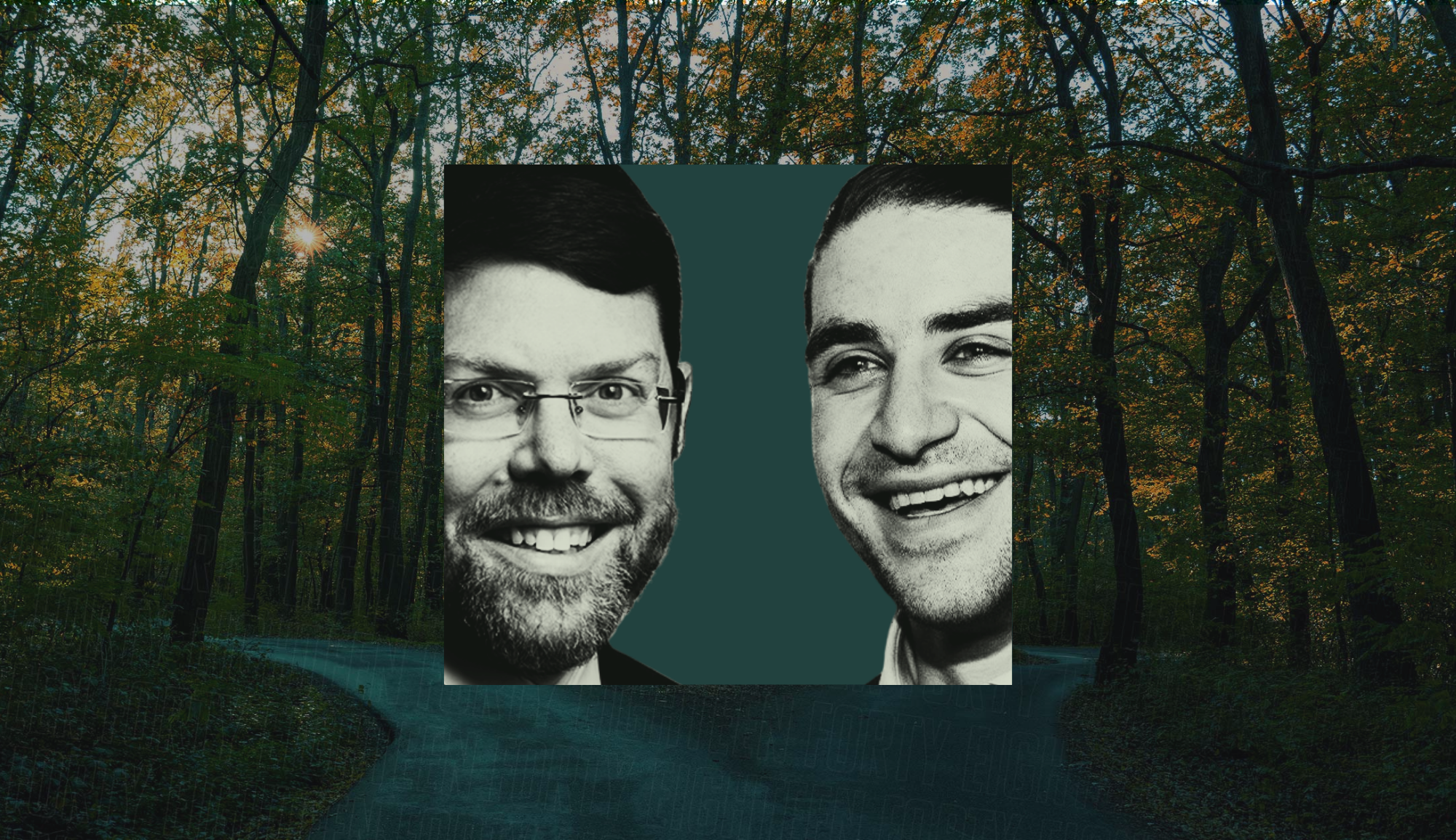
You know, whether it’s starting in Brooklyn or Lakewood or even Teaneck or any of these places, and you could kind of draw a map of what is the universe that a contemporary Jew inhabits and they kind of know their three blocks really, really well and it becomes more and more undifferentiated where it’s just kind of this mass of land and territory. Why am I talking about this as the introduction to what I think is a fascinating two-part series as we close the year 2024 and step into 2025? We are airing a two-part series where I am in dialogue with someone who I am privileged to call a friend named Diana Fersko, who is a Reform Rabbi and the head of the Village Temple in Manhattan. These are two conversations, one conversation I interviewed her and the next conversation in a way she interviewed me. And they were really, really eye-opening and I was trying to figure out an analogy or some sort of explanation for why exactly are we doing this and what is it meant to accomplish? My mind immediately went to this New Yorker cover.
Not because of what it represents geographically in the way that we think of the world, but actually in the way that I think most, if not all, contemporary Jews think in a way of Jewish peoplehood. Who is included within our notion of what the Jewish people encompass? It is very normal and I think very natural that when we think of the collective body of the Jewish people at any given moment in time, we very often think through the lens of our own Judaism, the Judaism that we practice. And my Judaism is an Orthodox Judaism that has a lot of cultural influences from the tri-state area. from the Yeshiva high school, what’s known as the Yeshiva League, which is the constellation of Yeshiva high schools that dot the United States and Canada.
And what I realized is that for myself, and I think for many others, when we think of the Jewish people, of Amcha Yisroel, of the collective body of the Jewish people, very often we are reenacting this New Yorker cover, where the first three blocks, so to speak, of our image of who are the Jewish people, are Jews who more or less look like us. And that includes families who, like us, have raised kids, the kids don’t always come out exactly the same as the parents. Most people know of families who have children who have either drifted to the right, they’ve drifted to the left, they’re not as observant or religious as they were when they were raised, they’re more religious and observant, or whatever you want to call it, than they were raised. We’re familiar with the change.
When I say those three blocks, I’m not saying that everyone literally looks exactly the same, but we have to understand that our image of what are the struggles, what are the issues, what are the Jewish people grappling with, when we think about that, our proximity very much shapes our very vision itself. And very often we think of the three blocks that surround us, and whether or not that’s three blocks of what it means to be Jewish in the New York area or in Lakewood or in Brooklyn or in Boca Raton or in Chicago or in Toronto or in Australia or in Israel. I think everyone to some degree or another, maybe Israel’s a little bit different, we could talk about that in a moment, are shaped by their three blocks. And then it starts to get more undifferentiated when we look outwards.
We look outwards and maybe we see an undifferentiated blob called Orthodox Jews. If your three blocks are in the non-Orthodox world, then you see this undifferentiated blob called Orthodox Jews and you see an undifferentiated blob called the Yeshiva world and an undifferentiated blob maybe that’s called Chabad. Perhaps you grew up in the modern Orthodox world, like the world I lived in, the modern Orthodox world in the Five Towns, and it becomes more and more undifferentiated, perhaps when you look to the Yeshiva world, perhaps when you look to the Hasidic world, and then you look even farther and you think about the non-Orthodox world, and it becomes less and less individualized, less and less unique, it’s kind of this undifferentiated blob, that’s what I call it, which is literally like the image of this New Yorker cover. And I think in a similar way, when we think about Klal Yisroel, when we think about the Jewish people, the collective body, Bnei Yisroel, the living body of the Jewish people, very often we are guilty, without any malice and without any, I think this is a normal way to view the world, honestly, it’s why the New Yorker cover resonates with so many, but as you go farther and farther out, the lives, the struggles, the successes of different Jewish communities begins to deteriorate and becomes more undifferentiated.
We start to talk about non-frum Jews, or some people talk about frum Jews, Orthodox Jews, and it just becomes this undifferentiated blob when you’re talking about a community outside of your own. And this, I believe, is a very real danger for every Jewish community, whether an Orthodox community, a non-Orthodox community, conservadox community, reform community, no Jewish community. I think at the heart of Yiddishkeit itself is a belief in our connectedness to the Jewish people, is a theological belief and an understanding that if God would have wanted, He could have established Judaism in a way, and it’s a great question to think about, but God could have established Judaism in a way where the only people who are Jewish are the ones who are observant, and how are they observant? I don’t know. Everyone would probably pick the level of observance that they’re comfortable with and that would be the baseline of what it means to be Jewish.
And anybody who does not observe like you is no longer Jewish. And Judaism could have been structured like that. I believe that that was very much at the center of Avraham‘s dialogue with God, where he begins to ask about future generations and begins to wonder what exactly are the boundaries that contain the Jewish people. But one thing that I believe all Jews agree to, they may not understand why or the history or even the halakhic reasoning behind this, but Jews inherently understand one’s level of observance does not determine their underlying Jewish identity.
And that is something that I think 99.9 percent of Jews instinctively understand. Even if somebody, God forbid, converts out of Judaism and converts to another religion, a question that has come up for literally a thousand years, that person still retains their underlying Jewish identity. And that is how we are structured. We are structured as a family.
The Jewish people are structured in a way where we are connected, our fate is bound together. And these variations began to emerge in the modern era. I mean you can literally point to the struggles that emerged in 1840, whether it’s the Damascus Affair, kind of the emergence of serious Reform communities, that Jews in modernity were given the freedom to make Jewish life as they see fit, and different communities were competing with what is our vision of Judaism for the future. And these were very serious ideological battles that I do not want to diminish because there is a great deal at stake.
There is a great deal at stake of what is the vision of Judaism? Does Judaism have a vision for itself? But as different Jewish communities began to argue with one another, whose vision is correct? And you can look at early works, whether it was from Rabbi Moshe Sofer, known as the Chatam Sofer, and even writings of Rabbi Akiva Eger, their halakhic reasoning for why the traditional Jewish community, what’s now known as the Orthodox Jewish community, felt that they were the heirs to the correct interpretation, so to speak, of Judaism. They had battles over this. Not everybody accepted that interpretation, and many non-Orthodox communities began to emerge that had a very different view of what authentic Jewish life and Jewish practice should be and should look like. These are debates that continue to this very day, and there is a reason why I have chosen to live within an Orthodox community, why I describe myself as Orthodox.
But even with that being the case, I think in this moment that we are in, which is a moment of tremendous vulnerability for the Jewish people, I feel like we are seeing antisemitism rising to levels that are frankly jaw-dropping. They’re genuinely frightening. Something that I shared recently, and it pains me to say it because I’ve enjoyed so much of his comedy over the years and know that he was never from the great admirers of the state of Israel, but I was genuinely shocked when the number one streaming content on Netflix, which was Dave Chappelle’s latest special, The Dreamer, closed on a joke that basically said, he said, I’m so worried that I’m going to be compromised, there’s going to be a conspiracy theory and they’re going to take away my voice. How will my audience know that it’s really me? I’ll give you a code word.
You know I’m compromised if I say it because I would never, ever say it and mean it. And with the following words he ended the special, he said, I stand with Israel. Which essentially he was making a joke that he would never say such a thing, which doesn’t really offend me. That’s fine.
Whether or not Dave Chappelle stands with Israel. What frightened me is that the number one streaming special on Netflix, which I’m sure is being seen by millions and millions, just ended with a joke that if there’s a somebody holding the strings and controlling media, it is the state of Israel. That’s a scary mainstream idea right now. Mainstream, number one on Netflix.
You want to gauge what is the zeitgeist of any moment? I don’t know. I think that whatever values are being captured by the number one piece of content on Netflix, I think is a reasonable litmus test of whether or not something is mainstream. And what we have seen in the aftermath of October 7th, this absolute collapse of affinity and coalition for Israel, for the Jewish people, is definitely frightening. And it’s those very ideas of a global conspiracy of Jews holding the strings.
It is those very ideas that God forbid led to a Holocaust. It’s what led to the shooting on Bondi Beach. It’s what leads to antisemitic attacks. And these ideas, we have to know, are very, very mainstream.
And yet, something that I’ve emphasized over and over and over again, and I think it always bears repeating, is that the purpose of Judaism is not to fight antisemitism, but we fight antisemitism in order to focus on the purpose of Judaism. And this is where I believe our work, and the world of 18Forty, is so crucial and so important. Any Jew alive today understands that this moment that we are living in feels different than whatever we were grappling with, and we’ve had real struggles, but whatever we were grappling ten years ago. Feels like we’ve turned back the clock to a very different world, one that unfortunately we are too familiar with through the pages of Jewish history.
But we are in a very vulnerable state right now. And your average Jew, I’m not sure if there is all that much that we can do to change the course or the tides of antisemitism. Despite what antisemites always say, antisemitism is not the fault of the Jewish people. Even the most famous Jews in the world cannot and should not be blamed, and that’s obvious for antisemites.
So what are we left to do? In my opinion, we need an awakening as well. And that awakening cannot just be be for our vulnerability, our awakening needs to be a deeper sense of connection to Amcha Yisroel, to the Jewish people, to the lived body of the Jewish people. And because of that, because of this moment of vulnerability, I think it is so crucial that we revisit our proverbial map of the Jewish people. I have heard there is no greater merit in this world than connecting with our Jewish identity, and our Jewish identity stands at the heart of what it means to be Jewish.
What Rav Tzadok, the great Chasidic teacher who I very often quote, writes in his work Tzidkas HaTzadik, which is his first Chasidic work of Jewish thought, in the 54th paragraph he writes, ikar ha-Yahadus bi-krias shem Yisroel. At the essence of Judaism is calling yourself Jewish, is connecting to your Jewish identity. And whether someone is in Lakewood or in a Reform congregation, I believe the collective work that we all need to ensure that our proverbial maps representing our connection to the wider Jewish world, everyone’s map needs to be adjusted. We have been living in this nightmare of a modernity that seems to be reshaping the Jewish people, reshaping what Jewish observance means.
And if we don’t reclaim, and by we I mean the living body of the Jewish people, if we do not reclaim and readjust our map, I’m not sure if there’s any other merit in the world that can protect us from this moment of vulnerability. The one area where every Jew without exception has work to be done is what Jews are included in their conception of the Jewish people. What does that body look like? To readjust that map. And I want to be really absolutely clear because I think this is very important to acknowledge and to say out loud, generally, this practice was discouraged for very real reasons.
I think everyone has taken a step back from emphasizing Jewish peoplehood because each community has been so busy since the advent of modernity ensuring that each community, whether denominationally or geographically, but each community was just doing the very basics to create the infrastructure that each individual community can survive, setting up a Yeshiva day school system, raising money for major institutions in the United States representing each of the denominations, setting up camping systems. And each movement and each denomination and each Jewish community set up their own infrastructure, and the infrastructure certainly varies and the level of observance and Jewish education varies dramatically. But the one thing that still binds everybody together is our underlying Jewish identity and the one thing that I think everyone has the ability to work on equally, there’s no one community that is doing this better, I think we’re all struggling with this, is connecting. Connecting can mean a whole lot of things, but connecting to the Jewish people, connecting to the entirety of the body of Am Yisroel, Knesses Yisroel.
I deliberately use the historic religious terms to describe the Jewish people. And this is something that I have heard across the spectrum. I don’t think there’s any Jewish community that says, you know what, we’re knocking this out of the park. Everyone feels that distance or feels that our map has been warped by the very rich Jewish life of our three blocks and when we look beyond that it becomes more undifferentiated.
And we set that up deliberately so. We set it up to ensure that streams of Jewish practice that other communities felt were either too suffocating and oppressive and would never survive on American shores, or certain practice were too watered down and not serious enough, certain communities some felt had inappropriate interpretations of Jewish law. And because of all of these concerns about what is the right vision for Jewish practice and Jewish life, we have deliberately set up very high walls to ensure that communities are not validating forms of practice that they do not want to idealize. And that happens across the board.
I think it is equally true in unaffiliated, Orthodox, non-Orthodox community, everyone is struggling with this because everyone is focused on their own self-preservation. But in moments when we feel the vulnerability about the Jewish people, I think we need to reorganize our map. And that is why I am so excited and privileged to share this two-part conversation with my dear friend Diana Fersko. I was introduced to Diana through a mutual friend, Liel Leibovitz, who I’ve been working on Talmud with for many, many years, really an incredible friend.
And he sat down and said, you know what, if we’re looking to build a coalition of people, this is not to transcend denomination, this is not to end our differences, but at least that we could have a shared vision of what the Jewish people need most so desperately in this moment. And we sat down, I think it was at Mr. Broadway. There isn’t a more Jewish place than that. And over a corned beef sandwich.
And we started dreaming about what we could do together to enhance our connectedness, to enhance our understanding of one another. So that God forbid we can avoid the very normal and natural instinct that everyone has when they look at Jewish communities other than their own and they look at them purely through an adversarial lens, purely through what differentiates us. And I am not suggesting that we should not notice our very real ideological differences. And those differences preclude a lot of different forms of gathering.
I’m not sure that we’re going to be in a space where everyone’s going to feel comfortable praying in the same synagogue. That’s not the goal. But with more understanding, I think what ends up being enhanced is every individual’s personal sense of Jewish identity. Because at the heart of Jewish identity, as I mentioned, is our connectedness to Jews regardless of their level of observance, whether it’s way beyond what we’re comfortable with or way less than what we are comfortable with.
And that’s what leads to this warped map of the Jewish people. But if we can have more understanding, if we can learn to listen to each other in a way that does not threaten the structure of our individual communities, to listen to each other in a way that does not ask anyone to change in their personal practice and understanding of Jewish life, but that everyone should just try to enhance and find a way to enhance their connectedness to the entirety of the Jewish people, to transform their own understanding of their Jewish identity and to realize the same way that other people’s Jewish identity is irrespective of their level of observance, to understand that that is true for everyone as well. And it gives you a deeper and more complex understanding of what it means to be a Jew, what it means to be alive in this moment and connected to Amcha Yisrael and the Jewish people. So it is without further ado that I am so excited and privileged to share our conversation with Diana Fersko.
Here’s my question, this is where I wanted to start, you are a Reform rabbi in New York City. I am an Orthodox rabbi but I don’t have a pulpit, but I do have a podcast, a modern-day pulpit. Yes. And we met and we were having kind of this very honest conversation about what is next for the American Jewish community, the larger North American diaspora community as it is sometimes called.
And we each have our own visions, there’s a lot that we agree on. There’s a lot that we love together. We love Torah, we love doing mitzvot. We love the Jewish people deeply.
And we’ve both have a very similar curiosity to figure out what comes next from this. From your vantage point, when you look at your congregants and your community, what do you think is going to emerge next for your community? And when I say emerge next, I’m deliberately not just saying October 7. I think there’s a larger societal trauma. I look at it as three all combined: COVID, October 7, and now I think AI is just reshaping the world and identity.
And when you look at your congregation, what are your hopes, concerns, what’s the vision, what happens next?
Diana Fersko: So, I like that we’re jumping right into it.
David Bashevkin: Yeah, we’re jumping right in.
Diana Fersko: When you were saying there were three traumas, I actually thought the last one was not going to be AI, I thought it was going to be political upheaval because I think that’s been a big thing.
David Bashevkin: I look at that as part of 10/7.
10/7 is part of the larger to me, there was COVID which brought everybody into their homes away from the larger society, brought up questions of trust, trust of government, and people started to radicalize. And then ten seven happened which basically it was a new political calculus where people were what side am I on all of a sudden. Am I left, right, Israel, everything got reorganized. So when you say political trauma, what are you talking about?
Diana Fersko: Well, I think it’s both Israel and America for my people.
It’s this question of what’s the Trump of it all, having him be the president again and how does that affect us and how do you feel about him and his policies in terms of Jews and Israel, but also in terms of the larger picture. That’s part of the shift andreassessing that I think a lot of American Jews are going through right now, coping with that and figuring out where they fit in. But I want to answer your question. So, I’ll speak from where I sit, which is within the Reform movement.
The movement is something that I love and feel really proud of in a lot of ways and I’m definitely I’m definitely a beneficiary of it. I would not be sitting here serving the Jewish people in the way I am without the Reform movement. So there’s a lot of gratitude there. But I also think the movement itself has been shrinking dramatically and will probably continue to shrink in different ways.
However, the Jewish population within the movement is getting stronger. That’s my opinion. And I think it’s a reaction to all of those things that you were just talking about, but it actually started before because there is so much assimilation, I’ll just use that word broadly, in the population I serve, it was already sort of in this process of contracting. And what that meant is the Jews who’ve stayed in the movement, who join synagogues, who choose to raise Jewish children are actually more committed.
They’re stronger. They’re interested in learning more, doing more, talking with their children much more bluntly than maybe their parents did about what it means to be Jewish. So while the sort of breadth of the movement may shrink and may continue to do so even sharply, the depth I predict, and in fact I observe, is actually growing.
David Bashevkin: It’s getting much stronger.
So, there’s this scene in the movie No Country for Old Men that I love. Have you ever seen that movie?
Diana Fersko: I’m sorry, I haven’t.
David Bashevkin: Oh, that’s no zero worries.
So, it’s this classic Coen brothers movie and the villain is played—I forget his name—but he has a terrible haircut in the movie. His name in the movie is Anton Chigurh and he comes in, he wants this money from this character played by Woody Harrelson, and he points a gun at him. And he says to him, ‘If the rule you followed,’ this is the villain talking, ‘If the rule you followed got you to this point, of what use was the rule?’ Basically, if whatever strategy you used got us to this point, of what use was the strategy? You need to reorganize the strategy. And I think every movement, all of Diaspora Jewry, is basically asking that.
If the rule that we followed got us—and all of us have different rules and are at a different point—but the rule that we followed got us to this point, of what use was the rule? We’re looking around. There’s so much messiness, there’s so much divisiveness, there’s so much assimilation. All of that. I’m curious for you, what do you think needs to change within the movement so that the future is actually stronger, that we don’t repeat the same mistakes? Because the vantage point that I have—I grew up in an Orthodox community, I teach in Orthodox institutions—so there are some obvious principles that I know are easy to say from my little perch, of be like, ‘Hey, why not Shabbos? Like sending to Jewish schools? Isn’t that so easy? Don’t we know that?’ So I’m curious for you, when you see other communities and when you see, ‘Oh, that’s a good rule, we should follow that rule,’ what do you think are the impediments or what do you think needs to change in order for there to be a brighter, more Jewishly rich future for the entire North American community, because the largest denomination is still the Reform movement?
Diana Fersko: I’m obsessed with this question.
This is what I think about all the time. So I’ll try my best to answer it, but I actually have a few different answers.
David Bashevkin: Yeah. Why are you obsessed with this question? Tell me.
I think it’s why we’re connected.
Diana Fersko: Because it matters. What’s the future of the Jewish people? And have we been doing this wrong? Yeah. Is what sort of your villain story is asking, like…
David Bashevkin: Kind of. That’s what I’m asking. So, obviously everyone’s been doing something wrong because we haven’t been redeemed. The full expression, whatever, this is not it.
Diana Fersko: Right. I think in the movement, there’s a lot we’ve done right. But what this sort of period has shown us is that we’ve overemphasized the universal aspects of being Jewish and dramatically underemphasized the particular. And let me explain exactly what I mean by that.
I’m going to make a statement. I hope it doesn’t offend you or your listeners, but just to say I don’t think the majority of Jews will ever be Orthodox Jews. So…
David Bashevkin: Oh, we’re on the same page.
I don’t even—that’s where my angst comes from. Most Orthodox Jews, it’s a much easier story. We’re waiting, we’re looking at our clocks, and we’re waiting for the entire Jewish world, the global Jewish world to become, so to speak, frum, to become Orthodox. And I’m just looking around and I’m like, A, my answer to that is even if that’s your hope, which I have no problem theologically if that is what you’re waiting it out for, then we, meaning the Orthodox community, is going to also have to change if we have any hope of reaching that point.
But even so, let’s stay with your premise, which I have zero problem with.
Diana Fersko: Well, I want to know more about that. But yes. Okay.
Given that, we both agree the majority or all Jews will never be frum or Orthodox fully. Yeah. Then the question is, what do we do with that? Yeah. Right? That’s sort of what the Reform movement is trying to answer: how to be a Jew in modernity, how to be a Jew when halacha is not actually the center of your life.
So they’re not going to say Shabbos every week. They’re not. And they’re not going to observe it in a religious context. They’re not going to mostly send their kids to Jewish schools unless that choice is made for them.
So that’s the…
David Bashevkin: Can I put this gently? Because the way that that’s such, we’re not going to do Shabbos, is that really an assumption that you have?
Diana Fersko: When I say they’re not going to do Shabbos, I mean they’re not going to do it every single week.
David Bashevkin: Like a full halachic Shabbos.
Diana Fersko: Yeah, they don’t.
They don’t count for Reform in that way. You know, but what you’re asking is what could it be.
I have some ideas about what it could be and the idea being how do we bring the Jewish people together? Like I look at my whole job as bringing Jews closer to Jewishness. Yes. So that’s what I want to do. So how do we do that? A few things.
One is part of the reason I was excited to have this conversation is because I think it’s a microcosm of the larger thing that needs to happen. Fully. So basically the movements themselves has put Jews in these silos, in these sandbox containers. You’re Orthodox, I’m Reform.
Right away we know we’re different. Yeah. That served a time and place, right? That was us figuring out how to be a Jew in America. But now we need to re-figure it out.
And the problem, one of the problems with movements themselves, is that they ensure you only meet Jews that are roughly like you. So most of the Jews that are in the Reform movement, not all, most, are Ashkenazi. I would say almost all of them are not Orthodox, right?
David Bashevkin: That’s the definition of Reform and they weren’t raised Orthodox.
Diana Fersko: Right.
And a vast majority not raised Orthodox. And most aren’t Israeli, by the way. You’re not getting the full picture of what it means to be part of the Jewish people when you’re in a Reform synagogue. That’s a deep pain point for me.
That hurts my heart. Because what it means is that my people are being, who are smart, sophisticated, worldly people, are deprived of this core aspect of being Jewish.
David Bashevkin: The wholeness of it. Right, the wholeness, of even the Jewish people.
Diana Fersko: Yes, exactly. And that’s so sad to me. How could you not sit next to someone that is Persian and knows what it means to be a Persian Jew and have that be a part of your everyday Jewish life? How could you not sit with an Israeli that says, I am totally secular and what are you even doing here? How could you not sit with an Orthodox Jew that’s like, I’m halachic, I don’t even understand what it means to be a Jew that’s not halachic or whatever it is. When you shrink what the Jewish experience is and instead prioritize maybe other things, that doesn’t bring Jews closer to Judaism.
So my first answer to your question of what could come next to be done is intentional mixing of the movements. We don’t have to pray together. Right? There are other things we could do together.
That leads me to my second idea.
David Bashevkin: I just want to pause right there because that sometimes is the impediment.
Sometimes the impediment isI only want to interact and hang out with people who are going to be able and feel comfortable doing everythingtogether.
And sometimes, and I think it’s so much more realistic and natural to say, you know what, maybe part of our genuine strength is that we’re not going to be doing everything together.
And how does it make you feel when somebody like myself, who we’ve broken bread together, we met, we both reached the conclusion that neither of us are actually evil, right? We’re more or less on the same page. But you also know that I would not feel comfortable davening in your shul. How does that make you feel?
Diana Fersko: Okay. So it makes me feel fine.
It’s fine, you know. I’ve been to many Orthodox shuls and varying degrees of comfort or discomfort with them, just depending on the situation. But they’re valuable to me. They’re a place where I think people take Judaism seriously.
Orthodox shuls. Yeah, where I think people take Judaism seriously, where I think there’s a lot to be admired, where I appreciate the real harnessing of tradition. And also when I go there, I leave.
Like nothing happens to me that’s bad.
Do you know what I mean? That was like three hours. But I will say that I feel like broader, putting the me of it aside, there’s some feelings in the liberal world of feeling very judged by the Orthodox world and defensive.
And this feeling of we’re looked at as not enough or we’re looked at as even not really Jewish.
And that creates a lot of bad feelings. So I don’t know, what do you think about that?
David Bashevkin: I totally agree. I think that this is the pain point and the pressure point of the movements of actually being willing to go through the stuff that make us uncomfortable to get to a shared vision together. I think everyone starts like, I have a friend, I quote him constantly, Eli Shulman, he’s a really special person, he would always say all Jews love talking about Jewish unity.
There’s not a Jew in the world who’s like oh my god unity wouldn’t that be a great great principle? But the thing that Jews don’t love doing is the garbage that you have to wade through in order to even have basic relationship. And to me everything that we’ve been doing on 18Forty, everything that we’re trying to build is really just a community that reminds people how to restore trust. And I do think the way you phrased it is, I think that there is a lack of trust that goes both ways in the community, a deep lack of trust that affects I think on the highest level. I think on one hand, yes, you are right.
There is a sense of judgment that comes from the Orthodox world, a judgment that looks at non-Orthodox Judaism as not just I would say like watering down, but I think there are people who it pains them. I think it’s coming from a place of pain. I’ll give you an example. My father did not grow up in a very observant household.
My zeide did not keep Shabbos. And this is like my foundational story. This is like my origin story. My father made a decision as a teenager, fought very hard and strong to become observant and become shomer Shabbos.
And there’s a sense I think that I definitely inculcated from my father and that I saw like because of our family that like there’s a lack of trust in movements outside of Orthodoxy of being stewards of Jewish communities in America. There’s a sense of pain of like, do you see what’s happened the last 75 years? Like the deep pain and somebody said the same thing, I was almost going to bring in the book. It’s a book Jew vs. Jewby Samuel Freedman.
Diana Fersko: Oh yeah, I know it, I’ve read it.
Yeah, I read it.
David Bashevkin: So in the epilogue he quotes from a Reform rabbi named Rabbi Aaronson, I believe, who was just finished with some major eiruv battle about, you know, the partitions they make on Shabbos, which gets a lot of people’s sensitivities going. Right. And he talks to his own congregants and he says the judgment that Orthodox Jews have towards you is so unfair and so unjustified and in many ways, and I believe this to be true, unearned.
Meaning, I didn’t make the choice. My father made a choice, I didn’t make a choice. So like why am I David Bashevkin, who has at least a million dollars of Jewish education coursing through my veins? My parents made that choice, I didn’t make that choice. So I think what is underneath everything is this lack of trust.
Rabbi Aaronson looks at his own congregant from Jews vs. Jews and he says the judgment is not fair, but at the end of the day, he says to his own congregants on Yom Kippur, this is at least Samuel Freedman writes, he says at the end of the day, and this is, it’s true. Meaning what he says is, at the end of the day, you have a Jewish education that is equivalent more or less to what you would get in like third or fourth grade in an Orthodox school. So that knowledge, that information gap, which I think the internet has democratized a lot of that, certainly not what it once was, but there is a trust gap where I think an Orthodox Jew feels why should I trust your vision?
Ifwhen I’m looking at the past it feels like you’re just pushing people, not you literally, pushing off the cliff of assimilation.
It’s that feeling and what I think is wrong about that is that it does come from a little bit of a self-righteousness that can metastasize into a lack of humbleness inrealizing that we don’t either have all the answers. This also happened on our watch. Meaning we can’t just point the fingers across the aisle, across the other side of the mechitzah and say well this is all your fault. I mean like I was also in the world during this time.
So if you didn’t have a vision that could reach beyond your community then I guess we’re both stuck in this stalemate. The other thing, and this is the hardest third rail issue, like genuine third rail that can electrocute people, but I personally take offense very often at how Orthodox Judaism is characterized, but the messaging, a part of me and you can correct me, I think this should have been the Reform movement’s job to message this better, but the switch which I believe was in the 1980s, it’s not that old, from matrilineal to patrilineal descent did create a massive rift. And this is where like as an Orthodox Jew, I’m like it’s not fair to blame us on this one.
Like we did have a working definition that went down, even if you want to fight with the scholars, let’s at least say to the time of Ezra. It’s like a good track record, it’s like 2,000, and like this is how it worked and that question, because observance is not what makes somebody Jewish. We’re born into it, you’re just as Jewish as I am, right? It goes that but the question is when we interrupted the very definition of Judaism, it left a massive question that I don’t think we’ve ever had in Jewish history where we are not all in agreement of what confers Jewish identity.
That to me is the frontier that we figure out some way somehow and everybody who’s attempted this has ended in utter nuclear disaster. It’s like Chernobyl. Those are the two main issues. Issue number one is the education gap and issue number two is I think the underlying Jewish identity which can be sidestepped.
We’ve been kicking that down the road every five ten years. But those to me are the heaviest issues when you talk about what’s eroding the trust educationally differently and that we have different definitions of Jewish identity.
Diana Fersko: Okay that’s a lot. So let’s take this in order.
The education gap. Yeah the liberal world is in a Jewish literacy crisis. That’s what we’re dealing with. But I want to push back on something that you mentioned which is that we’re sort of opening the doors towards assimilation.
But I would say in my view we’re doing the opposite. These are people that are Jewish born Jewish people that want to be Jewish but will never live their life in the way you do or your community does.
So what we’re doing is creating an on-ramp for them where they’re engaged and they come to synagogue and they worship and they send their kids to Hebrew school and they’re learning. Is it as much or the same as if they went to an Orthodox day school? No way. No that’s not real. But in fact we’re bringing people in and closer to what it means to be Jewish and without us we’re missing then you’re just riding off a huge amount of the majority of American Jews.
I’m not willing to do that. No way.
David Bashevkin: Neither am I which is what I think puts both of us in this interesting spot and kind of connects us because perhaps I’m wrong neither of us think that we have a perfect model. I love the Orthodox community I think it is the closest expression of how we can almost create scale to bring divinity into your lives on a large communal basis.
I also realize that I’m not sure that we’re ever going to get or ever had the hundred percent observance that we romanticize what Europe was like. The education levels in Europe are not what you think they were the observance levels in Europe were not what you think they were there were cities that were different. That’s number one. So I’m in complete agreement with you and I think the sense of feeling untethered and lost is coming from a place of I don’t see anyone who forget about articulating a vision of what Judaism can mean beyond each of our respective communities but very few people are even reflecting on the existing structure of the community.
Just for you when you talk about I love the idea of Reform Judaism is our largest on-ramp. My question that I would ask is there a way we can make it a better on-ramp? What’s your dream on-ramp? Forget even the word Reform Judaism. Sometimes you go to an event and there are different tiers of donors but everyone gets the basic gift bag.
And what should be that’s the question that occupies what should be in the basic gift bag that anybody who walks into any Jewish institution you’re getting this gift bag and at the end of your experience you’re having this base level either knowledge or understanding or comfort level within the Jewish world. It’s the ultimate onboarding of being Jewish. But I feel and I say this with great love respect and admiration I feel we both agree that we both would want to tinker with the on-ramp a little.
Diana Fersko: I mean tinkering is more than a hobby right it’s an urgent requirement.
So for me part of the on-ramp is Torah which we’re doing but not nearly as well or as deeply or as could be done and then Talmud which really we’re not doing at all. And when I say Talmud I mean Rabbinic literature broadly. So that’s a huge letdown. For example I mentioned sure I’m happy to go to an Orthodox synagogue with friends or whatever and one of the things that I like about Orthodox synagogues is the reading material.
David Bashevkin: Don’t we have the best reading material?
Diana Fersko: The best reading material.
David Bashevkin: Like brochures, flyers.
Diana Fersko: I love all that. I love the Torah commentaries with all of it.
David Bashevkin: It’s our secret people think that we’re davening the whole time there over three hour services.
Diana Fersko: I’m doing reading I’m learning.
David Bashevkin: We have a fantastic yes no every there’s just tons of stuff to take.
Diana Fersko: Yeah it’s more than stuff right? It’s traditional wisdom knowledge insight well written genuine and connected to Jewish tradition.
And I think that for us we use a Torah commentary that we call the Plaut because that was the editor’s name. Okay. And the material the commentary in there is all about modern things. It’s called a modern Torah commentary.
So it’s about geography archaeology biblical scholarship as applied to the text which are useful and have a fascinating time and place. Yeah. But the whole Rabbi Akiva omer… It’s not there.
David Bashevkin: More like inspirational.
Diana Fersko: Right. It’s only there in such a small way. It’s really secondary.
And what happens when you push away all of those traditional insights about the text is that you’re actually losing part of the essence of Jewish culture. Which is closer to what it means to be a Jew? Like, rabbinic interpretations or interpretations about, you know, where a certain mountain in the Torah might be?
David Bashevkin: Which is great.
Diana Fersko: Right.
David Bashevkin: It’s so interesting to me and I guess this is a relic of a different time that even in the Orthodox world, when I used to go to synagogue, the chumash, the chumash that they would use was the Hertz chumash. Okay. Who was like very scholarly and like you had to like really know your Roman numerals.
Right. Oh, Roman numerals? Okay. It was like very Roman numerally. I was just like, I don’t know, how do I find chapter 25? Like, there’s no way to find it.
I have to go back to school and learn the Roman numerals. Okay. And it was very scholarly and had these essays in the back. And then in the early 90s, there was genuinely, I think it’s the most significant religious revolution, perhaps, of the last half a century was the Artscroll revolution.
Yeah. When they started making these like accessible translations that translated the Talmud, beautifully done. Again, there’s also a Koren translation. And they just started translating, translating, translating.
Scholars hated them because it was like, this isn’t scholarly. But what always interested me is how do you even explain why the Reform movement, which is like the ultimate like on-ramp, if we’ll use that imagery in a way, why would the chumash be scholarly rather than like spiritually nourishing? Do you know what I mean?
Diana Fersko: I do, but I have the answer to that.
David Bashevkin: Yeah, what’s the answer to that?
Diana Fersko: Basically, when the Reform movement began and definitely when it came here, the idea was to be modern.
And modernity meant reason. Enlightenment.
Rational thought. Not all of that spiritual, superstitious, that sort of traditional interpretation was maybe seen as outdated.
And the early Reformers thought of themselves as modern. And what it meant to be modern was to release all of that and to really apply more scientific, sort of rational, objective modalities to the text.
David Bashevkin: I mean, 18Forty, which we’re named after, was a significant year in the Reform movement also. That’s when things really started to ramp up in the way that they were, you know, their temple services and in a way, people don’t know this, especially early Reform, what they were really trying to do was provide a dignified model to Christianity.
Where all the young people were like, okay, we don’t want to pray in this run-down European old, we want the prestige, the dignified. And people felt that in early America too. To matriculate into American society, we need that modernity, the dignity of modernity, so to speak.
Diana Fersko: Right.
I mean, and perhaps most devastatingly, they thought of Judaism as a religion only and not as a people. Yeah. And that’s sort of why we are where we are today because we’re still undoing that thought and even the Reformers themselves undid that thought eventually, but it lingered. You know, oh, we’re like Christian Americans.
We’re Americans but we have our religion which is Judaism. But that’s never really what Judaism was only. It was never just a religion. It was always this, the culture and the people and the food and the language and all that.
You know, it was so much more.
David Bashevkin: Yiddishkeit, it was seeped deep into your bones, so to speak. My bubbe who was not all that educated, she had good Jewish instincts, you know? Like, I still to this day, sometimes I’ll hear a rabbi say something, you know, about like a point of Jewish theology and in the back of my head, I’m like, if my bubbe didn’t know about this, like it could be true and it could be important, but like, I don’t know how central it is if my bubbe was able to function without this idea. But I’m curious, when they were updating it and the Orthodox world went through this too and with critics, they felt that Orthodoxy was almost becoming so funny, like not scholarly enough.
Yeah. Not serious enough. You know? And we started, you know, developing journals and the Reform movement had its journals. But in like the front end of like, in synagogue, the number one question every rabbi was always asking is, how do I get more people in? How do we make it more…
And it’s interesting in a way, and this is kind of crazy, it feels to me sometimes like the Orthodox world, which is always seen as more rigid, was actually doing like more creative programming to get people in the doors or their very specific model than the Reform movement.
Do you think… Tell me… Is that a crazy…
Diana Fersko: I don’t… It’s hard for me to answer that without thinking but it worked so much better for us. Like, we have so many more people.
David Bashevkin: I know, but that’s what I’m wondering.
I’m wondering like the haggadot that we put out, like the literature that we put out, even the stuff for kids. I’ve always said that You can’t judge an ideology and this is my criticism on Modern Orthodoxy. You can’t judge an ideology based on what it is like for a 25-year-old PhD. I want to know what the ideology looks like for a 5-year-old.
How do you express it to a child? What has the movement done in terms of children’s programming? The highlight for me in my shul in Teaneck, I know people there who don’t keep Shabbat. Not everybody who davens in my shul keeps Shabbat. But they’ll come Shabbat afternoon for parent-child learning.
It’s lovely. It’s the sweetest thing. And I’ve always wondered parent-child learning, why is that an Orthodox thing?
Diana Fersko: It’s not. No, so we have family learning. Lots of synagogues have models like that. We also have camps. The camp system is huge in the Reform world.
It’s like if you want to get from that 101 to that 102, 103 level, go to Jewish summer camps in the Reform movement because that’s where a huge amount of community is formed, of Jewish learning is formed, and it’s because we have them in a much more immersive way. So it’s not just after school, which is how we encounter them at this point in most of America. It’s all summer long you can have a child immersed in a Jewish environment.
David Bashevkin: What I’m trying to figure out, and maybe you could even suggest, is how could a Jew like myself who I look at myself as a fairly open-minded, well Jewishly educated person.
How could I help this on-ramp?
Diana Fersko: I think there’s a huge potential to help with this on-ramp and I think it’s because of the moment that you just described in the beginning where there’s a little bit of crisis and a little bit of chaos within the Jewish community. And while that’s awful, what it also means is people are open and they’re looking. Huh, what am I missing here? I suddenly feel so close to my people. I want to be closer.
And I think the interplay between Orthodox Jews who are more observant and are also open is a huge potential to share with the liberal world. So whether it’s people like you coming and deciding to teach at a Reform synagogue once a month, something like that would be revolutionary because it’s not done. You’re teaching two things. One, yeah, teach a text.
Please, teach a text. But two, it’s just the energy of a person who is living their life differently and Jewishly. That culture is also the learning that needs to happen. And I don’t want to put me or the Reform movement or the people I serve at a lower level.
I hope it doesn’t sound like that. That’s not at all what I’m suggesting. I think the interplay can go both ways. Perhaps there is more of an openness needed on the part of the Orthodox movement to say hey, these Reform Jews are Jews.
They want to be closer to Jewishness. Maybe I should play a part in that happening.
David Bashevkin: I could not agree more. Two things I wanted to ask you about.
Give me advice. As an Orthodox Jew, the moment you said they’re Jews, which is 100% true, with that asterisk. I’m trying to phrase this well because it’s so delicate.
From your chair, and you know me, and you know my commitment to the Jewish people, it’s coming from I think a genuinely sincere place. It’s not coming from a place of self-aggrandizement. But I have to be honest, when you said and they’re full Jews, the first thing that came into my head is some of them. And that’s really tricky.
What advice would you give? I think I’m asking as an Orthodox Jew, but I’m also curious within the movement. How do we educate Jews about this question, about this rift? I think both of us have work. We could both contribute to this issue.
Diana Fersko: It’s a lot of points.
One, as you said, this is a really new decision that the Reform movement made in the past maybe 40 years or whatever. That basically we accept not just matrilineal descent but patrilineal descent. They made it for a lot of reasons. One of the reasons they made it is to be egalitarian because that’s one of our values.
Sure. So they were like well why should a woman have precedence over this? It should be a man. And there’s lots of responsa literature, defensive literature that basically explains how the people that made that decision see themselves as actually in line with rabbinic thought which they found to be creative and reflecting of the times and they thought they were carrying that on by making that decision. I just have to say it because I feel for sure…
No it sounds when you say oh we accept patrilineal descent to an Orthodox Jew a lot of times that’s just…
David Bashevkin: yeah there was a responsa and there was a reason guiding it and I don’t want to characterize it. I almost want to begin with the reality. Not to re-litigate the…
Diana Fersko: Yes, the reality is the Reform movement likely will not change its mind again on that because then you’re telling a lot of people who are Jews and think of themselves as that way deeply you’re not a Jew.
David Bashevkin: That’s a painful thing.
Diana Fersko: Very painful. So it has to be reconciled but I really…
So it has to be reconciled, but I really don’t know how. The other piece of the puzzle is that I’m not sure that within the liberal world, this issue is understood on two levels. One, it’s not clear to me that most people in fact know that it’s always been passed down through the mother and that this idea is new. Some do, some don’t, but it’s not like everyone knows that.
But second, it’s not clear to me that people understand why that’s such a big issue for you. So tell me why that’s such a big issue.
David Bashevkin: Great question.
Great question. In the Orthodox world, I think, and I don’t think it’s just Orthodoxy, I think at the heart of the Jewish experience, I believe has always been the familial unit. Yeah. Like this family unit.
What I like to remind people is Judaism was not founded by prophets, it was not founded by rabbis, it was not founded by scholars. We call the founders of Judaism Avos and Imahos, mothers and fathers. That’s how we talk about it. And the concern is when you no longer have consensus on the foundational question of who is a Jew, it disrupts the familial unit in terms of now intermarriage.
It makes people worried. It’s an issue that I’m deeply sensitive to because, A, I understand, I think, both sides of this issue. I understand why somebody growing up in a movement, I even understand the movement. They made this change.
They didn’t ask me. They didn’t ask you. No, definitely not. We’re both living in this reality that’s not our design.
And I understand why in the Orthodox world, the most, I would say, central concern is the perpetuation of Jewish family. There’s always this sense of we want to invest. This family unit has almost a theological value in the way that we look at family and talk about, we use terms like doros, generations. So when you have a Jewish institution that does not exclusively, let’s say, you don’t have the same definition of who is a Jew, it makes it much trickier to say, oh, we can all just socialize because you may come home, and this happens all the time, I’m sure we’ve both been in circumstances where wait a second, we’re not in agreement now over the most central of like who are the Jewish people.
And the reason why I’m bringing it up in this conversation is not because I’m like let’s you and I, let’s figure, let’s rewrite the rules or anything like that. The reason why is because I think it’s a point of tension in the other direction that contributes unfairly to the judgmentalism of Orthodox Jews where we are seen as you don’t think everyone is Jewish. And I’m like, linguistically it’s just not fair. To me, it’s the equivalent of like it uproots language.
It’s like somebody saying, well, we have this term we call shomer Shabbos, Shabbos observant. And somebody saying, well, I’m Shabbos observant just my way. And I’m like, we’re not going to be able to communicate if we don’t have basic definitions. That’s why I think this issue is so powerful.
It contributes on a perceptual level, but I think it really pulled the rug out from under everyone’s feet of just having a common ground of confidence. And I think the part that I was asking you about wasn’t so much how to get the rug back underneath anybody’s feet, but how could we educate Jews in a way that this doesn’t blindside anyone and no one is seen, particularly Orthodox Jews, are not seen to be the villain in that story. That’s what I find frustrating. Like a lot of times we get accusations of like we’re being gatekeepers.
So when it comes to Jewish identity, everyone’s a gatekeeper. We’re just arguing where to put the gate. Right? No one’s like anyone can be like you can just wake up and just say, okay, I’m Jewish. Like there’s something bilateral.
There’s a people. We have 2,000 years of history, 3,000 years of history. And I don’t think it’s fair to look at one group as the gatekeeper. And I think because of this issue, it’s not messaged well to the people who are struggling with it.
It’s so deeply personal and it’s so painful. But as painful as it is, that level of pain is not going to change anyone’s mind. I think what needs to be done is better education.
Diana Fersko: And enough trust to recognize that all problems are not solvable.
Exactly. And any religious Jew, which I use broadly, knows that.
David Bashevkin: And the trust, I think, is a relational trust of that no one is trying to be malicious to make you feel bad. These are cosmic questions that we’re all doing our very best to figure out.
Diana Fersko: Yeah, and I think people do feel bad. Like there is some hurt and resentment. You know, it’s like this issue, the gender issue is one that gets a lot of people. Like the first time we met, we were talking about doing something together and I used this phrase with you and I was like, oh, people will say that’s the frummest common denominator.
David Bashevkin: Frummest, repeat that line. The frummest common denominator.
Diana Fersko: Meaning we were talking about pluralistic spaces and what that could look like. And there’s this feeling of a space is fine to be pluralistic as long as it’s becoming Orthodox.
David Bashevkin: Exactly. And there is that.
Diana Fersko: And it’s like that’s kind of a real thing, which is like, listen, it’s hard to solve every problem because we are different. You know.
David Bashevkin: When it comes to that, like the frummest common denominator, I like that phrase and I understand why there are people who don’t like always having to go to the frummest common denominator. To me, what I’m actually trying to actually imagine is like, what should be the frummest common denominator? Like is there a way that we could almost compare notes to create a new vision of what that basic common denominator is? Can I throw two at you? And just tell me the reaction. Kosher at all Jewish events.
Does that strike you as like Orthodox imposition or like a nice, you tell me.
Diana Fersko: What do you what do you mean by kosher? Do you mean like hekshered cheese? So, I would say like if you said kosher style, I would say like of course, very easy, no traif, no mixing, only kosher meat.
But when you’re saying like, oh, kosher at all events and you mean that in a halakhic way, it’s like that’s actually going into like an Orthodox marketplace, in a way. Not I don’t mean a literal place, but an Orthodox economy. You know. Could it be done? Yes, of course.
Of course it could be done. Does it feel Orthodox? Yes. It does. Because of because of the heksher.
You know, like not I’m not talking about meat. You know, of course. But yeah, it does feel Orthodox, but maybe that’s fine.
David Bashevkin: No, it’s funny which things are considered Orthodox and like no one would say, you know, on Sukkos, if you want to bring a lulav and esrog.
Right. No one’s like, why this lulav and esrog? Like is that is that an Orthodox lulav and esrog? It doesn’t feel that way, but with certain things, the very rigid interpretation of it, it’s hard to disentangle from the community that has perpetuated it.
Diana Fersko: Yeah. And there’s nothing wrong with that, by the way, I just want to be clear.
Like it’s good, you know.
David Bashevkin: No, and I think some like there’s a part of me that’s like, yeah, I think this is an idea worth sharing or like having in public space. Like yeah, I think that is a nice I don’t know, that’s a nice Orthodox contribution. I don’t like take personal credit for it.
I’m not wearing a big foam number one hand. That’s the New Yorker cartoon that always sticks out at me where you see people leaving they’re actually leaving a church, but they all have big foam number one hands like you would see at a baseball game. Yeah. My other question, this is what we brought up, the lowest frum denominator.
We brought it up in regards to a Shabbos together. I have such a weird relationship with this because like I get how isolating and difficult Shabbos observance can be. Like I understand it.
I also understand why in this moment to me, the urgency and the beauty of Shabbos, I wish we could almost decouple it from Orthodoxy and just give it like fresh. And everyone who’s tried and done like, you know, digital detox or this, like no one’s managed to sustain it in a way that I think is like and maybe I’m wrong, like I was wrong about parent-child learning. I but no one’s managed to sustain it outside of the Orthodox community in a way that I think is like you walk in and you feel it in the street.
And that’s the part of me that I wish we could like do a restart or like almost like I wish you guys came up with the idea. Shabbos is so good and it works so beautifully and I think it’s genuinely possible every like once you have it, it just requires a lot of communal buy-in.
Diana Fersko: Yeah. Well, I’m laughing all the time at these like modern influencers that are like wellness and self-care and it’s like you’re just doing Shabbat like poorly.
God already gave us this. Like it’s written down, it’s in the Torah.
Like what are you doing here? Like it’s amazing. It’s free. You don’t have to be smart, you don’t have to be educated, you don’t have to be talented, it often comes with built-in childcare.
You feel renewed. It’s with your family, it’s with your friends. You know, it’s just like nourishing isn’t even enough of a word for what Shabbat is.
David Bashevkin: So could you tell me when we spoke we’ve spoken at dinner about like bringing multiple people different backgrounds Shabbos and then right away, forget about let’s say we daven separately, there’s a question like oh it’s going to be the lowest frum denominator.
When you think about reintroducing Shabbos to a wider population, it’s more than soccer practice, it’s more than, you know, going to the JCC. What are like the potential impediments and opportunities when you think about Not for lack of trying. What’s the reaction? What could we do to like bring Shabbos to this moment?
Diana Fersko: I think there do need to be standards and guardrails. And I think that my community has really placed a lot of emphasis on being accessible to the detriment of having higher Jewish expectations.
Like we’ve placed so much emphasis on being accessible to the detriment of having more specific Jewish expectations.
David Bashevkin: Exactly. And those can sometimes be—
No, but there’s always pull. Like, in the Orthodox world, there’s a lot of expectations, much less accessible.
Diana Fersko: Okay, so continue. So maybe there is not a middle, but maybe something Shabbos-dik. So, you’ve said, well, what if it was like just no phones? I’m like, of course. That’s easy, you know, to create a space that was intentionally phone-free is such a gift for people.
But you also talked about like the community aspect that you have in your world. In my world, that Jewish peer pressure isn’t there in the same way. And that’s why it’s important to bring us together. Because I myself became much more observant, you know, throughout the course of my life.
And one of the things that made it happen for me was my peer group. You know, a friend of mine saying like, oh, like, I keep kosher like all the time. And I said, you know, oh, like, why do you do that? And she just said, well, it reminds me of God and makes me feel close to God, like every time I eat something.
And I was sort of like, oh, I like to be close to God. That sounds fun. Like, I think I’ll try that more, you know, and like explaining that.
So it’s important to have people like you in your community in those spaces, not because we’re trying to make everyone Orthodox or halakhic, like I’m not, but because we’re trying to bring them closer to a traditional sense of what it means to be Jewish. So I do think there’s a huge possibility right now to have Shabbat together, to do some study together and some learning, you know, to have ground rules and to be able to make the space for my community to say like this is what’s really valuable to me, this is who we are, this is how I understand my Jewishness, you know, and have that dialogue.
David Bashevkin: Can you tell me a little bit about how you have tried to incorporate text learning? Where do you like to start when you have somebody come in and you want to show them the beauty of Jewish life? You know, you are interacting with people who I probably infrequently get to interact with. They’re not showing up to my classes necessarily.
Maybe a few might listen to 18Forty, I hope some. You never know.
Diana Fersko: Right, more after this.
David Bashevkin: More after this.
But like where do you like to start when you introduce people to Jewish learning, Jewish life?
Diana Fersko: It doesn’t matter where you start because it’s all amazing is the truth. But I see it in like three buckets. I like to introduce people to mitzvot as a concept because it’s funny to say this to you, I’m so sorry. It’s the language of Jewish action.
Sure. So if people don’t understand like there is this organized list of behaviors and even if you follow it, interpret it loosely, but try and live by it, that will change your life and it will change the future of the Jewish people. Even if you look at something like Eilu Devarim and you just say like I’m going to try and base my life on fulfilling these really core mitzvot.
David Bashevkin: You’re saying the Eilu Devarim that we say right in the beginning? That’s a deep cut right there.
I didn’t see that—that’s a deep cut.
Eilu Devarim is the—I knew I was going to have to translate you at least once. It’s the Baraita right at the beginning that we say in the morning service.
Eilu Devarim, it gives a list of things whose reward is boundless, which is really not—we’re not motivated by the reward, it’s talking about the experience of these things I think are eternal. And there’s a very beautiful list about learning Torah, helping the poor, helping people get married.
Diana Fersko: Yeah, showing up early to study. Like these super basic Jewish behaviors that if you do them, your life will be better.
Like you will feel closer to the Jewish people, you’ll help other people. Like there are so many benefits. So mitzvot is a good place to start just broadly and even as a concept. I also absolutely love teaching adults Talmud.
Many of them have not necessarily encountered it before. And even just to show someone the daf is like another universe.
David Bashevkin: I love this.
Diana Fersko: And it’s our universe.
David Bashevkin: Just show them the page.
Diana Fersko: I literally say, look at this like art because like I said, people are so smart, so sophisticated, and analyze it. And you know what’s amazing? They get it. They get it right away.
They see the nature of the expansive conversation, they see the generational, you know, sort of like spanning geography, all that conversation. Like they see that it’s complicated, they see that it’s layers, they see that it’s artistic in a certain way and there’s just so much I can do. Like I’m not training people to be, you know, scholars in Talmud and that kind of thing. And I’m not like saying you need to get to a certain level of proficiency.
Like that’s not what’s happening. I just want to expose them to a simple aggadah and say like look, these three lines, we can talk about for an hour and they’re profound. You know, so just showing like the depth of what’s there and exposing people to Talmud, I think has just been something I’ve become very passionate about. So mitzvot, Talmud, obviously Torah is the baseline of it all.
David Bashevkin: I want to hear about how you relate to this moment within the Orthodox world. In the Orthodox world, I see two major things. Number one, over the last, I would say, 25 years, Chabadhasreally stepped into its own universe and I think have come the closest to articulating a vision of Judaism that is detached from any specific community. The closest.
Obviously, no one’s all the way there. Secondly, the Orthodox world, probably beginning in the 1950s, has basically been investing in Orthodox schooling non-stop. For you right now as a Reform rabbi, when you hear congregants or ask you about the Orthodox world or you see them drifting or going to a Chabad, what is your reaction?
Diana Fersko: It happens. They have a really strong preschool network that’s close to where my synagogue is.
What often happens is that that becomes an on-ramp, but they don’t stay there because the Chabad world is not inclusive of say interfaith families and has different ideas about gender than a lot of my congregants do. So I feel mixed about it. I’m happy that people are engaging Jewishly. Send your kid to Jewish preschool, thank God.
But I also feel you should be coming to mine first. I’m your person, not Chabad. But as I said, they do find their way eventually. I don’t know, how do you feel about it?
David Bashevkin: I used to, like most Orthodox Jews, we don’t look at Chabad, especially in the tri-state area, so a lot of the competitiveness between Orthodox community and Chabad doesn’t really happen because there’s just so manyJews.
I’ve just been on an uptick because the lack of developing a vision—and people may argue with me on this, it happens to be my point of view and just from where I see it—the lack of visioning for the wider Jewish community of the Orthodox world. I need to mention Kiruv, which is an important piece of that, that’s Jewish outreach, but it comes from the Orthodox world, it’s funded by the Orthodox world, and it’s about Jewish outreach, and they do marvelous work on college campuses. My caveat is that the real success of that world is to make people Orthodox, which I have no problem, I have no problem somebody embracing Orthodox observance, I think it is usually a decision, not for all but for many, that they will come to appreciate. But the Kiruv movement is based on the idea that we can one day make everyone Orthodox.
And maybe that’s true, maybe we’ll get divine assistance and help from God. I’m just, is it crazy to have a plan B of just some basic vision that could encompass beyond? And there’s an attitude in the Orthodox world, which I understand where it’s coming from, it’s an attitude that I think I heard from my own father who saw just an absolute wipeout of Jewish affiliation and he’s the only one who survived who was basically hanging onto this tree of Jewish education. So I understand the pain. I think my father and even sometimes myself will look at the non-Orthodox world as somebody who you lent a lot of money to or gave a lot and then they kept on losing it, you’re, I don’t know that I could trust you with—you’re going into a pretty bad neighborhood and just please don’t lose this.
So there’s that sense of disappointment, a real thing and saw with his own eyes. I didn’t grow up in a world where the enemy was rabbis of other denominations or affiliation, the enemy was assimilation. It wasn’t the enemy, it was sadness. It was to watch a family, not over 500 years, not over 100 years, in 20 years, the 50s to the 70s, wipeout.
I think that was extraordinarily hard. But the part for me is, I don’t want to put all my eggs in the let’s make the entire universe Orthodox Kiruv basket.
Diana Fersko: So what’s your plan B?
David Bashevkin: I think we do need to come back to first principles and ask ourselves what does it mean to be Jewish? We all have our old stories, I think everyone has some element of trauma from the break of the Holocaust. I’m not talking about the pain and the deaths of the Holocaust.
I’m talking about the rupture it created between American Jewry and European Jewry. European Jewry disappeared and we grew up, I think everyone grew up in a generation three generations ago, our grandparents, that there was something authentic about that and we were trying to figure out what’s authentically Jewish on American soil? What does it look like? What does it feel like? I don’t know that I ever came to the answer. To me, I think it begins with centering the Jewish family. I don’t think one will ever be able to be fully spiritually nourished from—this is a big statement—without a connection to Shabbos.
And there are different ways to do it and without a connection to Shabbos that by definition, if you’re connected to Shabbos, it’s going to be a little bit inconvenient.
Diana Fersko: Fine, inconvenient Shabbos, I can get on board with that.
David Bashevkin: The inconvenience of Shabbos.
Diana Fersko: I mean, it is.
David Bashevkin: Yeah. And then I think we need to dial up the basic knowledge of what you emerge from. What we want Jews to know by the time they’re bar mitzvah’d. I think the number one thing I think it’s crucial is I would love more Hebrew literacy.
That’s both in the Orthodox and Reform world. Oh okay. Language, being able to take apart a text. And I think I would love to bring back Chumash Rashi or like some of those like fundamental.
I don’t know if Chumash Rashi has what it, but to basically take what the Orthodox world did with Daf Yomi, which is creating this movement of saying, look, we’re not all going to be experts, we’re not all going to be scholars. Page a day, everybody together. That’s what I think the parsha should have been. But I think we need the movement to reinvest more resources in this and have more educators.
I think Dan Loeb and the Simchas Torah challenge was a step in the right direction. I honestly I could already tell some of the long-term infrastructure. It’s like too cool in the beginning. You know what I’m saying? It’s not my first rodeo.
You know Daf Yomi, everyone, everyone goes to the gym on January second. And learning how to create, take the elements from, I don’t want to call it the Orthodox world, from the Torah-loving world. There’s a world that loves and obsessed with Torah. Look at what they’re doing.
The concept of a siyum. The celebration at the end of learning. Like that’s such a beautiful, like that should not be one, like everyone should have the joy of the siyum. And I think there’s one thing that, this is a little radical, I think some of the lesser known holidays should be re-emphasized to adults.
Diana Fersko: Okay. Like bring back Tzom Gedaliah? Like what?
David Bashevkin: No, not Tzom Gedaliah. Tzom Gedaliah is a good one, but sure, no. Much more Purim, Shavuos, Tisha B’Av.
Diana Fersko: Okay, and what do you want to happen with those holidays?
David Bashevkin: I think Tisha B’Av is one of the most modern and profound holidays I could ever imagine.
Diana Fersko: Wow. Okay, this took a turn I did not see coming. Yeah.
David Bashevkin: Yeah. I’m a little obsessed. Tisha B’Av, it’s about confronting the sadness of our own history that courses through our veins, of our own brokenness, that we’re missing something and we can’t even articulate what we’re missing or we’d have it. There’s something very modern about Tisha B’Av.
Like the spirit of modernity of like feeling like we lost something.
The way I articulated modernity is having really impressive answers to really bad questions. That’s like modernity.
Like, how can I get like a more convenient taxi ride? Like, we have an amazing answer for you.
Diana Fersko: And you’re like, that’s because you asked the worst question.
David Bashevkin: And I was like, no, it’s an okay question. It’s just not like, it’s not getting to existence.
It’s not getting to how should I live my life, how should I find meaning and purpose and like, that’s like real. But those, it’s so quaint to talk about that stuff. Do you find that your congregants are, how do they articulate their thirst for spirituality?
Diana Fersko: A lot of times it’s through their children and it gets at your point to, the core of the core of the core of being Jewish is the family. And I think for my people, passing Judaism down is really important.
And I give them a lot of respect because they don’t have the halachic structure. They don’t feel that feeling of commandedness. You know, I’m not speaking for all of them, but broadly, it’s not there. They don’t have an Orthodox, you know, education.
Despite all that, they’re saying, I want this. I know I want this. It’s important to me. I care about it.
It’s been in my family. It’s who I am. They’re joining synagogues to go to that next step for their children. And that’s why I just have so much respect for them.
David Bashevkin: And dare I say, which is so beautiful, exactly what you just said, I think in many ways is the language I would give to explain commandedness. The word has always fascinated me because there is something about commandedness in Judaism in the way that it translates into action. But like, again, I don’t want to give away all of Orthodoxy’s secrets, but like here’s the bad news. It’s a good news, bad news situation.
I have never been commanded directly by God to do anything. I’ve almost asked myself the question of what am I even feeling when I feel commanded?
Diana Fersko: Right. I mean, what is obligating you? I guess it is an actual question for you. Like, is it Hashem? Like, you feel obligated to Hashem? Is it the Jewish people? Is it your actual community of like, well, I better be at the right place for Shabbos and I better be prepared because you know, if I’m not, like.
David Bashevkin: There’s definitely a communal act to it. Like, I look at the community as almost this collective avatar for the Divine. There’s a real idea behind that of like, the Divine emerges from the collective
Diana Fersko: and that feeling.
David Bashevkin: And I think when I say I’m commanded, it’s not like Moses.
It’s not that. It’s not the Ten Commandments. It’s sometimes what I would call an existential urgency. I sometimes feel I’m commanded to pray.
Not because God is going to be angry, it’s because I need to pray. I need to express this. I need this in my life. It’s the ultimate urgency of just, who am I? It’s how I reconcile with the parts of myself that I did not choose.
It’s what commands me. There are the things in my life that I choose and I fashioned on my own, but I was born into a world and I have a Jewish identity that is not fully my own and I’m a steward of this Jewish story and this Jewish soul, and the best expression of it is the one that emerges I think organically out of Judaism and that’s a life of practice. I think I’m commanded ultimately by me, I command me. I think you have to.
This is one of the most profound things and we’re getting really off course here, but it is interesting that in Kabbalah, mysticism, and Rav Tzadok who I love to quote says this a few times, we refer to God in all three tenses. Sometimes God is Ani, is I. We’ll read a passage where we’re doing the part of God. I mean even Shema Yisrael in some ways.
I’m not doing the part of Israel. I’m talking to Israel. Listen, listen Jewish people. Sometimes we refer to God as Hu, as He, third person, and sometimes we refer to God as you, right in front of, during prayer.
And I think that we need each of those. We need times where the God, so to speak, of Ani, of I, there’s a divinity inside me and that can command and figure out my life.
And sometimes God feels distant and untouchable, that’s He. And sometimes God feels intimate and right in front of you.
But I think that’s where my commandedness comes from. And also, my tenth grade Rebbe, he’s in my ear.
Diana Fersko: The lived experience, yeah.
David Bashevkin: But I think we need to create that.
We can’t all just rely on the original voice of Sinai. Then we’re all stuck. I think part of my Jewish education was creating that urgency that can become commandedness, showing you that this is good for you.
Diana Fersko: Yeah, and that you need it.
David Bashevkin: And that you need it, exactly.
Diana Fersko: And not just you, there’s a lot of Ani in my universe, that concept, but I think it’s you, but it’s also your family, your community, your people. Yes, there are concentric circles happening here and all those circles need you to pray, actually.
David Bashevkin: Yes, and to me the beauty of Judaism is actually, it’s so interesting, it’s the inverse of the universal.
It’s finding the universal deeply in the particularities of your individual life and knowing that there is enough right here that I am a microcosm of the entire world. And the way Judaism kind of sanctifies the hyper-local. The first question people usually ask about Halacha is does God really care how I tie my shoes? For some reason that’s always the example. I used to think of that question, I still do, and what I’ve begun to appreciate more is that maybe the very purpose of Halacha is the reminder of the existence of such a God.
Diana Fersko: That’s what my friend said about Kashrut. It was the exact same idea. She wasn’t saying well, it says, when quoting to me. She was saying I put the thing in my mouth and I feel connected to something bigger than I am.
Because it’s a specific thing I’m putting in my mouth, it’s not just anything. That to me speaks about the connection that you can get from fulfilling a very simple mitzvah.
David Bashevkin: Have you ever suggested an observance, a practice, to your synagogue where the initial reaction was gasp, did you lose your mind? We’re not doing that.
Diana Fersko: Really no, would be the answer.
So a few years ago I gave a High Holiday sermon that was all about mitzvot. And we did a year-long project on it. And it was basically I assigned every family a mitzvah. And it was super fun because some of these were very obscure that required a lot of interpretation to know how to fulfill.
David Bashevkin: It’s funny because you have the book Year of Living Biblically here which is basically, can you give me an example of, do you have one family who
Diana Fersko: Build a parapet, I don’t know, just these build a parapet on your roof, I don’t know.
David Bashevkin: Oh, the roof, a ma’akeh.
Diana Fersko: Yes. So what’s the word that you used? Just edit it.
David Bashevkin: No, we’re not, leave parapet in. Parapet. Okay.
Diana Fersko: But there were mitzvot that I thought were simple that were actually hard to fulfill and there were mitzvot that were hard to fulfill that people found, oh I figured out a way to do this.
So it really wasn’t about just fulfilling the thing and can I do the thing? It was just about dialoguing with this idea in Judaism and it doesn’t mean you have to come away feeling, oh now I’m going to fulfill this every day. It just means there’s this system out there. And it’s written down for us and actually you don’t have to live. by it in an Orthodox way to live by it and introducing that idea.
So really nobody went gasp, everyone was like yeah I’ll try this, I’m game for this, let’s go.
David Bashevkin: Because there’s an openness I think.
Diana Fersko: Yeah, because let’s be creative, let’s be curious, like we like Judaism, that’s why they’re in synagogue, you know? So no, there was no hesitation. It was fun.
David Bashevkin: What advice would you give the Orthodox world to help participate? You know, we have a lot of experiences, we’ve learned a lot from the last 75 years, as has the larger, everyone’s learned a lot the last 75 years, but we in the Orthodox world have really spent the last three-quarters of a century basically building our own institutions and schools and yeshiva system. What advice would you give to Orthodox Jews who want to help in this grand project of building the on-ramp?
Diana Fersko: One, I’m in no position to give the Orthodox Jewish organized world advice. However, since you asked me, what comes to mind is don’t keep it all to yourself. Basically what’s happened is because of how history has evolved, you have so much more learning about Jewish texts and traditions than exists in the non-Orthodox world.
Don’t keep it all to yourself. Find a way to share it because you know it’s a treasure.
David Bashevkin: With graciousness and love.
Diana Fersko: Yeah, exactly, with graciousness and love.
You know it’s a treasure, you know it’s a precious gift, and you have to spread that to all the other Jewish People.
David Bashevkin: That is absolutely beautiful. If you’ll allow me.
Diana Fersko: Let’s hear it.
David Bashevkin: I always end my interviews with more rapid-fire questions.
Diana Fersko: Okay, I’m really bad at these, let’s try it.
David Bashevkin: Okay, first is always book recommendations. What are the books, if you’re someone who is trying to step into Judaism for the first time, learning about it, what is the book that you love to give them, or books plural to facilitate a journey of Jewish learning?
Diana Fersko: There’s a book called The Tapestry of Jewish Time that I really like.
David Bashevkin: Do you know who wrote it?
Diana Fersko: I’ll send it to you. I can’t think of her name right now. I’ll send it to you and it just goes through the holidays and it talks about, you know, why they’re meaningful and it’s just beautifully written and very accessible. There’s a book, I think it’s called L’chaim, To Life.
Oh, and you know the book I love? The Sacks book, A Letter in the Scroll. Oh, so good. I love that book.
David Bashevkin: Yes, okay.
If somebody gave you a great deal of money and allowed you to take a sabbatical with no responsibilities whatsoever, but you have to go back to school and get a PhD, what do you think the subject and title of your, you were like smiling until you found out what you have to do with the money, you have to use it for a PhD, what do you think the subject and title of your dissertation would be?
Diana Fersko: All the things I wish I knew about the Talmud but never did.
David Bashevkin: That’s what it would be. I love that. My final question, I’m always curious about people’s sleep schedules.
What time do you go to sleep at night and what time do you wake up in the morning?
Diana Fersko: I love sleeping, full night of sleep every single night, great sleeper.
David Bashevkin: Same. What time do you go to sleep at night and what time do you wake up in the morning?
Diana Fersko: 10:00, 6:15. 10:00 to 6:15?
David Bashevkin: 10:00 to 6:15.
Glatt kosher. That definitely has a Hechsher, those are great sleep times. Thank you.
Thank you so much for joining us today, this was an absolute joy. Loved talking. I think my favorite part of the conversation that I had was the joy with which Diana described discovering the Parsha sheets, these kind of giveaways that exist in nearly every Orthodox synagogue that share really sweet and inspiring Torah on the weekly Parsha. It is something that it is so easy to take for granted or to not notice and then to really, a, give a sense of pride for the culture that’s been created and the Torah that’s been created within the Orthodox world and there’s no reason not to have a great sense of pride for our community.
But at the same time realizing what incredible opportunities we have in this moment. If we can find a place to share ideas, to realize it’s going to be very hard for any one community to claim total authority vis-a-vis the next community. Communities have tried that for ages and unfortunately it’s very hard to make the case for any one community based on first principles and say this is exactly the way Judaism should be. At a certain point, some of the differences are harder to justify based on first principles, which doesn’t mean that every community is wrong.
I don’t think that that’s true, but it is hard to say any one community is 100 percent right. But what we have in this moment is a really incredible opportunity that I think the digital world and many ways this listening community of 1840 is able to create is kind of a space where we are able to pass notes to one another in the back of the classroom. Even though we have very real differences and we’re all seated in different places in this grand classroom called the story of the Jewish people, I think it is still important, it’s more than important, it is crucial and absolutely essential that we do not lose our ability to listen to one another. I understand why those opportunities have been deliberately minimized, have been deliberately even discouraged because each community was fighting.
vying for its own vision of Yiddishkeit and if each community did not focus on its own growth, there was a very real concern that they would disappear. That is 100% true historically and so many communities have disappeared since our arrival on the shores of the United States. But one thing that I think has changed everything is the model that exists in Israel. In Israel what is absolutely clear is that there is a shared fate that transcends any religious boundaries.
There is a shared fate of the population of Israel that with all of the infighting that exists between the Charedi community and the non-Charedi community, the vision of the Dati Leumi community and the Chiloni community, the secular community, all of these different communities have very real ideological battles. But there is something about the population in Israel that I think there is an underlying understanding, which is why sometimes their battles are even more pronounced and more emotional and more passionate is because there is a real understanding that our fate is shared and we need to figure this out together. We can’t gerrymander the boundaries of our community. Gerrymander is politically the way that they create the boundaries of different voting districts and sometimes what is known as gerrymandering they make these very ridiculous boundaries.
And we’ve all done that with our Jewish life. We’ve all done that, whether it’s in the non-Orthodox world talking about Jewish peoplehood but absolutely ignoring and sometimes very deliberately distancing themselves from the lived Orthodox community or whether or not it is Orthodox Jews who gerrymander the line where they can appreciate somebody who is no longer observant so long as they were raised within our community. But even if they left and they’re no longer affiliated, there is that sense of connection because they were born within that community. Why is that connection so dramatically different than somebody who was raised within a different denomination? Why is it so much easier within the Orthodox world to connect to people who are off the derech so to speak, who are no longer Orthodox, than it is to people who were never Orthodox to begin with? To me, these are examples of how we gerrymander our boundaries.
How our map, so to speak, of the Jewish people like that New Yorker cover is so very warped. And if there is anything that I would like to focus on in 18Forty is helping everyone, regardless of the community of origin, to reorganize our map to be a window into the interiority of different Jewish lives and different Jewish communities with the very real understanding that these conversations are very delicate, they need to be done with a tremendous amount of responsibility and that we’re not looking to flatten and just say this Kumbaya that everyone’s the same, every Jewish community is equally correct in their approach to Jewish life and practice. I don’t think somebody needs to believe that. I think it’s okay to feel hierarchical about your own individual community.
I think people in fact should to some degree feel hierarchical if it’s really working for you, if you are proud of the Yiddishkeit that you have produced in your home, then you shouldn’t look to any other community. I don’t look to any community outside of what I’m doing in my home. It’s working. That’s what guides me.
And I think in this moment, if we have that ability, if we cultivate that ability to encompass more, to include the entirety of the Jewish people in our hearts, then hopefully the mercy, the rachmanus, the merit, and the strength that God bestows on His people will be realized as well and that all of us collectively will be able to really embrace the ultimate redemption where all Jews sit around in a circle so to speak and wherever their vantage point is, we’re all pointing to the same vision, to the same promise that God made to Abraham that I am going to be with you for all generations, that we could feel that viscerally in our lives and throughout the Jewish world. So thank you so much for listening. This episode like so many of our episodes was edited by our incredible friend Denah Emerson. Thank you so much, Denah.
And a quick mazal tov to our friend SruliFruchter who got married this week. Big mazal tov Sruli and really an entire 18Forty simcha. So mazal tov to you. If you enjoyed this episode or any of our episodes, please subscribe, rate, review, tell your friends about it.
You can also donate at 18Forty.org/donate. It really helps us reach new listeners and continue to put out great content. And even without your financial support, just clicking on a subscribe on YouTube, on whatever podcast platforms you may have helps us tremendously. So thank you so much to all those who have supported us whether it is financially, whether just subscribing, continuing.
We are so incredibly grateful. And of course, you can leave us a voicemail with feedback or questions that we may play on a future episode. That number is 212-582-1840. Once again, that number is 212-582-1840.
If you’d like to learn more about this topic or some of the other great ones we’ve covered in the past, be sure to check out 18Forty.org. That’s the number 1-8 followed by the word forty, F-O-R-T-Y, 18Forty.org where you can also find videos, articles, recommended readings, and weekly emails. Thank you so much for listening and stay curious, my friends.