

I Read This Over Shabbos is a weekly newsletter from Rivka Bennun Kay about Jewish book culture, book recommendations, and modern ideas. Receive this free newsletter every week in your inbox by subscribing here. Questions, comments, or feedback? Email Rivka at Shabbosreads@18forty.org.
Translated from Hebrew by Sara Daniel
On January 22, 2024, an anti-tank missile and RPG were fired at buildings where IDF forces were stationed in Gaza. 21 soldiers were killed.
I remember that morning well.
I was working at the time in the Kan 11 newsroom, and the reports of a terrible incident in the Strip began rolling in. As accustomed as I was to receiving devastating news, to maintaining my composure and getting on with the work, that morning, I broke.
From before dawn, we in the newsroom began searching for the stories behind the names, tracking down a phone number for a wife, a mother, a brother—so we could give them the honor they deserved and hear about these 21 fallen soldiers before we were swept away by the next wave of news that arrives, in a country like ours, at a dizzying pace.
And slowly, to each of those names, a face was added. A smile. Children who would never see their father again.
I remember that day well because I remember the moment the editor said: Okay, we’re done. He gestured at the show’s lineup, already full. We had 10 interviews lined up, and even that was pushing it.
I tried to argue. And I made myself a promise: that I would always do my best to start with the families no one knew about, the ones who had lost a child that everyone had already forgotten, the ones who perhaps didn’t speak Hebrew well enough, or whose phone numbers weren’t easy to find. That we would remember all of them.
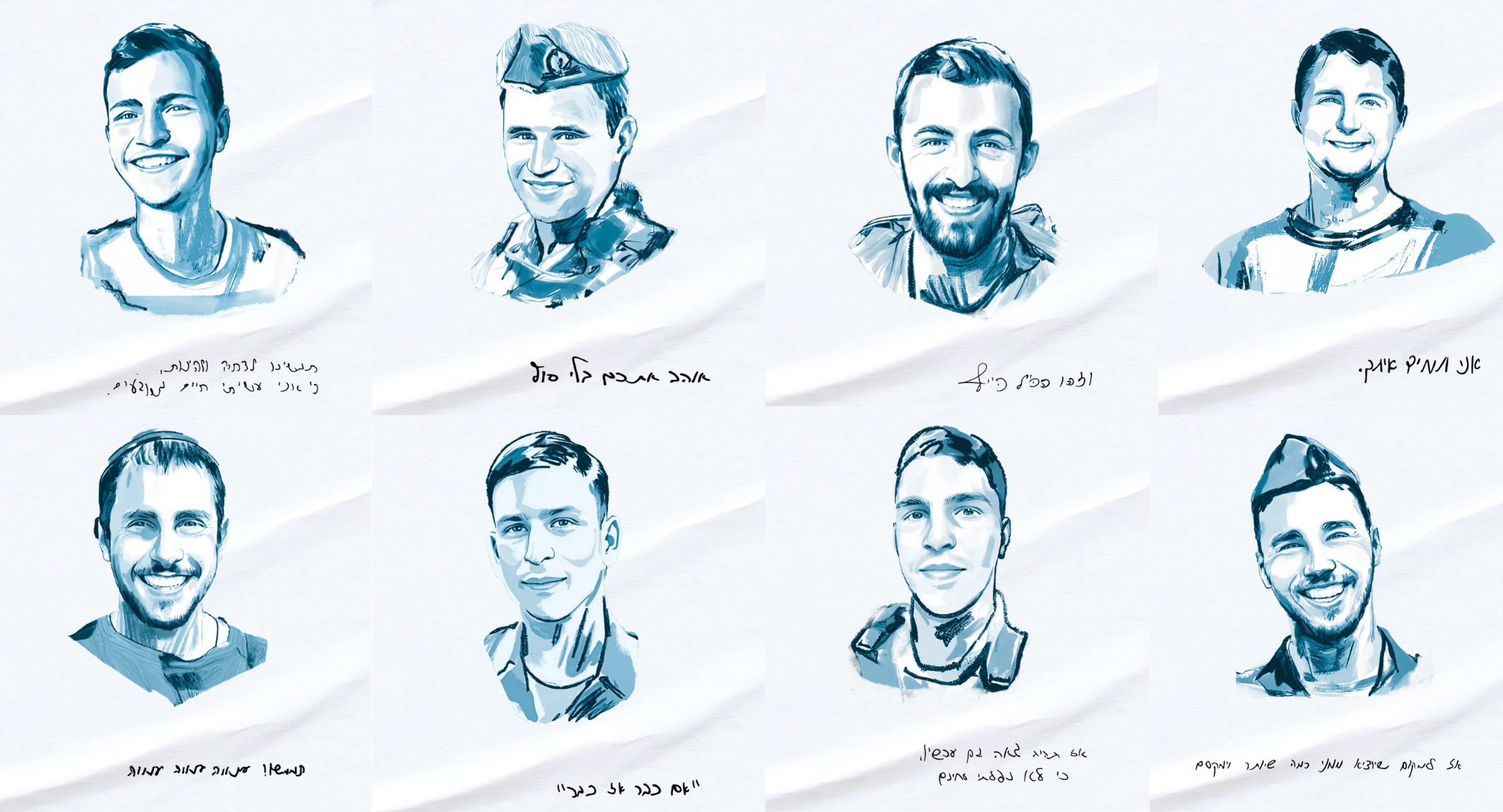
That promise became a guiding principle in the writing of the book If You’re Reading These Words.
We set for ourselves an ambitious goal, some would say an unrealistic one: to reach every single family of the fallen from the first year of the war. To approach hundreds of bereaved parents, one by one, personally, and ask: Did your loved one leave behind a final letter?
Shlomo Kavas, who co-authored the book with me, messaged me on a summer evening at the height of the war. In those days my husband Nitai was serving as a reserve operations officer in Gaza; I was at home with our four-year-old son, in early pregnancy, and working intensively in the newsroom.
“I’ve been thinking,” Shlomo wrote to me, “that the letters soldiers write before entering their final battle are truly unique texts—so brief, so honest, written knowing that they will only be read when the writer is no longer among the living. Texts that are obviously sad, but also fascinating, deeply personal and above all, important. They mustn’t be allowed to disappear.
“So I want to initiate and edit a book that will gather these letters, exactly as they were written. Those that have already been published, and those that haven’t, if the families agree to publish them. It will be called, If You’re Reading These Words.”
And right after that, he added: “One more theoretical thought: Would you be interested in joining me on this project?” Just a few seconds later, I replied: “Absolutely. I’m in.”
We set out on a long, all-consuming journey, and were privileged to come to know the most beautiful words and faces of Israel: proud fighters who went into battle with courage and swore to defend the communities around Gaza after witnessing the horrors of October 7. Reservists with families of their own who said: How can I sleep in my own bed at home while the hostages are sleeping in tunnels? And extraordinary families who, together with the news of their son’s death, also received a letter with a breathtaking last request: Keep going. Live. We did not fight in vain.
And all the while, my promise accompanied me, evening after evening, as I went over the very long list of the fallen whose families we were gently asking whether their loved ones had left a letter behind. Some parents answer sorrowfully that no, he didn’t leave anything, and how much they would give for just a few more words from him. There was one father who told me: “He didn’t leave a letter, and I’m so glad. I’m glad he fought without fear. I’m glad he didn’t think about death. I’m glad he believed, all along the way, that he would come home.” And 49 parents answered us that yes, there is a last letter.
We gradually deepened the connection, and carefully began to learn their words and everything that lay between them: the private jokes, the stories taking shape, where they were when they wrote these words. Some wrote a final letter with a trembling hand, in a small pocket notebook, as they were riding into Gaza in a tank for the first time. Some wrote a few brief words in a locked note on their phone, or printed one out and handed it to their closest friend, saying: If we make it out of this alive, burn this page. Some wrote their letter years earlier, like the late Elhanan Kalmanson, a Mossad operative who rushed on his own initiative to fight in Kibbutz Be’eri on October 7. Because he had worked in a dangerous job for years, he had long before saved a hidden document on his computer under the title: “If I die.“
What they all share is courage and love. Courage to look death in the eye and go into battle knowing they might not return. Love for their people, their country, their families, everyone they left behind. And the wish to leave them something that would give them strength on the long road ahead, the road they would now have to travel without them.
This is a book in which all the heroes have died, yet it overflows with life. It is a reminder of what we went through in Israel on October 7. A reminder of heroism, of the efforts to bring the hostages home, of the war for the south and for our homes, of young soldiers with their whole lives ahead of them who had already seen sights nearly impossible to grasp. And this book is a reminder of our greater story—of fighters who understood that they were part of a historic war, a chain of generations. Like Omri Schwartz, who wrote: “Our generation, our turn.“ And Daniel Toaff, who wrote:
Now it’s our turn. Our turn to be the ones who shoulder the burden and take responsibility for the people. Like Avraham, Yitzhak, and Yaakov, each with his own trials; Moshe, who brought the people up to the Land, Yehoshua ben Nun in the conquest of the Land, David, Shlomo, and the kings of Israel, Esther and Mordechai, the Hasmoneans, the fighters of the underground movements, the partisans, the Jews who endured the horrors of the Holocaust, the soldiers of the IDF through every generation, all of them took responsibility for their people. Now it’s our turn.
And this book is also a reminder of the simple, small, beautiful things in life that these soldiers thought and wrote about. We read the longing of the late Sufian Daghash, a Druze fighter, for his mother’s cooking. We learned of Yonatan Dean Haim, a lone soldier who converted to Judaism and made Aliyah on his own, who loved to pick oranges from the orchard next to his house and squeeze fresh juice for himself and his girlfriend.
This journey into these texts was heartbreaking and heart-expanding at the same time. There was grief, and there was hope, and above all there was authenticity, honesty, and the absolute truth of someone writing who knows that his words will be read only when he is no longer here.
And every now and then I would ask myself: What would these soldiers have said? Would they agree to let us read their diary? Would they want us to correct the typos in the letter? How can we publish all of this without having received permission?
So we made every effort to stay as close as possible to the original. To leave the handwriting as it was. Not to touch a single word. Not to censor. To add expansions and notes with great care.
We tried to slip between the lines to tell a little more about them. And I tried to be a transparent channel, a quiet link between heaven and earth.
Throughout this journey of writing the book, I thought often about my grandfather, R. Adin Even-Israel Steinsaltz, who devoted his life to elucidating the spiritual treasures of the Jewish People. He wrote commentaries on the Gemara, the Mishna, and the Tanakh, and was careful at all times to be present but unseen—to insert commentary, expansions, even critique, while giving the full honor due to the words that were greater than himself.
“A pipeline of 3,000 years,” he called himself. “I try to be the sound, the melody that I did not compose. I don’t try to stamp my own image on it. On the contrary. I try, as much as possible, to practice ‘let us make silence.’”
In If You’re Reading These Words, we let the words speak for themselves. Our goal was to give life to the words and thoughts of those who were and are no longer, who gave their lives for us.
Throughout the process, we learned how exhausting commemoration is. How much effort bereaved families invest to make sure their child will never be forgotten.
I speak with mothers, with partners, with comrades-in-arms, and I promise them that they are not alone in this difficult mission of remembering their loved ones. That the Jewish People will not look away from the final words they left us, and will fulfill the request that recurs in every one of the letters: Don’t fall into despair. Be proud of me. Take care of our country. Take care of this people.