

Your 18Forty Parsha Guide is a weekly newsletter exploring five major takeaways from the weekly parsha. Receive this newsletter every week in your inbox by subscribing here. Questions or feedback? Email Rivka Bennun Kay at Shabbosreads@18forty.org.
When we encounter something we cannot see clearly, our instinct is to zoom in, enhance, illuminate. Surely more information will solve the problem. This assumption shapes how we approach everything from medical diagnoses to relationship conflicts to questions about God. If we could just see clearly, we tell ourselves, the confusion would dissolve.
Yet in Parshat Ki Tisa, at the precise moment when clarity seems most urgent, God establishes a permanent boundary. Moshe has just shattered the first tablets. The Golden Calf lies in ruins. The covenant between God and Israel hangs by a thread. In this aftermath, Moshe makes a desperate request: “Show me Your glory.” He wants to see God face-to-face, to eliminate the devastating uncertainty that just led his people to construct an idol they could touch and see.
God’s response reframes everything: “You cannot see My face, for man shall not see Me and live, but you shall see My back.” We are granted a real, intimate relationship with God that remains perpetually incomplete. The encounter offers connection and presence without complete comprehension.
For those who grew up inside this tradition, these are questions about whether the ground you stood on was ever solid, whether what you were taught has any real claim on you, whether faith can survive honest inquiry. The story of Moshe in the cleft of the rock offers five insights into finding meaning within the limits of human perception.
1. The Human Craving for Absolute Certainty
Consider what Moshe has just survived. He ascended Sinai, received the Torah, and descended to find his people dancing around a golden statue. 40 days of divine instruction, shattered in an instant by collective panic. The people could not tolerate his absence, so they built a god they could see. Now Moshe himself stands before the invisible God and makes his own request for visibility: “Show me Your glory.”
One might reasonably ask whether Moshe’s request represents the same impulse that drove the Golden Calf. The difference lies in posture: The Israelites manufactured their own answer, while Moshe brought his question to God directly, accepting whatever partial response might come.
According to Rashi on Exodus 33:18, Moshe sought something more specific than a spectacle. He wanted to understand God’s ways, the principles by which the Divine conducts the world. He sought the cognitive framework that would make reality comprehensible, the operating system of the universe laid bare.
Modern psychology has a name for this drive. Research on what psychologists call the need for closure reveals that under high stress, humans experience an intensified craving for clear, unambiguous answers. Kruglanski and Webster’s foundational study demonstrated that when people face environmental pressure, the cognitive stakes rise dramatically. Ambiguity becomes intolerable. We seize on explanations and freeze them in place, resisting new information that might complicate our settled picture.
Rabbi Shais Taub’s discussion of teshuva and spiritual transformation illuminates how this dynamic plays out in religious life. His work on addiction and recovery addresses the psychology of surrendering certainty, the painful process of accepting that we cannot control outcomes through sheer force of will. The spiritually resilient, Rabbi Taub suggests, are those who learn to sit with questions without rushing to resolution.
Moshe represents every believer who has looked at a broken world and asked God to just show His face and make it make sense. The request is entirely human. What makes this passage remarkable is that God takes the request seriously enough to offer a partial yes.
2. The Danger of Overexposure
God’s refusal might initially sound like rejection. “Man shall not see Me and live.” Yet the text frames this limitation as protection, a structural feature of reality that preserves human existence.
Maimonides in the Guide for the Perplexed I:54 analyzes this passage with characteristic precision. To see God’s face would mean to comprehend God’s essence, which remains structurally impossible for a material being bound by time and space. The human mind is finite while the Divine is infinite, and these categories are incommensurable. Maimonides argues that Moshe’s request represented the highest aspiration of the philosophical mind, and God’s response acknowledged both the legitimacy of the desire and its impossibility.
Rudolf Otto, in his phenomenological study The Idea of the Holy, described the experience of the Divine as a tremendous mystery. Encountering the wholly other produces overwhelming awe, but this awe carries an implicit danger. Otto documented how religious experience across cultures involves a sense of being confronted by something that could annihilate the self if fully encountered. The gap between finite and infinite is qualitatively different from any other gap we know.
Rashi reads this limitation as protective. The skeptic hears apologetics. The text itself does not adjudicate between these readings, but neither does it require us to. What matters narratively is that Moshe receives something real without receiving everything he requested. The encounter produced transformation without producing omniscience. He emerged changed, not certain.
Rabbi DovBer Pinson’s discussion of higher and lower teshuva offers one avenue into this dynamic. Rav Kook taught that authentic spiritual growth requires boundaries that preserve the integrity of the self. The desire to merge completely with the infinite, to dissolve all boundaries, can become its own form of spiritual destruction. The boundary functions as a membrane that enables a relationship. By withholding the full vision, God preserves Moshe’s humanity. The limit creates the container that makes connection possible. Rabbi Pinson’s discussion of how we recalibrate spiritually in the face of overwhelming experience speaks directly to this protective function. The boundary is the precondition for a relationship with God.
3. Making Meaning in Hindsight
So what can Moshe actually see? “You shall see My back, but My face shall not be seen.”
The Talmud interprets this cryptically, suggesting that God showed Moshe the knot of the divine tefillin, worn at the back of the head. This image transforms abstract theology into embodied practice. What Moshe sees is the trace of divine commitment, the binding that holds heaven and earth together, visible only from behind.
The same passage in Tractate Berachot records that Moshe asked God directly: Why do the righteous suffer? Why do the wicked prosper? This is the question beneath the question, the real content of Moshe’s request to see God’s face. He wanted to understand the logic of divine justice, and God’s response was to show him the back, the retrospective view, the pattern that emerges only after events have unfolded.
Kierkegaard captured this in his journals when he observed that life can only be understood backwards but must be lived forwards. We cannot see the pattern while we are inside it. Meaning emerges in retrospect.
Alon Shalev’s discussion of Rav Hutner develops this insight. Rav Hutner taught that spiritual growth often looks like failure while it is happening. Only later, looking back, can we see how the struggles were forming us. The back of God is the retrospective clarity that comes after we have walked through the darkness.
This has practical implications for how we read our own lives. The moments of greatest confusion and pain are often, in retrospect, the moments of greatest formation. We cannot see this while we are inside the experience, which is precisely why we need the category of God’s back: a kind of seeing that operates retrospectively, through time and memory.
4. The Holding Environment
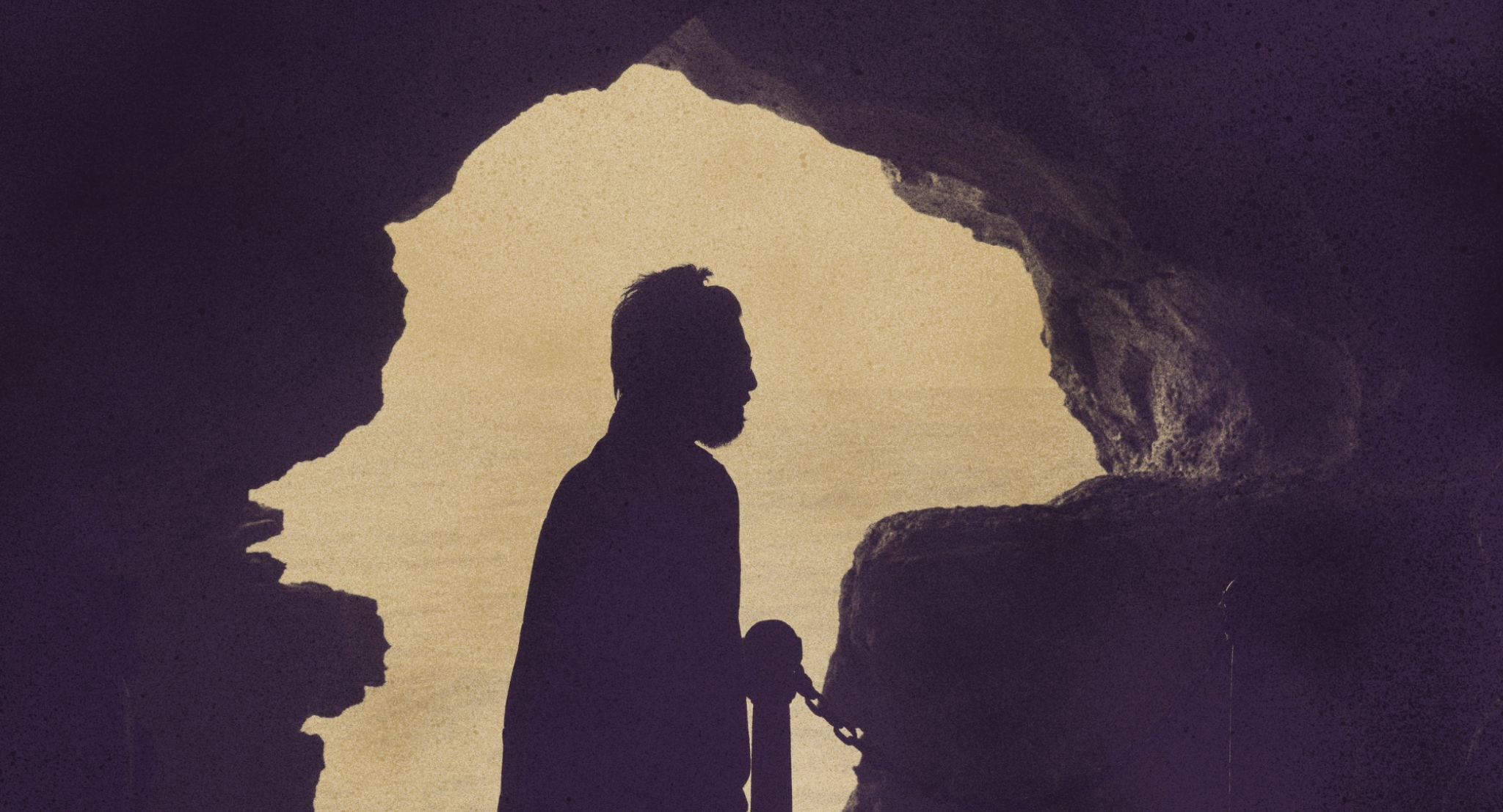
God instructs Moshe to stand in a specific location: “See, there is a place near Me. Station yourself on the rock, and as My Presence passes by, I will put you in a cleft of the rock and shield you with My hand until I have passed by.”
The cleft of the rock is a strange setting for the most intimate encounter between God and Moshe. We might expect illuminated mountaintops, open skies, expansive vistas. Instead, God places Moshe in a narrow crevice and covers him with the divine hand. The greatest revelation happens in darkness and confinement.
D.W. Winnicott developed a concept that illuminates this strange setting. In his 1960 paper “The Theory of the Parent-Infant Relationship”, he described what he called a holding environment: the conditions that allow a developing self to integrate overwhelming experience without fragmenting. The mother’s arms around the infant are the first holding environment, creating a safe container within which the infant can experience distress without being destroyed by it.
The cleft of the rock functions as precisely this kind of holding environment. David Bashevkin reflects on how moments of fragility and darkness, including his own mental health struggles, can become the specific clefts where God is encountered within limitation. When we feel covered, when we are in periods of confusion, depression, or restricted vision, we may be in the only posture safe enough to experience divine presence without shattering.
The Kotzker Rebbe, as recorded in Martin Buber’s Tales of the Hasidim, once asked visiting scholars where God dwells. They laughed at the question, noting that God’s glory fills the earth. The Kotzker answered his own question: God dwells wherever we let God in. The teaching suggests that receptivity matters more than location. We do not find God by going somewhere special. We find God by letting Him into where we already are. This reframing matters for anyone who has felt that their doubt or struggle disqualifies them from spiritual life. The tradition locates revelation in the dark crevice, suggesting that limitation itself can be the site of encounter.
5. Transformation Through Encounter
When Moshe descends from Sinai after this encounter, the text records a striking detail: Moshe did not know that the skin of his face was radiating light because he had been speaking with God. The Israelites were afraid to approach him.
Abraham Maslow, in Toward a Psychology of Being, studied what he called peak experiences: encounters so profound that they leave lasting, observable changes in how people carry themselves. Those who undergo such transformation, Maslow found, display altered relationships to others, heightened perception, and a quality of being strengthened even in daily life. This is precisely what Exodus 34:29 describes: Moshe descended from Sinai not knowing that the skin of his face was radiating light. The Hebrew word karan can mean either to shine or to send out rays, though Jerome’s Latin Vulgate mistranslated it as horned, producing centuries of Christian art erroneously depicting Moshe with literal horns instead of radiance. The Jewish reading tradition has always understood the term as emitting light, and the phenomenon itself was so striking that Aharon and the Israelites were afraid to approach him.
The Netziv, in Ha’amek Davar on Exodus 34:29 (available only in Hebrew), explains that Moshe’s radiance reflected the Torah he had internalized. The transformation was characterological, not cosmetic. Moshe returned from Sinai as someone who had been fundamentally changed, carrying no philosophical proof or theological system, only the imprint of encounter.
Joey Rosenfeld’s exploration of Jewish mysticism speaks to this dynamic. Drawing on kabbalistic thought, he discusses how authentic encounter resists systematization and how Judaism guards the essential truth that creature cannot become creator. The encounter changes how Moshe carries himself, how he appears to others, how he moves through the world. The radiant face emerges from engaging with the system of Torah while accepting what cannot be known.
Here is the shift that the encounter on Sinai produces. We are often paralyzed by the theology we do not have, the answers we did not receive, the face we did not see. We wait for certainty before we act. Moshe’s descent reframes the goal entirely. We have the back, which is tradition and history. We have the tablets, which are halacha and practice. When we stop waiting for perfect vision and start living the human-sized relationship with the Divine, something begins to change. The face we cannot see becomes the face we reflect.
Questions for Reflection
- In what areas of your life are you waiting for clarity or a sign before taking the next step?
- What is your personal cleft of the rock, the practices or places that help you feel safe enough to confront the overwhelming parts of life?
- How would your religious life change if you measured it by the radiance of your character instead of the certainty of your theology?
This project is made possible with support from the Simchat Torah Challenge and UJA-Federation of New York. Learn more about the Simchat Torah Challenge and get involved at their website.