Transcripts are produced by Sofer.ai and lightly edited—please excuse any imperfections.
David Bashevkin: Hi friends, and welcome to the 18Forty Podcast where each month we explore a different topic balancing modern sensibilities with traditional sensitivities to give you new approaches to timeless Jewish ideas. I’m your host, David Bashevkin, and this month we’re continuing our exploration of teshuvah. Thank you so much to our series sponsors, Daniel and Mira Stokar. We are so grateful for your friendship, guidance, and support over all these years.
This podcast is part of a larger exploration of those big, juicy Jewish ideas. So be sure to check out 18Forty.org, that’s 18Forty.org, where you can also find videos, articles, recommended readings, and weekly emails.I was never the kind of person who felt like they had a standard Rebbe, like who is your Rebbe? Sometimes people will ask that particularly when you are maybe dating, people want to know, like who’s your teacher? They don’t ask like who’s your rabbi. That would be a question about who your congregational rabbi is, but a common question people will get within a certain slice of the Orthodox community is who is your Rebbe? And I have always struggled with that question. I have been blessed with many different teachers, chief among them my own parents, as well as many different teachers from all of the kind of different yeshivas that I’ve studied in over the years.
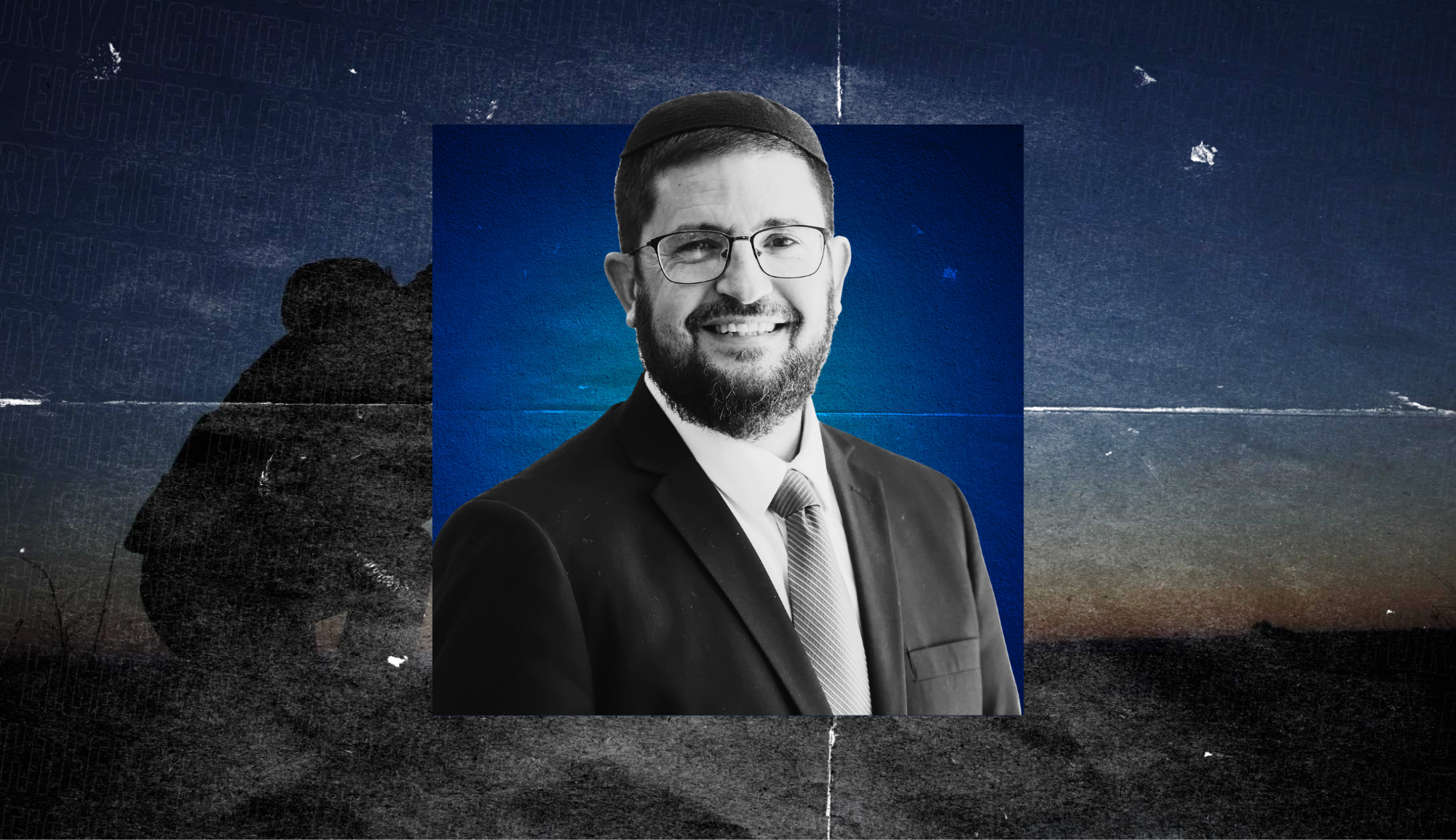
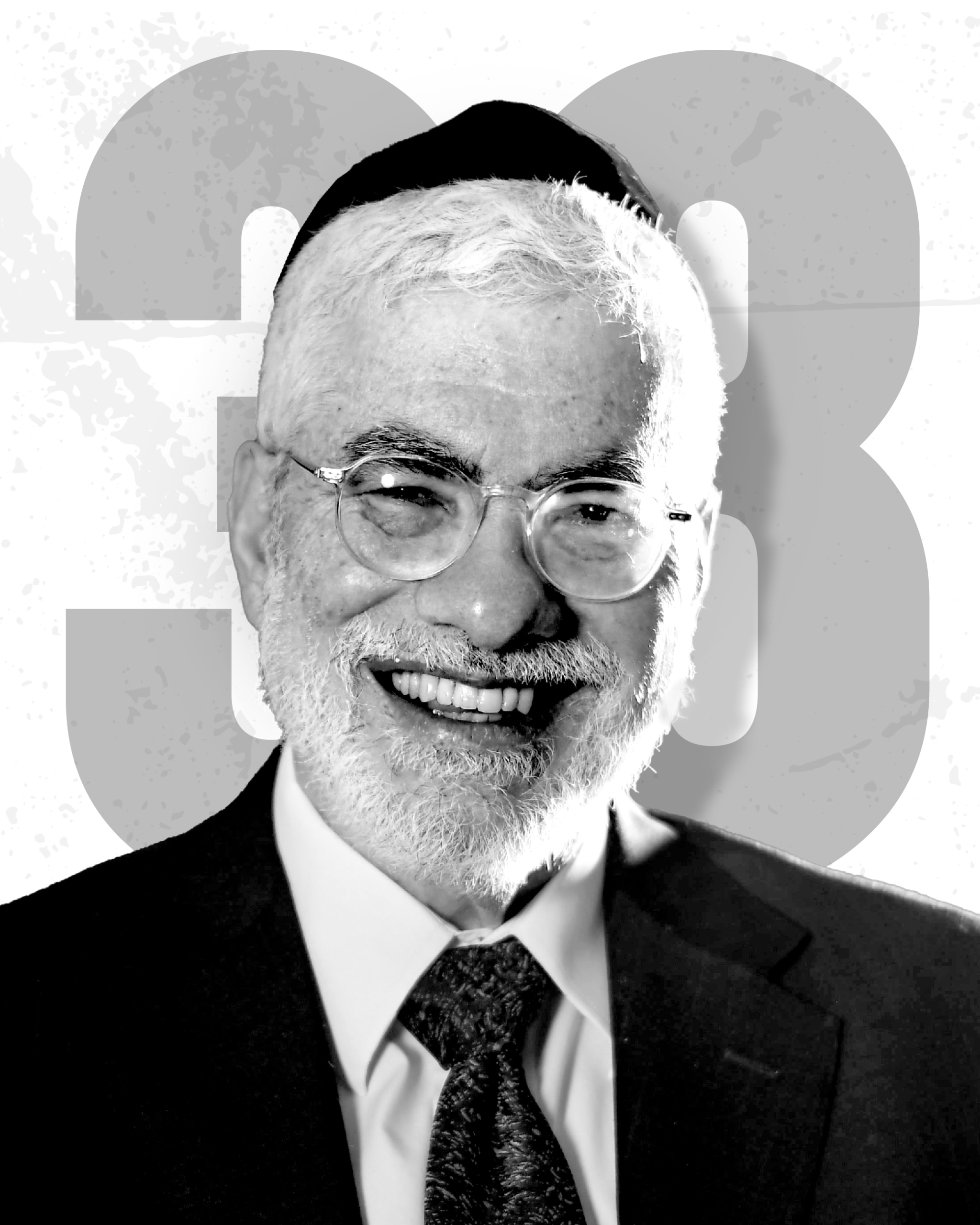
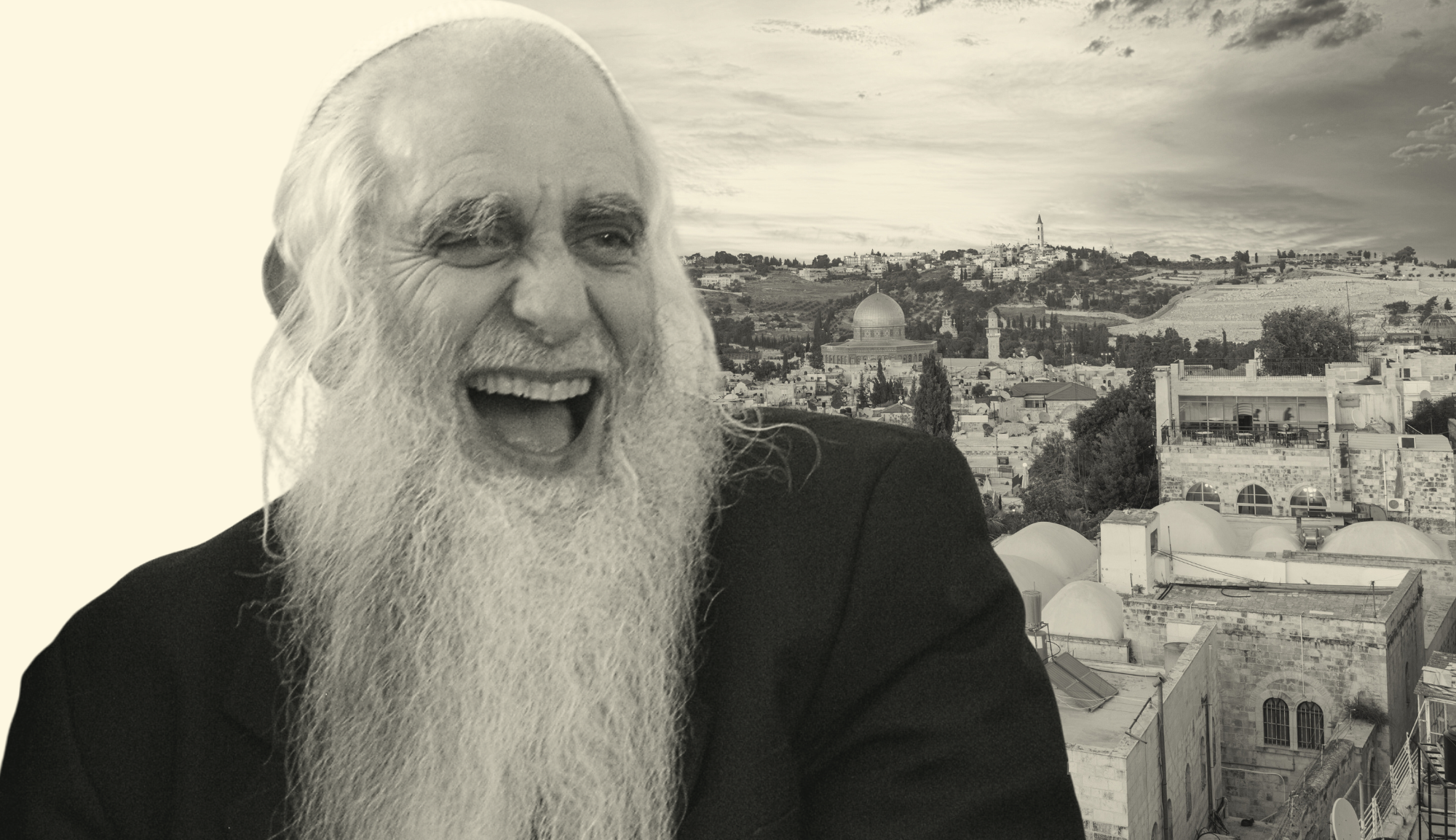
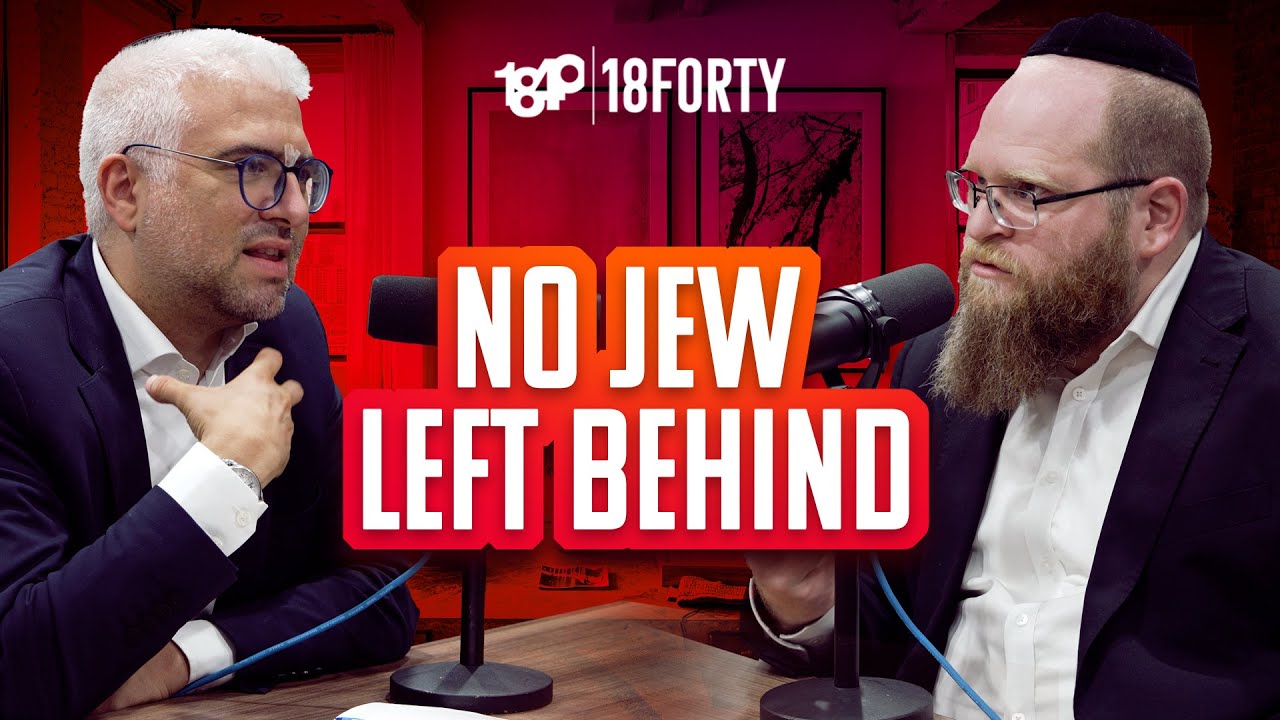
And really, I’ve had some incredible mentors and experiences. And I was thinking what was unique about my relationship with today’s guest, somebody who I do, and I am privileged to call Rebbe, not just a rabbi in my life, but Rabbi Moshe Benovitz, someone who I have known since I’m around 14 years old. He was a teacher in the high school that I attended known as DRS, Davis Renov Stahler High School for Boys, where I went to high school. And he was also the director of the camp I went in 10th grade, a camp that still runs now.
It’s more than a camp, it’s really like a movement, known as NCSY Kollel, which is usually for after 10th grade. It’s a summer where kids play sports and travel and learn Torah. It’s on an actual Kollel, and I spent a summer on there. Later I returned as a staff member, and I’ve really known Rabbi Benovitz for well over 20 years, really coming up on almost 30 years.
And he is one of the few people, it’s not the only person, but one of the few people that I always address as Rebbe.And I was thinking to myself, like what really makes my relationship or why I feel, and you’ll hear it in the interview, a certain level of awe, genuinely, to a Rebbe. I’ve had many teachers in my life. I’ve had teachers in my life who are probably even more kind of well-known in the yeshiva world, but there is a very unique relationship that I have always felt with Rabbi Benovitz. And to me, to encapsulate it, there is this beautiful idea from Rav Tzadok, where Rav Tzadok writes in Resisei Layla, which is this work, a collection of essays on the different holidays of the year, different essays on different ideas related to Jewish thought.
And he has an absolutely beautiful essay. It’s his 50th essay, which actually relates to this very time of year, about the high holidays, about Rosh Hashanah and Yom Kippur. And he says something incredibly beautiful, where there is a Mishnah in the 17th chapter of Keilim, which is a very complex tractate that talks about laws of purity and impurity. And it talks about a certain animal.
And it’s talking about this specific animal, what is the process to make such an animal pure, how is it actually considered? And the Mishnah says that this certain animal is considered a land animal, which affects the way that its purity process and the kind of the laws associated with it. This is an animal that lives some of the time on sea, sometimes in the ocean, some of the time on land. You can imagine like a turtle, there are some animals that live half and half. So do you consider it like a land animal or like a water animal? And the Mishnah says this certain animal is considered an animal of the land.
Why? Because when it’s in danger, it runs to the land. And Rav Tzadok says something very amazing. He says that based on this Mishnah, which kind of evaluates the halachic status of an animal based on where it goes during times of crisis, is it considered a land animal or an ocean animal or a sea animal? And the Mishnah says look at where it goes when it flees, when it’s trying to find safety. And Rav Tzadok, based on this Mishnah saying that you look to where this animal goes to find safety, says Rav Tzadok something quite amazing. The place that a person goes during times of times of crisis of v’tzaar and suffering.
Hamagia ad hanefesh that really goes to your very essence. You feel like you’re breathing out of a straw, they’re up to your neck. V’hu boreach l’hatzil nafsho and you instinctively go there to save your own life, misham hu shorsho. That place where you go to seek safety, just like we see in the Mishnah, that the way that we evaluate an animal is where it flees, does it go to the land or the sea in times of crisis, it is also true for human beings.
Where do you turn in times of crisis, in times of suffering, in times of doubt? Where do you turn? And I think that finding that place, it can be a place and for many people, myself included, it can also be a person. Who is a person, who is a Rebbe who you turn to when life feels absolutely upside down? When you feel like you have no path forward, when you feel like you’ve forgotten all of the lines that kept you in check, and now you are drifting out aimlessly, looking for some sort of anchor. I think all of us have people in our lives who we instinctively turn to. Some of us, they are family members, myself included.
For some of us, they are mentors, they are our teachers. And Rabbi Moshe Benovitz for myself is one of those teachers. Is somebody who I think what distinguishes him in my life is that he is a Rebbe who I’ve actually never sat in his formal classroom. Somebody who I think in terms of times of instruction, how long have I sat listening to him educate me, not that much.
But in terms of evaluating the imprint that a teacher has made on me, in terms of evaluating where I turn when I feel like the world is upside down, and I am looking for a perspective forward. That person for close to 30 years has been for myself Rabbi Moshe Benovitz. The person who I called, I remember right after October 7th looking for some words or some direction, what should we be doing. Before 18Forty, is a person who I have texted in times of absolute crisis when I felt my own life was absolutely upside down.
The first person I felt myself who could be an anchor to give some stability in those moments, give you some perspective. So the very untetheredness of life can feel like it has some foundation, has been Rabbi Benovitz. And that has been an incredible privilege for me and in many ways, it kind of sets up an episode that will inevitably be disappointing because there is no way to capture one’s relationship that is forged within the crucible of crisis, a relationship that emerged when I was at my most vulnerable, personally, professionally. This for me is really an episode that is a privilege to just share gratitude and appreciation.
I really cannot think of a more significant guest than my Rebbe, my teacher, Rabbi Moshe Benovitz. If you’ll allow me, I just want to share an idea that Rabbi Benovitz shared with me and that I think in many ways he is representative of communally. I would not fault anyone for never having heard of Rabbi Moshe Benovitz. He runs a semi-popular camp within the Orthodox community.
He is a Rebbein Reishit and works on the leadership of NCSY, where I worked under him for many, many years. That does not capture his significance within the community. I have many times compared him, as you will hear in this interview, to the Lorne Michaels of the world of Modern Orthodox education. Lorne Michaels, who is the producer of Saturday Night Live is quite famous.
Why? Because if you look at nearly any major star in comedy and trace back their origin story, where did we find them, who discovered them, there are so many greats, Tina Fey, Conan O’Brien, Will Ferrell, I don’t need to go through all of them, but their first start, the person who discovered them was Lorne Michaels. And in a similar way, in the contemporary educational world, particularly within the modern Orthodox educational world, I cannot think of a school that has not been shaped by Rabbi Benovitz. I cannot think of one modern Orthodox school in the United States at least, that does not have staff members, principals, rabbeim, student activities coordinators, whatever it is that either directly, whether a student on NCSY Kolel, indirectly, students of a student, or really his imprint in really bringing that vision of experiential education into high schools, was in many ways a credit and something that Rabbi Benovitz was one of the great pioneers and innovators of. But there is a particular idea aside from being kind of this Lorne Michaels figure, but there’s a particular idea that he shared that made an impact on me and that I think about particularly during this time of year.
And that is a thought that he shared from the Chasidic world of Modzitz. It’s a Modzitzer idea, that’s a Chasidic school, but it’s an idea based on a blessing in Shmoneh Esrei. in Shemoneh Esrei. We pray, Hashiva shofteinu kevarishona.
We pray that God reinstitute the judges of old, reinstitute the governance that we had during the time of the Second Temple. And this is actually the one prayer that we insert a change in the daily Shemoneh Esrei. We actually change the bracha, and we end the bracha specifically during the 10 days of repentance between Rosh Hashanah and Yom Kippur. We actually conclude this bracha with a special conclusion where we pray for Hamelech Hamishpat.
And it’s within this bracha where we pray to God as the king of justice. It’s specifically during this period between Rosh Hashanah and Yom Kippur where this bracha features quite prominently. And it is a very difficult bracha for anyone who grows up in the modern world because the bracha seems to be asking to be beseeching God for the return of a theocracy. And anyone who has read a little bit of the Torah, the return of a theocracy is not something that most Jews openly welcome, even though it is something that we seemingly pray for in Shemoneh Esrei, in the daily Amidah, our daily prayer service.
Why is it that we are praying to reinstitute the governance system of old? I don’t know if I’m looking forward to that. What exactly is this bracha, is this prayer about? And Rabbi Benovitz so eloquently, quoting from the school of Modzitz, says, yes, maybe perhaps this is a bracha about governance, but more than governance, this is about our own hopes, ideals, and boundaries that we have in our own lives. There is a time in our life when our own youthfulness gives rise to a certain idealism of how we want to live our lives. This very often happens during the teenage years, where our eyes are kind of opened up to a certain idealism.
Who hasn’t sat around with a group of friends promising themselves that they’re not going to turn into the kind of zombies that they look, perhaps negatively and uncharitably, but the way that they look at kind of adult life is I don’t want to turn into that. I want to retain the vitality, the sincerity, the authenticity with which I am committed to at this stage in my life. And it’s very often those teenage years. And I want to bring this into the rest of our lives.
And what often happens and what usually happens is that you grow up and it’s easier and less cringe to just pretend like you never had those dreams and aspirations in the first place, to hope that you never had that idealism, that spiritual idealism of what we wanted to become and how we wanted to fashion our lives. We look around at the current state of our professional lives, our religious lives, our personal lives, and you know what? It’s enjoyable, it’s nice, it’s nourishing. It may not, and I’m, we talk to ourselves here, but I think our listeners understand what I’m describing. It doesn’t usually measure up to the idealism we had in those earlier years.
And what we are actually davening for, and specifically during the 10 days of repentance when this blessing takes on even more significance, what we are davening is that we do not look at our own past with a cynicism by ignoring it, by that cringe of saying, I was such a idealistic, naive, know-nothing, but looking at our childlike idealism and actually fashioning that into a prayer. To going back in time and asking ourselves, Hashiva shofteinu kevarishona. I hope that the way that my life, that the way that I judge my own life, the way that I set up boundaries in my own life, coheres to the idealism that I once fostered and once embodied. Maybe that idealism is not the operating function of every moment and every decision I make in my life, but at the very least, I hope my younger, idealistic self is proud and can look fondly and admirably at the life that I have built.
We look back and say, Hashiva shofteinu kevarishona. Return back the judgment of youth. We’re not asking for a theocracy, what we are really asking for is a return of the sincerity of idealism that we fostered during those years. And I think this idea, aside from being incredibly beautiful, and anyone who has lost touch with that idealistic self, who looks with cynicism at their own past lives and their own past hopes and ambitions.
This is a prayer that can reawaken that idealism, that spiritual ambition that I think always stays in some way or another humming along within our own internal sense of self. It’s that place that we do turn to in times of crisis, hoping that our spiritual lives and our spiritual commitments could somehow deliver on that nourishing life that all of us has hoped for for ourselves. But I think in many ways, Rabbi Benovitz embodies that authenticity. He embodies what it means to dream when you are younger and to live the rest of your life unfolding that spiritual dream of youth.
Rabbi Benovitz is someone who I met in 10th grade when I was far too immature to appreciate his perspective and what he offered. Yet at the same time, at that very time in 10th grade, my 14-year-old self caught a glimpse of a form of Torah that was so compelling, that was so authentic, that was so real, that I find myself to this very day turning back to that relationship which really fashioned my very appreciation for Torah, for religious life and religious growth. Just a quick note, this conversation was recorded live at Stern College, arranged by my dear friend, Rabbi Azi Fine, someone who I’ve known over many, many years, and was gracious enough to organize this live conversation that was so special for me that I thought we should absolutely include this on 1840 as part of our preparation for Yom Kippur, which is why it is my absolute privilege and pleasure to introduce our conversation with my Rebbe, Rabbi Moshe Benovitz. It really is an absolute privilege and pleasure to be here in Stern College.
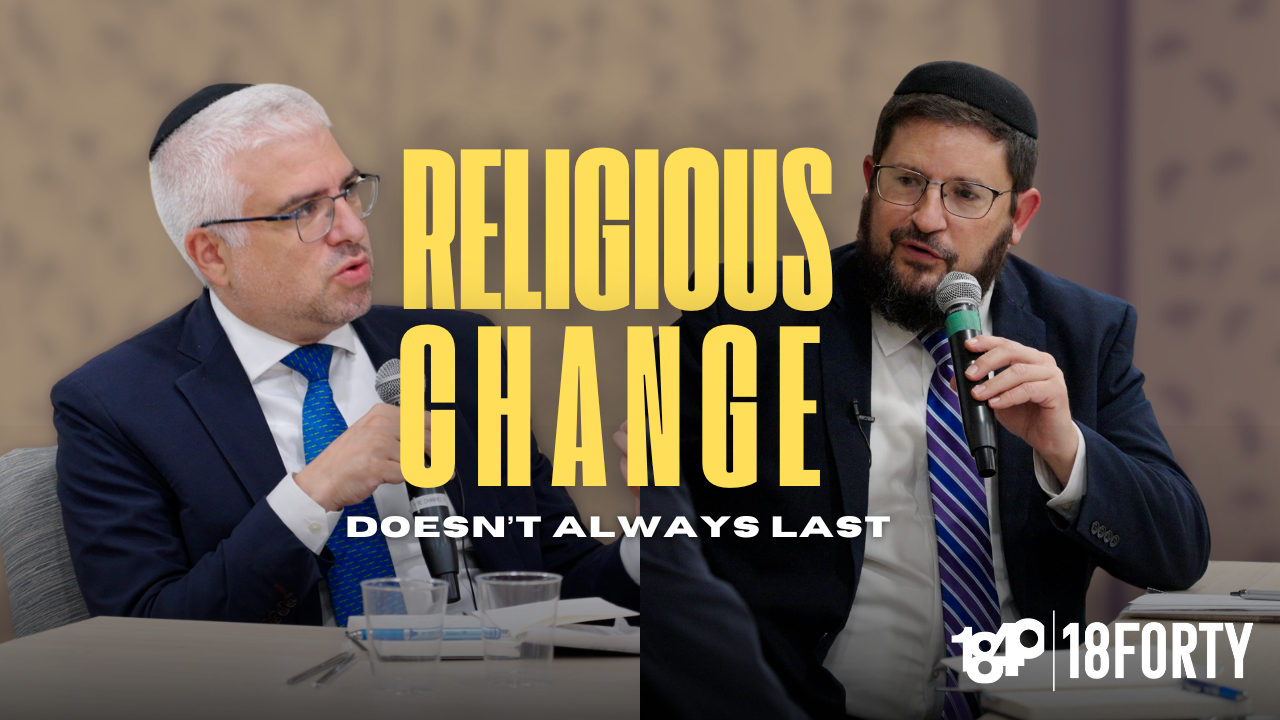
It is a unique privilege and I have a little bit of trepidation if teshuva talks was modeled in some ways after 18Forty, then 18Forty and the inception of 18Forty was modeled in many ways based on the influence of my Rebbe, Rabbi Moshe Benovitz on myself. I have known Rabbi Benovitz for 25 years. We met probably in the year 1999, 2000 and has really from me as a 10th grader through NCSY Kollel on summer programs. I never had you as a formal Rebbe, but to be sitting across from you, having shared some of my proudest moments with you and having shared some of my most difficult and darkest moments with you, it really is genuinely, sincerely a privilege to be sitting across from you from talking about teshuva.
And I wanted to begin by kind of that reflection of 25 years that we’ve known each other and thinking a little bit about your role. You have taught in high schools. I met you when you were a student activities director in DRS. You were a 11th grade Rebbi.
You left right after I graduated and went to teach in Reishit. And throughout this time, you were the director of NCSY Kollel. And what is very interesting is that you have always had a front row seat for religious change, for dramatic religious change. Religious change that occurs in high school, religious change that occurs over the summer when you go on one of these inspirational NCSY programs.
And really thank you to our partners, to Suzanne in particular from 4G. Shout out to Suzanne, we appreciate you. Sure. But the question that I have and I want to begin with is not the ingredients of religious change, but really the ingredients of why religious change does not last.
And I am wondering over your course as an educator, when you see somebody changing dramatically religiously, do you have a way of predicting? Are there telltale signs whether or not the religious change that often occurs when we’re quite young, we’re 15 years old. Do you have any way of predicting what forms of religious change last and what forms of religious change ultimately dissipate?
Moshe Benovitz: I’ll save my own words of introduction and address the excitement, which I agree with, the trepidation, which I hope to put you at ease with, and I I don’t feel a level of trepidation ever in having conversations with you. We’ll be able to tie that in in a minute, I think to the answer to that very profound question. I think the answer specifically is a resounding yes and no.
I don’t know if we ever know. If you’re asking if I’m a mind reader, and that’s what it would require to be able to look at a person and say, well, this isn’t going to happen. That cheapens the human experience so much and it limits it to a series of indicators and signs or things that are superficial and able to know. However, those factors, the yes part, surely do exist.
There are ingredients for meaningful and sustainable change and there are clear ingredients for something that is much more transient and something which is much more flimsy and isn’t worth that much when it happens initially. And because it isn’t worth that much when it happens initially, is not likely to have any legs to it and not likely to last for a long time. The question of whether I or any other educator or parent or friend can know or identify those things is both irrelevant and the answer is is no to that. You can’t know what’s actually going on inside of a person.
But it’s most instructive, I think for us to measure that within ourselves and within our own experiences. There are two fundamental kinds of change in my opinion and in my observation. Here when I say observation, again, I’m not contradicting myself. I don’t refer to the nature of what we observe perhaps in the moment, but over a period of time, we can clearly see what was in place and wasn’t in place.
And I like to refer to the two elements of this change as being behavior modification as contrasted with personality development. One of them is a process, one of them could be much more abrupt in the ways that you are describing, and that itself is often an indicator. The quicker you change in one direction, the quicker that change can be reversed and go back in the other direction. But it’s significantly more than that also.
Behavior modification has a place in this world. There is a need for us to control our behaviors, for us to modify our behaviors, and for us to measure ourselves not in the olam, not in the world of thought, but in the world of action. What do we do? How do we perform? How do we manage to galvanize ourselves and to translate our strongest desires, our most inner urges into a life of behaviors and a life of actions? We don’t mean to minimize the role of behaviors, the role of active mitzvos or good deeds, or any other type of behaviors, any other type of actions that we have. In the world of teshuvah, it is appropriate to minimize it, at least to an extent.
Behavior modification is the domain of dog obedience school, of monkey training, of getting someone or something to do something, to behave in a particular type of way. It’s not a neat trick to be able to, there’s a former student, that’s a terrible term by the way, especially in our relationship, we’ll get to that. There’s very little such thing as a former student. There’s a fellow who formally sat in multiple venues.
He was once upon a time one of the high schools I taught in, and later on a talmid in, I think also in Eretz Yisrael. I call it probably in three different venues, and in Reishit as well. Unfortunately, he lost his father at a relatively young age. It was a year or two after he had left yeshiva.
And he had a regular experience in Yeshiva. Right now he happens to be a rabbinic figure in our community. At the time, he was still finding his way, so to speak, in and out, and he happened to have, at the time he was sitting shiva, a lot of the rabbeim in, I think there might have been a Yeshiva dinner at the time. So there was a little bit of an awkward silence.
There were four of his rabbeim, not sure what, hadn’t seen him in a while, and his face lit up at one point and he said, “Oh, you all have to see this.” And he called his dog in from the kitchen, and he said to his dog, he laid out a dish in front of the dog. I don’t remember if it was water or dog food, and he said to the dog, said the dog’s name, I don’t remember the dog’s name, “Kosher.” And the dog ran over to the dish and started lapping up all of the food. And then he said, “Treif.” And the dog walked away right away from the food and turned its head away from it. And everybody had a great laugh.
Everybody enjoyed it so much. And one of the rabbeim, like an old chasidisha maisa, one of the rabbeim put his head in his hands and he started to break down. And of course we asked him, were you not entertained by the dog that keeps kosher? And of course, he said that, no, I wonder if that’s so radically different than all of the changes that we see. You say a word and you control a behavior and you modify like that.
It’s an entertaining parlor trick. You go to the circus to see what are the influences that we could put on the lion or the bear or the dancing monkey to get it to perform. Heaven forbid that that should be our avodah, that that should be our efforts in the month of Elul, that that should be the way that we feel walking out of shul on Yom Kippur, that that’s what the Rambam is referring to in his Hilchos Teshuva. Heaven forbid that that should be the way.
We should leave behavior modification, again, we measure ourselves based on that performance, we should leave behavior modification for the circus and we should be focused on personality development. I see the world in a different way. I think differently about the world that is around me. My attitudes have changed.
I’m more in control of my emotions, my instincts, my urges. I find myself being different instead of acting different. To specifically answer your question, I have years, I don’t know if I have any degree of wisdom or insight, but I certainly have years and collected experiences. There is a pachad, there is a terror that seizes people when they embark on intense experiences, be it a particular summer program, certainly the year in Israel in Yeshiva or seminary.
One of the greatest fears that people have is, for lack of a better term, the flip-out and flip-back phenomenon. That I’m going to change, I’m going to be this mercurial up and down. I’m not even going to know myself what personality do I have today, because I’ve gone from one extreme to the other and sometimes back again. And people are terrified about that.
Here too, I’d like to put anybody who has that fear at ease. I think it’s a very overrated phenomenon. I think the vast majority who flip out, flip back, didn’t flip out and they didn’t flip back. They tried on a different pair of shoes and a different jacket and a different dress, and they put on a different way of presenting themselves, a different set of behaviors that are come and go and part of that behavior modification.
I know who they are. Obviously, I won’t mention them right now. In my experience, I can count two people that I have ever encountered that had their personalities developed, that really did the work and had that growth in a process that became different people and then lost that and went back. It is as rare as a blue moon.
It is as rare as finding the Loch Ness monster.
David Bashevkin: Obviously, we’re not going to ask who those two people are, but can you say what their last names rhyme with?
But but along those lines, I wanted to ask you about that notion of being a long-term rebbe, not having former students and watching people, meaning you met me when I was 14. I am now 40 years old. And my question is, when you have those natural ups and downs and people do change, a lot of times the outward religious change does not stay.
And it represents something. You see that they used to affiliate maybe with a more Beis Medrash community, they may have affiliated more with intensity and with passion and then they kind of level off. Do you feel a responsibility as a rebbe to be a reminder for what they once were? Or do you kind of lean in and encourage people to like find the religious stasis that works for them, even if that religious stasis over the long term is a notch or two lower than what they had achieved when they were in their early 20s. And now they’re 10 years later.
You get together with them. You clearly see they are presenting differently. What do you see your role as a rebbe, as a mentor to people who are clearly not who they once were when you initially knew them and inspired them?
Moshe Benovitz: Let’s focus on your phrasing, the last phrasing that you used, which is I think a really critical question, and it applies not only to professional teachers, but it applies to anybody who is in a position of influence, parents, and good friends for sure, on any other individual in the world. And I think the way that you phrased it at the end is the most important point to focus on, which is how do I in any of those scenarios as a rebbe, as a father, as a friend, as a husband, how do I view myself and my responsibilities vis-a-vis the people that I care about and the people that I’m interacting with.
And when we focus on that, then I think others can join in me and being confused and a little bit offended by the assumptions of your questions. Meaning I struggle mightily with what you’re asking and not struggle in a good way, meaning I resent what you’re asking a lot of ways. I say that to a very, very dear friend and an expert interviewer in what they’re asking. There are at least two assumptions that are extremely dangerous and faulty as far as what the role of a person of influence is to do, anticipating particular outcomes, and then a further error, which is connected but I think a little bit different as well, about how we measure that degree of success and what we’re looking for.
The first level of offense and resentment about the question would be in that sense of are we trying to manipulate or grade ourselves based on those particular outcomes. I see a person who’s behaving a certain way and if I had encountered them in a shiur room or if they’re my own children, then the behaviors that they do are an indication of the strength of the relationship that I have for them or the efficacy of my role as being a father, a friend, or as a rebbe. That’s a very strange place in which to operate. It will never be successful, I don’t think.
I would not want to live in that world. I don’t want to live in that world, and I don’t live in that world. I choose not to live in that world in all of those interactions. There is an obligation to connect, to transmit information, to discuss and to debate, to consider, to be with people in a process of growth.
I mentioned earlier that I think the trepidation and you said so movingly that there is a long relationship and that the nexus of 18Forty, you know, this teshuva talk’s coming out of 18Forty and 18Forty coming out of… That’s not an empty compliment. Meaning what we are doing right now is a process of exploration and connection, hand in hand navigating complex issues, those big juicy topics that we confront all of the time in our lives and trying to navigate the world with intellect and with humor and with connection and with support for one another. That’s the role of a rebbe.
The outcome, and that’s the role of a parent, that’s the role of a chaver. Of course manifested in all of those situations in different ways. A parent doesn’t have a blackboard and a good friend doesn’t have discipline responsibilities and there are many, many ways in which we could distinguish. But ultimately, that degree of companionship and that degree of exploration and that degree of taking this journey together wherever it may lead, that’s the barometer of success that matters in any of those situations.
And similarly, although not identically, and again, we can say it quickly because it’s what we mentioned already, measuring success in any human being, not just the success of the intervention and of the interaction, but success of the individual that’s based on the behaviors that they have is denying us the ability to maybe there’s an effect that is a latent effect. Maybe the person is not so different than they were before. And again, that goes back to what I said before about encountering people who are different people than they were. They may look very different.
They may be affecting themselves very different, but there’s such a beautiful, almost plaintive cry that they’ll make in those encounters. I know I look different.
I promise you that I am the same. Tell you an amazing thing, because especially in some of the teaching that I do in Yeshiva in Eretz Yisrael, so there are the types of visible or external transformations, the range of where people are, especially as you pointed out as the years go on.
You would think that their reflections on their time in Israel would mirror and be proportionate to that same range. People who are so very different will have a proportionally different impression of what happened when they were in Israel. It is almost invariable that the wistfulness, that the respect they have for the experience of being in the classroom is exactly the same, which is a way of their demonstrating not so different after all. I am so connected to that place where I was.
I’m not as far afield as I may seem. May have manifested itself in different ways. Maybe we’ll get into some of that a little bit later as well.
David Bashevkin: One very interesting and kind of influential seat that you have is being the director of NCSY Kollel for well over two decades.
NCSY Kollel, which is a boys learning program in Israel that I attended as a young student and later was a junior madrichan. I have oftentimes compared you to Lorne Michaels, as Lorne Michaels is the producer of Saturday Night Live. And if you look at anybody who’s big in comedy, they usually at some point have been identified by Lorne Michaels. In a similar way, most people in the Yeshiva League constellation of schools have in one way or another probably gone through either NCSY Kollel or have been influenced by that experience that you created there.
I’m very curious about your view on the current state of what I am calling broadly speaking, the Yeshiva League. We’re not talking about floor hockey now, I promise you, though I would love to. Honestly, I could talk about floor hockey, the sport that the Modern Orthodox community invented in the late 90s. But what I want to ask is you have had a front row seat in not only watching the products of the Yeshiva League, not only fostering the ambitions of people.
The first time I ever saw somebody who I considered cool who was into Yiddishkeit was a product of I didn’t even know such a thing existed as a kid. I’m like, cool kids are into learning and Yiddishkeit? I thought if you’re cool, you’re not into that stuff. And it was a product of what you created in the model of NCSY Kollel. That model, as you have written about, has been co-opted in many ways.
Imitation is the highest form of flattery by all of the high schools that we have. High schools run Color War, high schools run learning programs, they have madrichim and madrichot, they have informal learning. When you look at the current state of the Yeshiva League, all of the schools, I don’t need to mention them, but schools in the tri-state area, in Boca, and Chicago, and LA, Florida, all over the world. What do you see as the next stage of growth for the Yeshiva League? Are we doing fantastic? If our schools were to do teshuva, and not the teshuva that’s in the normally the headlines, affordability.
We talk constantly about affordability. It needs to be less expensive. But the actual high school experience, you’ve had a front row seat about what Yeshiva high schools have been doing for 25 years. What do you think is the teshuva, the alignment that they need to be doing to better serve our community?
Moshe Benovitz: There’s a whole lot there.
First of all, the hockey league was invented in the 70s, not not in the late 90s, it’s around for longer than that. But everything else you said about it is good, and including both of our desires to speak about it for a while, but we’ll probably save that for a different evening. I think we should start with affordability, but don’t be scared. Not to contradict what you said at all.
One of the answers to the issue of affordability and tuition crisis is that, no one should be scared by what I’m about to say, but our yeshivas don’t charge nearly enough. They should be providing a product that is invaluable to our community and is worth all of the. The frustration comes not only from the very real financial pressures, but from the underlying concern that it’s just not worth it. We’re not getting enough value out of the sacrifices that are entailed in sustaining that type of life.
I don’t like the question of are we doing great or can we be doing better, because of course, especially in the month of Elul, and in a spirit of, there are two kinds, not just in the way that I described before, there are many ways to introduce a dichotomy within the world of teshuvah. But there is a more desperate type of teshuvah, the rock bottom teshuvah, something’s got to change. There’s also a very, very holy and healthy teshuvah of it doesn’t have to change, but I sure like it to, and it can and it can be even better even though it is perfectly acceptable or maybe even wonderful the way that it is right now. And I think that is the state that we’re in.
To throw out the incredible pride that our community should have in who we are and what we are. The greatest example of this is the situation that we have in Israel, which of course requires all of our focus and tfilos that it should continue to be better and stronger all of the time. But I refer all the time specifically in the world of education to the level to which this generation and a few of the generations before it are constantly maligned, told how they’re not going to be any good, reminded of their failures all the time, no ambition, no drive, no success, lazy, video games, wasted times, toxic social media. God is going to help us when these people are running the world.
And then guess what? The people who were running the world of the older generation failed miserably and the people who saved and were the source of the salvation were the people who had been maligned all of that time. To say that everything is terrible is just an awfully cynical type of perspective. We need to celebrate our successes, we need to take enormous pride in what’s being built and what’s being done, and we have to look in the mirror and know what’s critically important to be better. Why isn’t it obvious that that Yeshiva League education is worth 10 times more than what it is providing right now? On some of our NCSY summer programs, we too have issues with affordability and with how much it costs to send people to Israel.
We also have the inspirational stories of the level of sacrifice that are out of a shtetl in Poland and staying up all night and working just to be able to afford it. There are products that people will take out. And again, this is happening on a regular basis with tuitions. They’re doing it, I won’t say happily, but they’re doing it with such a sense of purpose, a second mortgage, to be able to afford because there’s no question about the value, there’s only a question of the affordability and the how.
That’s unfortunately not the case in many such situations. Why would I have something which I can’t afford and which ultimately doesn’t provide me with great value also? So there are a lot of ways in which to answer your question. I think that one of the influences of assimilation, and that certainly requires us to do a little bit of teshuva for ourselves, is that we are so desperate for acceptance and approval from the world and the culture around us, even if the arbiters of that approval are proven time and time again to be unworthy of those titles and those responsibilities. We allow fashion icons and we allow celebrities to determine our sense of belonging.
We are a persecuted people. There is danger in not belonging, in standing out and in not fitting in. We have unfortunately been conditioned and it has been integral for our survival to be under the radar. You think about right around the time when we met each other in high school, Joe Lieberman, zichrono livracha, a great Jewish hero, passed away a couple of years ago.
In his vice presidential campaign, the number of people, especially those who were of his generation who had lived through times of incredible persecution, not a good idea. Like, do not draw attention, you know, we need to be just like everybody else. The just like everybody else phenomenon is a watered down, diluted, untransmittable form of our Jewish identity. We need to be respectful of all others, we need to be inclusive as many people as we can be.
But to not have a full understanding and appreciation of where our values, where our worldview differs from the conventional wisdom, to not have a pride in what we’re receiving and how we’re doing it. It’s so fascinating to me, I’ll use your word of curious. I am always curious about where are the places where there are discernible differences between the Yeshiva League and the world around us, the culture that we find in the Western world, and where are there no discernible differences. There are many places where there are clear and discernible differences.
There is not a crisis of teenage pregnancy, for example, in the Yeshiva League. Why not? There are certain values that are absolutely ingrained. There’s not an epidemic of gun violence in the Yeshiva League. These are not only extreme examples, we take them for granted.
That would be ridiculous. Why would it be ridiculous? There are epidemics of irresponsible driving, drug abuse, alcoholism, it does not filter down, phone addiction. What are the rates of technology usage and of phone addiction? Are you more likely or less likely to text and drive if you have a Yeshiva education? Some people would view that as a ridiculous question, like what does one have to do with the other? They have everything to do with one another. U’shmartem m’od es nafshoseichem, that’s a pasuk in the Torah, to be very, very careful about the sanctity of life, to be respectful about it.
I have a Yeshiva education and I drive my car differently. Shelo asani goy. That’s not a discriminatory comment. That’s not a those terrible, terrible Gentiles.
No, no, no. There is an education, there is a value and there is a worldview that is different and that that difference manifests itself not only in these extremes but in a variety of of situations.
David Bashevkin: Really incredible, and I appreciate that response. But one thing that I struggled with is I spent many, many years in yeshiva.
I learned in Ner Yisrael and in Yeshiva University, in Shaalvim. Fantastic rebbeim the whole way through. And yet, as frum as I may have been, as committed as I may have been, as inspired as I may have been, I struggled mightily learning how to become an independent adult, specifically in the context of marriage. It was very, very difficult.
The dating process was difficult and initially for me, being married was difficult. I was not used to it. And I’m curious. curious to hear from you, what skills, what ideas are unable to be transmitted in the context of Yeshiva that we need to be aware of, that we need to ascertain? We need to get a hold of these skills because you’re not getting it in Yeshiva.
You’re only going to get it afterwards. You know, what we call the real world, even though we don’t love that term, but in the rest of your life. What do you see are the limitations of a Yeshiva education and where specifically in adulthood, in the context of a long term, healthy, sustainable marriages. Surely you and I can make a list of people who are incredible talmidei chachamim, who can give incredible shiurim on Chumash, on Nach, on Gemara, on whatever it is, and yet they’re not really emotionally healthy people.
Their marriages are not great. Their marriages are falling apart. What do you think are the skills that we need to start emphasizing in order to ensure that the investment that we make in those initial years of religious growth actually translate into sustainable, long term, healthy Jewish families?
Moshe Benovitz: It’s an incredible question, and as you went on there, I think you introduced a second aspect to it. So maybe we can discuss both of them for a minute.
One of them is almost a cliche, but in the most beautiful and healthy and wonderful of ways. It should continue to be a cliche. It should roll off our tongues and we should understand it that there is a difference between a Toras Chaim and a regular Torah. There is a distinction between a Torah that is a museum piece, what some of my rebbeim have referred to as temple Judaism.
There’s a place where you go where you access a degree of spirituality, and that place would be the shul, the beis medrash, the yeshiva, and it just doesn’t translate into, in this again, cliche type of form, to the business, to the home, to the ball courts or to anywhere else like that. And we need to excel at that. I mean the specific example, I remember being incredibly moved. I don’t know if the story is apocryphal or not, and therefore I won’t mention the name of the great gedolim that are apparently responsible for it.
But there’s a fellow who was from a weaker background who entered into one of the great Yeshivas in Brooklyn in the middle of the 1900s, and he was a very, very precocious talmid, and he demanded right away to be chavrusas with study partners, with some of the leading people in the Yeshiva. Okay, they didn’t take him that seriously. So they said here’s one of the leading guys. And he basically gave him a test.
No, he isn’t. I want he really, really pestered the Rosh Yeshiva to set him up with one of the great, great gedolim of all time, who would make sense that the story is true, but I don’t want to mention the name in case some of the facts are not. And finally, finally, because he was nonstop, really, I need to learn with the top guy. I want to have, you know, the highest ambitions.
He said, okay, you’ll learn with the top guy, but I want you to, you know, spend some time with him first. I’m going to arrange, he’s already a fellow who’s in the kollel, he’s married, you’ll go to his house on Friday night. And he went to his house Friday night and he came back, his face was white, and the Rosh said, how was it? How was the meal? Tell me. And he he was shaking, you know.
He said, tell me, how was the meal? Was the soup good? Was the fish? I didn’t even get to any of the food. He said, this guy, I’ve never met a person who’s a bigger ogre. I’ve never met a person who’s a bigger boar. He’s just a miserable human being.
His table manners, the way in which he spoke to his wife, the way in which he did things, he’s such a miserable human being. And the Rosh Yeshiva said to him, right, that’s what I wanted you to see. Don’t judge what goes on in Yeshiva by that level of, you know, you’re learning with one of those type people. The top people are those who excel at the integration and that preparation that you’re describing.
So that’s the second point that you described. And of course, yes, acknowledging that there are people who excel in the Yeshiva setting, but the minute they leave the comfort of their walls, it doesn’t translate into the necessary what we would call life skills of kedusha, of having a life that has a degree of consistency, where you can trace the effect of the Torah that we learn and the mitzvos that we do through the activities that define and that make up a comprehensive life and a comprehensive existence. This, though, the first point that you made, which is not the same at all and it has a very, very different set of answers about what we could do differently. And this is such a beautiful one of many.
I’m almost reluctant to say it because I don’t want to limit the effects of me’talmidai yoser mi’kulam, but it’s such a beautiful relationship. It’s such an incredible nachas and pride to quote you as often as I do, and the Torahs that you have. And maybe again, of the many terms that you’ve introduced our community to, one of the ones that’s most resonant with me personally and with so many of my students and that I’m so proud to quote you all the time is post-institutional Jewish life. We are factory farming Judaism and Jewish life, and we are not just leaving them unprepared.
Whatever is the anti-preparation, I don’t know if there’s a word for that. We’re anti-preparing. We’re preparing for something that is so different than they’re going to encounter. When the walls fall away, we could create an AI video and image of this thing.
I’m in the Yeshiva and I am in a cocoon of those four walls, the rules, the regulations, the expectations from rebbeim, from social pressures that are around me that leave me so little wiggle room, and I do not have to develop the muscle. of decision making, of independence, of ownership of my own Jewish destiny, of my own sense of purpose, of my own sense of worth. I don’t have to own any of those things. I simply have to move along that track of Jewish life and of going through the motions in that way.
And it’s often all of a sudden. The most frightening thing I ever say when I’m teaching in Yeshiva in Israel, especially to those who are not continuing to Yeshiva University or to Lander’s College or to an institutional going on, I say, “You have three more days of institutional Judaism.” And you have never in your life, this is the second part of the sentence, it is visibly terrifying to them. You have never in your life experienced for a moment anything but institutional Judaism. You can’t possibly know what it is you’re about to, you know, nothing that you’ve been prepared for in this way.
You don’t have anything like that at all. Two anecdotes, neither one of them particularly entertaining. They’re both cautionary tales, you know, more than anything else. But I once had a very, very proper, you know, always following the rules type of friend who was from a family of everybody following the rules and doing what they’re supposed to do.
And he once encountered a older fellow who knew him from when he was very, very young, and he wanted to ask him what are you up to in life? A normal Jewish geography type of question, what are you up to in life? And the language that he used to ask my friend, what are you up to in life and said, “What point of the assembly line are you on right now?” My friend answered him, “I am at such and such point in life,” and he turned to me and he, I mean, he the look of horror on his face, the look of sorrow on his face, because he knew it wasn’t an absurd question. I’m on this conveyor belt, I’m on the assembly line. Did I get my sticker label on me yet? Did I get filled up with the, where am I on the assembly line? It changed his life. Hopefully in a positive way that he was able to do it.
You know, I’ll shout out my colleague for many, many years in NCSY Kollel, Rabbi Netanel Lebowitz. So he has some things that he’s so strict about and so careful about. And he was responsible for many years for the placement in different shiurim, in different tracks that we have on the program. And he had zero, literally zero, he had plenty of tolerance for all the things that we talk about that you’re supposed to have zero tolerance for.
He appropriately had infinite tolerance for all of those things, as we should and as we could, many, many times. Here’s what he had zero tolerance for. A parent would call up and they would say, “My child would really like to do X, Y, and Z. Can that be arranged?” And he would, “No, it cannot be arranged.” You know, “What do you mean it can’t be arranged? We’ve paid a lot of money for this.” You know he said, “It can easily happen.” Then he would say to them, “Tell your 15-year-old son to be the owner of his own religious journey.
Let’s prepare him for a world in which what he is, what he does, and what he believes is a product of his choice and his decision and his initiative, and that he is not just being, you know, maneuvered around. Hang up the phone, call your son. I don’t care how angry at me you get, and ask him if he can walk over to a person and request of them, can I move in this direction and go in this direction?” It’s a brilliant example of to answer your question, what can we do even now? Savor the moments of independence and opportunity, remove ourselves from the walls even temporarily from time to time and see how it plays, and this is both aspects of it, outside of that comforting cocoon of religious life. That’s what we have to do and introduce more of that.
What have we decided today? There always are margins of choice and there are always margins of independence. We just ignore the margins because we’re so overwhelmed by everything else. But in every situation, this is what I did, what could I do that’s even more as a part of that? I’ll give you one more example. This is a lesson I learned from my father-in-law.
My father-in-law has the practice very often for people, regardless of whether he knows them very well or not well at all. My father likes to have the practice sometimes of visiting the Shiva house twice because the first one is institutional life and the second one is post-institutional life. They’ll say to him, “Are you senile? Did you forget that you were?” “No, no. The first time I was here because that’s what the assembly line had me do.
The second time I’m here because I opted to pay a Shiva call,” you know, I would say, tefilas nedava of sorts within the the other tefilos that are there.
David Bashevkin: That’s a very beautiful story. It’s your father-in-law. Oh, wow.
You are one of the few people, I think aside from my mother and my spouse, who in the last 10 years has seen me cry. We don’t usually talk about it. Usually, you have seen me break down because of professional ambitions, frustrations, walls that I feel like I step into. And I am probably predisposed to that because much of my high school life and your year in Israel, you want to be the best, you want to be the superstar, and you have that ambition that is driving you, and you want to be the decision maker, you want to be at the center, and you’re young and you’re not.
And I have had a very difficult time with that over my career. I’ve made a lot of very real errors and mistakes. And we have it almost as a running joke where you always emphasize what I call this zen mentality of don’t let it bother you. Don’t let things get to you.
I want to drill into your disposition on that. I am a very emotive person, I’m a very emotional person and I have learned from you how to be less reactive. I could see somebody giving me advice and say, Dovid, believe in yourself, keep punching through walls, keep screaming at the top of your lungs, and you will get there. Instead, you still had faith in me at all times, but you would tell me to be much less reactive.
I want to know two things. What is the value? Why do you emphasize, was that specifically for me, over and over so many of our conversations, you would almost say, you know where I’m going with this, you know what I’m going to say, don’t let it bother you. That’s number one, but number two is, take me under the hood. Who taught you how to do that? I’ve always seen you as being this remarkably like removed to the point that people can almost imitate the way that you speak to people.
Like, you don’t get emotionally entangled. You seem to have very healthy boundaries and I have never seen you kind of like get frustrated, disappointed in this like emotional spinning out kind of way. I spent probably the first 10 years easy, and I’m being generous, it was probably much more than that, literally like a car careening on the ice, just spitting off the mountain. Who taught you the value of that zen mentality, of not being so reactive, and why was that such a central principle that you placed in our relationship and our interactions?
Moshe Benovitz: It’s a heavy question for sure and a deeply personal one for both of us, so it’s a little bit odd to be discussing it to a large audience of people who are sitting in front of us and an even larger audience of people who might be listening to it.
But I think there are some principles that can be shared and can be shared easily. I don’t mean to be correcting things that you say, but in the very, very powerful question that you’re asking, there are at least one and maybe more kind of these false dichotomies of what you’re saying. I’m an emotional person as well, but emotions are not synonymous with careening out of control and of kind of breaking those boundaries at all. One can utilize emotion, one can be in touch with their emotions, one can relate to people and to the Ribono Shel Olam and to God from an emotional perspective and yet have a certain degree of discipline that control those emotions and keep them the way that they’re going to be.
More importantly and more direct as an answer to your question, the second dichotomy that you’re making is that the advice to have confidence in yourself and therefore keep on careening out of control makes no sense to me. The very source, what you’re asking, the very source of that more calm demeanor is based on a supreme confidence in oneself. The reason why our emotions get the best of us and we careen out of control is because we have an underlying lack of confidence of ourselves and are dependent on external motivations and validations that prop us up and hold us up all the time. Your challenges in that area have nothing to do with your, I mean not nothing to do.
They have something to do with your personality and your general disposition. They have more to do with your extraordinary successes. You are an ambassador for all of us in putting yourself out there and knowing the risks that that entails in being dependent on likes and views and adulation from crowds of people that give you standing ovations after you demonstrate your brill you’re a performer, you’re a person who’s out there and is in need of for your own sense of professional responsibility, the adoration from crowds that are there. Celebrities and athletes have written about the fact that it’s near impossible to maintain a true sense of confidence in ourselves.
There is something about the intimacy of a relationship with a spouse and a relationship with God in which all of those external motivations and validations are taken away and we’re able to focus on simply first ourselves and then building out from those concentric circles to the people closest with us without the interference. People sometimes confuse the reasons why our society and it’s voyeuristic and absolutely completely kind of immoral tendencies, they link that only to the question of morality. The problem with a more public display of affection or of a person’s deepest and truest sense of identity, even in a physical way, the problem of doing that has as much to do with a violation of that intimacy, of that privacy, and of that core, which is where the Zen part comes from, that core sense of confidence that a person has in exactly what they are and to be less dependent on that adulation and what’s coming from that before. I have to say, and it’s very, very emotional for me. I have zero doubt about who and where I learned that from. I am in a year of aveilus for my father, the grandfather of some of the people who are sitting in the room right now, and they know the answer to that question before. My father was a person of incredible stillness, of incredible confidence, and it would have been absurd to him for him to be reactive to the nonsense that is floating around on all of us.
He had an ability to shrug his shoulders and to shrug off at virtually anything that was outside of his core disciplined self of purpose and of confidence. And we are a fraction, his descendants, his children, his grandchildren, we have a fraction of that measure, which you can imagine, you know, what that means for knowing some of his children, some of his grandchildren, what that means for what he had and what he possessed. It was a privilege for us to have that.
David Bashevkin: I’ve been wanting to ask you this question for a long time.
Sometimes actors, they do movies for their audience and sometimes they do movies for themselves. And most of the questions that I try to ask you are questions for the audience. This is really a question for me and I’m so curious to hear how you understand it. I have always been fascinated with the very diverse but very specific people who are drawn to you.
I have some very close friends, myself is one of them. I have a best friend who I’m very, very close with. I could go a list of names of people who you stand singularly in their lives as their Rebbe. It is most often people who were never even in your class.
I was never in your class, and I struggle to understand or to even characterize, and I’m going to phrase it in a crude way, what is it that you bring to the table? Like, how do you characterize your methodology of why it’s specifically, there are certain personalities and people who are drawn specifically to your approach to mentorship and religious education. What is it about you that you think draws certain types of people? They don’t fawn over rabbeim usually, and you are able to find something in people like myself when I was a tenth grader. You drew me, there were 300 kids on Kol, and on the, I don’t know, third to last day, you pulled me aside and said, we should learn together. And it was a moment, even though I famously dumped you as a chavrusa just a couple weeks later.
It was early in the morning. Who’s going to learn at 7:45 in the morning? Meshuga. But leaving that aside, from that time, I have looked towards you and what I find remarkable is I still look towards you. I’m a grownup.
I have kids of my own. There is a comfort in knowing that I have you available to speak to. There are many rabbeim I can call, and yet there are some matters that I turn to you. What’s your own understanding of your religious approach that you think you brought to the world and to your talmidim?
Moshe Benovitz: I have no idea if what you’re describing is completely true or not.
I certainly don’t know whether it’s unique or not. I don’t. So I don’t want to take any answers as being a…
David Bashevkin: I just want to pause. I’m not interested in like, many rabbeim.
Again, I have the bonafides. I went to DRS, I went to Shalavim. I learned for many years in Ner Yisroel and in YU. I have been exposed to many, many Roshei Yeshiva, people who you and I would both agree tower over you as a talmid chacham.
Honestly.
Moshe Benovitz: Sure, of course. Yeah.
David Bashevkin: Yeah, yeah, we’re we’re talking honestly.
And yet, I know that there are people who also were exposed to that and there is something specifically about you. Do you ever reflect on what are they being drawn to?
Moshe Benovitz: I think there are two things that are dangerous, not just to my ego, but dangerous in general to what you’re describing, and that might be the answer itself, meaning to acknowledge those points of danger. First of all, I think one of the great myths in popularity as a teacher is the myth of you and only you and uniqueness there. I’ve had it many times what you’re describing, so there won’t be any false humility here.
A person might be 38 or 47 years old and say, you know, I’ve been through all these things and the only person I ever learned with was you. And they’ll say that as if it’s the biggest compliment they’ve ever given me. I would never use words like failure for any talmid, certainly ones who do something as benign as give a compliment and say that I’m the only rebbe they ever learned with. It is a failure as a rebbe for that.
The greatest success is that they move on and they’re able to be introduced to the world that I have been introduced to and that vicariously and via what I communicate to them, they fall in love with the world, the values, and the personalities that I fell in love with. I once had a conversation, there’s only one person and unfortunately is unlikely to listen to the podcast, but if he did, he’s heard from this me before also. But I had a student who was brilliant and who he and I had a very, very close relationship with, and he was in an Ivy League college and for reasons that were at least 50% religiously motivated, and I was the North Star of his religious development, so it meant that it was me-motivated. He switched from the Ivy League College to Yeshiva University.
There was another 50% of the reason. and why a particular major and things that he had, and he had a relatively successful time in Yeshiva University. I have a very wonderful relationship with Rav Meir Twersky, shlita. and he is my Rebbe in so many ways.
And he has a very distinctive physical appearance. If you’ve encountered Rav Meir Twersky based on the force of his personality and the physical bearing that he has, you’re unlikely to forget it. I met this talmid for breakfast in May of his senior year in Yeshiva University. He had been on campus for three years in this particular major.
It didn’t transfer over, none of the credits mattered. Three years on the campus of Yeshiva University. And Rav Meir Twersky walked into the eatery that we were sitting and having breakfast in together. And I jumped out of my chair and I went over to speak to Rav Twersky for a minute.
And I went back to the table and he said to me words which were as painful as any words I’ve ever heard from a talmid of them. And those words, of course, were, who was that? And I said to myself, this is a person who went to SAR High School. I say that not as a knock on SAR High School. I say that purely for geography reasons.
Rav Meir Twersky lives around the corner from SAR High School. I said, this is a failure of Modern Orthodoxy of the Yeshiva League. This is a failure of Yeshiva University, but most importantly, this is a failure of me. That doesn’t answer your question about if I have any degree of success, what makes me successful.
Maybe the acknowledgment of that is part of what makes me successful. But it is not a compliment that a person has one Rebbe over 40 years. You didn’t say that, I’ve only learned from one person. You said you’re drawn to something.
I think it’s the opposite of uniqueness. I think there is a universalism of certain values that are there. There has to be an ingredient of activating a mind and of curiosity. I believe that the ultimate measure of success in a learning experience is being inspired to think and to consider and to look at things differently than they’ve ever looked at before.
I always used to think about anything, about a menu in a restaurant, about NFL analysis, about the way the game of football is played. Did you ever wonder why people do these things this way? Life hack videos on YouTube, even as silly as they may be and as exposed as they may be silly. There is a level of kedusha to that. Why do we dice a cucumber the way we dice a cucumber and not use a toothpick and I don’t know, there’s a kedusha in that type of analysis and that type of activation of curiosity is definitely a hallmark of, I hope, conversations that I have with people.
And there’s something that again, that gets ignited with that. And then of course, it’s a question of personal connection. To believe and to listen and to be able to have the capacity to really understand that there is a back and forth dynamic that is going on. I said it before and I’ll say it again.
I said I was going to save, you know, for later on. This conversation is teshuva. This conversation is chinuch, and this conversation is very familiar to you and me. Not because in our professional lives and our personal lives we’ve had this conversation many times before, but because in addition to the fact that through phone and through zooms, we’ve had it many times before, we’ve also had it in our chavrusas and our shiurim experience.
A conversation of two people, I’m curious. As you say, I want to know and I want to understand and I want to understand it with you. And anybody can do that, and many people do. And that’s why like I said, I deny and run away from the uniqueness.
It’s more universal than it is unique and it needs to be.
David Bashevkin: I definitely appreciate that and you once wrote in the NCSY magazine where there was a Shabbaton and there was a band and everyone was rocking and dancing and all of a sudden the band leader stopped playing. And you wrote so eloquently you went up to the band leader and said, everyone’s rocking, why would you stop now? And the band leader said something, always leave them wanting more. Always leave them wanting more.
And as an educator in my own life, I felt that way. You always left me wanting more. So I do want to wrap up with one final question that really relates to your own religious change and touches upon some I think very sensitive but very important issues in our community. The general trajectory for many decades of people who became frum and passionate in their teens and their 20s was they would kind of slide on the hashkafic scale towards the right, towards if you’re the right-wing, more yeshiva communities.
And those people like yourself who made Aliyah, chose to live within the community that reinforced the Torah values that you came to cherish during those times. You made Aliyah in 2001, maybe? 2003, and affiliated with the Charedi community in Israel, like many of my friends who grew up in the kind of modern Orthodox community and then wanting a life infused with Torah chose to make Aliyah, which is an incredible thing, build their lives in Eretz Yisrael, but specifically chose to raise their kids in the Charedi community. I’m curious in a post October 7th reality when the divisiveness between the Charedi community and the religious Zionist community has kind of opened up a gap.
I am curious about how you relate to that initial decision. You are certainly a supporter of the State of Israel. You certainly do not ascribe, and I wouldn’t say, to the Chareidi community’s, and I’m painting a very general brush, but the Chareidi community’s relationship to the state of Israel. And I’m curious in your own self reflection of your own affiliation, how do you make sense and process in a post October 7th world when that choice has so many other more serious implications? How do you relate to that initial decision and that current affiliation of living in Eretz Yisrael and choosing to live within the Chareidi world and not within the religious Zionist world?
Moshe Benovitz: That’s a very serious question, so I don’t want to start with something that’s even slightly facetious, but just that incident that you mentioned about leaving them wanting for more, so I’m I’m going to give a big plug.
Can we push product here? It’s for a book that doesn’t yet exist but that someday I’m going to write, which is entitled, Everything I Need to Know About Life and Judaism I Learned from a Chinese Restaurant. So one of the chapters in that book, stay tuned for it, you’re not going to want to miss it. One of the chapters in the book is that I once had a conversation with the owner of this Chinese restaurant that I worked in when I was in high school as a mashgiach, nonetheless. I had to turn on the rice machines to make sure that there would be no problem of who was cooking them.
That was the extent of my knowledge of mashgiach work. So I once had a conversation with her about portion sizes. That incident with the band leader will be part of this and it had nothing to do with diets or anything else like that. He said there’s an art form.
He said there are two things that might be contradictory, but if you want to have a successful restaurant, you can never let anybody leave hungry. You can never, when are we going to eat now, you know, because that’s a meaningless experiment. But you also can’t leave them so stuffed that they never want to look at Chinese food again. They have to leave there saying, I can’t wait to come back.
The brilliance of that, as far as education is concerned and everything, you know, give them something that, again, fills them up so that they don’t have to, but that their prevailing notion is, I can’t wait to do that again. I can’t wait to have even more of that, and that’s an important value. There is an understanding of teshuvah. Rav Hirsch speaks about this extensively in his description of Kol Nidre and the different mechanisms by which we can annul a vow.
There’s a revisionist history form of teshuvah. My wife, a former 18Forty guest, I must mention.
David Bashevkin: Former 18Forty guest.
Moshe Benovitz: That’s right.
Pushing product. My wife likes, specifically in response to your question, she likes to point this out that teshuvah doesn’t mean that with the benefit of hindsight I am filled with shame and regret for things that I couldn’t have known before at the time when I did it. It means that even with what I had then, I made a mistake in calculation, in methodology, and I came to the wrong conclusion. There is no point at which we are filled with regret of having done what we felt was and still feel in many, many of the instances, was the right and the best thing to do for our children.
Number one, and we’ll come back to that point maybe in a second. Number two is that some of the identifications are very complicated. You took for granted that we affiliated with the Chareidi community. Ramat Beit Shemesh, where we live, is a wonderful place that is far more diverse than it gets credit for.
Our children are far more diverse than you were implying. My wife and I ourselves, I’m not wearing a black velvet yarmulke, I never have. You are an expert of the fashion choices of so many people and we rely on you for that. Okay, thank you for.
David Bashevkin: We’ll save it for after the conversation, but I have some notes. I do have some notes on today’s outfit. We’ll we’ll talk about it later.
Moshe Benovitz: Appreciate that very much.
But again, I’m less affiliated and always was. In other words, tried to keep to the, you know, the basic core values that are there. And that’s the point that’s the common denominator between, you know, how to deal with it. First of all, any normal and healthy person should live their life with a sense of evolution as part of that teshuvah process and be willing to reassess where they are and what they are.
It’s often built on some fundamental values and convictions that in different circumstances and at different times will express themselves in different ways. So this goes back to the very first question of this type of healthy personality development as opposed to simple behavior modifications that a person may have. I don’t know how much we’ve you know, given the circumstances that are here and given the values that we have, so you feed that into your life and you see what emerges from that. Might that mean in a post October 7th world we might have made different decisions for the education of our children? It might, it also might not.
You know, at that moment, you have to take all the factors that you have and be very, very aware of what it is that you want out of life and what you think is the best reflection of your most important values and where that leaves you and and what you do with that.
David Bashevkin: I cannot thank you enough and this has really been a tremendous privilege and pleasure. I always wrap up my interviews with more rapid fire questions.
Moshe Benovitz: I had not heard that.
David Bashevkin: My first question, people are always looking for book recommendations. I always get a ton of texts, emails from people. We spend a lot of time in shul. Not everyone has the stamina to keep their head in the siddur the entire time and there of course there are breaks and the period that we have leading up to it.
What is the book or books that really you feel helped you develop your approach to teshuva, to falling in love with Yiddishkeit, and kind of that self-reflective perspective that I feel like you always embody? Are there specific books, ones that have already been published, not ones that have yet to be published about you in the Chinese store? What books come to mind?
Moshe Benovitz: Yes, I think you and I have known since the inception of this custom of these questions that I wasn’t going to give you a straight answer to that question. But the truth is here though, there cannot be a straight answer to that question. Teshuva is not a book thing. You love books and what you’ve done in the world for introducing books and promoting books is incredibly holy and valuable.
But there is a time for reading and that’s a lot of the time of our lives. But the book that we need to learn is the book of ourselves and to have that kind of awareness of who and what we are. The other type of evasive answer I would give is that we so often neglect the wisdom of those classics that are there. So to start with the Rambam and his Hilchos Teshuva, which is a treatise on genuine and healthy real growth is very important.
But even for the words of the Rambam, even for the words of the Chumash itself, for a person to think that they will read a book and that will teach them the skills, it gets to the post-institutional point that that’s there also. There has to be an ability to be bookless and then to discover the joys and the beauties of teshuva. That’s a critically important thing to do. Even your question, which I think lends itself more to a book that excites a person and introduces them to the absolute beauty of what Judaism is.
For that my answer would be the Rav Aryeh Kaplan series. That was for me at a certain stage of my life. The acknowledgment of my first introduction to the depth, meaning, and joy that can be in religious observance came from many of the Rav Aryeh Kaplan books. But that would be an answer for that.
But even that question, here it’s not a meditative substitute, it’s an experiential substitute. One will not fall in love with Judaism from books, as great as books are. One can heighten their appreciation for different aspects of it. It has to be with that experiential feel and the way we live life for that.
David Bashevkin: I’ll let you off the hook on that one. My next question, if somebody gave you a great deal of money and allowed you to take a sabbatical with no responsibilities whatsoever and allowed you to go back to school to get a PhD of your choice. What do you think the subject and title of that dissertation would be?
Moshe Benovitz: I’m tempted for the world of concrete sciences and just the ability to have those types of boundaries in the world we live in. It’s the thing that’s most glaringly absent from the work that I do, and I have a temptation for that.
But I compromise on the social sciences. I have a pretty strong, borderline obsession with like the social sciences and how that works. And to study that in an academic environment would be very attractive to me. The specific element to it, I don’t know if dissertations have cover art, but I know the cover art of what I would like to study more than anything else, and it would be, you would never guess, it would be the Verrazzano Bridge.
I think the Verrazzano Bridge as a symbol for what it represents. I imagine a person who grew up, especially in the Jewish communities of Brooklyn, who woke up one day to see them over this giant New York Harbor, the construction of a bridge which gave birth to so many things, some good, some bad, in the way in which we describe them. It certainly was instrumental in Lakewood’s development and becoming a thing. And also exposure to Hollywood on the other side of the country and everything that is beyond in that place.
I think the symbolism of the Verrazzano Bridge and its impact on our community, I don’t think that’s been written yet and it would be an amazing study.
David Bashevkin: That is an absolutely fascinating answer and I will certainly be thinking of that the next time I am stuck in traffic on that Verrazzano Bridge. My last question, I am always curious about people’s sleep schedules. I am particularly curious, and we’ve discussed this many times, about your sleep schedule because you seem to not need that much.
What time do you go to sleep at night and what time do you wake up in the morning?
Moshe Benovitz: It’s a big challenge because so many of my professional responsibilities are with a seven-hour time difference from what happens in Israel and also trying to maximize. In older age I try to compensate for that. I do take naps on a regular basis and make sure it’s very, very hard to function. There’s nothing superhero, it’s more martyrdom, and that’s not a good thing when people don’t get the sleep that they need.
So I don’t really take it as a badge of honor that I have less time at night that I’m sleeping. It’s not even that little all the time. I am also emulating my father. Thank God I was able to do it while he was still alive.
My father was an early riser. I’m a huge morning person and the productivity of pre-sunrise type of behaviors and setting one’s day in a proper way, I think it’s so consistent with so many of the halachos that we have. I get up in the early fives most days and try to be in bed on the right side of midnight, but not always successful at at doing that.
David Bashevkin: Rabbi Benovitz, or as I call you Rebbe, it is really a privilege to be sitting with a Rebbe, someone who’s known me for 25 years.
On behalf of myself and the audience here, thank you so much. A kesiva vechasima tova and a good gebentshed yahr. That idea from Rav Tzadok that the place that you go to in times of crisis reveals your essence in many is not just true of a place and is not just true of a rebbe who you turn to, but I think in many ways that is true of the teshuva process. I one time heard from, I believe it was Kobe Bryant who said the importance of practice is when you repeat an action over and over and over and over again.
So when you’re actually in the game, what you really are relying on is such absolute muscle memory that you don’t require yourself to think. What practice is doing is making certain actions so instinctive, so real that when you’re not thinking, when you’re in crisis, when your brain is in that fight or flight mode, what you return to in that moment is your muscle memory. And I think in many ways, the entire process of teshuva is learning how to enhance and focus our muscle memory so that for the rest of the year, when we’re sitting in the middle of November, mid-April, whenever it is, and the High Holidays feel like a distant memory, all of the promises that we made during this time are a distant memory. It’s even during that time that that underlying muscle memory of teshuva, of returning to whom we are most, that inaudible, that instinctive cry that we embody throughout the High Holidays is meant to be that place that we turn to the rest of the year during times of crisis.
It is this period of time that is supposed to be the ultimate place of return, not a physical geographic place, but a period, a time period, a place that we return to. Later on in the year when life returns and life feels upside down and all of our commitments pile up and we feel like we have nothing left to continue forward, we return back to our most essential selves and the place and the time when we fashion that most essential self is in this process of teshuva leading up to Yom Kippur. And as a part of that process and something that I think is recurring throughout 18Forty, but I look at it as one of my most important responsibilities is turning to our listening audience. And aside from wishing you a happy and healthy year, aside from sharing my appreciation and gratitude, but really asking this audience for mechila, for forgiveness.
Thank God, 18Forty has developed into a very real platform where thousands of people are able to come together and listen and share ideas, and inevitably, because so many of the ideas that we deal with can be quite sensitive and can bring up issues for people or people may feel sometimes I should have dealt with an issue differently or I didn’t make the right choice and that absolutely is true. I think it is absolutely imperative and it’s at the very heart of 18Forty to be a listening community, to be a trusting community, to be a community as I’ve mentioned many times capable of betrayal, a community that it feels like a betrayal when you disagree because we take responsibility. We are trying to build a relationship that is capable of having a betrayal. I look at that as one of the great privileges and responsibilities of 18Forty.
And with that in mind, I really, in a very personal way, ask each and every one of our listeners, whether it was, you know, you’re tuning in consistently or one episode here or there, if you or somebody you know has been hurt by things that I have shared on 18Forty. First and foremost, from the bottom of my heart, I want to say sorry. I hope that you find a place in your life and your heart to be mochel me, to forgive me. And secondly, I would encourage, and I would do this to the best of my ability, don’t sit with your hurt, articulate it.
You can always reach out to 18Forty. All of the emails are forwarded to me. I am not great at responding, but certainly for somebody who wants to share any feelings of hurt or feels like I should apologize more personally, which I’m obviously unable to do on this platform, I would encourage you please to give me that opportunity and to reach out. The very concept of mechila, as I write about in my book Sin-a-gogue: Sin and Failure in Jewish Thought, quoting from my friend Mitchell First, the word mechila has a very curious etymology.
It is not a word that appears in the Torah. And one suggestion that he writes is that the word mechila comes from the word chalal, which means a space, and that to grant forgiveness, to grant mechila, is to be mechalel, to create space for another, to create space in our lives for those we love, to create space in our lives for our family, for our community, for the entirety of Knesses Yisrael, of the Jewish people, to stretch our own interiority, to build our capacity to fit as much of the Jewish people we can within our prayers, within our very sense of self. That is what the act of mechila is creating, that capacity, that space. And it’s with that in mind that I ask each of you for mechila and thank each of you for helping me build capacity and space in my.
heart for more Yiddishkeit, for more of the Jewish people. I am so grateful for this privilege and opportunity and from the bottom of my heart, wishing each and every one of you a Gmar Chasima Tova, an auspicious and meritus ending to this year. May you be granted our most deepest desires, the deepest form of love and acceptance and understanding that we so desperately seek in this short life of ours. A Gmar Chasima Tova, happy, healthy, sweet New Year.
So thank you so much for listening. This episode, like so many of our episodes, was edited by our incredible friend Denah Emerson. If you enjoyed this episode or any of our episodes, please subscribe, rate, review, tell your friends about it. You can also donate at 18Forty.org/donate.
It really helps us reach new listeners and continue to put out great content. And of course, thank you once again to our series sponsors, Daniel and Mira Stokar. I am so grateful for your friendship and support over all these years. And of course, you can leave us a voicemail with feedback or questions that we may play on a future episode.
That number is 212-582-1840. Once again, that number is 212-582-1840. If you’d like to learn more about this topic or some of the other great ones we’ve covered in the past, be sure to check out 18Forty.org. That’s the number 18 followed by the word forty, F O R T Y.org.
18Forty.org where you can also find videos, articles, recommended readings, and weekly emails. Thank you so much for listening and stay curious, my friends.