


Your 18Forty Parsha Guide is a weekly newsletter exploring five major takeaways from the weekly parsha. Receive this newsletter every week in your inbox by subscribing here. Questions or feedback? Email Rivka Bennun Kay at Shabbosreads@18forty.org.
By every measure you can put on paper, your life is good. You have your health, people who love you, an education most of the world would trade for, and enough security that money is not the thing that wakes you at three in the morning. And still, on a lot of days, you feel almost nothing. You move through a life that looks full and lands flat, and at some point the Judaism you were raised with turned into one more form you keep without warmth, if you keep it at all.
This week’s parsha speaks to exactly that, in a passage whose name is worth a moment of attention. Jews call it the tochecha. The word means a rebuke, and Jews have always read the passage aloud as the curses, but its plain purpose is to warn, the way you warn someone you love about a road they have begun to walk. The verses are blunt and active. God says He will send these things, that He will strike. The classical commentators do not soften those words. They read them as what happens when God draws back His protection from a people who have pushed Him away, and not a blow thrown in anger. The most honest word for the passage is a warning, which leaves the verses as hard as they are on the page and still names the reason they were spoken.
Buried in that warning is a line that names the cause. Devarim 28:47 says the trouble comes “because you did not serve the Lord your God with joy and gladness of heart, out of an abundance of everything.” Read by itself, that sounds like an accusation pointed at you, as if God were punishing you for failing to feel a joy you cannot summon. It is not pointed at you, and reading it that way is the first mistake.
RELATED: What the Ancient First Fruits Teach Us About Jewish Joy
The warning was never spoken to an individual. Moshe delivers it to a whole nation, standing together at the edge of the land, about the shared life they are about to build. It warns a people about what a people can become, the way you might warn a community, not a sentence handed down to one struggling person. God is not telling you that your flat Tuesday is a sin. He is describing, to all of Israel at once, a slow national failure. A people can be given an entire land of good and stop feeling a thing.
So what does a warning to a whole nation have to do with your flat Tuesday? Everything, though not because you are being charged with anything. The Torah hands a people a collective failure and trusts each of us to do the oldest Jewish thing with it, to hold it up as a mirror and ask, honestly, whether the same drift is starting in our own lives. That question is not an accusation. It is an invitation to look before the numbness hardens, and the parsha that delivers the warning also shows, in its opening lines, how to answer.
1. The Parsha Teaches You to Make It Yours
Ki Tavo does not open with the warning. It opens with a basket. Devarim 26 begins with the farmer who brings the first fruits of his harvest to the Temple, and the Torah puts a speech in his mouth. He does not thank God for his own field. He recites the story of the whole nation. “My father was a wandering Aramean,” he says, who went down to Egypt, and God brought us out and gave us this land. He tells the national story in the first person, as though he had been a slave in Egypt himself, and only then, in verse 11, is he told to rejoice in every good thing he now holds. The order is the whole lesson. A man standing in the Temple with a basket of his own first fruits, at the peak of a good year, is told to start by remembering when his family had nothing and belonged nowhere. Gratitude grows from holding the good you have against the lack you still remember, not from the size of the harvest in your arms.
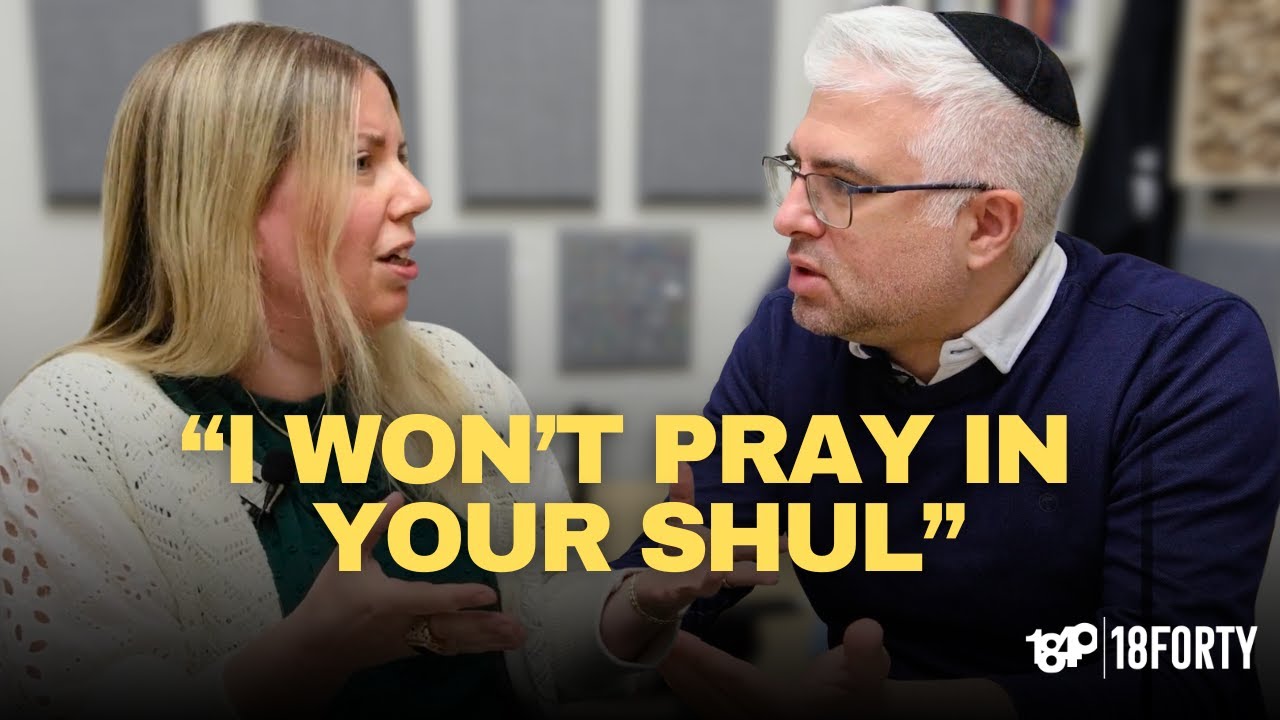
That is the move the rest of the parsha will ask of you. The farmer takes a story that belongs to the whole people, makes it his own, and out of that ownership his gratitude grows. Kayla Haber-Goldstein, on the 18Forty Podcast, describes that same work in modern terms, the work of taking a faith you inherited and never chose and deciding, as an adult, whether to make it your own or let it go cold.
RELATED: Rebuilding Faith as a Frum Person
The warning at the end of the parsha works the same way as the basket at its start. The farmer who says thank you over a basket and the nation that feels nothing in a land full of good are the same people at two different times, before and after they stopped paying attention. Ki Tavo puts the thank-you first, so you have the practice in hand before the warning ever arrives.
2. Two Warnings, Two Different Failures
The warning appears twice in the Torah, and the two tellings name two different failures. In Vayikra, in Bechukotai, it is addressed to a people who treat God “bekeri.” Rashi reads keri as “by chance,” a people who decide that whatever happens to them is random luck with nothing to do with the relationship, and who keep the commandments only when keeping them is convenient. Bechukotai describes what comes upon a nation that drifts into that kind of cold indifference, once its protection lifts.
Moshe delivers the Devarim version the same way, starting with a people who do not obey, but Ki Tavo adds a line Bechukotai never says. Devarim 28:47 puts the failure as serving “without joy and gladness of heart, out of an abundance of everything.” This is not the cold rebel of Vayikra. This is a people who never walked away, who still show up and keep the forms, and in whom the joy has simply gone dry.
Dovid Bashevkin, who built 18Forty for the half-in, still-searching Jew, talks in his episode on unchosen identity about staying inside a tradition you did not pick and are no longer sure you want. That is the person Ki Tavo worries about, the one who has not left and feels nothing, and it is a different person from the one described in Vayikra. The first warning is for the nation that turns cold and casual. This one is for the nation that still performs every ritual after the warmth behind it has died.
RELATED: What Leaving Religion Means to Me
3. Why a Full Hand Stops Feeling Full
None of this means you are a bad person for feeling flat. It means you are a normal one, and Moshe says so first. Ki Tavo says where the failure starts, “out of an abundance of everything,” and the danger is the abundance itself. A few parshiyot earlier, in Eikev, Moshe had already warned how it begins. There, it says that once you have eaten your fill and built your house, “your heart grows haughty and you forget the Lord.” You do not lose God in a crisis. You lose Him once the crisis passes and the good has become the wallpaper you stop seeing.
Sonja Lyubomirsky, the psychologist at the University of California who studies happiness, has a name for the same thing. In The How of Happiness, she describes hedonic adaptation, the way people adjust to good circumstances until those circumstances stop registering as good at all. The raise becomes the baseline. The health you once prayed for becomes the body you take for granted. A person can have nine things going well and one going badly and lie awake every night on the one.
Moshe Krakowski, on the 18Forty Podcast, has studied why people raised inside observance leave it, and the picture is rarely a single moment of rejection. Far more often it is a slow cooling, a person who never decided to leave and simply stopped showing up, one ordinary week at a time. That is the national drift of Ki Tavo, running one person at a time.
4. Joy Is a Practice, Not a Mood
If joy were only a feeling, the call to serve with joy would be a cruelty, because no one can summon a feeling on demand. But the tradition never treated joy as a mood that shows up on its own. It treats joy as something you build by doing. Rambam writes that the joy a person takes in doing a mitzvah, and in the love of the God who commanded it, is itself “a great service.” He is not describing a good feeling that happens to come along with the act. He is describing joy as part of the work, something a person climbs toward by acting, not something he waits to feel before he begins.
The Sages even built a daily practice to train that attention. The Talmud records the old obligation to say 100 blessings a day, a blessing before bread and after it, on hearing thunder, on seeing the sea, the moment your feet touch the floor in the morning. Those blessings are not decoration. They drag your attention, 100 times a day, back onto the good you have stopped seeing, which is the exact abundance Ki Tavo says you were meant to feel.
The research agrees that the drill works. Robert Emmons, who has spent his career studying gratitude, has shown that people who keep a regular practice of naming what they are grateful for score higher on well-being and lower on despair, not because their circumstances improved but because they changed where they were looking. Rav Dovid’l Weinberg, on the 18Forty Podcast, teaches prayer as song, putting a melody to the words until the words start to move you, instead of standing silent until you are already moved.
RELATED: Vayikra and the Shape of Sacrifice
5. Show Up Before You Feel It
There will be stretches when you get nothing back, when you make the blessing and the words feel hollow in your mouth. The Sages have an answer for that too, and it is not to wait until you mean the words. The Talmud teaches that a person should keep doing the mitzvot even when his heart is not in them, “because from doing them not for their own sake, he comes to do them for their own sake.” The Sefer HaChinuch puts it plainly, that a person is shaped by what he repeatedly does, and the heart is pulled along behind the actions, not the reverse.
William James reached the same conclusion from outside the tradition. In The Principles of Psychology, he argued that feeling follows action as reliably as action follows feeling, and that a person who carries himself as if he cared will find the caring follows. The numb person who makes the blessing anyway is not a hypocrite. He is doing the one thing that can return the warmth he lost, and walking away is the only move that guarantees it stays gone.
Rabbi Steven Gotlib, on the 18Forty Podcast, speaks openly as a rabbi who has wrestled deeply with questions of faith and continues to take those questions seriously, and explains how that struggle ultimately strengthened and grounded his Orthodox belief. That is the lesson Ki Tavo leaves you with, and it is not a verdict on your empty Tuesday. You cannot order yourself to feel grateful for the life you already have. You can say one blessing tomorrow morning and mean a single word of it, and let everything else grow from that one word.
Questions for Reflection
- Name three things in your life you prayed for once and now take for granted. When did each of them stop registering as a gift?
- The Sages ask for 100 blessings a day. Which blessing do you recite without intention, and what would it take to mean even one of them tomorrow?
- If the feeling really does follow the action, what is one practice you could keep this week without waiting to feel it first?
This project is made possible with support from the Simchat Torah Challenge and UJA-Federation of New York. Learn more about the Simchat Torah Challenge and get involved at their website.