Transcripts are produced by Sofer.AI and lightly edited—please excuse any imperfections.
David Bashevkin: Hi friends and welcome to the 18Forty Podcast where each month we explore a different topic balancing modern sensibilities with traditional sensitivities to give you new approaches to timeless Jewish ideas. I’m your host David Bashevkin and today we are exploring Jewish life on college campuses. This podcast is part of a larger exploration of those big juicy Jewish ideas so be sure to check out 18Forty.org, that’s 18Forty.org, where you can also find videos, articles, recommended readings, and weekly emails. I want to open up with a question I mentioned on a previous episode, a statement that I made that got not a tremendous amount but a considerable amount of pushback, criticism, people asking me to kind of flesh out what exactly did I mean by that because it relates so closely to today’s conversation, and that is the statement that I made when I was interviewing Diana Fersko, who is the rabbi of the Reform Village Temple, and I mentioned, though I’ve mentioned this in the past as well, that I believe not everyone can or should be Orthodox.
The can and the should in that statement for a lot of people was quite shocking to hear from somebody who, aside from being an Orthodox Jew—I don’t introduce myself this way but I am an Orthodox rabbi—how can it be that an Orthodox rabbi could say that not everyone can or should be Orthodox? What exactly did I mean by that? And I think it’s a very fair—I also happen to think it’s a very important question and one that lies quite closely to the work that we do on 18Forty. And let me begin by saying I understand why people found that upsetting. I understand it because of the amount of generations and time and effort and financial resources and genuine sacrifice that have taken place over the last, I would say, hundred years to build this modern edifice of a community that we call the Orthodox community in the United States of America. It did not have to turn out this way, and the fact that we have the community that we do, I have also said many times, is nothing short of a miracle.
The Jewish life that it provides really to the masses, to people of varying backgrounds—I think the strength of the Orthodox community is not its rabbis and scholars, which we have plenty; I think its real strength is in its just regular people who invest a tremendous amount of their life. They send their kids to Jewish day schools, they keep Shabbos week in and week out, they make brachos, they show up to synagogue, they go to shul. These are things that the Orthodox community sustains in a really unique way. The education gap, even the observance gap, between different denominations has only widened over the past few decades, and to dismiss or even diminish the accomplishments of the Orthodox community, you’d have to be blind.
I mean honestly, it is nothing short of remarkable. And my family, and I mean that—my father didn’t have to go in that direction. We were lucky enough that he chose to lead an Orthodox lifestyle. That was absolutely not a given in the home that he was raised.
As devout as my Bubby and Zaidy were to Jewish identity, Jewish practice, and halacha, and Jewish life, they did not know a great deal about. My father had to make an active choice to lead a certain kind of Jewish life. So I wanted to just begin by kind of reinforcing that. I secondly want to say, what do I mean when I say Orthodox? I mean, Orthodox is not a term that appears in the Torah.
It was a term I believe that actually originated in the Reform community or in reaction to the Reform community—that they were ortho, meaning straight, doxy, thinking, that they thought straight; they were not looking to reform the tradition that we had. But the Orthodox community is a lived community. It’s a community people may affiliate, they may self-affiliate, they may affiliate while the community doesn’t really see them as their own, or vice versa; they may actually lead perfectly Orthodox lives but they don’t see the Orthodox community completely reflecting their own. There’s a whole gamut of people and lives within this community, and it spans a great deal of levels of observance and geographies and even education backgrounds and styles.
I mean, there’s a very wide spectrum of Orthodox life. I would say broadly speaking it coheres to a certain form of, number one, institutional affiliation—obviously a synagogue that calls itself Orthodox; they send their kids to community day school, that has become the norm in most Orthodox communities; and I think Shabbos… observance, while there are certainly many people who affiliate as Orthodox or who pray in an Orthodox synagogue who may drive to shul on Shabbos or not yet completely observe Shabbos, I think the ideal of what Shabbos observance is, they still hold that in their head. They say, okay, I may not be able to do it completely, but I still have that affiliation, I still have that ideal in mind.
Now when I talk about not everyone can or should be Orthodox, I am not saying not everyone can or should try to bring Torah and mitzvos into their life. I think Torah and mitzvos are the lived way that we bring divinity into our life. This is the oldest debate that the Jewish people have had. I mean, this is very much what separates Judaism from Christianity is that we believe in a lived tradition, we believe in a commandedness.
With that being said, I also understand that not every iteration and not every kind of when we talk about the Orthodox community, not everything is perfectly aligned with that ideal. We don’t live in an ideal world. So first and foremost, when I say not everyone can or should be Orthodox, I’m referring to just the modern communal structures. Not everyone is in a relationship that is going to be able to transition into the Orthodox community.
Not everyone has that capacity, either emotional or physical or even financial capacity. Should they still? Is it worth it? Yes, I think it’s worth it for nearly everybody. There are people who maybe can’t stretch any further, or if they even tried to stretch it would yield such unspeakable pain that I think that they are not even obligated to do that. But when I say not everyone can or should be Orthodox, I am describing an imperfect world where Torah and mitzvos themselves are not performed perfectly, not by any community.
The Orthodox community is also not perfect. If we were perfect, we would have a hundred percent retention rate and every Orthodox Jew would smile and say, oh my gosh, my shul, my community, my school, everything is perfect. And if you’ve ever met an Orthodox Jew, that is not what they say. We’ve got plenty of complaints, lots to kvetch about.
We ourselves know we do not have a perfect vision of what Yiddishkeit should be. Now that doesn’t discount or delegitimize what I think collectively the Orthodox community has preserved. But it does mean in an imperfect world people are not necessarily going to have the capacity and if they don’t have the capacity they shouldn’t necessarily even attempt. If circumstances—like we’re not starting with a blank slate.
If there are circumstances in your life that prevent you from ever reaching full integration in the Orthodox community, and I believe that such cases do exist, we could argue about how frequently, but surely everyone knows someone in their life that our community did not work out for. I am not placing any blame, I’m not saying it was the parents’ fault, it was the school’s fault, I’m not placing any blame, I’m just descriptively acknowledging the fact that there are people who were unable to thrive in our community. That has happened, unfortunately, in all necks of—whether in the modern Orthodox community, whether in the Hasidic community, or whether in the yeshiva world. That just tells me not that we’re wrong, God forbid.
I think our tradition of Judaism is wondrous and miraculous and beautiful. But it does mean that we have not yet reached even our own ideal. We have not yet reached a form and a vision of Judaism that can even retain everyone who’s passing through our hallways, who’s already inside. And that is why I think it is important for specifically Orthodox Jews to think about what is the vision for the wider Jewish community.
If there has been an awakening post-October seventh, if there has been this sense that Jewish identity needs to mean more for our community if we are going to thrive and survive as we see our enemies emerge more boldly and more emphatically than we have in decades. If we see the steady rise of antisemitism knowing that we need to take responsibility for ourselves as a community, that leaves us with the question of what is our vision for the wider Jewish world? I wish we could snap our fingers, you know, like Marvel Endgame and put on our infinity gauntlet and snap our fingers and have a total blank slate where every Jewish parent and every Jewish educator and every Jewish child is getting the exact form and level of Yiddishkeit that completely unifies with their soul and they become a burning ember of divinity in this world for themselves, their family, their community, and the world. I wish I could do that. We don’t have that.
We have a world where everyone has been exposed to different forms of Judaism, whether or not you’ve left one denomination for another or just moved Some of us have parents who have nurtured a great love for Yiddishkeit and Torah learning, and some of us who had parents who were carrying their own baggage and had their own limitations, and we were unable to get that and we never had that. And we’re waking up in the middle of the story without a blank slate, where we have a majority of the American Jewish population who has never gotten a yeshiva education. They’ve never gone to yeshiva day school. So what now in the middle of the story, when we don’t have a blank slate, what is our vision of Judaism? When we have a microphone and we can reach beyond our community, what exactly should we be saying? I believe we are in that moment, which is why I personally, I certainly am not advocating everyone to leave their community and start proselytizing or even doing outreach to just get people more in your community.
And I do want to say publicly that I did and I do ask a rabbinic advisor before I really do anything. Everything I do is vetted and in consultation. So yes, I asked, I have a process to make sure that the decisions I make on 18Fortyare not stepping over clear halakhic guidelines. Everyone should do the same in their own life, but I did want to acknowledge that publicly.
But the question that is kind of occupying me and has occupied so much of the work of 18Forty is what exactly is that vision? How do we create a common vision for a Yiddishkeit that can reach beyond the boundaries when we’re halfway into the story and not everyone has yet found or discovered a Judaism that can uplift them, that is even worth them committing to? They don’t know enough to even want to commit, or people have been given too much and it’s too suffocating and they just want out. They just want autonomy, agency, and freedom. What do we do now that we are halfway in the middle of the story? And that is why I think at times it is necessary to reach beyond or even listen in to conversations that reach beyond and just talk, to study another Jew, to listen to their life, to appreciate their questions and realize that we can and should have answers for this. We can and should have a vision for everyone wherever they may be, whatever decisions have kind of already been handed down to them based on their childhood or their marriage or their professional limitations.
We all have limitations. But all of us, and that’s regardless of denomination, all of us have room to grow, whether it’s growth in our appreciation of the Jewish people, whether it’s growth in our appreciation and commitment to Jewish life, whether it’s growth in the way that we treat our wife and children, the way that we talk to our family, the way that we reconcile with people that we’ve fallen out with. We don’t have a magic antidote that sets us back to zero. But what we do have is the ability to listen and to have honest conversation that doesn’t need to impede on our lived commitments.
No one’s coming into our communities and changing anything. But I think everyone, no matter in what community, has a way that they can reach out a little bit more. They have a question that they can ask and surface about the future of the Jewish community. Are we doing right for the next generation? Has this awakening post-October 7th yielded a sustained new course for the Jewish world? Honestly, I am not sure and I am worried that we do not have the sufficient amount of philanthropic support, leadership, everyone coming together to chart a course for the future of Klal Yisrael, to chart a course for the future of the Jewish people.
I mean, we’re here. This is it. This is not a drill. And that is why I think today’s conversation is so fascinating and so important.
First and foremost, I am extremely grateful to our friends at Tikvah, particularly Jonathan Silver, who is actually the host of the Tikvah podcast where I’ve been a guest a couple times. He is a true friend and our friends at Tikvah in general, I’m very grateful for them inviting me to have this conversation at their most recent leadership forum, which brings college students from across the country to talk about civics and Jewish identity and the state of Israel and kind of all of these major important issues. And we thought about a conversation to talk about what is the current kind of religious climate on college campuses? What is Jewish life like on college campuses? Now, we have touched upon this before and we need a totally separate conversation to think about this within Yeshiva University, where I happen to teach. Yeshiva University is a Jewish college that is under Orthodox leadership and has a certain style.
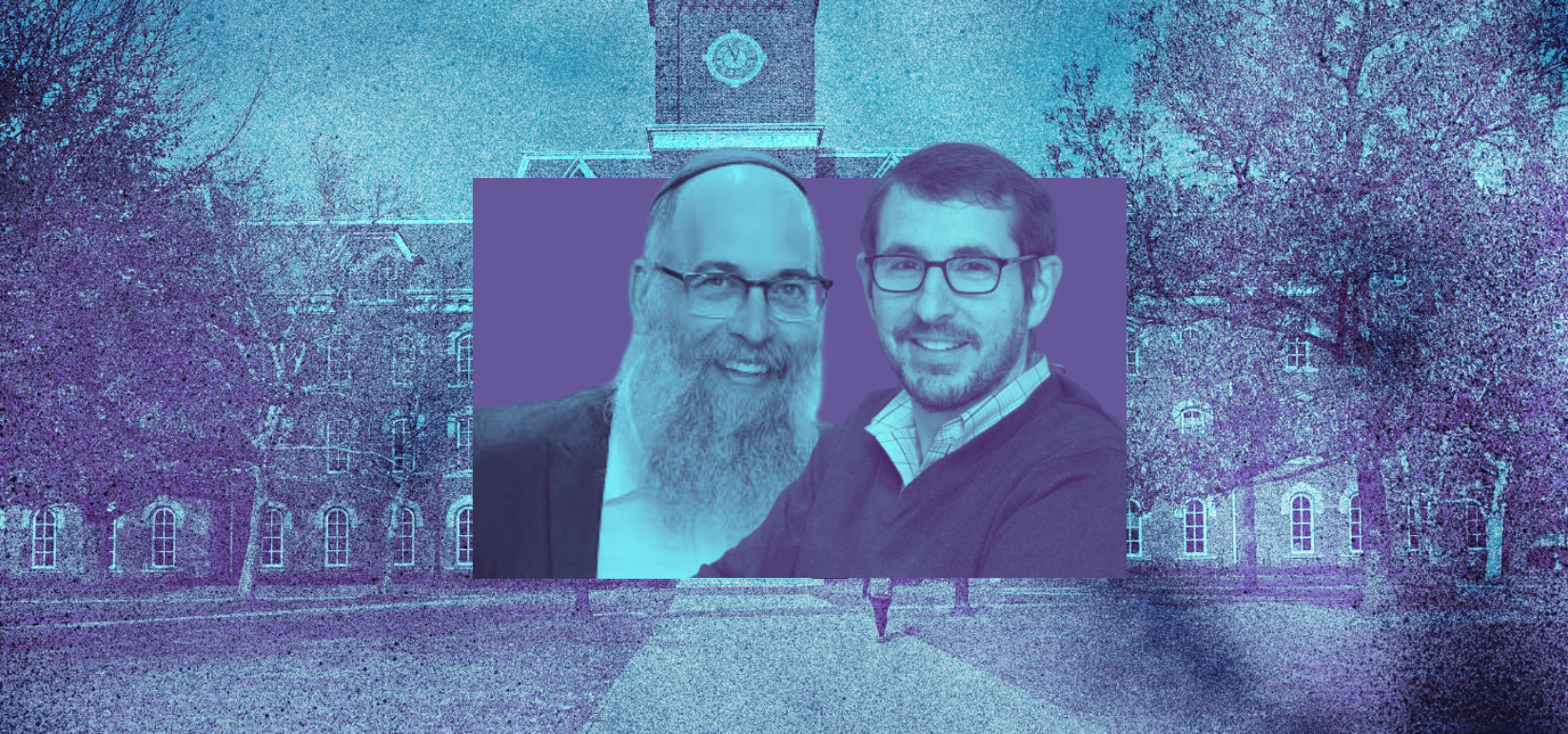
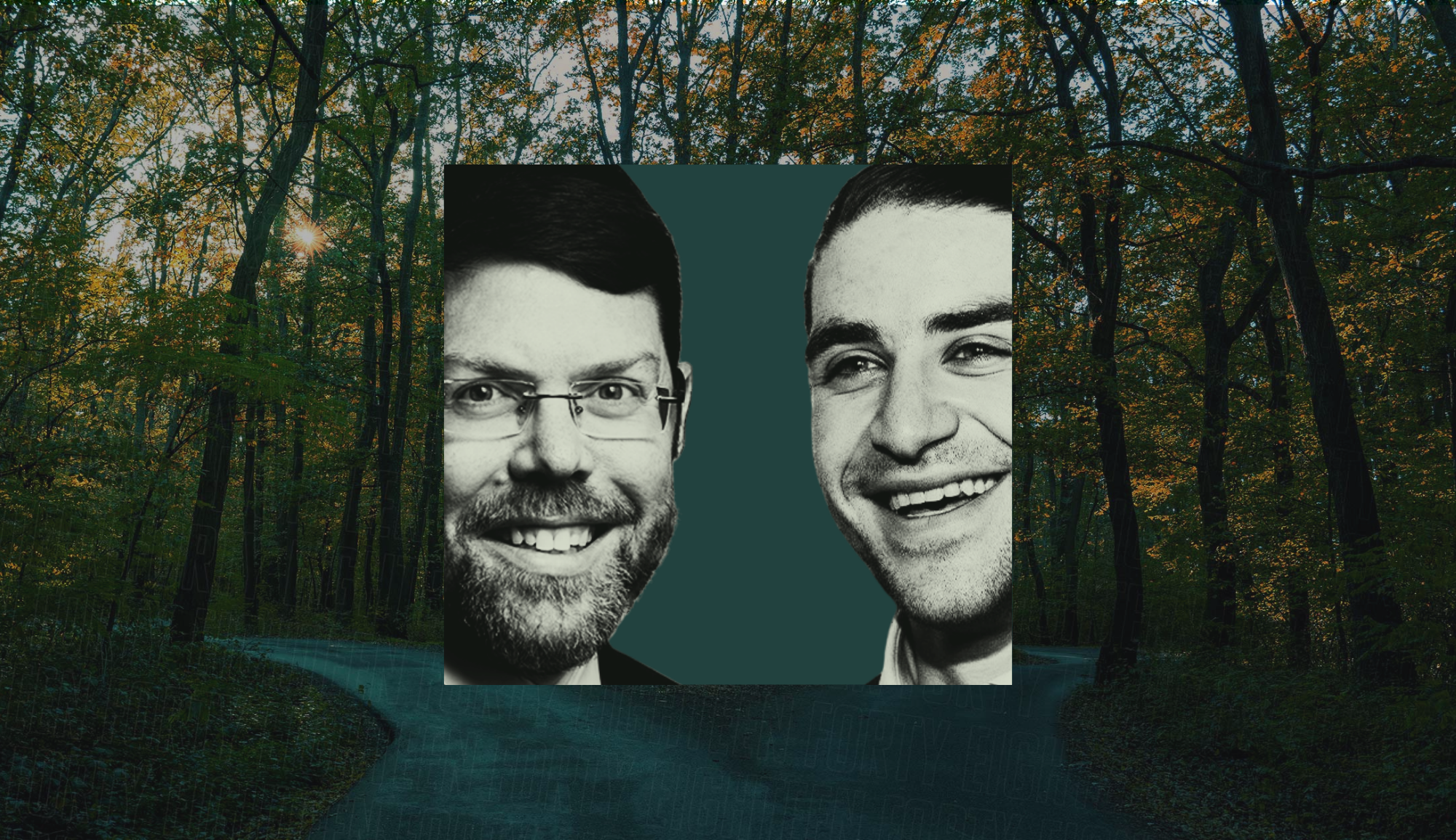
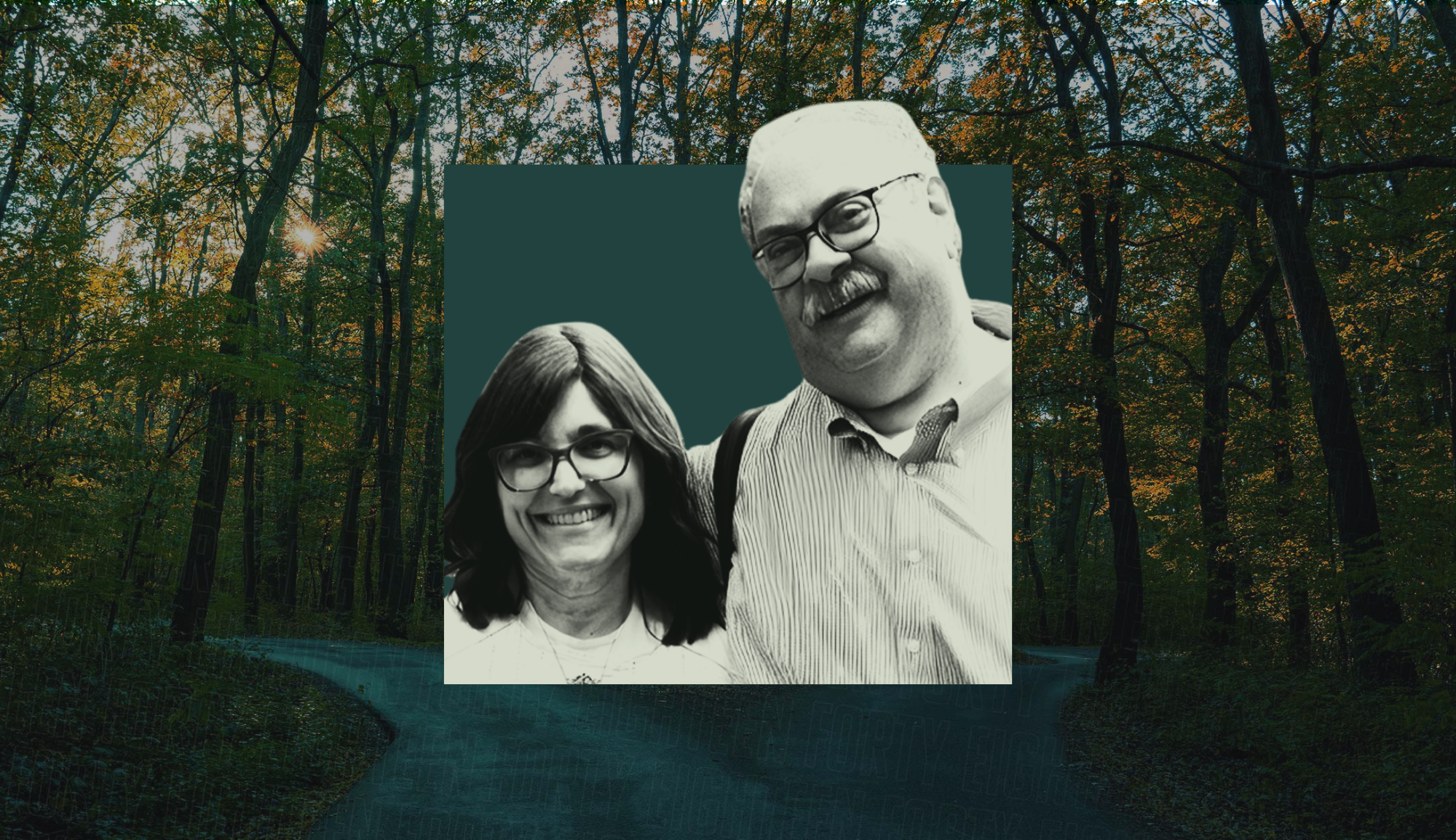
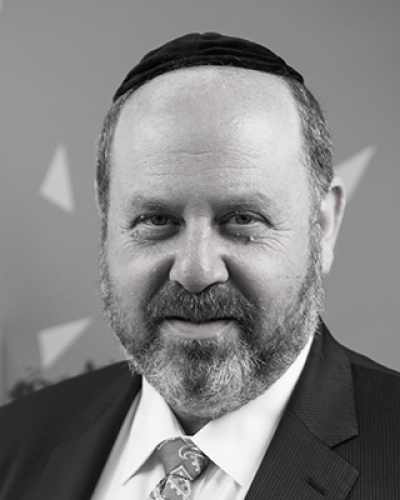
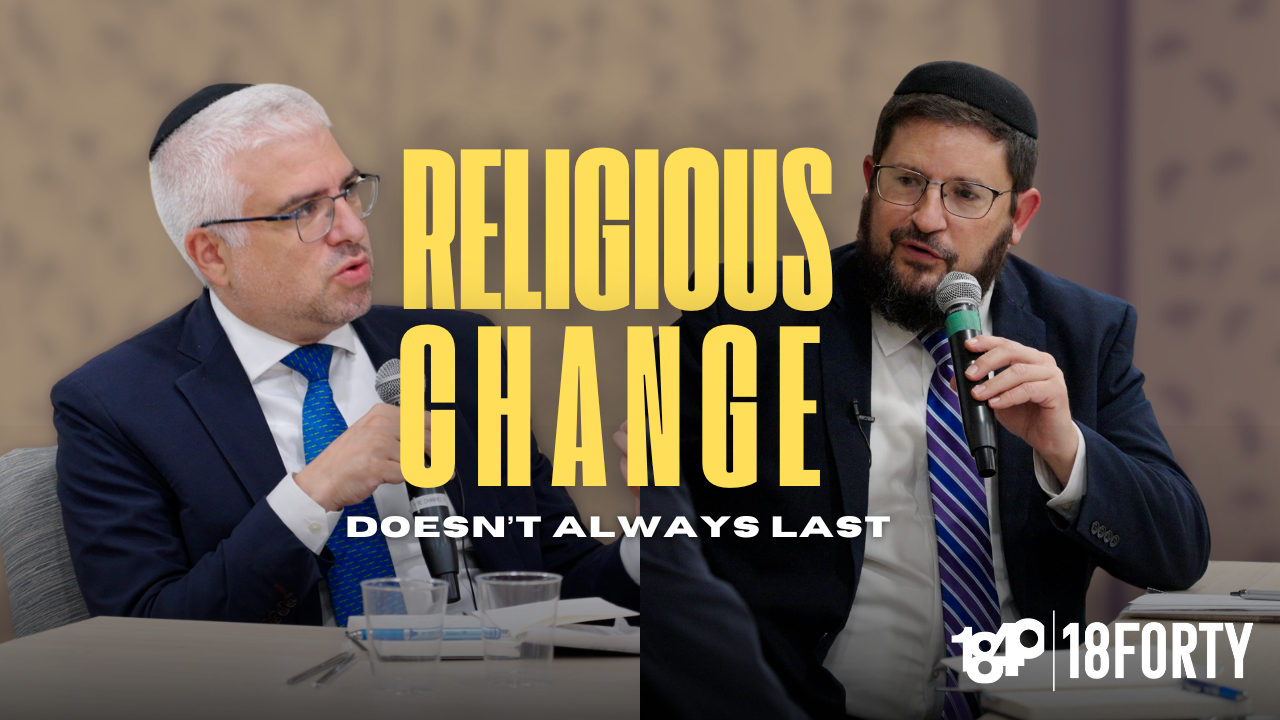
But a lot of the questions that came up in this conversation are equally applicable to Yeshiva University, the flagship Jewish university that I am proud to call my professional home. We sat down with a head of Hillel and a head of Chabad together in conversation to talk about the nature of Jewish life on campus. We spoke to Etan Webb, who is the founder and director of the Chabad house in Princeton, and we also spoke to Rabbi Ari Israel, who runs the Hillel in the University of Maryland. I know Rabbi Israel for quite some time, dare I call him a friend, I know his family, his wife has a very special place in my heart because she made me a plaque of all of my funniest tweets.
But our conversation between Rabbi Israel and Rabbi Webb, the head of respectively Hillel in the University of Maryland and the Chabad in Princeton, was about this religious awakening. Is it there? Is it real? But really underneath that question and at the heart of I think our conversation was should we be re-evaluating the way that we introduce Jewish life on campus? That I think is equally a question whether it’s a Chabad or a Hillel or JLIC or a Yavneh or any of the other host of organizations that serve Jewish life on campus. I think it is a fair moment to ask ourselves, are we prioritizing the right parts of Jewish life? Is there a way to sustain or to center or to elevate Shabbos observance on campus? Should there be a vision for what communities people matriculate into post-college campus? Are there basics of Jewish life and the Jewish calendar that you would hope a college-age Jewish student in 2026 would be exposed to? Who is the one ensuring that every Jewish college student has access to matzah, to a Seder, to Hanukkah candles, to the actual lived Jewish life? We’ve said it so much that it’s become a cliché, but the purpose of Judaism is not to fight antisemitism. We fight antisemitism so we can focus on the purpose of Judaism.
And I would ask for all of the philanthropic dollars and for all of the leadership and for all of the effort that has been made to fight antisemitism, and I’m not sure if the yield of that investment is even something to be that proud of, but that’s for other people to decide. Do we have the requisite amount of minds who are putting together and thinking about the actual vision of Jewish life? Who is in that room? This is of the most important questions facing the Jewish people. What is our vision for Jewish life? This is a question that every parent, every Jewish professional, I hope every college-age student, this is a question that we should be thinking about. And it is at the heart of this conversation.
And so really to our friends at Tikvah, to Jonathan Silver and of course to our two panelists for this conversation between Rabbi Ari Israel and Rabbi Etan Webb, I’m extraordinarily grateful. And without further ado, here is our conversation about the current state of Jewish life on college campuses.
Host: We’re going to run for our first session right into the core of the problems I’m trying to identify with the campus crisis. And when you hear that phrase the campus crisis, you probably think about another session.
You probably think about another panel on tentifadas and civil rights abuses and violence on campus and absurd activism. I don’t think anybody in this room needs another panel discussion about those. I’d like to do something else instead, which is to provoke a discussion about the intellectual and spiritual crisis that is driving women and men to ask profound questions and undertake serious efforts to learn outside the classroom. The explosion of YouTube videos and podcasts expresses a need that’s very rarely met in the classroom.
It represents a hunger for something that is beautiful and ancient and true that cuts through what seems to nineteen and twenty-year-olds to be cheap and inauthentic. That’s why Jordan Peterson exploded among college students. That’s why YouTube videos about ancient Rome are being watched for three hours at a time. That’s why some of you are here today.
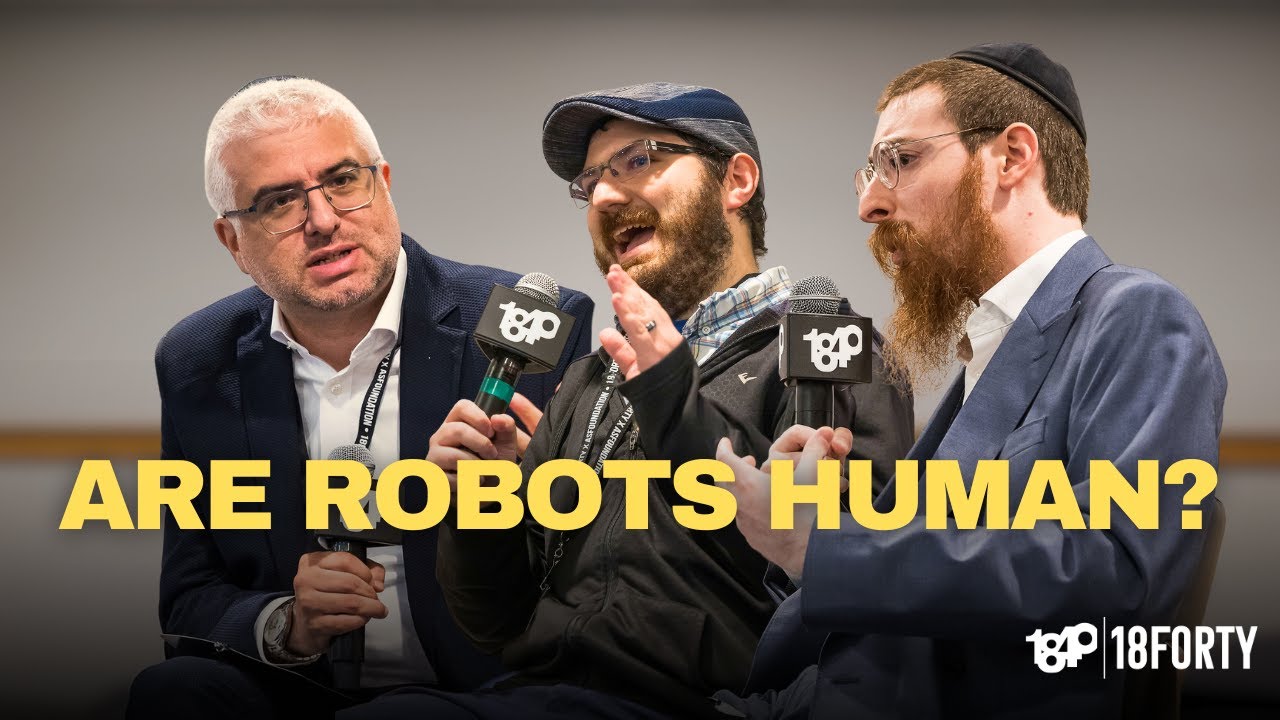
So we want to ask what rabbinic leaders on campus are doing to satisfy that deep longing. Rabbis are teachers of wisdom. So what responsibility do Jewish teachers of wisdom bear to speak into the lives of these young women and men? Into your lives? To explore that question we’re going to record a live episode of the 18forty podcast. If you’re not familiar with 18forty, it’s a platform that empowers Jews of all backgrounds to engage in explorations of faith and identity and community.
Its founder and grand impresario is Rabbi David Bashevkin, director of education for NCSY and a faculty member at YU. Joining him, of course, are two extraordinary rabbinic leaders: Rabbi Etan Webb from the Chabad at Princeton and Rabbi Ari Israel from Hillel at Maryland. Gentlemen, welcome to Tikvah. Rabbi Bashevkin, the floor is yours.
David Bashevkin: Thank you, thank you, thank you. This really is a distinct privilege and pleasure. So I really want to jump right in to our opening question and that is, reflecting on October 7th, reflecting on how that has changed changed the campus atmosphere and environment. Do you in fact think that there even has been a religious awakening among Jewish college students? And in what ways have you felt, if at all, some sort of religious revival of people exploring, looking to discover and taking their Jewish identity either more seriously or more nervously in the wake of October 7th? Let’s start with Rabbi Israel.
Ari Israel: Look, October 7th, we all remember where we were, we remember that moment in time and I think since, at least at Maryland I can speak locally, provincially, we are definitely seeing a revival, not a decline. I think there are studies out there that Jews are hiding their identity. At our campus, more students are more proud, wearing Jewish insignia, flags are all over campus. There are instances we’ll talk about a little later, but definitely seeing a revival and numbers and classes and interest.
Just one anecdote for a moment: a few weeks after October 7th, I’m the Hillel rabbi, I went to Yeshiva University and one of our conservative student leaders called me up and said, Ari, I think I want to take my mezuzah down. I’m very nervous. And I said, okay, we’ll talk about it back and forth, and her anxieties and handle sort of the situation and what she’s feeling. I said, look, if you’re more comfortable taking it down, by all means, you should take it down and be more comfortable from that perspective.
She then said to me, what are you hearing? What else is happening? I said, what’s interesting is I just put up six mezuzot this week. She said, really? I said, yes. And I told her where she was living, there was one in… she said, oh, if that’s the case and I’m a part of Am Yisrael, I’m part of others, I’m going to keep it up.
Just gave me one story, one anecdote, it’s not six to one, she was afraid and here’s six students, but I’m just giving you a little bit of one mashal, one story that I think is indicative of the revival that we’re seeing.
David Bashevkin: Rabbi Webb, tell me a little bit about what you have seen on the Princeton campus and what you’ve been hearing from your colleagues on Chabad on campus across the country.
Eitan Webb: The biggest revival, to my mind, is something which I think has not been noted much in all of the articles and all the literature, and that is the parents. In 23 years, I’ve never seen the hordes of freshmen which come into Chabad and to Hillel.
And that is a testament to the parents. And I’ve spoken to many parents about this and I’ve asked them about this and I’ve heard from many parents that they’ve said, yeah, well, we were always a little bit nervous to tell our children to go and inhabit Jewish spaces because sometimes when parents say things, children tend to go in the opposite direction. And so we’ve been kind of hands-off. And after October 7th, we said to our children, this is what you gotta do.
You’re getting on this college campus, you gotta go. And I think that is something which should be noted. Call your parents and thank them. But it is something I think that is important to be mentioned.
David Bashevkin: So let me jump in and try to get a little bit more specific about the current landscape on college campuses and what ways, if any, it may or may not need to change. There is a movie that I like to quote called No Country for Old Men, where the villain in the movie, Anton Chigurh, has this moment where he looks at this other person he has a gun pointing at him: if the rule that you followed brought you to this, of what use was the rule? Meaning, if you followed a certain methodology, whether Jewishly or at any point in your life and it brought you to this where you have… you’re sitting on a chair with a gun pointed at you, of what use was the rule? When you look at the classical Jewish campus experience, is there anything specific that you think needs to change in order to address this moment? Do you think that we need to reimagine in some ways what it means not just to survive the Jewish college campus experience, but to thrive Jewishly on a campus? What would need to change, if anything, to create an environment where the college experience was one where en masse we saw Jews thriving? Rabbi Webb.
Eitan Webb: So as a Chabad rabbi, I should never admit that I’ve seen a movie and this one I have no idea about.
But I reject the premise and I think that in the Jewish ethos, certainly in the Chabad ethos, certainly in the Chassidic ethos, we don’t believe in transformation of character, we believe in revelation of character. Gilui hamahus is the terminology of Chassidus, revealing the essence. And it is pervasive in Tanya, it is pervasive in the Chassidic literature that a person is a chelek eloka mimaal, a person is a literal piece of God here placed into your body.
And then yeah, you have a body and that body gets in the way and that body is troublesome, but the core is good. The core is brilliant. The addition of the Alter Rebbe mamash, the literally, literally this piece of God inside of you, that’s who we are. And this is there from chapter one of Tanya through chapter 18, which is today, where he speaks about how what we have is yerusha.
yerusha me’avoseinu. What we have is an inheritance from our fathers. And he explains this, that when we speak of the founding fathers of Judaism, Avraham, Yitzchak, and Yaakov, it’s not just that there is a people who were smart who had ideas that they gave to us. A father gives something more than ideas.
A father gives metzius. A father gives essence. A father gives core. When we say that we inherit something, we inherit something even if we don’t understand what it is that we inherit.
That’s what it says in the Gemara, right? That a person who is one day old can inherit. They don’t have to understand the inheritance. They have a whole life to understand it. But the inheritance is already there.
So to say what do we need to do in order to change cultures, to help the students to change, to help them to learn, none of that. All we have to do is help a student understand that they already are a ben Avraham Yitzchak v’Yaakov, a bas Sarah Rivka Rachel v’Leah. This is who their metzius is, this is their identity. You are a child of Avraham, of Yitzchak, of Yaakov, of Sarah, Rivka, Rachel, and Leah.
You are a prince and a princess. And if you know that, and if you absorb that, and if you appreciate that, everything else is easy.
David Bashevkin: That is a remarkable response, but I want to push a drop. Based on your response, what exactly are you rejecting in the premise? That nothing needs to change on college campus? We’re doing swimmingly? That we don’t need to change any of the programming or presence on campus? Meaning, yes, the process of surfacing one’s Jewish identity is more of a return to an essence rather than putting on a new coat.
But based on that remarkable word from the Ba’al HaTanya, from the first Rebbe of Chabad, the Alter Rebbe, what exactly does that mean for the college campus?
Eitan Webb: It means that if you walked onto a college campus, me, I walked onto a college campus 23 years ago, to Princeton. I’ll tell you the truth, a year before I went to Princeton, I did not know where it was. This is true. And when I came to visit Princeton, I walked around together with my wife, we met one or two students, we asked them a couple of questions which were probably highly irrelevant, and based on that we made a decision that this is where we were going to go.
We did not have long, involved conversations with the administration. We did not write long sermons to ourselves or to others about what our goals are, what our vision is. We had no vision. None, zero.
Our vision is the Lubavitcher Rebbe said “spread light.” That was the vision. We could have written it on the back of an envelope or on a napkin, and we probably did. And to the extent that we maintain that vision 23 years later, it works. To the extent that we deviate from that vision and say, “Okay, now I’m here and now I’m smarter, so now that I’m smarter I can take on all these other things and solve all these other problems,” I think those things are mostly a distraction.
So that’s the pushback.
David Bashevkin: That’s completely fair. I want to rephrase a little bit the question before I pose it to Rabbi Israel specifically, talking about his perspective from within a Hillel. A Hillel takes a decidedly pluralistic approach to Judaism on campus.
And what I would love to hear from you are what are the challenges post-October 7th that students, that organizationally have been taking place on campus in terms of maintaining a pluralistic coalition but still addressing kind of the existential needs of the Jewish people?
Ari Israel: Just to be honest, I do watch movies, but I didn’t see that one. And I didn’t see that piece of the Ba’al HaTanya, so I’m 0 for 2 here. 0 for 2. To answer your first question and then I’ll jump into where Hillels play a role and the opportunity for Hillels to continue to be great, I do think college campus needs a shift a little bit.
I really do. I think the greatest challenge that we are facing is not the atmosphere as a whole. It’s not SJP or a handful of individuals screaming at us. It’s, I do think professors.
There’s a challenge with professors. Not all, and we have some great professors in the room, so keep on doing great stuff. That is a challenge. I think that we need to address and we need to call out and we need to, you know, put that out there.
And the antidote, not for professors, is education. Jewish education. I think Hillels are primed for that, as Chabad are as well. I love the big tent.
I think the big tent is what Kol Yisrael is all about. We’ve always been a big tent. I think we get in trouble when we get too narrow and too provincial and too parochial. We don’t learn from each other.
Lomeid mikol adam, right? There is so much out there that we can learn. Religiously, Israel politics, everything else. I think there’s amazing opportunities. I think at the same time, Hillel is a big tent, but like any tent, we have poles, values, that hold up those tent flaps.
Like Avraham and Sarah, the tent is open, the doors are open. I’m doing a chuppah this afternoon of a Maryland couple. So we have an open tent, but we have poles holding up that chuppah. Those are our values.
And I think every great Hillel needs to have values. And one of those values is Israel. One of those values is Kol Yisrael. One of those values is, you know, ethics and who we are as individuals.
So I think it’s great to learn from everyone. And where do we have a red line, where do we not have a red line? I can go into details. Where do we… JVP students fit into that? If you want to sort of get to the jugular, I’m sure all of you are proud card-carrying members of JVP in this room.
I think it’s important though to identify where someone’s Jewish identity rubs against a value and how we play that stuff out.
David Bashevkin: I wanted for Rabbi Webb to kind of give an outsider’s perspective. If I were to pose that same question to you, you are not a Hillel professional. You work for Chabad who might be a part of that larger tent.
But if someone were to pose the same question to you, to look at what changes you would make to the Hillel landscape, where do you find the areas for growth or opportunity from the chair, the vantage point that you’re sitting in?
Eitan Webb: I don’t work for Hillel. I think it’s important for them to go and figure out what’s good for them.
David Bashevkin: What a lovely answer among Jewish professionals. I thought we were going to have a boxing match. I love the peace corps that just took place just now. Okay, this is a very blunt and basic question but I want you to explain your answer: Antisemitism on campus.
Too much attention or not enough attention? Please explain. Let’s start with Rabbi Webb.
Eitan Webb: If you’re a donor who wants to give more money because there’s antisemitism is pervasive- Listen, the Rambam lived at a time where he needed to run away from three countries. And he nevertheless wrote the Rambam, writes very little about his running away and we don’t remember him for that.
And history will know that there were problems in the 21st century, but ultimately we here in the room cannot become obsessed and overwhelmed by those problems. We need to be aware of them to the extent that they get in our way. We need to know what they are and be up front so that we can overcome them. But that’s all they are.
They’re obstacles. The whole premise of Mitzrayim is Yetziat Mitzrayim. It’s important to note that in the founding book, the founding document of the Jewish people, God tells Abraham, your children will be strangers in a land which is not theirs for 400 years and then they will go out. And the rabbis note that this is not a punishment because they hadn’t done anything wrong.
Know the story of the guy who goes and punches somebody and somebody says why did you do that? He says for next time. But this isn’t for next time. This is for this time. This is part of the forging of the Jewish people into who we are.
It’s part of the founding. We go down into this place, into Kur HaBarzel to Mitzrayim, into the forging furnace, into Mitzrayim. And as Chassidus says Mitzrayim is from the terminology of meitzar, of boundary, of gevul, of limitation. And the purpose is Yetziat Mitzrayim.
To come out, to come out bigger, stronger, more powerful and with an identity. And the Jewish people who spent their life in a desert looking back over their shoulder and said it’s a problem in the desert, we should go back to Egypt. They did not succeed. They were not in denial, but they did not succeed.
And Moshe who said to them, you have complaints, you want to have the melons and you want to have the cucumbers and you want to have the onions, I’ll give you the slav, I’ll give you the quail. Moshe was not in denial either. He recognized that they were in a desert. He understood that they had sand.
But he understood that he had a mission and that if you spend your entire focus on the sand and on the onions, you’re not going to get to eretz tovah urechavah. You’re not going to get to a good, special, fantastic, bountiful space. And so especially in this room, more than in every other room, but particularly in this room where people here have been spending so much time thinking about what our values are, Western values, Jewish values, who are we as an identity, you are the leaders, you are going to be the shapers of the future. It is important to be fully, fully self-aware, but it’s important to never ever fall into the trap of despair and of giving up.
Awareness is only and entirely for the purposes of getting up higher and of moving forward.
David Bashevkin: Rabbi, round of applause, that was quite beautiful. Rabbi Israel, same question: Antisemitism on campus. Too much attention or not enough?
Ari Israel: Probably depends on the day, the moment, the weather.
It’s like shifting sands. Antisemitism is real. We can’t deny it. We can’t pretend it doesn’t exist.
Our mascot at Maryland is a Testudo, a turtle, you know, sort of like hides into a shell. I think there’s beauty in a shell. I think there’s beauty in protection of a community and also we need to be out there, you know, visible, looking around, etc. I use languages, you know, we are not too far where we are right now from the UN, right, you know, on the East side of New York and UN is our greatest friend for the Jewish people, we all can agree. And university starts with UN and I actually like to look at three buckets of being uncomfortable, unwelcome, unsafe.
I don’t think Jewish students are unsafe at the University of Maryland or on other campuses. As I see, mental anxiety is real and I think that’s critical. I do think students are uncomfortable. That’s a reality in a post-October 7th world, but antisemitism didn’t start on October 7th.
It’s been around for thousands of years. It’s been around on college campuses and we’ve dealt with it before. So it’s not going away. We have to work hard to make sure that Jewish students are welcome and not unwelcome.
And that’s critical. One of my mentors Richard Joel, who recruited me for Hillel thirty years ago, he liked to quote one of the great Jewish philosophers Woody Allen: the definition of Jewish swimming is, “hey come into the pool and let’s not drown together.” I think we need to really work on a definition that’s going to be more inspiring than not drown together because of antisemitism. We need to work on a philosophy and an attitude that is rowing in the right direction, the butterfly stroke and the breaststroke and everything else that’s going to move us forward. That is I think the challenge.
When we focus too much on the crisis and every time I get an email from those beloved parents Rabbi Webb, who are amazing partners and also sometimes a little bit off the record please stop the recording annoying, I think we need to figure out a balance act where the parents calling us “oh my god I saw on Facebook” and the Jewish student is thriving and wearing an Israeli flag “but what are you doing about the problem?” I go, the problem doesn’t exist except for you’re making a problem that might not be there. And I think we need to balance that. So if we keep on trying gevalt, which is screaming out “don’t drown with me,” we’re in trouble and we have to refocus that conversation.
David Bashevkin: One of the really interesting presences on campus is known as the kiruv movement or Jewish outreach which for the last more than half a century has been doing Jewish outreach specifically to bring people into the Orthodox community.
There is a great deal of money and funding that is done to have programming that allow for a kiruv movement and whether it was in the sixties or in the eighties or this very moment there are many people who are dedicated to that. I am curious of how you relate to the kiruv movement, the formal movement of Jewish outreach. Is that how you would characterize your own work? Why or why not? And what do you think are the opportunities and struggles for the current campus kiruv moment in this 2026 post-October seventh moment? Let’s start with Rabbi Israel.
Ari Israel: I went into the rabbinate to connect with students, to build community, to help individuals to grow, to learn, to teach, to be involved in Klal Yisrael.
I don’t use the word kiruv. I actually like the word chizzuk. Kiruv for me is like “I have truth, come to my truth.” I believe we have truth, I believe everyone has truth. I think there’s a lot of opportunities out there, we can go back to my tent idea that where’s it fit, where’s in now, we’re not gonna get there now.
But I like to mechazek et kol adam b’atzmo, each person on their own opportunity. Each of us can grow by yourselves, I want to be a part of it. Chizzuk. I also mechazek et atzmi, I strengthen myself.
I think there are amazing kiruv professionals, there are individuals who are impacted and are becoming shomer Torah u’mitzvot, mah tovu u’mah na’im, beautiful. I think sometimes if you want a little bit of pushback from the kiruv community is for some individuals, and I’m not speaking about anyone in particular, but some kiruv professionals sometimes one size fits all. “Oh, you’re becoming religious, you have to go to this yeshiva in Israel.” But it might not be the right fit. But that’s the place where we send people and we have to balance.
Is there a place of a different ideology that might be better? And I think that’s a challenge, one size doesn’t fit all. And I have to deal at Hillel and other places sometimes we have to deal with some of those challenges and we have to think about how we think about the whole person and they’re doing great work.
David Bashevkin: Rabbi Webb, any thoughts on the current state of the larger Jewish outreach movement?
Eitan Webb: The short answer is going to be the same answer that I gave with regard to Hillel, I don’t work for them. But the truth is that the Rebbe’s approach was holech v’mosif v’or, to go and increase in light.
Period. It is not a mantra, it is just the way that it is. You go and say “do another mitzvah” and then study a little bit more, “teach somebody else do another mitzvah,” “teach somebody else do a little bit more.” And the fact is that there are going to be people who reach people that I do not. That’s just how it is.
I relate to some people and to others I relate less. And there are going to be some people who come away from this and say “oh Rabbi Webb was so interesting” and some are going to say “Rabbi Israel was fantastic.” And people will relate in different ways to every conversation. That’s true in terms of what people call kiruv professionals too. Some people will work really well with a person that holds their hand and listens and guides.
Some people want to have someone stand up to them and say “you, get on a plane and go to Israel.” Look, if it works it works, I’m not stopping it. I think that there are many models, I think that there are many approaches and I think that the Jewish people is large enough and diverse enough and that we can trust our students to be smart enough to be drawn towards the things which they feel drawn towards and to move away from the things that they feel comfortable moving away from.
David Bashevkin: You are really good at giving PC answers, I just want to give you a round of applause for that very PC, you avoided a lot, but I want to drag us right back into it and I really do want to hear from Rabbi Israel but really both of your perspectives on this. Specifically the role of Chabad.
Chabad, which you’re a member of, their campus movement has rightly received a great deal of appreciation for its impact on Jewish life on campus and throughout the world. Looking ahead, what is one area where you think Chabad’s campus presence could be expanded or deepened? even further and one area where you think maybe caution or restraint is especially important as you and Chabad more largely continue your incredible work. I want to first hear from Rabbi Israel who’s really an outsider, you don’t work for Chabad but is a part of the larger umbrella, what do you see in this moment the great opportunities and areas that you would see as a Hillel professional of maybe room for restraint?
Ari Israel: To quote a mentor and a guide and a dear friend who I’ve known for about 45 minutes, I don’t work for Chabad, they’re doing great stuff, and thank you. And I really adore my colleague Rabbi Bachman, Elie Bachman at Maryland and the Chabad professionals at Maryland, we work really well together and mah tovu umanayim and keep on being matzliach and you know the Rebbe should be proud of all the good work that you’re doing.
David Bashevkin: So let me rephrase it for Rabbi Webb: are there ever instances where the work of Chabad on campus is butting up or there is a misalignment with the Hillel on campus?
Eitan Webb: Yeah.
David Bashevkin: Can you give—can you give me is there a common theme of where that misalignment arises, is there areas where it happens more often or less often and is there any way that we could address it so it happens less frequently going forward?
Eitan Webb: I’ll tell you a story, everything reminds me of a story. I’ll tell you two stories. Many years ago there was a student at Princeton who would engage with me on a regular basis about my position on various things as it relates to our holy land Eretz Yisrael.
And it came to a point I think where we both knew each other’s lines, you know, we’d spend an hour and we’d say our pieces. And I said to him, why don’t we learn Tanya? And he said to me, why should we learn Tanya? So I said the real reason is because this conversation is boring. You know what you believe, I know what I believe, you’re not convincing me, I’m not convincing you, this is just, it’s not interesting. So he said okay.
So we learned Tanya and we did it for about a year and a half and went through the whole Tanya and we finished it, I said, how was it? He said I hated it. I said okay, so why do you stick through it for 18 months? I knew the answer, because he’s more stubborn than me and he couldn’t stomach the idea of telling me that, you know, he doesn’t like it, he’s going to stick it out all the way to the end, never ever ever give up and have me have the satisfaction of knowing that, you know, not going to happen. All right, so after 18 months he said, but now it’s my turn. I said okay, so you pick a book.
So he picked a book. We did that for a while, then I picked a book. My second book was Chelek Yud of Likkutei Sichos, the tenth volume of Likkutei Sichos. And we did it for about four years and we finished it and we made a siyum on it.
And afterwards he told me he never went to yeshiva, he never learned Gemara, he never properly read a book in Hebrew. But again, he’s very stubborn, so he was never going to admit that to me and so he would take time on his own to review and to practice and to make sure that he was, you know, up to snuff. I don’t know if I’ve changed him politically, I have no idea. But I do know that we’ve gone through a few really good books together, we’re very close friends, and that if I need to I can reach out to him on almost any subject and we can have a conversation.
When the Hillel director came to Princeton, the most recent director, we met, he said to me, how are we going to work together? And I said to him, this is how I work with people: if you want to go and create a relationship and the relationship is based in Yiddishkeit and the relationship is based in Torah, then we will become friends. And if we become friends everything else will work. If not, everything is just a challenge because oh do you know why he did that, probably because he doesn’t like me, you know why he did that, oh because he’s planned to steal that donut. Friendship takes down these walls.
And when you don’t have friendship then you dream up all sorts of other things. And so this is what we’ve done and we’re now in the middle of the 25th chapter of Tanya, 26th chapter of Tanya we just started, and it’s been a few years and we study together every single week, the Hillel director and myself. He says it publicly so I don’t mind saying it. And after October 7th we spoke and I said to him, I don’t know if we’ll always be on the same page, maybe we will, maybe we won’t, but we have a friendship.
And because of that he’s going to do what he’ll do and whenever I can align I’ll be there, and I’m going to do what I’m going to do and whenever he can align he’ll be there. And I don’t think that we agree on everything and I probably don’t agree on most things, but because that yesod is there, because that foundation is there we’re able to go and do better for the campus.
David Bashevkin: Absolutely beautiful, I want to shift now and talk more generally about the state of Jews on college campuses, specifically the basic knowledge of a basic Jewish education. Students come to you on a college campus and they have already been through elementary school, they’ve been through high school and they may have had very varying experiences in terms of their own Jewish education.
Do you have in your own mind your conception of what you would hope a basic Jewish education should look like for a college-aged student? Someone wants to know, I am now of college age, let’s leave aside what missed opportunities I had or too much opportunity I had from elementary or high school, is there a basic threshold of what you would consider a baseline Jewish education that we should at least strive that all college students should have? Let’s start with… From Rabbi Israel.
Ari Israel: I don’t know how many of you actually let’s do a poll quickly, how many of you in this room went to Hebrew school, not day school, Hebrew school, Sunday school? Alright, about maybe 20 percent. So if you keep your hands up I’d like to give you a hug and say I’m sorry.
I’d rather get a clean slate when they come to Maryland than a usually negative slate from Hebrew school. I teach university course, Jewish identity and leadership, and many students just have this negative perception. So I’ll ask a different question. How many of you had a Bar or Bat Mitzvah? Just raise your hand.
Okay. How many of you know where that suit or dress is from your Bar or Bat Mitzvah? Okay, when’s the last time you put it on? All right, it probably doesn’t fit, but for many students they come to university growing, they have the same perception, they stopped their Jewish identity their Bar Bat Mitzvah and they don’t grow with their Judaism and they’re growing everything else and taking classes in physics and English, you know, but Judaism is stale. And I think we need to shift that sort of focus, get there are some core values. Go back to Israel.
I’d like us to work together on not the what of Israel but the why. Not defending Israel, but defining it.
David Bashevkin: No, I wanted to jump in because you pivoted and I was very careful. There are a lot of beautiful Jewish values, but I want to stay focused on what a basic Jewish education should look like.
A student comes to you and says I didn’t get to go to Hebrew school, I didn’t, you know, my Bar or Bat Mitzvah was many many years ago. Is there like a baseline where you would call this is the starter pack, this is what you should be familiar with to catch yourself up so you are able to share in the common language of Jewish education?
Ari Israel: I mean the simple answer is yes, there’s some basics, right? Hebrew, basic Hebrew
I think is critical, basic connection to Israel and its history and its identity, but not just the political side of it but I go back to that language of why not what. I think ethics and values are critical in terms of how do we see Judaism through a lens of ethics and values, not just you come to Hillel you’re Jewish but you go to the math department you’re not Jewish, it’s not the proverbial take off your kippah, but how does your identity fit in both of those. Your Jewish identity, I think Shabbos is critical.
I’ll talk about Shabbos a little later. I think Shabbat is really an amazing tool, an amazing key, and I think tools of Shabbat, not just the don’ts but the do’s I think is critical. Basic calendar. Basic calendar of the year.
It’s not that Tisha B’Av is the most important holiday, but having an understanding of the path to the history is what Tisha B’Av represents and how we move forward and learn from that.
David Bashevkin: I really appreciate, I appreciate the Tisha B’Av shoutout because I think it is a holiday of remembrance that does not get such great PR. Rabbi Webb, what would your answer be? What is that basic Jewish education that you at least strive to cultivate I’m sure in your Chabad on Campus?
Eitan Webb: The technical answer, if you’re going to read one book and one book only in the modern Jewish sensibility, I actually would say that you should get This is My God by Herman Wouk. It is an old book and still I think one of the best primers on Judaism.
He’s an interesting writer, he’s a fantastic writer, doesn’t spend too long on any one subject. You guys are smart and can read the whole thing in a few hours and I think it’ll start you off well. I would say this is a question which bothers me a lot and at Princeton we’ve done two things to address it. One, we actually have a person on staff whose job it is to study with people individually, not in a class setting, but on an individual basis.
And you can set up time, if it could be 45 minutes a week and it could be 10 hours a week. And this is specifically meant for a person that says I want to go deep. We jokingly call it the Princeton Yeshiva. We’ve had many people who have gone through here who have not been able to read the Hebrew alphabet and have graduated learning Gemara if that’s what they want, learning Chassidus if that’s what they want, learning Chumash if that’s what they want, going through ideas of Judaism if that’s what they want.
It’s specifically meant to be tutoring for a smart person that says how do I get to the next level. It’s also why we created the Princeton Institute for Hasidic Thought, which is probably beyond the scope of today’s conversation, but you can look it up online and it is a pretty fantastic place. And I will just say on the on this subject, you got your first disagreement. I will disagree with what Rabbi Israel said, that he wishes for a clean slate.
I would never ever wish for a clean slate. In fact, the Alter Rebbe writes in Tanya, as you can see Tanya is going to be my go-to book, le’olam ya’asok adam baTorah afillu shelo lishmah shemitoch shelo lishmah ba lishmah. Quote from the Gemara, the Talmud says that a person should always involve themselves in the study of Torah even if it is not for the correct reason, afillu shelo lishmah, because if they do it not for the correct reason they’ll ultimately do it for the correct reason. And he asks is that really a good approach? And he suggests that what the Gemara is saying is the following: information, knowledge, at its core is something which is cumulative.
You cannot get to level C without levels A and B. And even if a person got to level A because it was force fed, and even if they got to level B or C or D because they weren’t interested and someone gave them information or whatever else, it’s nevertheless cumulative. And at any moment, at any moment that a person says, “Ah, I’m interested, I’m connected, I want to click in,” at that moment everything up to there folds into the right now, it folds into the here. And so even if a person says I don’t really find myself motivated by Jewish thought read it.
Even if a person says I find myself for now antagonistic to ideas of Judaism read it anyways. Keep on reading keep on growing because emotion is a funny thing and you never know when your emotions suddenly shift and say you know what now I’m interested. But at the moment that you become interested you don’t want to be five years behind.
David Bashevkin: My final question is almost thinking about what comes after the college campus experience.
There is a very beautiful ecosystem of communities on a college campus and then you leave the college campus and you go out into the wider world where there’s a lot of choice the communities are much more mutually exclusive you can’t belong to all the communities. The Hillel the Chabad the Meor the JLIC all the acronyms are kind of right next to each other on a college campus and you go out and you build a life on Judaism for the rest of your life and it is much trickier to navigate that world that you had on that college campus. Thinking about what comes afterwards I want to ask do you think that there is a common Judaism of what allows people to remain tethered and bound to a lived Jewish experience after they leave the college campus? Not to say any particular denomination or any particular neighborhood but do you think there is a core basic essential Jewish experience that students should insist upon if they want to continue their lived Jewish experience after they leave the cozy ecosystem of college campus communities? Let’s start with Rabbi Israel.
Ari Israel: I appreciate that question something I think about on a regular basis not just dealing with the four years of a college campus but sort of what happens afterwards and I’ll try to summarize my attitude towards this and bring in some of the other questions that you asked.
I’d go back to Shabbos. I think Shabbos is the great equalizer. I really do. At least the Friday night experience.
I mean I keep Shabbos as a twenty-five hour experience of beauty and I think Friday night is definitely an equalizer goes back to some basic knowledge skills and I think there’s something there that is critical. The October seventh moment was for all of us I think a pivotal moment and I ended up performing a wedding the Sunday after October fifteenth. My son-in-law Rabbi Josh Fagan who I’m a huge fan of I texted him he was in Israel at the time and I texted him said Josh I need a Dvar Torah because the couple I’m marrying the chosson the groom his Hebrew name is Levi Yitzchak and he is an eight-generation descendant of Levi Yitzchak of Berdychev. He knew it the kos I held under the chuppah was the fourth generation the middle generation he was named after his great-grandfather.
I said Josh I need a vort. I need a piece of Torah. It was Parshat Bereshit right after Simchat Torah and he quoted Rav Levi Yitzchak and Rav Levi Yitzchak says when there’s choshech al p’nei tehom the second pasuk in the Torah there’s darkness in this world which we’re still living in Vayomer Elokim Yehi Or there should be light. Rabbi Webb spoke about light there needs to be light that’s a simple antidote.
Rav Levi Yitzchak only a Hasidic rabbi could do this puts a comma that didn’t exist. It’s Vayomer Elokim Yehi Or God said let there be light. Rav Levi Yitzchak says Vayomer each and every one of us has to say Elokim God bring or. I think my attitude is that all of us have to be the driver in the driver’s seat and I think to some extent we are passive birthright is a problem it’s a beautiful gift but to some extent that’s not how we live on a regular way free Shabbos dinners that Rabbi Webb and I do at Hillel and at Chabad is a challenge because people aren’t owning that experience.
We have to teach people how to fish we have to teach people how to make the kugel not just eat it. Vayomer all of us have to be involved in our Judaism Elokim Yehi Or we have to partner with God and we have to bring light that is our opportunity and that is our mission it’s not simply passive but it’s an opportunity.
David Bashevkin: Round of applause for Shabbos. I have only spent one Shabbos on a college campus and it was on Rabbi Ari Israel’s University of Maryland campus and the way that he cultivates that Shabbos experience insist for the rest of your life that whatever community you belong to is able to cultivate a Shabbos experience.
Rabbi Webb final word on that common Judaism that students should insist upon after they leave campus.
Eitan Webb: Well in the spirit of a common Jewish experience I’ll agree that we should go and focus on Shabbos. There you go.
But it really it has to be not only Shabbos it has to be taking what you have in order to provide is really the big point of the Yeshiva system the college system there is a time in your life which you’re meant to be taking. You’re supposed to be you’re in school you’re supposed to be taking knowledge you’re not supposed to be chasing money you’re supposed to be sitting with books you’re supposed to be curled up on the couch supposed to be sitting in the library and reading and talking to friends and gaining experiences that is what you’re meant to be doing. And in that time if you say I’m not going to use that time to go and absorb I want to use that time to go and run around do a million other things you’re going to turn around later in life and say wait why didn’t I read why didn’t I absorb? This is the time. It’s okay to be selfish right now.
It’s fine. Fine. You don’t need to worry about how to give. Just take.
Take. Take from anyone who is willing to go and provide you. Somebody’s willing to go and teach you, sit them down and say, “I want nine hours of your time.” And apologize, “I’m sorry I took nine hours, but I would like another nine hours tomorrow if you’ll give it anyways.” Just take the time. If they offer a finger, take the hand, take two hands, just take anybody who is willing to give you education, take it and take it and take it.
Because this is your time right now. And yes, there is the time when that flips. You will leave the campus culture, you will go into the world, and then you go and become the matfiach. That’s the terminology of the Gemara: tofeach al menat l’hatfiach.
To absorb in order, not just in order but conditional, al menat, conditional on that you will one day then be the provider of that education. But nobody can provide if they haven’t absorbed. So right now is absorption time. Yeah, we’ll talk to you later and tell you why you should be donating to the Chabad and to the Hillel and to the Me’or and to all the other things, and we’ll have all those conversations.
But right now is not that time. Right now is the time for you to go and just absorb.
David Bashevkin: Okay, we have very limited time, but I did want to allow at least for one or two questions from the audience. Let’s see our friend Benjamin.
Question: Hi, I’m curious, given the discussion of very big tent Judaism and the willingness to meet a very wide variety of people in a very wide variety of places, is there any boundary at which we can say this person or this group of people has affirmatively stepped outside the tent, has separated themselves from the future of Am Yisrael? And if not, how do we deal with the very real challenges of trying to be in unity with those people?
Ari Israel: The answer is yes, right? I mentioned before that we at Hillel have a big tent, tent’s open and we have poles, right? Those values. JVP as an organization is outside those values. Anti-Zionist, non-Zionist, etc. outside those values. As individuals, they’re welcome and they do come to our community, absolutely.
Jews for Jesus, I know that some might, I’m just going to put it out there, right? It’s a different religion. I work well with the Catholics and the Protestants on campus and the Muslims. Amazing. But outside that tent, that’s not a Jewish expression.
So yes, 100 percent we would have fine lines that we need to say no. And that’s a challenge, you know, and it hurts sometimes to say no and sometimes it’s important to say no too.
David Bashevkin: What’s your name?
Question: Bailey.
David Bashevkin: Bailey.
Question: So Rabbi Israel heard you talk a little bit about student leadership. I’m curious from both of you since you’ve been on campus for a long time, you’ve probably seen like a lot of different variants of student leadership on campus. I guess, like, just being observers of that, do you see positive benchmarks of student leadership and involvement in the Jewish communities that has like really grown communities versus maybe like having seen, I guess, negative experiences of student leadership on campus?
Eitan Webb: It’s really hard. It takes an enormous amount of forethought, and sometimes we get it wrong. We moved to Princeton, our first student board was three students. We now have, I think, 33 on our student board.
And we had over 60 or more than that applications. It gets harder and harder and harder. Now, we want as much as possible to bring everybody in, to give them some sort of leadership role, but more than leadership role, we want to give them a role where they can go and discover their own leadership skill inside of themselves. This is something which I can give a formula for it, but it would take much longer than the time that we have.
I actually can do it, but it’s, there’s a lot of grunt work.
Ari Israel: Very quickly, I’ll just answer and say leaders are amazing, partners are amazing, students are amazing, and the beauty of Hillel, and one of the reasons I’m not in congregational work, is that you graduate every four years. When someone is not the best in whatever that means, too much of an ego, too caustic, that person graduates, and the challenge is when most great leaders graduate, that’s a constant rebuild, but sometimes it’s a beauty to send people home.
Eitan Webb: So the pushback on the pushback, I will say that maybe the success of Chabad is that people graduate four years, we’re still in touch with them.
And we are in touch with over 4,000 people still today.
David Bashevkin: Any closing words from either Rabbi Israel or Rabbi Webb?
Eitan Webb: Well, mine are very simple. Challenge yourself, grow, don’t be afraid to get things wrong. I get things wrong every single day.
And sometimes you’ll be corrected and you’ll buck up at that correction. Sometimes you’ll be corrected and you’ll accept it. It’s okay. Life is long, mistakes are common, Judaism is forever, lean in.
Ari Israel: Future of Judaism, Deborah Lipstadt, we need a lot more joy and not oy. I think it’s critical we focus on that positive energy, not the negative number one. Number two, on the question about Hillel before, Battle of Midway, 1942, navy pilot, attributed to a navy pilot, as they were getting flak, flak is, you know, anti-aircraft carriers shooting at the plane. And the person said, “What are we doing?” He says, “It’s good.
We’re over target.” So when Hillel gets flak, that means we’re over target. I’m okay with flak as long as it’s l’shem shamayim and we’re moving forward. And the last thing, just a little end with a piece of Torah is the word l’chaim, as we’re all, you know, celebrating life. On the outside are four, two letters, a chet and a mem, which we need passion.
We all need and thank you for your passion, your leadership, and the inside we need yud-yud, we need God inside of us. And that is the balancing act. L’chaim‘s not just a vort, not just a word, it’s not a drink, it’s an attitude of life that we have the passion inside and the warmth outside and together really Am Yisrael Chai.
David Bashevkin: As we began, the purpose of Judaism is not to fight antisemitism, we fight antisemitism in order to focus on the purpose of Judaism. So a round of applause to our incredible panelists for helping each of us find that purpose, discover that purpose for a lifelong Jewish growth. Thank you all. Hovering under so many of these conversations, whether it’s the conversation with Rabbi Israel and Rabbi Webb, the head of a Chabad and a Hillel, whether it’s the conversation with Diana Fersko and thinking about Jews within the reform movement, whether it’s a conversation with Rabbi Mark Wildes about the modern Orthodox community and Jewish outreach, I think there’s a common denominator at least in my mind that animates all of these conversations, which is how do we do a better job of sharing the best of the Jewish world with the rest of the Jewish world? And in a way, this is a conversation that I recently wrote about in an article on eJewish Philanthropy which was entitled What Orthodoxy Has to Offer for Non-Orthodox Jews and No It’s Not Kiruv.
The reason why I made a distinction with Kiruv is the objective of Kiruv, meaning real complete integration within the Orthodox community, is a worthy and lofty goal for many. I am just not sure that given the current state of the American Jewish community that that is a realistic goal. It is one that we can continue to strive for, but I feel like we need another vision and another plan. What are we going to do to move the needle to make sure that this post-October 7th awakening, this new moment of what it means to be a Jew in 2026, to take responsibility for our Jewish lives and Jewish identity, may need a different frame? And what I offered in this article was almost like let’s put down our weapons for one second and instead of arguing about which community is right, let’s just figure out some model or some basics that we could all agree upon would be better and the larger Jewish community’s lives would be collectively enriched if we embrace them.
The quote that I mentioned both this conversation and in this article comes from a movie called No Country for Old Men and in this movie the villain of the movie, Anton Chigurh, is pointing a gun at somebody. He clearly already has the upper hand and he basically asks him, he says if the rule you followed brought you to this, of what use was the rule? And I just look at the current state of the larger American Jewish community and I am worried. If the rule that we followed brought us to this, where we have large swaths of Jews who sadly don’t even have a basic Jewish education, who are being asked to serve as representatives in a cosmic battle, this is a real battle of good and evil that we’re seeing in the world and you have Jews who it’s hard to appreciate what you’re fighting for if you don’t know the very story of the Jewish people and Judaism and Yiddishkeit. And what I’ve always found so interesting is very often a lot of times the people who insist that everyone can and should be Orthodox are the very same people who are the least likely to interact or to even have an audience with people who are not committed and who are not yet Orthodox.
While very often, this is the irony that it’s the people who are willing to admit like myself that not everyone necessarily can or even should be Orthodox because it doesn’t necessarily work for everyone because we live in an imperfect world. I think it’s everyone’s job to try to model what a healthy Yiddishkeit should be. Start in your own home, start with your own family. That’s the closest thing we get to a blank slate, taking real responsibility for our own lives and the lives of our families, but not everyone even has that.
But it’s very often it’s those people who understand that not everyone is going to be able to integrate within the Orthodox community who are then interacting with those who are not a part of the community. It’s just an interesting irony that emerges from all of this. That’s everything that we’ve been discussing and that’s how I ended this article, which surely we can agree that many Jews, even without becoming Orthodox, could be meaningfully enriched with more Shabbos, more Torah learning, more Jewish peoplehood. If the rules we followed brought us here, then it’s time for new ones.
Not rules that flatten our differences, but rules that let every corner of American Jewry draw on the best of what already works. Rules that say we don’t thrive by staying in our silos, we thrive by learning from one another’s strengths. And I think this goes for everyone who is fighting the good fight, which is trying to bring Yiddishkeit to someone else, whether it’s a child, whether it’s to yourself, whether it’s to somebody else in your community, whether it’s to somebody on a college campus. We really are indebted to each person who serves.
more seriously. I think in that way, whether it’s Kiruv or not Kiruv, I think the non-Orthodox world is indebted to the world of Jewish outreach. Even if it has not been successful, and it’s not, because we don’t have the entire world is not Orthodox, but to understand how much has been invested in trying to bring Yiddishkeit to the entirety of the Jewish people, even right now in this moment, on the college campus where you or your children may be, to look at how many people are committed to ensuring that each of us has a Jewish life that is nourishing, satisfying, and uplifting, to bring a Yiddishkeit into their lives, I think is worthwhile to think about and thank somebody who’s brought a Yiddishkeit into your life, who’s been that neon entrance sign in your life and bring that Yiddishkeit, and each of us can serve as that neon entrance sign for someone else in our lives. So thank you so much for listening to 18Forty.
This episode, like so many of our episodes, was edited by our incredible friend Denah Emerson. Thank you so much, Denah. If you enjoyed this episode or any of our episodes, please subscribe, rate, review, tell your friends about it. You can also donate at 18Forty.org/donate.
All of this helps us reach new listeners and continue putting out great content. So thank you so much to our listening audience. Without you, we do not exist. So thank you.
You can also leave us a voicemail with feedback or questions that we may play on a future episode. That number is 212-582-1840. Once again, that number is 212-582-1840. If you’d like to learn more about this topic or some of the other great ones we’ve covered in the past, be sure to check out 18Forty.org, that’s the number 1 8 followed by the word forty f-o-r-t-y.org, 18Forty.org, where you can also find videos, articles, recommended readings, and weekly emails.
Thank you so much for listening and stay curious, my friends.