Transcripts are produced by Sofer.ai and lightly edited—please excuse any imperfections.
David Bashevkin: Hi friends and welcome to the 18Forty Podcast where each month we explore different topics balancing modern sensibilities with traditional sensitivities to give you new approaches to timeless Jewish ideas. I’m your host David Bashevkin and today is a very special episode, which you will hear more about in the intro. So stay tuned. This podcast is part of a larger exploration of those big juicy Jewish ideas so be sure to check out 18Forty.org, that’s 18f-o-r-t-y.org, where you can also find videos, articles, recommended readings, and weekly emails.
One of my older friends, who many of you may be familiar with, he’s an extraordinary individual, his name is Yummy Schachter or Yisrael Schachter. Yummy is his nickname. And each year he has done something really extraordinary with an organization known as Amudim. Amudim is an organization that provides resources for the Jewish community for people struggling in crisis, whether it’s drugs, abuse, really some of the darker or difficult struggles that we have in our community and they’re an incredible organization who provides them with services of all types.
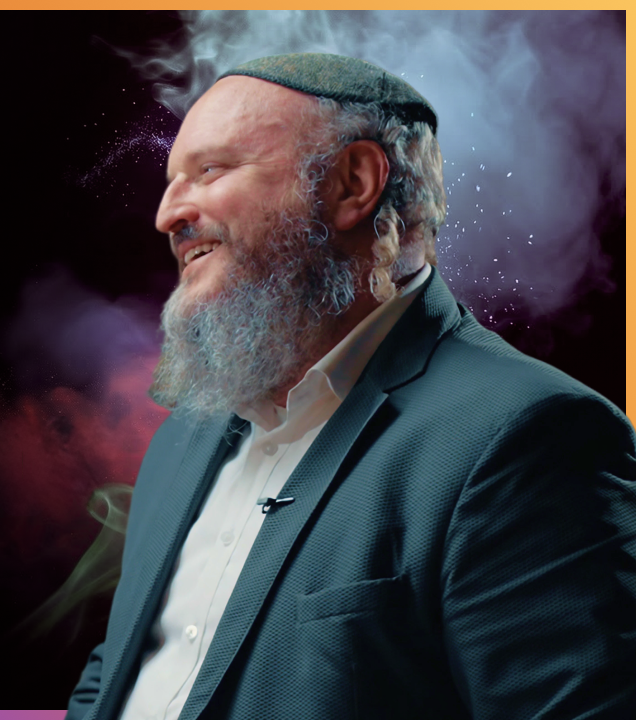
They really do incredible work and each year they have a fundraiser where my dear friend Yummy has invited me to participate where they have different conversations focused on mental health. We had a past episode where I interviewed Lipa Schmeltzer and this was part of the Amudim program and they have all these fantastic conversations that you can find online that they do to fundraiser for their incredible work. This year he called me and asked me who would you want to interview, who would you want to be in dialogue with and it didn’t really take me so long to imagine a conversation with someone who we have had on the past and that is Rabbi Shais Taub. Rabbi Shais Taub is an incredible person if you’re not familiar with his work.
He has a very strong presence on social media, online, he has an organization called Soulwords which really does incredible work and presents Torah that really provides a great deal of comfort and direction for people who are lost in their Jewish lives. And I said I would love to have a conversation with Shais and I figured we would talk about mental health, he’s done work in the past on addiction. He has an incredible book that I strongly recommend to anyone whether or not you have actually struggled with addiction called God of Our Understanding. It really develops a program for people struggling with addiction of all sorts and he is an incredible figure and friend.
And the conversation you’re about to hear I can say at the outset did not go according to plan. And I want to explain why. Very often when you have whether it’s a podcast or an interview series so much of it is you want to present your very best self. You want to make sure that you come off well and that you’re in a good place and all of that stuff.
And generally when I interview I do my best regardless of what’s going on or how hectic things are, you’ve got a PTA meeting after run to, but so long as people are listening you want to kind of present yourself in a way that welcomes in listeners. I was unable to do that for this episode and it has nothing to do with Rabbi Shais Taub, it has to do with what I was kind of dealing with over the course of this year and I feel like it has been a really tough couple months for me on a personal level, on a professional level. We’re continuing trying to build 18Forty and it can be very exhausting. Thank God I have the privilege to have something in my life that I take extraordinarily seriously, extraordinarily personally.
I really do have high hopes for what God willing we can build with this community that we’ve been developing over the last five plus years. And any time that you need to build part of that is fundraising. And fundraising if you’ve ever actually sat across from the table and tried to make a case for someone to invest, whether it’s sales or business and certainly with a vision that is not-for-profit but is really for the Jewish people, it is difficult. You’re trying in many ways to sell a vision, you’re trying to get partners and investors in a vision and thank God I genuinely believe I am surrounded by such incredible people who have invested in our vision and continue to invest in our vision.
Again, I’ll be honest, you still have good days and bad days and you can go on a string and on a tear where you get a lot of no’s or a lot of misunderstanding, a lot of do I even know what I’m trying to build, do I have a vision of what I’m trying to do and it tugs on all of your insecurities. it certainly tugs at all of my insecurities. I don’t think this is particularly unique, I think everyone in their life has some vision of what they’re trying to build, what kind of life they are hoping to see and realize. And we have all of these avenues of ways that we try to realize our visions that we hold, and there are periods in our lives where we feel just wave after wave of success and there are periods in our lives where we feel wave after wave of disappointment.
And when I went to sit down with Rav Shais Taub, I came to sit with him on a day where I’ll be honest, I was extraordinarily depleted. More depleted than I have felt in a very long time. Just a series of, you know, little unfortunate paper cuts. I mean nothing of the sort of magnitude of the suffering that the Jewish people are experiencing right now, but sometimes that only compounds your own loneliness and isolation.
Very often when we’re dealing with kind of these cosmic issues and we’re seeing antisemitism rear its head in the absolute ugliest way, we aren’t able or we feel almost guilty, I certainly feel guilty even paying attention to whatever paper cuts we’re nursing in our own lives, and they absolutely pale in comparison with some of the historical suffering that we’re dealing with in this very moment. The cosmic quest that the Jewish people are very much in the middle of in this moment, it feels almost ridiculous and so small to articulate your own frustrations in your own life when, all things being considered, thank God, my life is surrounded from beginning to end with blessing, with bracha, with goodness and with optimism. Yet even with all of the blessing that I very much see and appreciate in my life, there are times and there are days where you are existentially exhausted. You’re exhausted in your own life.
I don’t know how much longer I can do this, when are we going to get to the end of this, when am I going to have to stop justifying myself? Or whatever it is, whatever language or narrative kind of seizes a hold of your thinking. And I think different people struggle with different words. You feel inadequate, you feel insecure, you feel like you’re just waking up to the same day every day over and over again. However you articulate that feeling of kind of existential exhaustion, I do think that it is something that visits many, many people and on this day that I sat down for this interview, it was very much front and center in my life, which gave rise to what I believe is an even more fascinating conversation because I did not hold back.
I was kind of very honest and transparent with what I was dealing with. And as much as I wanted to have an amazing conversation to help my dear friend Yummy Schachter and Amudim, I was extraordinarily depleted on that day. And I remember I came to this recording studio which is right around the block from the Ohel, which is the place where the seventh Rebbe of Chabad, the seventh Lubavitcher Rebbe, Rabbi Menachem Mendel Schneerson is buried. And there’s a really special place there where you can go to daven and really pour your heart out.
And when I showed up at his house, he actually told me, “I feel bad, I forgot something at home. Can we push this back, you know, like a half hour or so?” And I said, “Sure, of course, absolutely.” And I had this half an hour on my own. I was by myself. And I took that time and for the first time alone—I had been to the Ohel one time previously—but for the first time by myself, without accompaniment, without a tour guide so to speak, a rabbi telling you, you know, this is how it’s done or what to do, I went in completely by myself and I spent some time at the Ohel, which was a genuinely transformative experience.
But stepping into that conversation already existentially depleted and coming into this conversation having just spent a half hour at the Ohel, at the burial place of the Lubavitcher Rebbe, I came in with a real rawness and vulnerability that long-time listeners certainly should not be surprised by, but I’m just kind of setting the stage for where I was when we entered and began this conversation. Which allowed for kind of a more free-flowing conversation among friends and I mean this really with all my heart and soul. The advice and the presence of Rav Shais in that moment in my life was genuinely transformative and something that we’ve been building on ever since. I mean, he’s an extraordinary person and if you’re not familiar with him and his Torah, I hate to use such a cliché term, but one of the most real and authentic people I’ve ever met in my life.
Just deeply, deeply honest. And I consider it one of the great privileges of my life that in a moment of great vulnerability, of exhaustion, of tiredness, of negativity, of cynicism and frustration, you know you’re caught in one of those days and you’re kind of like forced to step into this kind of conversation. He used this opportunity to kind of like, “Let’s talk, let’s be real for a little bit in our lives, just two friends sitting with each other.” I’m not sure if it fulfilled the exact vision of what my dear friend Yummy and Amudim were looking for, but I know… on a very personal level speaking with him was so uplifting and so nourishing and really changed my perspective on so many things and gave me an opportunity just to talk honestly and sincerely and whether or not you enjoy this conversation, it was deeply, deeply transformative for me and deeply, deeply nourishing and I am so, so grateful to Rav Shais for his time speaking with me and it is a great privilege and pleasure to introduce our conversation with RabbiShais Taub.
We’re here because a dear friend of mine once again has asked us to participate in the incredible work of Amudim where they’re having kind of a night where we’re having all of these conversations related to mental health, life, religiosity and I wanted to kind of use this opportunity as an excuse to force you, to pressure you, to coerce you into conversation. We had one conversation once,
Shais Taub: I came to your house.
David Bashevkin: It was aboutmidnight, we finished past midnight. It was the first time that we met.
Shais Taub: And our friend Jeff Bloom, we should shout him out.
David Bashevkin: Yes, huge shoutout to Jeff Bloom who introduced us and in that conversation was about teshuva but I wanted to talk about something else because I really look towards you as somebody who is doing public work in teaching Torah and bringing Torah to new people and you look like you are authentically in touch with yourself.
And what I’m trying to figure out is why am I still struggling? Why do I still have so many days where I feel performative, inauthentic? What’s so interesting to me like I’m staring over here, you have this like YouTube thing, you have a hundred thousand YouTube subscriptions, YouTube silver plaque, now, yeah, blown up on Instagram and what I find very moving, honestly, and what I’m trying to learn from you is how do you preserve your humanity after stepping into this like public space of clicks and driving and virality and I know you have because we’re in touch constantly.
Shais Taub: Not as much as we should be, we should
David Bashevkin: be in touch more.
Shais Taub: We should be friends and I don’t have friends. I’m saying that if I were to have a friend, I would consider maybe this.
David Bashevkin: But I’m coming to speak out loud, that’s really what I want to do. I want to talk out loud and I want to figure out what am I doing wrong at this point? No, I’m being serious. I’m fairly frum, I’m a reasonable talmid chacham, I do mitzvahs, I mess up like anybody else.
Shais Taub: I like that you’re comfortable with knowing your maylas, that’s, I mean you toned it down a little bit but yes, and I would say you’re a respected thought leader.
David Bashevkin: Sure, that’s great. But what I’m trying to figure out is I’ve gotten to the point where A, I’m suspicious of anybody who says that I have answers that you don’t have. Like the knowers in the world.
Shais Taub: Oh yeah, oh yeah.
David Bashevkin: I’m very suspicious of the knowers. And what I find remarkable about you is you don’t present as a knower, something must have I don’t know changed about you, I find you to be both very inviting but also very mysterious because I don’t really know your past, there’s a lot to me when I speak to you, what I’m trying to understand is what is the suffering that you experienced that allowed you to have the profound insights that you do? Because I don’t believe you and I asked you this the last time we were on, I don’t believe you that there’s no major that there isn’t a kernel of catalyst suffering in your life.
Shais Taub: You just started like you were just talking about being more authentic and then you gave me a little compliment oh you’re so authentic and your success hasn’t changed you and then you’re like and what’s your deepest pain, let’s go there, let’s go straight there, what’s because I know you’re hiding it.
David Bashevkin: No, cause you’re not hiding it.
That’s what I find so amazing is that you’re able to authentically connect, you’re able to authentically empathize and really people’s pain, the suffering what they’re going through, you’re not just mirroring, you understand what they’re going through and I just find that you’re able to both be so outward focused and uplift and have this core that is not getting swept away in this modern world of virality. I’m trying to understand what you’re doing because I feel like I need to learn how to do this. I’m not doing it well.
Shais Taub: Remember when we had that conversation at your house in your little side office there in the basement? Which we’ve expanded.
David Bashevkin: Oh, it’s much nicer, yeah, you’d like it now.
Shais Taub: With the little roadcaster over there. Yeah, yeah, yeah. Okay, and there was no video.
Remember I told you the story about getting the ticket on Rosh Hashanah and getting towed on Rosh Hashanah?
David Bashevkin: We had to cut that story in half basically. You told a forty-five minute story.
Shais Taub: About getting towed on Rosh Hashanah.
And about the draconian bureaucracy of beating the ticket and getting my car.
David Bashevkin: What I described as like this Kafkaesque story where you kept on you finally get to the counter where the person who’s going to figure out the paperwork that you need and sign it off and you keep on getting shuffled to another counter. That’s how I feel in my life right now. Honestly.
Shais Taub: So the reason I brought that up is because I told that whole story and I wasn’t sure you would get it because I didn’t know you well. But I told the story and it’s a real story. And it’s a sort of a banal story. I mean there’s no real drama there, I mean that’s kind of the point of it.
And I was wondering if you would get it and when you said that was Kafkaesque so right away I knew a few things about you. First of all I knew you were literate. Okay. Secondly I knew you got it because you understood.
That was a horror story but the horror wasn’t gore and shock, persecution—
David Bashevkin: None of those things.
Shais Taub: The horror was the tedium of it, the heaviness of the system that everyone accepts as normal and you used the exact right adjective, Kafkaesque. And usually when people use the term Kafkaesque it’s pretentious but that was one of the rare non-pretentious uses of the word Kafkaesque
David Bashevkin: Because it came from a place of suffering. I have a friend who told me something that’s made a big impact on me, his name is Eli Shulman.
When I had him on he said the biggest bracha is the right amount of suffering. There are people who have too much suffering but there are a lot of people who have too little suffering. Yeah, yeah. I just look at you and honestly what I see is somebody who seems to have done a good job healing their suffering to the point where they’re able to be out in the public constantly and not lose themselves.
You don’t come off as that prostitute-esque influencer which always worries me. And I’m not calling God forbid any influencer… No. But you don’t step into the world that way.
What am I missing? I’m here for your guidance.
Shais Taub: Okay so I’m going to tell you a Kafka quote. Please. And I love this quote so much that I can even say it in the original German.
David Bashevkin: Okay you have my attention.
Shais Taub: Ich schämte mich, I was ashamed, als ich bemerkte, when I recognized, when I realized, dass das Leben ein Maskenball ist, that life is a Maskenball, masquerade, costume party, und ich mit meinem wahren Gesichte teilgenommen habe, and I with my true face participated.
David Bashevkin: And he felt shame from that?
Shais Taub: I was ashamed when I realized that life is a masquerade and I attended with my own face, without a costume, with my own face. Now someone in 2025, almost 2026, reading that quote will say what Kafka was describing was neurodivergent masking and they’ll diagnose him and they’ll say his mother took Tylenol and…
Okay. Okay. I don’t think Tylenol existed then.
David Bashevkin: Probably not, correct.
Shais Taub: Got to tell Bobby. Neurodivergent masking. A differently wired person, a little bit too sensitive for this world, a little bit too deep for this world, having this shame, this burning shame when you realize that if you show up to life as yourself there’s going to be a severe penalty to pay. You’re going to be judged, you’re going to be ostracized, you’re going to lose opportunities.
You thought everyone was just being who they are. You find out one day that everyone’s lying, everyone’s faking, and there’s this, he calls it shame, this shame of, some people call it the vulnerability hangover, but that’s from one night of sharing too much. This is realizing at some point in your life I didn’t realize that everybody’s lying and they expect you to lie and you’ve overexposed yourself. There’s a reason why I remember the quote and I remember the quote in German is because when I saw that that resonated with me on a deep level.
You’re asking me about my pain. What’s your pain? What’s your pain? Right? Everyone wants to know everyone’s pain. So I’m not telling you this because I think it makes interesting content. One of my deepest pains, top three or four pains, maybe even could be top one or two, but for sure top three or four pains in my life is the pain of not being able to be my true self, the fear of being rejected, intermingled with a complex sort of, oh I figured out how to play the game, now I do know how to mask, I can make people like me, and then the self-loathing participating in that, and then even worse, the even deeper feeling of rejection that you can get people to like you for your false self.
You understand what’s more painful than being hated for who you are is being liked for who you’re not. Even more painful, more devastating. That’s the answer to your question.
David Bashevkin: Knowing this you have had a very interesting career.
I’m actually quite fascinated by it. Yeah. You wrote this best-seller book which actually had a pretty big impact on myself that was about addiction which you deliberately no longer like to talk about.
Shais Taub: Rarely speak about it, yeah.
David Bashevkin: Rarely speak about it.
Shais Taub: It was called A God of Our Understanding.
David Bashevkin: A God of Our Understanding which I love that title, A God of Our Understanding, that’s taken from the blue book?
Shais Taub: I mean it’s a play on words from AA lingo. They talk about God as we understood Him so yeah it’s sort of paraphrased it but yeah there was an implication that the…
David Bashevkin: But you could have rode that train into the sunset, the addiction train. That could have been the only thing that you talk about.
Shais Taub: Yeah could have made hay of that, yeah.
David Bashevkin: And then you kind of pivot away from that into something more like what you’re doing now which is maybe more generic, is that a word that you don’t like, generic?
Shais Taub: It is more generic.
David Bashevkin: And it’s more to the public, direct to public.
Shais Taub: Well the wider… But it’s the same exact stuff.
David Bashevkin: It is. Why did you do that? What is it that you pivoted away from? It was right in front of you. You could have been the addiction rabbi.
Shais Taub: I told you my greatestpain is, I could have been the addiction rabbi, yeah.
David Bashevkin: It was right there for the taking and you just said,
Shais Taub: Like Napoleon said, they said, how did you come to rule France? He said, after the French Revolution, the crown was lying on the floor and no one bothered to pick it up. Correct.
David Bashevkin: And you had it there. It was waiting.
You were on this, like, when did you publish? Twenty years ago?
Shais Taub: Close to twenty years ago, yeah.
David Bashevkin: You published a book on addiction twenty years ago, before, before the opioid epidemic.
Shais Taub: It was like buying Apple in eighty-three.
David Bashevkin: Correct.
As a rabbi. Yeah, as a rabbi. Trauma, existence, all this stuff. Oh man.
And you could have rode that into the sunset. Yes. Why didn’t you?
Shais Taub: Because I told you my greatest pain is being misunderstood.
David Bashevkin: And what would have been misunderstood had that been your primary window through which you interacted with the world?
Shais Taub: I wrote an entire book, the thesis of which, and this will save you however much the book costs, and by the way, I don’t get the royalties anyway. At any rate, the whole thesis of the book is that addiction is not really the problem, addiction is the solution.
David Bashevkin: But the problem is the pain of existence.
Shais Taub: Existence.
The pain of existence as a separate selfhood, as a conscious ego apart from God, and the only real solution is spiritual awakening. That was the whole thesis of it, and yet, like, people kept coming to me, like wanting me to talk about what I just said is not the real problem.
David Bashevkin: And they kept on wanting you to treat their…
Shais Taub: Yeah, like, whenever Purim is coming up, can you make a statement about drinking? I’m like, I don’t care about drinking.
No, no, well, what are you talking? And they think I’m being either I’m being facetious or I’m being rude, I’m just blowing them off. I really don’t care. Let people drink on Purim. I really don’t…
Can you lend your voice? We have a petition against the Kiddush clubs. I don’t care about that.
David Bashevkin: So you wanted to decouple in order to focus on that spiritual awakening.
Shais Taub: My whole point was the spiritual awakening.
My point was that I was speaking to the recovery world where you don’t have to sell them on the fact that life is unbearably painful. They already know that. They’ve learned that from life. And then I’m presenting this possible solution, that spiritual awakening is the solution, and that was all I wanted, that was my only message.
And instead everyone is coming and asking me about something that to me is so secondary, so incidental to the whole thing. I’m like, don’t you understand what I’m interested in is that existence is painful, inherently so, for some people even more so, sensitive souls, and God of my understanding I called it spiritual canaries. By the way, I coined that phrase spiritual canaries. By the way, that’s another thing about being this quirky, off-beat type of like authentic guy is that you say weird things that people don’t understand.
David Bashevkin: A lot of them catch on.
Shais Taub: But then they catch on and you don’t get credit. I had that. Ask my kid here, Yisrael is the producer of the show, that’s my son.
How many times I’ve come home and I said, somebody ripped off a thing that I said.
David Bashevkin: I had that with Gvir culture.
Shais Taub: Gvir culture was your thing. I know that it was your thing.
I know that it was your thing.
David Bashevkin: It was my thing. And there was a conference that everybody came together to talk about…
Shais Taub: And you weren’t even invited?
David Bashevkin: Wasn’t invited, didn’t contribute, and I got…
Shais Taub: You didn’t get to sit on a dais and drink Diet Coke?
David Bashevkin: I got an email afterwards from the person who organized, you were mentioned a few times, who actually came up with Gvir culture?
Shais Taub: I know that you came up with it.
David Bashevkin: I like that, spiritual canary.
Shais Taub: Spiritual canary, like the canary in the coal mine that he shows the symptoms first. Now they use it in political contexts, the canary in the coal mine of Western civilization, but the spiritual canary.
But spiritual canary meaning to say, embodiment is inherently painful for every soul, but most people kind of get used to being in embodiment. No, the pain of separation from God, they don’t even complain about that. They get used to embodiment, and if they complain about any pain, it’s about a lack of material stuff. If they have any problem or any complaint, it’s a lack of material stuff, most people.
But then the spiritual canaries are the ones who they never get over the soul’s trauma of embodiment, that’s why I call them the spiritual canaries. So the sensitive souls, that’s who my audience always was because that’s who I am. That’s what I wanted to speak about, and it was misunderstood as me being interested in drugs and alcohol which I’m not.
David Bashevkin: I think, and I don’t think my problem is all that unique because I think that if you’re plugged into a spiritual community, if you have a synagogue that you go to, you have a…
Sin-a-gogue. I love that. I love shout-out to my book. Thank you for that.
Shais Taub: Tell tell them about the book.
David Bashevkin: Tell them about the book.
Shais Taub: How can we get your book? You’ve written many books.
David Bashevkin: I’ve written a few books.
Thank you. Yes. Thank you for pushing the product.
Shais Taub: Which one you make the most, you self-published any? Because self-publishing makes the best margins.
David Bashevkin: I know, I didn’t self-publish any of them. It’s such a mistake, right?
Shais Taub: It’s a big mistake. With Amazon especially, the best margins.
David Bashevkin: It goes right into your pocket.
Shais Taub: Right into your pocket, yeah. Except for the fulfilled by Amazon, but that’s it. They take less than a publisher.
David Bashevkin: No, oh, I’m getting…
my royalty check… no, I’m not retiring off of them. My dream of retiring as a book writer has been fully dashed and dispelled.
Shais Taub: One of our favorite books at our house is the funny one, the top ten list.
David Bashevkin: Oh, top fives.
Shais Taub: Top fives, yeah, I’m sorry, the David Letterman…
David Bashevkin: That’s a good book. Top fives.
That’s a good book. I can’t get the publisher to give them away, though. It’s hard to sell books.
Shais Taub: It’s a coffee table book.
I love it.
David Bashevkin: It’s a great coffee table book.
Shais Taub: It’s a great… it’s a conversation starter and you put it out in your house and people know you’re hip.
That’s what I’m saying.
David Bashevkin: But come back to the spiritual embodiment. It’s much more difficult now because it’s so much less organic. There was an article that had a big impact on me in the New York Times that was written by a travel journalist.
I have to send this to you. It was so profound. Who covers that kind of stuff, type guy. This is somebody who studies awe and wonder.
And he said, the billionaires who are paying money to go into outer space are not going to get the experience of awe and wonder that they hope for and paid for. Why? Because the experience is too manufactured and expected. And in order to really experience awe and wonder, it needs something that is organic and that it’s not obvious that it’s going to be like the end of the road, that’s when you’re going to experience the awe and the wonder. And a part of my frustration is this moment in the Jewish world.
If you’re tapped in and you have this community and you have all this content and all these rabbis who you could speak to and get inspiration from, it gets harder to have like a spiritual awakening. I almost envy, and I’m going to say something radical, I envy in some ways non-Orthodox Jews because post-October 7th, I think that they had a very organic awakening about what their Jewish identity is supposed to be and like it started a frenzy search, oh no, like I don’t know enough about it, I got to learn more about this. And like I look at that journey and it’s so exciting and very quietly and obviously, you know, October 7th changed all of us, but like quietly deep down inside, a, I don’t really see that within our community and secondly, in myself, forget the community. Like me, David, I think whatever spiritual awakening was is maybe taking Judaism more seriously, but it didn’t give me more serenity, didn’t give me more peace.
Maybe briefly it did. I just need to make a disclaimer, I came to you and I’m having a terrible day. I told you that up close up front. So I just need to be clear that this conversation may be colored by a certain just like Sisyphean cynicism, which I would define as there’s this boulder, story of Sisyphus, pushes boulder up, and when it keeps on dropping, at some point you just end up saying well this boulder is dumb or this is stupid.
I don’t know. It’s my way of coping and I feel like that’s where I am right now.
Shais Taub: You want to talk about what your boulder is for the world here?
David Bashevkin: My boulder, my boulder honest, the boulder I’m talking about, should I just say it out loud?
Shais Taub: You said you’re having a bad day, so what was the boulder that put you in a bad mood?
David Bashevkin: Fundraising for 18Forty. Okay.
I stink at it, I’m not good at it.
Shais Taub: Okay. Do you know that when people fundraise for their causes, they borrow your platform?
David Bashevkin: That does happen a lot, that’s one of my frustrations.
Shais Taub: You understand they’re coming to you to ask for a platform to fundraise for their cause.
You’ve got the platform.
David Bashevkin: I’m not good at asking people for money for myself.
Shais Taub: You can do it for others. You give others the platform that they should get the money.
You’re the Cyrano de Bergerac of fundraising.
David Bashevkin: Explain what you mean by that.
Shais Taub: Cyrano, he knew how to write the poetry that would woo the ladies, but he couldn’t get the girl himself. That was the tragedy.
David Bashevkin: It’s a great Seinfeld episode where Kramer falls in love with a book dealer or somebody who works at a bookstore. And Kramer was not that literate, so he positions Newman, who’s this very lovable character played by Wayne Knight, behind the bookshelf and Newman’s whispering the poetry into Kramer’s ear so Kramer’s able to say all the right words.
Shais Taub: Mamash the Cyrano de Bergerac.
David Bashevkin: But it has an effect on me that I’m disappointed at how much it knocks me out.
I’m disappointed in myself. I should be stronger, I should be more resilient, I should have a deeper sense of what I’m worth and I feel like it brings out my.
Shais Taub: You should, but can I just say as a friend or as a potential friend? Okay. It’s good to take responsibility and to say where can I change myself instead of changing the situation? That’s very good and you’re right and you should expand your threshold for frustration.
It’s all true. But I think at the same time, there’s an expression I think they say the bad dancer says the floor is crooked, right? Everyone always externalizes the problem instead of owning up to their part.
David Bashevkin: The bad dancer says the floor is crooked. I love that.
Shais Taub: So to a certain extent, yeah, you’re right, you need to expand your threshold for frustration and okay, no problem, true. But there really is an issue here that is a practical issue, objectively is a real issue that needs to be fixed and maybe you need to talk to some friends. I will volunteer to be one of them. Talk about the fact that 18Forty is a worthy cause and ein ani ela bedaat, the greatest type of poverty is lacking knowledge.
And if people support worthy causes where they feed the hungry who are literally hungry and you’re feeding people who are spiritually and intellectually hungry, that’s no less of a worthy cause, perhaps even in some ways even more of a worthy cause. And especially we’re heading into a people can call this era in history whatever they want, but the reality is these are the chevlei mashiach, we’re heading into the redemption and we’re heading into a time where prophets tell us people are hungry not for bread, but for knowledge to hear the word of the Lord.
David Bashevkin: I see it, I see it deeply so. I see my own hunger.
Shais Taub: Okay, so why is that not a worthy cause? It is a worthy cause and the problem is not just that you need to learn how to deal with frustration more. You do, sure, but there’s an objective problem. problem that can easily be fixed with some smart minds to get together and 18Forty should, not only should it be something that you can support yourself so you can focus on it and not have to run around and do anything else, but to be completely focused on it, but to grow it, to expand it, to expand the reach and really, I mean a guy like you who you have your finger on the pulse and you understand things I think in a deeper way, you should have a vision for what at least your niche and how that’s developing until the Geula Shleima and you should have that mapped out and how much money it’s going to cost and you should have a budget.
David Bashevkin: Is it weird that when you’re speaking I got like a little emotional?
Shais Taub: Not weird at all because it’s your pain point.
David Bashevkin: What is the pain? Is it about fundraising? No. I got emotional as you were talking. A, it’s nice to hear somebody be optimistic and be kind of like praiseworthy. That’s really nice.
I get a lot of really nice praise and feedback. I don’t know, what you just said right now was very kind of you. That was really nice.
Shais Taub: Because I think first of all it was affirmation that you haven’t heard.
People give you compliments all the time. You’re a brilliant guy, creative, funny, people appreciate you. But it’s like yeah thanks, that and a dollar fifty will get me a cup of coffee, right? I don’t even think you can get a cup of coffee for a dollar fifty. So people can praise, but you’re trying to create something that people value.
Like put up your money. Like show that you care about this. My father Hacham whose yahrzeit is in a couple of weeks, so I remember he told me a story about an encyclopedia salesman who came to his house.
David Bashevkin: Okay.
There used to be encyclopedia salesmen who came to your house. My parents had a World Book and a Britannica. Yes. But the World Book I loved.
Shais Taub: Did you have an Encyclopedia Judaica?
David Bashevkin: Of course we had an Encyclopedia Judaica. Right. The ’76 one. They redid it and they made it worse.
The old school from the ’70s. But the World Book, there are pages of the World Book that I have memorized. A, they used to have a page where they would show how fast every animal goes and they’d also… I was very into the World Book Encyclopedia.
Very. Brown.
Shais Taub: So before the internet existed, guys like you and me. Before Encarta.
Yes. Very good, Encarta. Yeah. People don’t know what Encarta is.
David Bashevkin: Throwback. That was Microsoft’s digital encyclopedia.
Shais Taub: Pre-Wikipedia. Pre-Wikipedia.
And I used Encarta by the way last week was the Kinus HaShluchim. So I used Encarta when people asked me how do they get guys to go to crazy places like Ghana? And I say you don’t get it. It’s not like they say oh here’s your package, here’s your compensation package and the health plan and your 401k. No, no, these guys have literally no support.
They’re paying to be able to go. Right? How do you get them to go? Okay, so I say like this. And by the way, I didn’t make up this mashal. It’s from a book about motivation.
I think the name of the book is Drive. Okay. I never read it. Sure.
I have a secret though. When someone tells me there’s a good book, I find the TED Talk by the guy who wrote the book. I watch the first five minutes on double speed and in two and a half minutes I know the thesis of the book.
David Bashevkin: Do you know what I do? When somebody tells me of a great television show or movie that I know I don’t have the time budget to commit to, like oh Harry Potter, I’m like eight movies, I don’t have that kind of time.
So what do you do? I read plot summaries on Wikipedia and I read YouTube movie recaps. How short?
Shais Taub: Eight minutes. Eight minutes and you get a feature film?
David Bashevkin: The whole thing.
Shais Taub: Wow.
It’s a bargain.
David Bashevkin: Yeah. It’s one of the ways I veg out. It’s my number one.
Sometimes I need to like veg out to almost like let go of the consciousness steering wheel and just veg out and just let my mind like…
Shais Taub: How you self-soothe. I self-soothe.
David Bashevkin: You numb, you check out.
I self-soothe, my addiction that helps me escape the pain of reality is watching YouTube movie recaps.
Shais Taub: I’m not going to forget. I’m going to take us back to the fork in the road before we… Please.
Before we come back. What eight-minute YouTube summary did you watch that you believe, that you feel you had a full experience as if you saw a whole movie? Like you don’t feel like you’re missing anything. Like maybe someone will say no, you have to see it, it’s two and a half hours, you don’t even know there’s a whole subplot that you didn’t even see and you’re like no trust me this eight minutes rocked my world. It was incredibly meaningful to me.
It took eight minutes. I don’t even want to see the feature.
David Bashevkin: Right now there’s a horror renaissance right now which is very interesting. It’s interesting to me that horror movies have captured the public’s attention and a lot of these horror movies are made by comedians that crossover like Jordan Peele went into…
he was doing comedy sketches… Key and Peele. Very good, Key and Peele and he went into horror movies and I love his horror movies. I think they’re very profound.
The movie that I saw that is an eight-minute movie recap where I was like wow.
Shais Taub: Is that one of his?
David Bashevkin: No, but it’s a horror movie. It’s a horror movie about an unexplained…
the entire classroom of kids disappear except one kid. That’s the mystery. That’s the premise.
Watched in eight minutes, I was blown away by the way they structured it and I got all of it in that eight minutes. The whole thing. Very intense.
Shais Taub: Yes. Okay and we’re not recommending this.
David Bashevkin: No, no.
This is bitul zman. Of course. Complete total bitul zman. Do not veg out, do not watch six YouTube movie recaps in order to fall asleep on a weeknight.
So once again we’re just being clear we’re not recommending.
Shais Taub: It’s the opposite of a recommendation. We’re telling you not to do it.
Okay, so Encarta… oh hold on, there’s two browser tabs open here. So when I explain to people how they get people to go on shlichus to crazy places I say like this: Encarta, Bill Gates had an idea of an online encyclopedia, put tons of money into it, he hired the biggest experts to write the articles, the biggest developers to create the platform.
form, and it totally tanked. Long comes Wikipedia, was all free, everyone did it for free, it’s all voluntary, and it became like the number one website. So I explain like this, and I got this from Drive, which is where I said that I watched the TED talk and then you’ve the secret, you watch that. Very good.
Okay fine. He says that Encarta with all of their money and all of their funding and hiring experts, but no one was mesiras nefesh for this. He doesn’t use that term, but like, it’s a job, it’s a living. But Wikipedia, someone’s doing it out of the love of their heart.
It’s personal, right? So the thing that was funded fell apart. The thing that had zero budget flourished. So I say, you know, if you try to put out an ad and say we’re hiring a yungerman for $150,000 a year salary plus benefits, you would not get people to go to Ghana. But if you say no, you get nothing.
You’ve got to go fundraise for yourself. Then you’ve got guys lining up. Okay, but at any rate, so the encyclopedia salesman comes to my father and he says, listen, you may or may not need an encyclopedia. That’s not really the point here.
He says, this is democracy and you vote, okay? You vote for a candidate you believe in, that’s what you do, you vote. Well, here’s the thing, when you buy from me an encyclopedia, that’s how you vote for me. You’re voting for me. You’re saying you believe in me.
It doesn’t matter if you need the encyclopedia, by buying the encyclopedia it’s a vote for me. I can’t remember if he bought it or not, but I remember my father telling me decades later how compelling that was. There’s something true about it. It’s like, do you believe in me? And now that’s a little manipulative and weird because a stranger I never met you before.
Right? But you know they say if someone’s a real friend and you have a business, they shouldn’t ask you to give them a discount when they buy from you. But if someone’s a real friend they should pay full price when they patronize your business because that shows that you believe in that person’s business. So similarly, you were asking why it was so poignant for you to hear the validation that I gave you even though you get tons of validation Baruch Hashem. Because specifically the validation of saying that what you’re doing has tangible value, to quote Eric Adams who was in that chair six months ago before we knew he was dropping out of the race.
He was sitting in that very chair. He was here in so many words. Yeah, you remember that.
And he didn’t say it here but he was famous for saying it. And it’s a movie quote which you probably know, but he was famous for saying it, show me the money.
David Bashevkin: Show me the money.
Shais Taub: Show me the money.
David Bashevkin: Show me the money. The great Jerry Maguire. Sure.
Shais Taub: Right, that’s the origins of it.
But show me the money means tachlis. Let’s be real. Talk is cheap.
David Bashevkin: But I want to move away.
Shais Taub: So when someone says to you what you’re doing is worth money, that validation hits deeper. If someone says, oh, that was inspiring. Yeah, how inspiring? How inspiring? Sounds cynical, but listen, we’re talking about embodiment. We are in a physical world and there are certain realities of the physical world.
You know, it’s like the Meraglim. They wanted Torah on a conceptual level. That’s why they were happy to stay in the midbar Yeshiva and just learn all day and don’t enter Eretz Yisroel. Don’t become farmers.
Don’t deal with agriculture and city building and infrastructure and roads. No, no. All abstraction, nothing concrete, all soul, no body. Okay, but as you being a real Chabad Chossid know, it’s about Dira Betachtonim, dwelling place in the lower realms, and it’s got to be tangible.
That’s show me the money.
David Bashevkin: But I wonder for myself, and I do find that, I wonder for myself, how does one figure out where to invest in spiritually? People come to you and you decoupled where we started with, you decoupled kind of addiction from the actual spiritual awakening so that existence is not as painful. Yes. What I’m trying to figure out is most days are good days, genuinely.
And it happened to work out that I’m here on one of my bad days. A few things didn’t go right. Had a couple of meetings that didn’t go great. And I came here feeling dejected, exhausted, and frustrated.
Which I was very straight up with you about, and I appreciate you bearing with me as I share it. But when I’m in this place, I wonder to myself, what is the spirituality I need that these moments do not feel quite as, I’m going to use the word like frightening. Like there are times where like, usually like right before I’m going to sleep, that’s where it gets you, like I feel like I’m falling through the floors of my own self until you’re literally just like on the bottom of this skyscraper.
And you’re just like, how’d I get here? What am I trying to do? And I can feel spiritually bereft. And I don’t always know where to turn.
Shais Taub: Okay, I’m going to deny you a little bit.
Okay, and I told you this before and I’m going to say it again. You’re right to some extent, you do need to learn how to man up and deal with this stress. You’re right. And maybe that means looking for, of course it means looking for some type of a spiritual way of reframing it and sort of giving yourself more resilience, maybe call it.
Okay, you’re right. That’s true. But I’m not letting up on this. One of the weird things about me is people seem to think that I have insights about people.
I don’t think that I do, but people say that I do. People say that I’ve been helpful to them. Which, by the way, that’s a whole other thing, like avoiding the whole addiction world, avoiding the label of being a therapist. That’s like, please, I’m not a therapist.
Okay.
David Bashevkin: Is that deliberate that you didn’t?
Shais Taub: So deliberate. I’m not a therapist. Get out of here.
I’m not a therapist. Well, but certainly you trained, you stud- No, my father, who I mentioned, was a psychologist. So I grew up with the books. I read a lot of psychology books.
There were certain books that I really, really connected with on a deeper level.
David Bashevkin: But what were you trying to avoid by not going down that path also?
Shais Taub: No, I really don’t know what it is. I never heard of it. You never heard of it? All the rabbis heard of it.
Because they follow that stuff. I’m not interested. I don’t follow, I don’t know these new therapies. I never heard of it.
But at any rate, people say that I’m pretty good at figuring people out. I’m not negating the fact that you’re trying to own up to this and say that there is some growing that you need to do. That’s true, that’s always true. Sure.
But I think that you’re bypassing the fact that you really do want and deserve and need, not for you even, more like, and I use the word shlichus, as part of your shlichus in this world to receive that validation, not just because you need the pat on the back. That’s nice, too. That’s a side benefit. But there’s a real thing that your soul came to a body for and it’s not just to be the ideas guy, because you could have been in Gan Eden and you could have hung out in the Mesivta D’rakia and done the same thing.
If you’re an ideas guy, you could have stayed in Gan Eden and been ideas guy. You wouldn’t even need Twitter. I don’t know how they communicate up there, but that’s a world of ideas. You came to the physical world, there has to be some marriage between the spiritual and the physical.
There needs to be something physical, something built, there needs to be something that I can see. 18Forty has to be something tangible, not just ideas. You’re a guy who lives in a world of ideas, I’m also a guy who lives in the world of ideas and I have the Meraglim syndrome very much so. That’s why I built this house, by the way.
The studio that we’re in is in the basement.
David Bashevkin: It’s crazy what you built here.
Shais Taub: Okay, why did I do it? Because when I started to have millions of people a month online, I said, “Oh, good. I never have to leave my house again.” I really said because I used to travel to speak.
COVID knocked that all out, people don’t do in-person events anymore after COVID. I used to travel to speak all over the world. Australia, South Africa, everywhere. It was crazy, constant travel.
You can ask my son how much I used to travel when he was a kid. And then I was reaching millions of people a month online and I was like, “I don’t have to travel ever again. Beautiful. I don’t have to deal with people ever again.
I never have to sit in the same room with other human beings. I can just put it all out into the ether.” And I realized how dangerous that is. My soul didn’t come to the world to be divorced from physicality. So I made a house.
At this house, we’ve had thousands of people come here. We have events here, we have farbrengens, we have this podcast. I want to just tell you one thing real quick. A friend of mine told me and it changed my life, I think about it all the time because it’s one of my main struggles: You can fake caring, but you can’t fake showing up.
David Bashevkin: You can fake caring, but you can’t fake showing up.
Shais Taub: Right, because either you did or you didn’t.
David Bashevkin: Either you did or you didn’t, correct.
Shais Taub: Caring, you could trick someone to think you care more than you do.
For sure. Maybe you don’t care at all and you make them think that you care. But showing up, you can’t trick someone to think you showed up. Either you did or you didn’t.
That to me is the difference between the abstract and the concrete. The world of ideas, you will always question how much value it had, but something that’s concrete is undeniable and I want that for you. And the world needs that for you. And Moshiach has to be here in this world, so it’s all part of geula is something tangible and physical.
David Bashevkin: What’s amazing about this house is that it’s very close to the Ohel. Our timing was off, so you had 40 minutes. This is going to be broadcast later so I feel more comfortable sharing it now because it doesn’t have that immediacy. You understand what I’m saying?
Shais Taub: Yeah, yeah, a little bit removed.
David Bashevkin: There’s a custom that when you go to the Rebbe’s Ohel, which I had only been there one time previously but with not a delegation, but with somebody else, with handlers. With a, yeah, somebody who I love but I wasn’t on my own. Somebody telling me what we do next, what you do next.
And this is the first time that I was really there on my own and I felt like I desperately needed it. I’ve never felt… I’ve been to the Ohel twice in my life and I loved it. I loved that I was on my own.
There’s a mikvah and then you come in and then you usually write a note for the Rebbe, which is not something I’m used to or comfortable, that’s not my default, writing a note, I’m just not good. Right. But I did it because I had to do it, because I wanted to do it. No, honestly.
It didn’t require any force. I wasn’t looking around. It was beautiful because it was just me and it felt very sincere and real. And I don’t want to share what I wrote but one sentence that was there and it was such a real sentiment, kind of what you said now, was this desire: I want to be a shliach.
And I feel like I am, but the sense of feeling mission-oriented and mission-driven and I guess in my darker moments and I feel like a lot of people deal with this but it comes in very strong, you don’t feel aligned, you feel missionless, you don’t feel like you remember who the meshalleach was. You’re on the way but you forgot, “Wait, do I even have an envelope on me? I don’t think I was given an envelope. I don’t even know what the shlichus is.” And that’s sometimes is hard because I’m trying to… I feel it in my bones.
I’m on a shlichus. Yes. But I don’t know what it is and then somebody, you meet with someone and they’re like, “You run a podcast.” I want to…
Shais Taub: So when people say to you, “You run a podcast.”
David Bashevkin: Iwant to jump out of a window.
I want to jump…
Shais Taub: That’s like when they say to me, “Oh, you’re a therapist.” Good, no, that’s even worse because I’m not a therapist. You do run a podcast.
But when they say to you, “Oh, you run a podcast,” that’s like when they say to me, “Oh, you wrote a book about addiction.” It’s like, “Yeah, I did, but that’s not who I am.” That’s not what I want you to know. Okay. And also by the way, and I know this about you, I only met you one time before in real life.
We only sat together in the same place once …
Twitter guy. Come over and tell us some jokes.
David Bashevkin: Yeah, the Twitter guy.
Shais Taub: We’re having a Kiddush club in the lobby. Come over and tell us some one-liners.
David Bashevkin: There is nothing I find more diminish— I find it suffocating. Genuinely.
Shais Taub: Oh you have a podcast, oh you’re the Twitter guy.
David Bashevkin: Twitter guy, Twitter rabbi, Twitter guy, Twitter rabbi.
Shais Taub: Twitter rabbi doesn’t make it any better.
Right.
David Bashevkin: Doesn’t help, no. I think it makes it worse honestly.
Shais Taub: Why is it so dehumanizing and demeaning? No, I’m asking.
And you realize that people watching right now and judging both of us and saying, these guys get to make a living doing what they’re great at and tons of people— Well this was a
David Bashevkin: favor so I feel like I’m allowed to do
Shais Taub: whatever I want with this one because I’m doing a favor for Amudim, so you can say whatever you want. But people are like, this is their complaint? But don’t worry about their judgment. I’m here, I’m empathizing. Why is it dehumanizing, demeaning? Why is it diminish— It sucks the air out of you.
It does.
David Bashevkin: Yeah. Why? I’m very enamored with this thinker named Lacan who was a French philosopher. And he has a moment where he talks about the first time a child sees themselves in the mirror.
And he says that there is a trauma in the first time you see yourself in the mirror. What is the trauma? It is the first time that you realize there is an interior self and a public self and that people are just interacting with your surface self. And he talks about that pain of like the first time that you realize that you’re kind of like not one with the universe. It’s when your consciousness starts to individuate.
I have a three-year-old son. You know what he— the only thing he talks about now? I’m still a baby. I’m like, babies don’t need to— But he keeps on saying— he feels it. He’s three.
He feels the individuation and the con— I see it. And he literally declares, I’m still a baby. Constantly. I’m still a baby.
And I feel like that foundational pain of looking in the mirror and realizing there’s the perceived self and there’s this interior self. When I confront that perceived self through other people’s comments, even positive comments, it shifts my focus away from my interior self and I find those experiences really painful. There was a show that was produced by Tina Fey called The Unbreakable Kimmy Schmidt. And she has this very flamboyant friend named Titus Andromedon.
And there’s this scene in the show that Titus, who he wants to be an actor so badly, so desperately, he’s finally getting on television for the first time ever, like on live TV. And he’s sitting there like powdering up like his face. It’s like this big, heavy black man, but like very theatrical. He’s a hilarious character.
And he’s ready. And then like he starts like singing to himself where he’s like, I’m going to be with eternity. Like— like I finally have my moment. I’m now living mamash I’m one with the stars.
And then all of a sudden his mic is like, Titus, you’re on. We’ve already been filming. And then all of a sudden he’s like, what? You’re filming? Like he just made a fool out of himself. He’s like singing to himself.
Like stop! And then he realizes the chyron is there that has his name and he’s like trying to like cover the digital chyron. It’s hilarious. And then he screams out— this is in a TV show— he screams out, stop! I want to be a baby! That’s what he screams out. I want to be a baby.
And that— I appreciate that feeling of like I want the pain of differentiation and individuation to be less acute. And there are times where like that feeling of like that mirror stage, I feel like I experience that over and over again in my life because we are in public and we so often interact with people’s perception of us, it can erode or serve as kind of this mask or barrier between me remembering and constantly centering my real true internal self.
Shais Taub: You’re describing the pain, the trauma of the Etz HaDaas. This is the trauma of the Etz HaDaas.
When you taste from the tree of knowledge, what knowledge do you gain? Do you become like you can win Trivial Pursuit? Like you know lots of, right, Jeopardy. The knowledge is self-knowledge, but not in like an edifying sense of like insight. Self-knowledge like crippling self-consciousness.
Shame. Shame. Which is why the first symptom of self-awareness was shame.
Busha. Sure. And particularly we could talk about this about sexual shame. They covered up their nakedness, which they didn’t have a concept of before because they were like babies.
What does it mean they were like babies? A baby runs around without a diaper, there’s no busha. Right. Because a baby doesn’t have a self-concept or a fragmented sense of self, or what you’re saying Lacan calls this difference between the inner and outer self. So the Etz HaDaas, the tree of knowledge, basically is where that construct of the false self emerges and maybe even becomes not only a distraction but maybe even becomes a focal point and then there’s that pain of separation from self, the separation— separation from self, which is an awful thing to be separated from, to be separated from your true self.
David Bashevkin: Can I ask you a question? Yeah, yeah, yeah. And this we were talking about, but I kind of want your approach to it and it doesn’t really align with what we’ve been talking about before, but you brought it up.
Shais Taub: Sure it’ll align.
David Bashevkin: Why is it that the prototypical shame that the Torah addresses is sexual shame? I also feel shame when I get up at 2:00 o’clock in the morning and I eat a loaf of bread that could feed a family of four.
You know they make those like big loaves. I could get like in a carb spiral and like I just first I just peel off like the crusty layer and then I’m like shame to leave the beautiful delicious white fluffy inside. And then before I know it, it could mamish be like in the middle of the night. I’m talking 2:30 in the morning and I have just finished a full proper loaf like that you cut up into distinct sandwiches that could feed a family and I just finished.
Shais Taub: That’s your thing? That’s your taiva? A loaf of bread?
David Bashevkin: It’s one of my many taivas. It’s one of my many taivas, but I’ve always intrigued by the unique why sexual expression, sexual shame, embarrassment is always held apart in Jewish law, in philosophy…
Shais Taub: Why is it a category unto itself? Correct. Because it is the quintessential shame, not because it’s inherently shameful, but because shame, like we said, is awareness of self.
Too much awareness of self. And sexuality is synonymous with self. Too much awareness of self is too much awareness of sexuality and vice versa, too much awareness of sexuality is too much awareness of self.
David Bashevkin: Why sexuality so tied up with self?
Shais Taub: Because the true self, I’m talking when I say self, I mean the true self although when it becomes fragmented then it becomes misappropriated and co-opted by the false self.
Okay. The true self is alignment with God. Oneness with God, even.
The signature quality of the human being that is godly is the capacity to create. Now that can be creating a podcast or writing a book or it can be literally the quintessential act of creation, procreation.
Peru u’revu. And that’s where your selfhood is most clearly revealed, your deepest self, and that’s why it is subject to the deepest shame. And that’s why the injury is the deepest injury. Somebody comes over and insults you, you’ll get over it.
Somebody comes over even punches you in the face, take a little longer but you’ll get over it. Somebody violates your sexuality, why is that such a deep wound? Why is it such a deep wound? And we know that it is, we see that it is. Correct. Because it is the most synonymous with my deepest self.
When that is I’ll say not even injured, but even when too much attention is called to it. When somebody becomes aware of the sexuality at a too young of an age, classic example. The awareness of it is the trauma. In other words, it’s like I want to be a baby.
I want to not really understand where I end and the world begins. I don’t want to have this much awareness. It is killing me, this degree of self-consciousness is killing me.
And so when someone comes over and says you got a podcast, what they’re doing is they’re highlighting an aspect of your external self. Exactly. Which is not a shameful thing, it’s not a bad thing, it’s a good thing, but it’s highlighting that awareness that you have of that outer self. There’s a pain.
It’s like someone making you look in the mirror. I don’t want to look in the mirror. I mean I’ll check my hair just to make sure I don’t look crazy but
David Bashevkin: I used to have a lot of trouble looking in the mirror because when my hair started going white, it gets a little thinner, I didn’t want to like look at that. I don’t want to be reminded of what other people are seeing.
Shais Taub: By the way, I love your white hair. It’s one of your signatures.
David Bashevkin: I know, but it started too young. Now it’s great, I fully own it, it’s great.
Premature gray. When did you think you got your first white hair?
Shais Taub: In your 20s?
David Bashevkin: 16. That’s a little too young.
Shais Taub: No, no, it’s good, it’s a look. Premature gray is a good look. You don’t look old. No one thinks you’re old. No one thinks you’re old.
David Bashevkin: I’ve caught up with it. I’ve caught up with it. I’ve shared some I used to dye my hair.
I mean I had to in yeshiva.
Shais Taub: You struggled with it. That’s shame.
David Bashevkin: Oh big time. That was real shame.
Shais Taub: You were ashamed of it.
David Bashevkin: Did you know how to…
Shais Taub: No, I was never prematurely gray, thank God I never had such a…
David Bashevkin: Have you ever lived in a yeshiva dorm? To dye your hair you have to put on gloves and there’s a lot of dye. You can’t do that in the middle of a dormitory.
Shais Taub: You locked yourself in a toilet stall?
David Bashevkin: I was saying 2:30 in the morning. I’d do it in the middle of the night, for sure. The same way that when you miss Shacharis and I wouldn’t want to be putting on tefillin at 9:15 and people would see.
Shais Taub: Should have learned in Lubavitch.
David Bashevkin: You know what I would do? I would go to the bathroom in the middle of morning seder around like 11:00 and I’d like walk out very like calmly and quietly and then the moment I was not in view run back to the dorm, slap on the Rashis quick quick quick because I just don’t want anybody to see. I don’t want to be associated with it even though I was like pretty much missing Shacharis fairly… the Cal Ripken Junior of missing Shacharis. It was a fairly consistent practice of mine, but I want to wrap so I would run to my dorms and do that privately at 11:00 and I would dye my hair once every…
yeah like 2:30 in the morning in the Ner Yisrael dorms.
Shais Taub: So how is it now? Can you look in the mirror now?
David Bashevkin: A little bit more? Yes, I’ve learned how to do it much better. It was very genuinely very difficult for a long time. I want to ask one question about and this is almost what we were originally going to talk about because we were talking about sexuality and self.
So one of the things… One of the theories that Lacan talks quite a bit about and I want you to weigh in on is what is the nature of desire? What are we doing when we covet, when we want something very badly? And specifically with sexual desire, it’s very interesting that there’s something that it arouses you to such a degree that you feel like, “I need to do something with this.” So Lacan has this theory, which I love, which he says the name of a book: all desire is a desire for being. Whenever we want something, what we want is not necessarily the experience but what the experience represents. It’s why we advertise luxury cars a certain way.
We’re trying to sell being, we’re not actually trying to sell cars.
Shais Taub: Not the car, it’s the identity that I will have when I have that car.
David Bashevkin: Correct. Correct.
But there’s no other desire that I have where you’re walking the subway and you see somebody eating a nice sandwich. Right. It doesn’t arouse me in the same way as being sexually aroused. I’ve fasted.
Yeah, you want a drink at the end of the fast. It’s not arousal in the same way that sexual arousal shifts your whole sense of being into that direction. Right. What my original question was, which I was going to start but now it looks like we’re going to end on this note.
Is how do you address and almost change desire itself? Meaning, how do you learn to want things that are healthier and better for you?
Shais Taub: That’s an interesting thesis.
David Bashevkin: I wish, I’m a shikur baal taivah.
I am. That’s the real truth.
Shais Taub: And you eat whole loaves of bread in the morning.
David Bashevkin: Full loaves.
And they’re not, it’s not whole wheat, right? It’s white. Proper processed carbs. How do you get to that root? That root of to get the desire and fix it and fix it in a way that it is more constructive. We all have ambitions.
They can be so strong and so powerful. It’s not quite the same question as healing addiction. I’m sure it’s related in some ways. But how do we figure out how to desire the right things?
Shais Taub: Yeah, there’s a lot here.
I mean, you’re trying to wrap up but you’re opening up a whole new vista over here. No, it’s fine. I’m okay with it.
But this is a lot.
David Bashevkin: I genuinely love sitting with you.
Shais Taub: Okay, I do too.
David Bashevkin: I really, really do.
Shais Taub: Sitting with you, not sitting with myself. Although I’m okay with that. I mostly sit by myself. I mostly am misboded.
So let’s take one on-ramp and see where it takes us. Why do people do stupid crazy things and mess up their lives because of sexual desire more than other things? Arguably, I would say that’s the main thing. Right? Proverbial crime of passion, right?
David Bashevkin: People throw away careers, jobs, politics, empires, families.
Shais Taub: Right. And their self-respect. Or their morality. Like why is it the thing that can get people to be so careless and stupid and why is it the downfall, the bane of? Yeah.
Yeah. So like I was saying before, the first symptom of self-awareness after the Etz HaDaas, after the tree of knowledge, was awareness of sexual shame and they made clothing to cover it and God said, “Why did you do that?” Because I didn’t want to be naked. Who told you you were naked? What do you mean who told you you were naked? Adam wasn’t a fool. He knew he was naked.
It just didn’t have any meaning. Being naked didn’t mean anything. It wasn’t scandalous to be naked.
Like when we were kids we used to dreikop. We’d say, “Oh, your epidermis is showing.” Yeah, we had that. Right. Right.
Of course my epidermis is showing. Right. Okay. And before the Etz HaDaas, before the tree of knowledge, having your reproductive organs exposed was like having your epidermis show.
It didn’t mean anything. Again, like a baby. Like a baby.
When we became self-aware, when the self became fragmented into the, I’ll use what you say is Lacan’s terminology of the inner and outer self. I’m not sure if that’s the terminology he uses, but something akin to that. Here’s the thing. The desire, the deepest desire of the innermost self is for union.
I mean, there’s a reason why King Solomon wrote Song of Songs as a love poem and it wasn’t to sell more copies. Gemara says Shlomo Hamelech had three thousand meshalim. Three thousand metaphors for every concept. For every concept, any concept, he could do three thousand metaphors.
He certainly didn’t have a lack of
David Bashevkin: imagery to call upon.
Shais Taub: Right. And he chose this.
David Bashevkin: And he chose romantic, sexual imagery to describe our spiritual relationship.
Shais Taub: Right. Correct. So there’s a reason for that. And there’s a reason the kabbalists equate, I mean all of the imagery of world-building, of God’s being a creator is all reproductive imagery.
Male, female, yichud. So there’s a reason for that. Because the ultimate pain is the fragmentation. The ultimate pleasure is union or reunion where one loses one’s fragmented self and has the bliss, the peace,
David Bashevkin: The ultimate pleasure. I just love that is union and reunion. Yeah. To feel that wholeness.
Shais Taub: To feel the wholeness, right?
Now, when that is misappropriated… Now, when that is misappropriated, obviously, it takes us very far from God. Makes us do things, not even far from God, things that are just far from common sense. But the original power of it is because not only is it the most basic desire, but it’s actually the only thing that we’re here to do.
Like you said, I’m on a shlichus and I forgot what my shlichus is. I have this nagging sense I’m sent here on a mission and I loved your imagery. I’m on a mission and I’m like, where’s my envelope? What did I? Put it somewhere. So then what’s the mission? I cannot tell you specifically what your mission is.
I have some theories about your mission based on things that I know about you and your skills and your resources and opportunities, so maybe I’ll tell you later offline. But in general, I know your mission because I know everyone’s mission. Your mission is to make a home for God.
Home for God, we call it dirah b’tachtonim, but a home really means a home in the sense of like you get married and you have a home, okay? So your job is to get married, get married to who? To God. And you’re going to move in together and you’re going to make a home together. Now, we’re all doing this as well. It’s not just you.
It’s not just David. I mean, it’s also me, it’s everyone else. So your deepest desire is to experience that reunion with your true self, which is reunion with God, which is that feeling of wholeness, that I can finally forget about the fragmented me, I can finally stop feeling separate, I can stop being self-aware, I can lose myself in the oneness. And your job, it’s counterintuitive, but in heaven, the soul was much closer to God.
In the embodiment, the soul is, so to speak, farther. I mean, we’re not talking spatially, obviously, farther from God. But by becoming far, it’s like when Adam and Eve were separated, they were one and then they were separated. And He says, now cleave together and become one flesh.
Draikup. You had one, you broke it up and said, get together? Just leave it the way it was. No, no, no. Because the point is reunion, not unity, reunion.
So to be divorced from wholeness and then to come back to it, we also call this teshuva. You don’t have to sin to do teshuva. You can do teshuva from the embodiment trauma. Teshuva doesn’t mean you did anything wrong.
People are like, why should I do teshuva? I didn’t sin. Who said you sinned? Teshuva means returning to your innate oneness with God. If you were embodied, you were sent away from God. The purpose is that through your embodiment to come back closer to God than you were before.
In other words, I don’t want to, you know, speak dirty here, but when the Adam was male and female in one being, one organism, one body, there were certain things that he could not do.
David Bashevkin: Yeah, yeah, we’re on the same page.
Shais Taub: Right. Okay. By the way, just parentheses, in honor of my father’s upcoming yahrzeit, I have to tell one of my father’s jokes. Please.
My father was a psychologist. So my father said there was once a little boy who they were very concerned about him because he was making inappropriate comments of a mature nature. So they sent him to the school psychologist and he gave him the Rorschach test. The inkblots, you know, these abstract forms and you have to say what it looks like.
All right. So they showed him the first inkblot and he looks at it and he says, well, that’s an image of a, you know, like I’m trying to censor myself to be more eidel here, but he said it’s a, yeah. So then he showed him another inkblot and he said, what’s that? Yeah, that’s even hotter than the first one. Okay.
And he shows him another inkblot. Whoa, look what that is. And the psychologist says to the kid, he says, little boy, you seem very preoccupied with sex. Kid says, me? You’re the one who brought in all the dirty pictures.
David Bashevkin: That’s great. That’s great.
Shais Taub: By the way, I have a whole video on YouTube of stories and jokes that my father told me and I didn’t tell that one because I didn’t have the guts to tell it, but
David Bashevkin: here we are.
Shais Taub: Here we are.
He used to tell that about projection. People who go around, you know, complaining about
David Bashevkin: you brought the dirty pictures, this is your fault.
Shais Taub: Exactly. Okay, but at any rate, the shlichus is to feel fragmented from God, from our true self, to have the trauma of becoming hyper-aware of that fragmented self, to feel pain from that and then to do teshuva, to come back to oneness, the release, the bliss of just self-transcendence.
I’m no longer stuck in myself. You said Lacan uses a term being, I don’t know what he means by it, but like to me, being is the ultimate being, He who just is. Correct. God is ultimate being.
And when we transcend our doing and we become one with God through surrender, what we call bittul, doing our shlichus, there’s that wonderful pleasurable experience of just being. Just being. It’s the most profoundly satisfying thing. But if you don’t know about that or you don’t know how to do it, then you end up running after the fake version of it, the imitation version of it, which is, you know, the hagshamah of it, the lower level, coarsened version of that very actually spiritual desire.
David Bashevkin: I really can’t thank you enough that we got this opportunity to talk. Anytime I speak to you, I feel so, it’s a strange term and it’s used a lot. What is it? Feeling seen. What is the experience of feeling seen? It’s the way we talk about what used to go up to the Beis Hamikdash.
Feeling seen, feeling that in your entirety, which is something I don’t say lightly and I take quite seriously. Also your entire idea, which I love, about reunity as being the goal. Right. Unity is not the goal, reunion is the goal.
Right. Which I always found beautiful. just in the Jewish holidays that we have so many holidays that celebrate the return of the Divine Presence to the Temple and we never celebrate the actual construction of the Temple.
Shais Taub: Is that your chiddush?
David Bashevkin: I just know it. There’s more time in the entire five books of the Torah spent on the one day of the calendar, which is Rosh Chodesh Nissan, which is when God’s presence finally rested on the Temple, than any, I mean it’s multiple parshiyos, and it’s a really important day, and yet we don’t really see it celebrated in a formal way. It’s not Pesach, it’s not Shavuos, it’s not Succos, it’s not Chanukah, and it’s kind of this idea that I find very moving is that the celebration isn’t about dedication, the celebration is for rededication.
Shais Taub: Right. And the ultimate celebration is Moshiach.
What’s Moshiach? Moshiach is reunion. But what we should understand is when Moshiach will come, it will not just rectify the collective trauma that we experienced from the Tree of Knowledge. Because if that were so, and it just rectified it, then it would be a zero-sum game. Basically, we started off here, we had a terrible time, but then we came back, we broke even.
Broke even. You leave the casino, at least I broke even. No. The whole thing was to come to a higher level.
So just like embodiment, you go far away from God and experience the pain of self-consciousness in order to be able to do your shlichus, do your mission in the world, and then become one with God through doing that mission, and thereby becoming higher than you were from your point of departure before your embodiment. It’s the same thing with galus and geulah, that we have to go through this whole dysfunctional, yeah, collectively like all of history since basically day six of creation has been dysfunctional, but we come out of it on an infinitely incomparably closer plane than before. I’m opening up a whole new discussion, but
David Bashevkin: this is the Moshiach that I wait for.
Shais Taub: Adam was one with God before the sin.
Then what did the sin cause? Fragmentation, that he felt separate from God. So then if Moshiach comes and we’re one with God again, so what was gained? The whole thing was, like I said, you broke even. It would have been better not to do it in the first place. Ah, but what he gained was separation and then to be able to, I wouldn’t even call this the parallel to sexuality as a pair, it’s not even a parallel, it’s literally the same concept, becoming a separate entity so that there can be two who are really one becoming one, that’s what we gained, that because of the Tree of Knowledge we gained that sense of separation.
When Moshiach comes and we reunite with God, that will not just be going back to the baby-like innocence. In fact, we spoke about this when I was at your house.
David Bashevkin: We spoke about teshuvah of experience and teshuvah of innocence.
Shais Taub: That’s right, and it’s a recurring theme.
It’s the same thing, teshuvah of experience and teshuvah of innocence. So before the sin was the innocence. That’s you’re one with God, but you don’t even know what that means. Yeah.
Then you lose it and it’s a crisis and you’re self-aware and people are calling you the Twitter guy or you have a podcast and I can’t look in a mirror because I’m hyper aware and then you realize all of those things, all of those things are part of my toolkit for getting closer to God and ultimately becoming closer than when I was a baby. Re-unity, re-dedication. Yeah. Rabbi Sheis, we have a lot to talk about after the cameras are off.
There’s no question about it.
David Bashevkin: We’re going to come up with a plan here.
Shais Taub: I am so grateful that we got to spend time today.
David Bashevkin: Really, this was an incredibly special day and I needed this day desperately.
Shais Taub: Hashgacha pratis. But I want to put it out there, I think the olam should demand that you and I should do, in addition, I’m not going to stop Soul Words, you’re not going to stop 18Forty, but we should do regular collaboration.
David Bashevkin: More because it’s I would it would be a great privilege in my life.
Shais Taub: Okay, we’re going to talk about it after the cameras are off.
David Bashevkin: Let’s just both look into the camera and be yotzei our shlichus for this video. Look into the camera and say on the count of three.
Shais Taub: You started off talking about you loathed being performative. So this is not performative.
Just look into the camera and say Amudim. Vote early, vote often.
David Bashevkin: Vote early, vote often. Thank you so much for speaking with me today.
Okay. That feeling that I articulated is still something that kind of rests very quietly on my heart and it’s the feeling that I want to be a shliach. I want to feel what it means to be a shliach. A shliach is the term that is used within Chabad, it literally means a messenger, to be an emissary, a messenger of the Rebbe, but there is something very special I think what Chabad is modeling for the world and especially in this moment where the entire world’s gaze is on the horrific anti-Semitic attack we saw in Sydney, Australia on Bondi Beach, a place where I have visited personally.
I lived in Sydney, Australia for two months on a shlichus as a messenger of my own, not a messenger of the Rebbe of Lubavitch, but on a mission with a purpose, the purpose of Jewish education, which really is the ultimate mission and purpose of the Rebbe and everything that he has done to transform the landscape of the United States and the entire world. But that feeling, that feeling of I want my life to be mission-oriented, I want my life to be life to be purposeful, I want to feel that sense of shlichus in my own life, that I am on a mission, I was sent here for a purpose, and the ability to both discover that purpose and to hold onto it. I think people have different flashes in their lives. Why was I sent here? Why am I alive? What is my existence for? And what I think binds all of humanity, literally all of humanity together and certainly the Jewish people is this search for what is my shlichus? What is the message that I carry for myself, for my family, for my community and the world? And it was that feeling and that confrontation and those moments that I had in the ohel where my underlying prayer that continues today, a prayer that I think the entire Jewish world is articulating right now, is that we should find our shlichus, we should find our mission and our purpose, that our lives should feel aligned to something transcendent, to something real, to something divine where we feel that our lives are not just kind of this flat, apathetic, passive existence that is momentarily enlightened by a good friend or a good piece of steak or a nice Torah idea, but really feeling that with every breath I am fulfilling, I am on a mission, my life is a mission, my existence is a mission, and being able to have a moment where that is clarified, of what that deepest desire is, that deepest desire to live a life of purpose, to sit with another friend and have that conversation was such an incredible privilege.
And I hope for everyone listening, as strange as it may have been, but what it was was two friends, it was me opening up and saying how do I build my life that it feels like that has the mission and the purposefulness of being on a shlichus, of being on a mission. And I think that’s what everyone is awaking to. And I think our collective prayer in this moment with all of the crises and all of the difficulties is finding comfort in the knowledge that we all do have a mission and we all do have a purpose and whether or not we have fully articulated it or discovered it in its entirety, knowing that life itself is a mission and the greatest mission perhaps in life is helping others find their own purpose and their own mission. And the conversation we had together with Reb Shais I am so grateful to him, to my dear friend Yami Shechter, and to all the friends at Amudim.
Really grateful for this somewhat unexpected conversation. I didn’t know where it was headed or where it was going, but at least there’s one person, and that’s me, who it really, it opened up my heart and really allowed me to focus and find and hold onto that mission-oriented life. And it’s our collective prayer that each of our listeners and this community that we have is not just finding our own purpose but the ultimate purpose, which is helping the person next to you light their candle, helping the person next to you find their purpose is the ultimate purpose that binds us all together. So thank you so much for listening.
This episode, like so many of our episodes, was edited by our incredible friend Denah Emerson. Thank you so much, Denah. If you enjoyed this episode or any of our episodes, please subscribe, rate, review, tell your friends about it. Be sure to subscribe on Apple, where you listen to the podcast, on YouTube, doesn’t cost a penny and it really helps us continue our work.
And of course, you can also donate, that does cost a penny, but you can donate and it really, really helps us continue our work and that is at 18Forty.org/donate. All of your efforts helps us reach new listeners and continue putting out great content and helping uplift Amcha Yisrael, the collective Jewish people. You may also leave us a voicemail with feedback or questions that we may play on a future episode. That number is 212-582-1840.
Once again, that number is 212-582-1840. If you’d like to learn more about this topic or some of the other great ones we’ve covered in the past, be sure to check out 18Forty.org. That’s the number 1, 8 followed by the word forty, f-o-r-t-y dot org, where you can also find videos, articles, recommended readings, and weekly emails. Thank you so much for listening and stay curious, my friends.