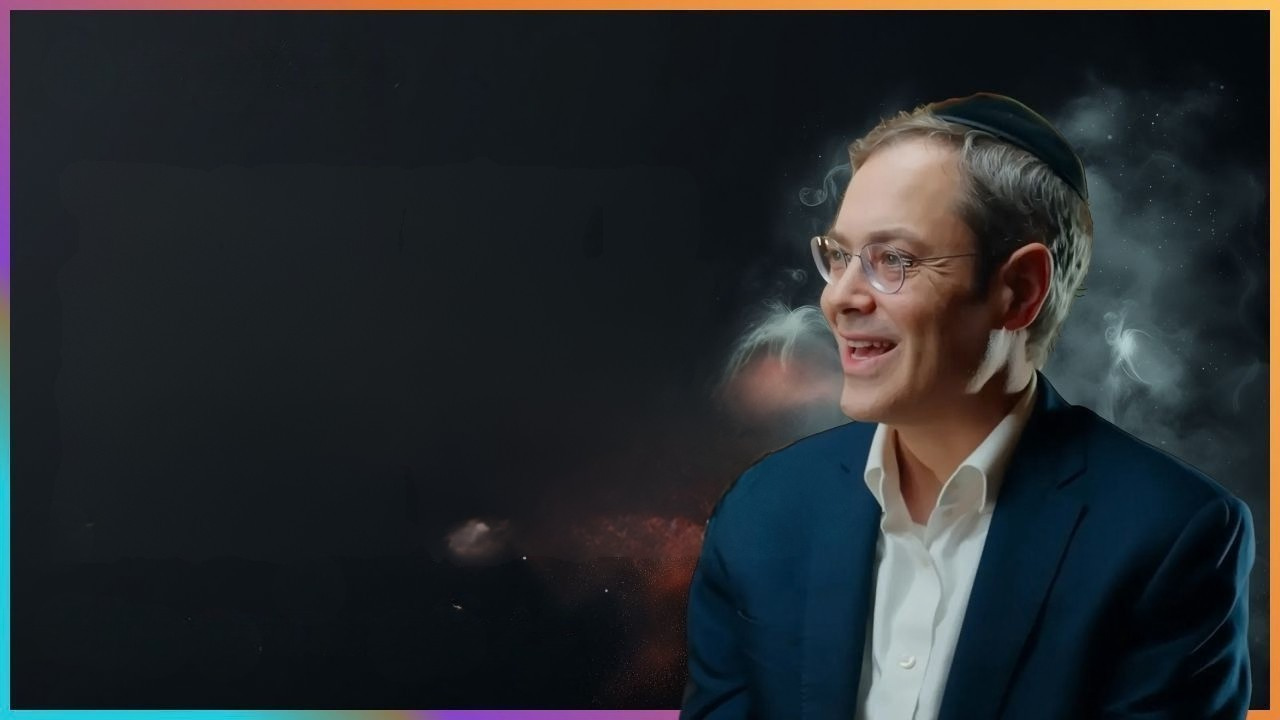
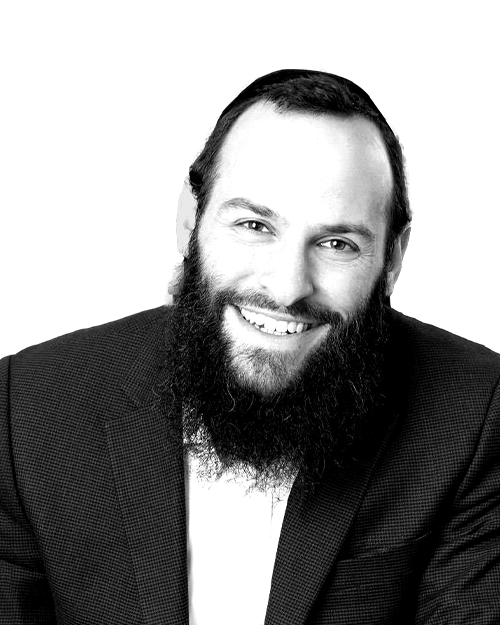
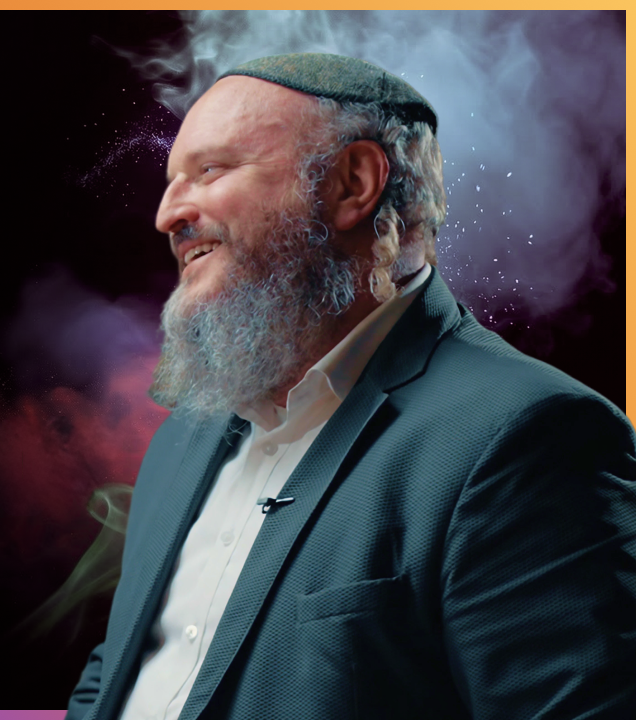
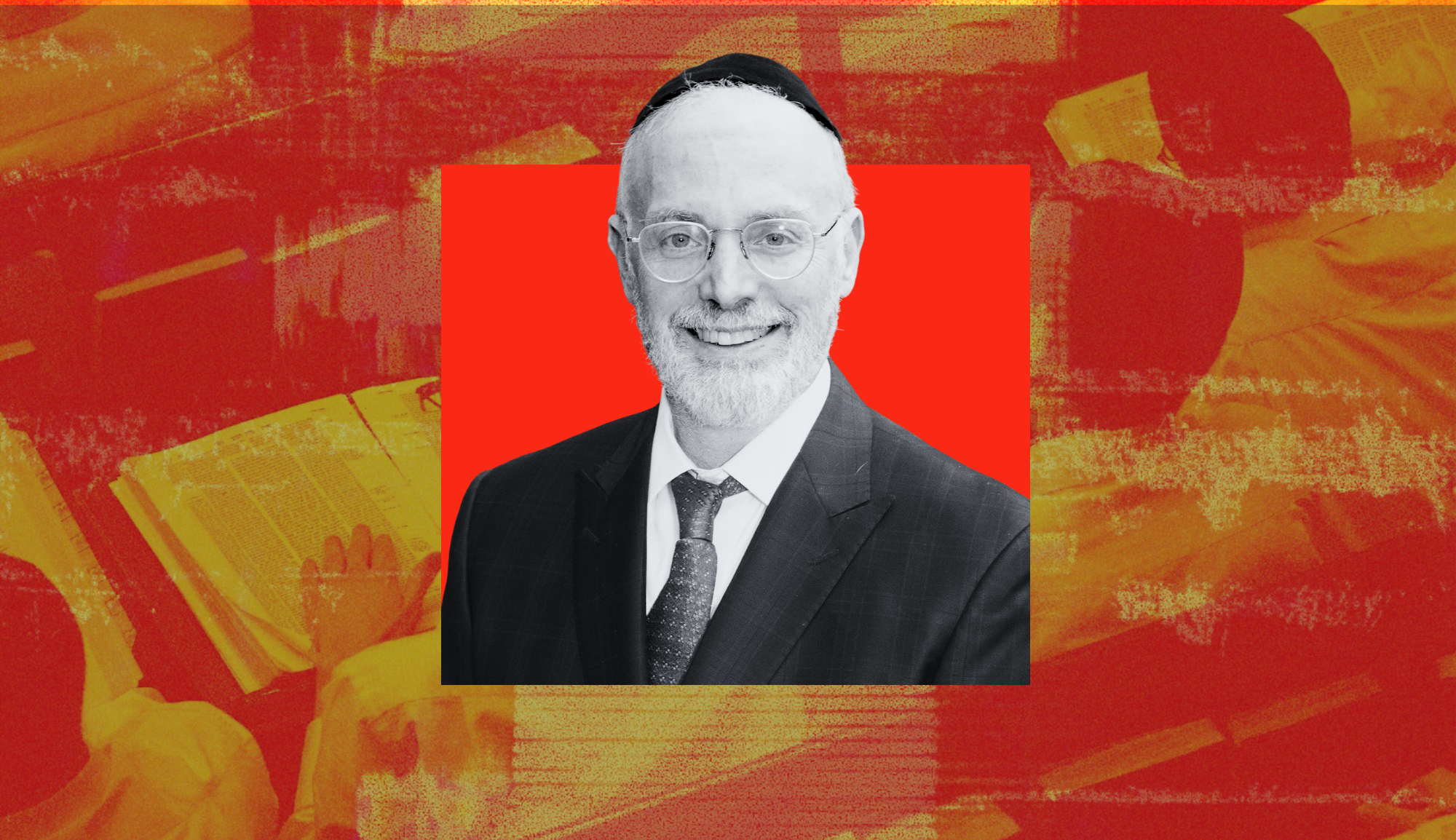
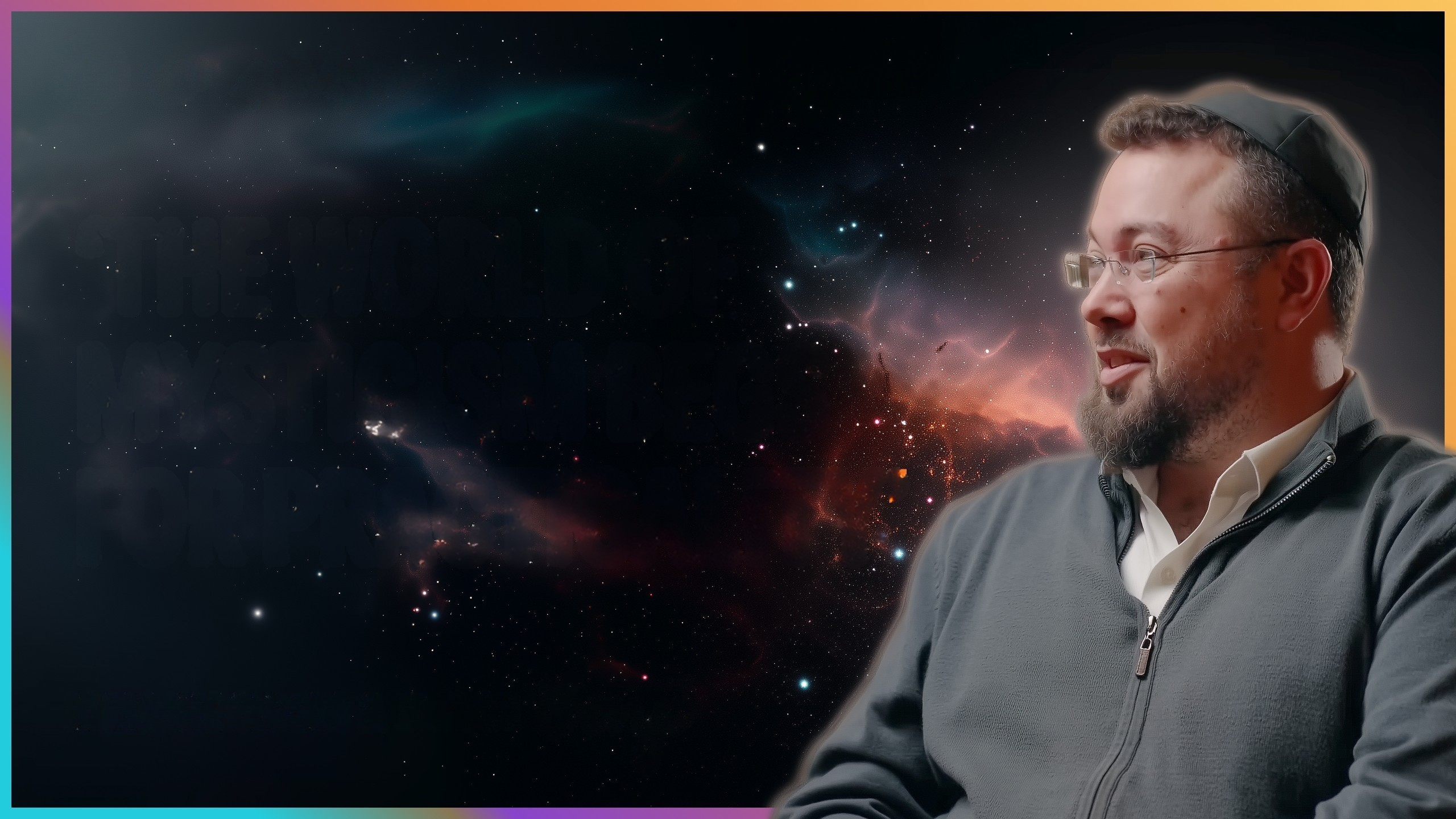
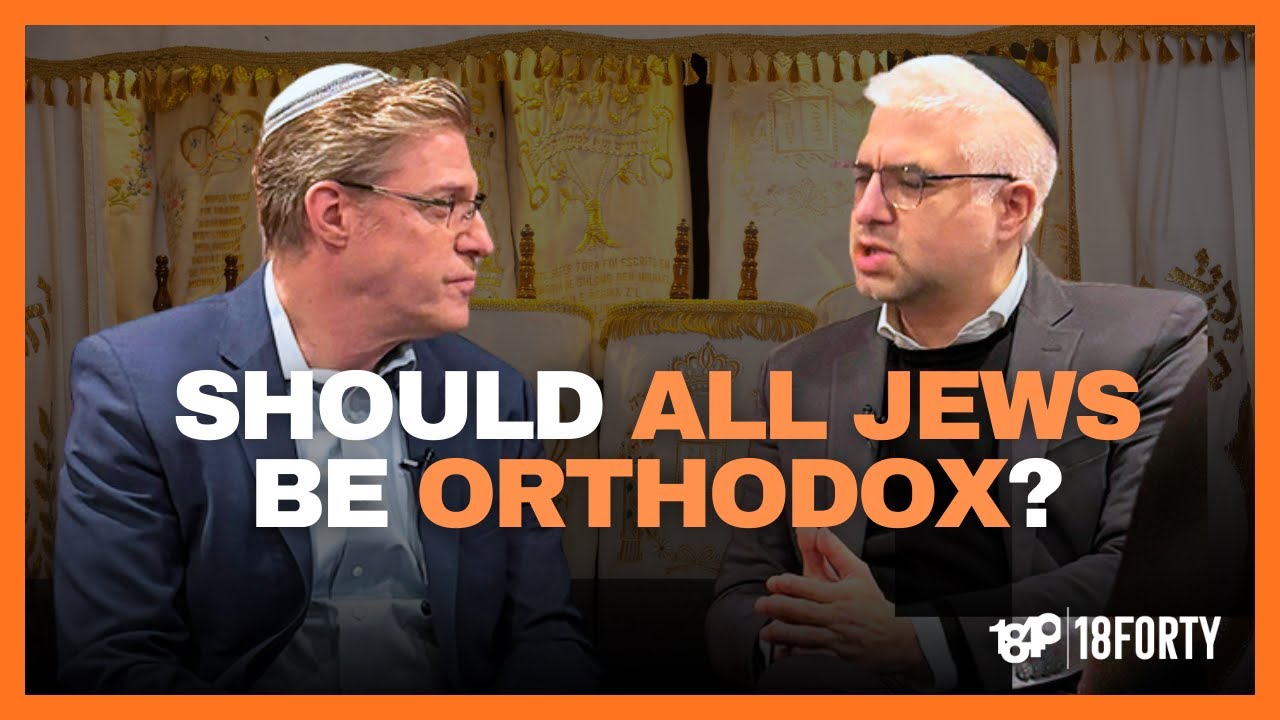
RABBI DR BENJI LEVY. Rabbi Daniel Rowe, it’s such a privilege and pleasure to be with you here in the heart of the city that you now call home. You were the executive director of Aish UK and did phenomenal things there. A senior educator now at Aish Global and a phenomenal writer, phenomenal teacher, and really an incredible person. So thank you so much for joining us today.
RABBI DANIEL ROWE. Pleasure.
LEVY. So there are so many different aspects to you, Rabbi Daniel Rowe, and what not as many people know about you is your incredible knowledge of Jewish mysticism and the deeper teachings. What is Jewish mysticism?
ROWE. It can mean so many things. The Gemara talks about what we call either Pardes, the orchard, or Maaseh Bereshit and Maaseh Merkava, the Work of creation and the Work of the Divine Chariot.
And it talks about the parts of Torah that are sisrei Torah, secrets of Torah, that are not taught in public. Now, the Rambam has his take on what that is although he says he has no tradition. The world that’s called Kabbala today and typically called mysticism today focuses very strongly on the aspect of God’s names and God’s, if you like, middot, the attributes that are popularly known as sefirot. That is the language that has been used since about the thirteenth century: these hemispheres, these channels through which God interacts with the world.
So typically today we’d call it Kabbala, the received tradition. That’s what we mean by all that. But in essence, what it means is it really goes all the way back to the neviim, the prophets Isaiah and Ezekiel, who have these visions that there is an inner working of the heavens. They have it in Isaiah chapter twelve and in Ezekiel chapters one and ten, where they see something behind the scenes of reality and creation.
Then they see things that seem incredibly anthropomorphic and they are on the journey back to the core, if you like, of the will of God. And that mystical sense of this behind the scenes of what we see is this, not just the infinite depth of God, which we can’t reach, but the possibility of God expressing himself through various layers that allows us somehow to touch and have a relationship with that which is infinite and beyond. That, I think, is the essence of what you might call Jewish mysticism.
LEVY. So how were you introduced to it? How did you connect with Jewish mysticism?
ROWE. So first of all, I should say I’m not a great expert. I really am not. I have the privilege of teaching Torah and I have some knowledge of some areas, but I really would not consider myself a great expert. I actually remember a very wise man once saying, “Those who know don’t say and those who say don’t know.” So since I’m saying this now, you can assume I’m one of the “don’t know” people.
So maybe I have more familiarity with secondary literature and so on. I got involved, I think, because I was always searching for [answers to] lots of deep questions about lots of areas and just generally exploring loads of things. I eventually came across shiurim [lectures], and when I was in yeshiva, for example, there were a lot of Maharal shiurim and other lectures and I started just learning and learning and learning, finding my vein, finding people in new material, and I’m [still] doing that to this day. And I found, I tell you what, it’s an area where you feel the coherence of things.
Things start to really fit together and yet build this meta picture where everything just makes sense, both intellectually but also experientially. Now, I don’t draw the line as rigidly as some do between what they might call the kabbalistic and the rationalistic, these kinds of distinctions. I don’t think they’re such legitimate distinctions. First of all, rationalism is the wrong term for medieval Jewish philosophy because rationalism is a seventeenth-century intellectual movement and people like the Rambam would not have been rationalists, more like empiricists, but leave all technicalities aside.
They were also struggling to understand this inner world. The Rambam believes you access actually through the natural science world and then you go deeper into the philosophical concepts underneath and then deeper all the way up the ladder, all the way. And he writes in a very subtle way in the Moreh Nevuchim about this, in the Guide for the Perplexed, and others do the same. The mekubalim [kabbalists] have a whole tradition of how this inner world works and a language for it, and they don’t start from the scientific layer, if you like.
And then there are obviously schools and strands that go into all sorts of other things, but I think there’s a unifying principle in Judaism. On the one hand, God is absolutely ungraspable and beyond. And on the other hand, the Torah clearly makes that very clear. If you imagine you’re reading it with an ancient lens, especially, it would be absolutely clear. Where is this description of God?
And yet there are anthropomorphic terms used, which means, and we are asking for a relationship with God. God is not an abstraction. It is something we’re really trying to have a relationship with. And so that’s why I think a lot of this teaching opens it up and it sort of shows how it’s manifest in all the mitzvot [commandments], and the stories, and everything’s just coherent, and it’s unifying and it’s just this beautiful, majestic world that is intellectually staggering and exactly talks to the inner struggles of each one of us too.
LEVY. So you essentially started almost on a path of inquiry, looking at broad questions and finding mystical answers that come as part of a broader coherence. If someone wanted to sort of connect with this school of thought, where would you suggest they start? How do they go on this journey?
ROWE. It totally depends on what they want to connect with. It’s not just a school of thought. It’s in essence like trying to pick up, if you like, the soul of the Torah itself. You don’t need the soul of the Torah. The Torah is a soul and it’s a journey of the soul. But it’s really trying to see the deeper dimensions between what already exists on the surface and trying to not just relate to the surface but see what’s the infinite depth beneath.
So for one person it might be an intellectual pursuit. I want to see the sense much more in the mitzvot [commandments] and the stories of I. For another person, it’s: I’m just drawn in to search for the beyond. That’s what we call the mystical. For another person, it’s: I want to develop myself and I want to see how this wisdom can help me heal my inner struggles and shed a pathway on things I’m going through but also give me meaning and purpose.
LEVY. And is there specific literature on each of these areas that you would suggest?
ROWE. There’s a lot of literature on each of these areas. There’s really, really a lot. There’s not one school of thought.
LEVY. So I guess it’s about identifying the path you’re coming from and then looking accordingly.
ROWE. I mean, not everyone’s saying things that should be. Yeah, not everyone’s a great teacher. There’s a lot of really great teachers today. It’s really accessible on different levels. Once upon a time, you had to be reading the Arizal or we [had] to be dealing with things that are so abstract that they were just very easy to anthropomorphize and almost make idolatrous. And you have to be really subtle as to how you learn and study this. Today, there’s so much secondary and tertiary literature.
You know, people love Rabbi Kook [Rabbi Abraham Isaac HaCohen Kook]. There’s that world. People love Chasidut [Hasidism]. There’s so many. There’s not even one thing you call Hasidism. Obviously, Tanya is very popular and a very beautiful sefer [book] and a powerful journey. And again, if a person wants to go there, there’s an entire library in the universe. A person could literally immerse themselves into the Chabad world.
There are whole other genres of Hasidic literature that tie into similar themes but in totally different ways. Rabbi Nachman and Breslov is a whole different journey. And then you’ve got, in the literature, or let’s say if you’re very into philosophy, the Ramchal is perfect. I mean, there are loads of others. But the Ramchal really translates Kabbala into a way of making sense of the world philosophically and understanding how God is interacting with the world. So there are just so many different journeys. A person who wants to feel in davening [prayer] that they’re touching heaven, there’s the entire Sephardic world of Kabbala.
So it’s like endless possible journeys. Thank God.
LEVY. And so you didn’t like the distinction between rationalism and mysticism. In an ideal world, should all Jews be mystics? Should we all be accessing this literature?
ROWE. I think a lot depends on the terms we’re using.
The word mystic, if it means touching the transcendent and finding a way to bridge it, I think there is a legitimate distinction between those who are using Kabbala and those who are not. But it’s not as sharp as one would think. You know, the fact that the Ramak, Rabbi Moshe Cordovero, is one of the greatest writers of what’s called Kabbala, [and he] is drawing all the time on the Rambam. And you would look and say, one second, there’s no Kabbala.
But actually, it’s not really true. He’s also trying to understand the Maaseh Merkava [the mechanics of Divine manifestation], just without a tradition. But he’s thinking through the lens of the Falsafa world of the Aristotelian Muslim schools and stuff and wrestling with that and the anti-Aristotelian world. And he’s dealing with their concepts. And he says a lot about how he can’t describe God. But then he also says, yeah, but you can’t just negate [God]. That is what you’re meant to do.
And as the Rambam would say, like this question, can I say God loves me? The Rambam would say, how can you say God loves? That’s a human word. But the Rambam would also say, you can’t say God doesn’t love me. And of the two, God doesn’t love me is a lot more false than God loves me. So we’re talking in negatives, but a double negative does not mean a positive. So to say, it’s not true that God doesn’t love me, [it] doesn’t immediately mean that God loves me [like] what humans are doing when they love, but it’s much more true than the other.
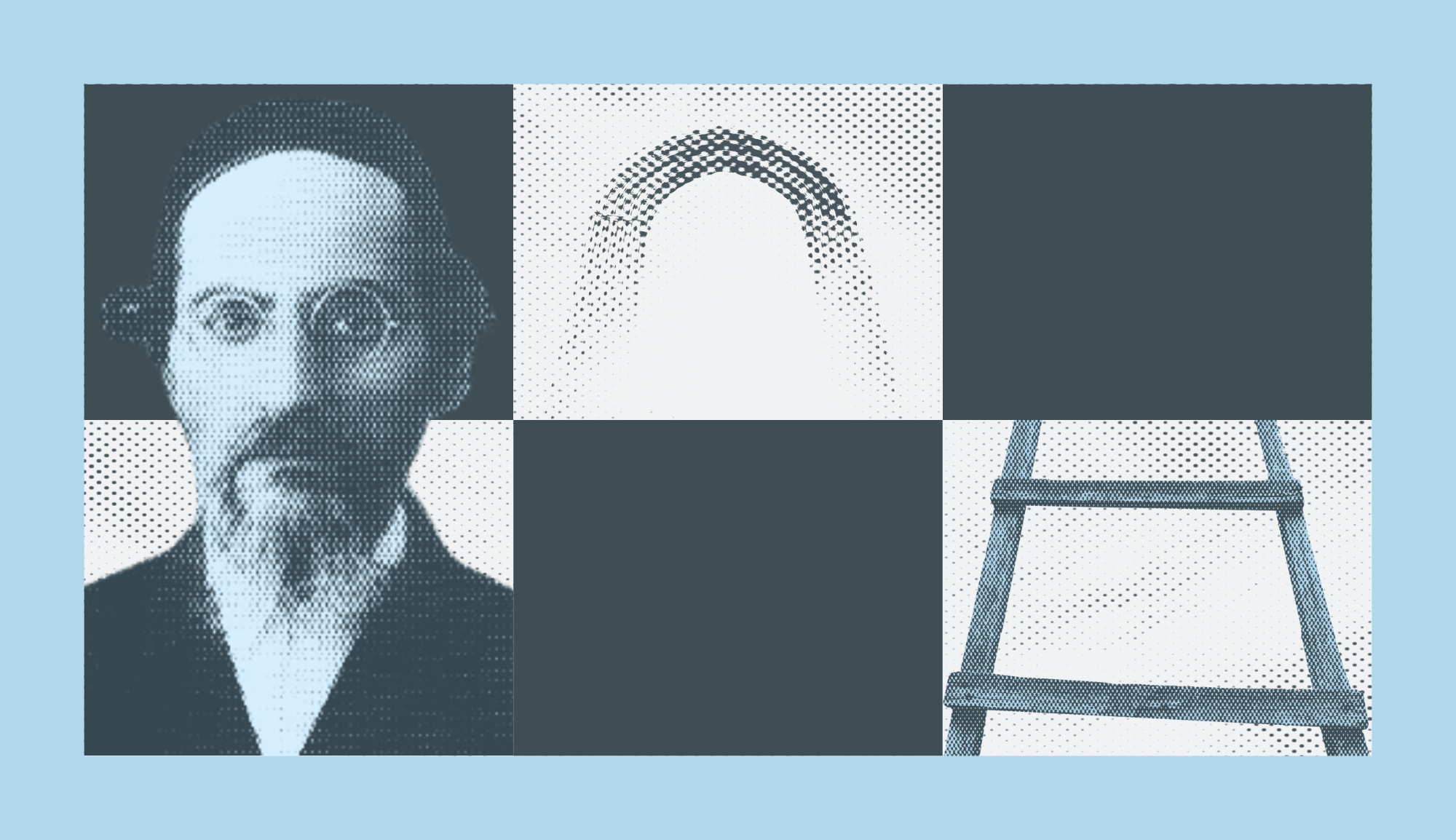
And how do you bridge that? And the Rambam sees there’s a journey. He literally talks about climbing Jacob’s ladder. And if you’re sensitive to the text, he sees the whole of creation as operating on multiple layers. Then he turns to the kabbalists and they’re also talking about the whole of creation operating on multiple layers.
Now, the Rambam, for example, will not talk about shefa [abundance], things flowing down from heaven. If the Rambam says you can’t touch an element that serves as an idol, we’d say, yeah, because it’s tamei – it’s impure. We’re trained to think kabbalistically. The Rambam would say, no, no, no. It’s because you might come to use it once. You’ll say, hey, wasn’t this the god of wealth? And I sold and invested money and made wealth. So this might lead me away from God.
So you think they’re two different universes. And then you realize, one second, what do we mean when we say something is tamei [impure]? We mean it has an intrinsic property that could lead me away from God. You see, and this is the interesting thing. When you’re dealing with very abstract things, sometimes you’re talking very different languages, but it’s not a given that you’re actually saying something as different as we think we are.
But in the kabbalistic world there will be an emphasis on when we do something here, the light of God shines into the world. That is where the emphasis is. The Rambam would talk about [how] we’re grasping more of God. So there is a difference and there are important differences, but what I’m saying is they’re not as different as we think they are. People like to make these sharp, rigid lines and [they] don’t quite work. People also do the opposite. They put things together that don’t really belong together too.
LEVY. So interestingly, you talk about God: God loves us or God doesn’t love us, this infinite light. When you say the word God, what comes to mind? What is God?
ROWE. Yeah, that’s really important. And a lot of kabbalistic works will distinguish God in essence [in a way] that we can’t meaningfully talk about. We can say that it creates the world. And when we use the names of God, that is when we start having something we can sort of relate to.
And perhaps the four-letter name encapsulates the entire will of God. Now God’s will is infinite. God’s will underpins all of creation; all of creation expresses it. And we don’t have the tools to fully grasp it. So we don’t have the tools to fully grasp anything the word God could fully mean.
However, we have a lot of ability to connect to it. I use the analogy – Bertrand Russell, the philosopher, once said, “When I say I know something, I can mean three different things: I can know that something’s true. I can know what it is, which usually means I can picture it. And I can know it directly and have some kind of relationship with it.”
So in math, you could do the mathematics of fourth-dimensional space. Now, we have no clue what fourth-dimensional space is because our brains don’t think that way. Right? So I can know that things are true, that I can prove them, but I don’t know what they are. I know you’re conscious [and] hopefully you know I’m conscious, right? And all people out there, but at the moment science doesn’t yet have a theory of consciousness to work with.
So I don’t know what on earth you are. I don’t know what I am either. But I know that you are. And because you’ve got an expression through your face, and as we get to know each other better, your emotions and your thoughts, and I can go on the journey, I can connect to you.
And it’s like that with God: I can know that there is an infinite creator out there. I can know that It’s, by our best metaphor, thinking the universe into existence. I can’t know what it is and any attempt that I have to picture it will be wrong. Any attempt I have to relate to it will humanize it. But I can know it and have a relationship with it. And I can do it because God has, so to speak, built a face of Himself, which is creation and also the Torah. And therefore I have different portals. And especially in Kabbala, via Torah, via Pnimiyut HaTorah [inner dimensions of Torah], we can directly connect to God.
And if we think about it in the analogy that the Ramban actually brings on the Torah, we often talk about Torah creation as a speech of God, but the Ramban really could say it’s the thought of God. If I could think something into existence, which I can do and you can do, if I could somehow withdraw enough that it’s aware of itself, it wouldn’t have to go looking very far to find me. And that’s like us and God. Any relationship with God is mystical in that it transcends our normal human limits and it enters a dimension that is far more vast than we can grasp with our head.
But it means that it is present everywhere and it is accessible. And the Torah suddenly becomes a deep tool for that access. And whereas, let’s say, the Rambam would say it gives me knowledge of God, the Hasids would say we become nullified within God, and other kabbalists would say we’re experiencing the flow of the light of God. Are they different things? Possibly. But there’s something in common with all of those even though they’re different.
LEVY. Interesting. So what is the purpose of the Jewish people then?
ROWE. I would phrase it as, although, again, you’re treading so many different ways of talking, one way to talk about it is, the whole equation is: God wants to fill the world with His light, call it with His love, call it with His presence, call it with His knowledge, call it whatever you want. And He’s created this space for something other than God to exist. And then that space has to be filled. But if God just fills it, we dissolve, we don’t exist. So He’s given us the free will to draw that light in.
But not just in ourselves as individuals, in ourselves as the single soul that is Yisrael, that is Israel, and ultimately the single soul that is humanity. And all of humanity was actually one in the Garden of Eden. This would be a typical, more kabbalistic way of talking. And the soul in the Garden of Eden was meant to be split into two, male and female, meant to come together and go to God.
And instead it chose to become the center of reality. This is again what the Rambam talks about in his way. But the center of reality now means, and this is now the kabbalistic language, [one is] no longer able to be oneself. There are now billions of selves. Every little piece of this soul becomes its own self.
LEVY. Each connected to the ultimate self.
ROWE. Each connected to the ultimate self, but [each one] experiences itself fundamentally as separate. And so all of us feel separate, and self-centered, and we feel the world through our own self-centeredness. And yet on the kabbalistic dimension, we’d say, well, we’re still all one. But on that spectrum between all one living the vision of God and very self-centered is a journey that has to be undertaken.
And ultimately all humans are playing some role in the rectification. Our job is to rectify that soul, to heal it and bring it back together.
We gather for this on Rosh Hashana. Veyaasu kulam aguda achat – the whole world should become one. Laasot retzonecha belevav shalem – to do Your will. We want to recreate Adam, right? Adam dies in the Garden at some level. On some level he lives, on some level he dies. The oneness dies. And we’re now in this world of fragmentation. We experience time in fragmented moments. We experience self in fragments.
And yet beneath it all is really unity. And this unity is what we’re striving to express. And that’s what I need to learn: to see the world through your eyes and you through mine. And the Jewish people have taken upon ourselves to be channels of the light of healing to enter the world or to live already now, trying to live the Torah, the final state of humanity.
And so we have to feel ourselves exactly as the Torah says, “Venivrechu becha kol mishpechot haadama” [And all families of the earth shall bless themselves by you]. Our responsibility is that through us the whole world should be healed. And we have to feel [that] if the world isn’t healed, we’re not doing what we need to do.
LEVY. And that’s not an elitist role vis-a-vis other nations. How does that come together, the universal and the particular, in terms of the Jewish people’s role?
ROWE. So it’s both. It’s particular and universal. Torah is always full of these things that you think of [as] dichotomies and really the answer is both. And yes, Judaism is intensely particular on the one hand, in that we are meant to work as a people with one another, with a deep, super sense of oneness. But then there’s the universal: we’re doing it for the healing of all mankind.
And Judaism famously doesn’t believe, and it’s not just true of mystics, it’s true of everything, that only Jews have a portion of the World to Come. Then you see some contradictions about this. And the answer is very simple, it is that in the Messianic Era, every nation will still be an independent nation. And as we dissolve towards – the kabbalists always talk about the World to Come being the final state of humanity at the end of the Messianic Era. That’s where it’s all now called either Adam or Yisrael [Israel]. It’s the same thing. So everyone’s dissolved into a titan “one.”
But yes, on the one hand, we can respect others out there in the world. And there’s the deep Noahide covenant that consciously and subconsciously drives humans, hopefully over time, in a more and more monotheistic way. And at the same time, because God is manifest in different voices, there’s an easy tendency towards idolatry, and ripping those apart, and making each one into a separate God, and not connecting all back to the one. Which is, anything that rips apart oneness into pieces is disastrous. And anything that brings it back to oneness is great.
And if it does it via separate channels, that’s great. And humanity is the same, just like the seventy faces of God and seventy faces of Torah, but it’s all really one. And by the way, when we call Torah, the Pnimiyut HaTorah [inner dimensions of Torah], the secret, the sod, that’s [the] gematria [numerology] of seventy, meaning that is where all seventy become one. So [we’re referring] to the seventy nations, and then there’s one, and it’s all working together. There’s a vessel, which is the nations. There’s the light, which is the Jewish people. And we have to be together. They can’t have one without the other. But in the end it would all dissolve and become one.
LEVY. So then how does prayer work? How do we communicate and commune with God? And what is this thing called prayer? How does it work in a mystical sense?
ROWE. So prayer, even in a non-mystical sense, is about building our relationship with God. If you’re talking more kabbalistic, you would feel that as one prays, every word is lighting up the universe in some sense. It’s a channel through which God’s light becomes more manifest in the world
LEVY. Through our prayer?
ROWE. Through prayer, through the idea. Because in a sense, Rabbi Chaim of Volozhin, who’s not the only school of Kabbala, puts it this way. He says that really, God is naturally all the things we pray for. Rofeh cholim [Who heals the sick]: if God’s presence was manifest, no one would be ill. Mevarech hashanim [Who blesses the year]: all the world would work economically. Right, we’d have anything we’re praying for. Chonen hadaat [Who grants knowledge]: anything would be happening for us. The world would be full of knowledge. Bring us back to teshuva [repentance]. That would be natural. Forgiveness of sin. These are all troubles solved. Jerusalem rebuilt.
Everything we’re davening for is the natural state. What it is that we have to preserve [is] our free will, to preserve our sense of self. I’m going to come back to what I said earlier. Some things have opened up and it just became so interesting to meander. We have to get back.
Kabbalists often teach that way, by the way, that the valentine is often your meandering. Anyway, hopefully you get back.
So we have this free will space [that] God’s given us and we have to invite God in. We have to invite the light of God in. If God just filled us, we’d stop existing. So prayer is when we say, actually, God, we don’t want to keep pushing You out. We want to shift away from self-centeredness into You-centeredness.
Again, the Hasidic way of talking about this would be to say we have complete bitul hayesh [self negation]. We dissolve the self altogether. The self-nullification. And then deveikut, complete connection.
Other kabbalistic schools wouldn’t talk that way. The Arizal’s language would be the Kavanot, or as we’re praying, very –
LEVY. Intentions.
ROWE. Intentions. That means the various channels of divine revelation that are happening. But again, is it the same? Is it different? It’s probably a different aspect of something very similar. But what’s happening is that overall the self-centered, I am other than you, God’s son, is moving away and the God-centered self is becoming manifest.
And prayer is very central to that because I’m really saying, God, what is the essence of what I wish for more than anything else? What You wish for.
LEVY. So it’s almost aligning our will with God’s will through prayer.
ROWE. There’s a mishna in Avot. It says, “Aseh retzono kiretzonecha,” make His will your will.
LEVY. But prayer is the mechanism.
ROWE. Prayer is a very super powerful mechanism, a direct mechanism for doing that.
LEVY. So then what about Torah study? What’s the goal of Torah study?
ROWE. Torah study is a similar thing, but it’s almost a reverse process. So Torah study is the practical translation of that desire to live in God’s will.
So what it does [is] it takes every detail of halacha [Jewish law], of how you can live a life in service of God, or if you use a kabbalistic language, [of how you can] bring [it] as a channel of God’s light. But instead of just understanding it as a channel of God’s light, it is also: Can I align my brain with what’s going on behind?
So I’ll give an analogy. You know, if you’re in love with somebody, you’re married to somebody, and they want something that you do not understand, right? Let’s say you’re married to somebody who likes flowers and you think they just cost a lot of money and die, right?
So you could say, look –
LEVY. This is just a hypothetical.
ROWE. Hypothetical, right. So you could say, look, I’m not going to do it if it doesn’t make sense to me, which is not called a relationship. You could say one second, I love you. So it matters to you. Therefore, it matters to me. We call that, I mean, the Torah calls it naaseh [we will do]: I’ll do what you want. As long as I know my relationship with you is real, I’m in, I’m doing whatever.
And then there’s naaseh venishma [we will do and we will listen], which means I want to understand what you see in it. Can you tell me why these flowers are beautiful and not those? I don’t know if I’ll ever fully get it, but the more I can align my thinking with yours, it not only means I can get a better result, which is one benefit, but [I can align] my brain, which in modern science [means] my neurons are now aligning with your way of thinking. I’m connecting with you in a way that will change everything I do.
So Talmud Torah [Torah study], yes, it’s important on a very religious level just because I need to know what the law is. I also need to know the reasoning behind the halacha [Jewish law] so that I can apply halacha much more broadly. But now there is, if you like this more, call it mystical, call it whatever you want, [a] dimension of, I’m actually shifting my brain to be filled with Godly thoughts so that my soul and my brain are tying together. They’re flowing into one another. Neurons are aligning now with divine consciousness and divine will. So then everything I do is going to hopefully be more aligned with what Hashem wants.
LEVY. So you highlighted a difference between spouses. Does Jewish mysticism view men and women as the same?
ROWE. Jewish mysticism views the whole universe as male and female. The Hebrew language does that, obviously. Names of God do that. There are names that are male.
LEVY. Therefore, they’re different, right?
ROWE. Therefore, there’s a difference between male and female. Now, when it [comes] to men and women who are filtered down to this world, we all have some male and some female energy and soul.
LEVY. So male and female are constructs that are broader than just male and female human beings. So when we’re talking kabbalistic language about male and female, it’s broader than just a human being’s application.
ROWE. Absolutely. Now, there are some applications in men and women, right? They’re not as broad because there are only a few mitzvot that are different. Now, when you focus on them, they’re very different. And there are certain natural proclivities that are different. There’s biology that’s different. So we can focus on the difference. We can focus on what’s similar. But there is a harmonious integrated relationship between anything that’s called male and anything that’s called female.
And spirituality is about often aligning the two. You see less of this in maybe a Hasidic thought where the goal is slightly different. But in, let’s say, the Arizal thought, everything is about male and female, the parts of them and things harmonizing and integrating. And what’s male is always the potential state of something. And what’s female is always how it manifests. And integrating those in the right way is always very powerful. Now, when it translates down into men and women, there are translation mechanisms that are – there is definitely room for a lot of fluidity in terms of what people do and don’t do.
Then there are areas where it’s rigid. These are the mitzvot of men, these are mitzvot of women. So there’s definitely going to be much more male energy, if you like, oriented towards the mitzvot men do and more female oriented towards the ones women do. But it’s not as strong as, let’s say, when you’re dealing with this much more abstract form.
LEVY. Interesting. And what do you think in today’s day and age is the biggest obstacle to living a more spiritual life?
ROWE. The biggest obstacle always is self-centeredness. Self is the biggest single obstacle. Self, meaning a superficial self.
One of the interesting things is that really, if you go down the levels of neshama [soul], the kabbalists talk about five different levels of the soul. And there’s really iterations and permutations of all of them. So you’ve got many, many levels. But the outer level, it’s like twigs on a tree. So each twig could identify itself with its separate status, with our body, let’s say, in the sense of my body is separate from yours and everyone’s separate from each other. And if we were twigs on a tree, we’d be fighting – my leaf wants photosynthesis, no, mine does, right? Or we can start to notice we’re actually all part of one. And that’s where, for example, love comes in, a ruach [spirit], the desire for relationship and speech and intercommunication and love based on giving. That’s where we feel we’re actually all part of one branch.
And then we can go deeper to where we get [our] neshama [soul] and we’re feeling the divine faintly within us and the desire to do what’s good and right in the world and connect that, you know. We’d even want people we love to be willing to give their life up for the life of others sometimes. That’s a very deep place.
And then there are deeper places. We go into our, I might call it higher, the life point of the soul, where we each have a unique role to build this world so even future generations would have a better life. We connect not only to people alive today but to history. And then we have the pure oneness, the yechida, where we feel a part of us that’s connecting all the way back to, if you like, the thought or will of God. And that is very deeply subconscious, but that’s also a self.
And so we have layers of self. So it’s the superficial self that is the biggest impediment to spirituality. And today, anything that stimulates that, be it my own inner ego state [or] the stresses and fears and lack of trust [in] God, the outer, stimulating world can be an impediment. The pursuit of anything that starts out like power and money for the sake of honor and glory, these things are very, very distracting in a spiritual sense.
LEVY. So you talk about coming back to that inner unity and the thought and the will of God. One of the teachings is bereishit. The first word of the Torah is “be-reishit,” [meaning] with reishit, with God’s thought, “bara Elokim,” God created the world. Why did God create the world? We know that God created the world. Why did God create the world?
ROWE. Well, essentially, what you point out is actually a midrash [homiletics] on Rashi, which shows how you can’t draw a sharp line between what’s mystical and not mystical, right? Why did God create the world?
So the why question can mean lots of different things. Typically, when a human asks why, they mean what was the cause, right? So whatever answer you’re gonna say, God created it to give, God created it to shine His light, or tov dira betachtonim, we wanted a light in the lower places, or we wanted to give to humans, any of the language we’re gonna use, someone’s gonna say, yeah, but why did He want that? And ultimately, you’re going to get to the place where it’s the pure first cause: it just was His will. And it’s not that we can’t know the why, which is also true, there’ll be a place where we can’t know, but at some point, probably way beyond that, there is actually no why; there is no cause of that pure desire. So at some point, the “what caused it” question ends.
LEVY. So we know that there was a desire, but when we keep peeling back the layers, it comes to a point where it was God’s desire.
ROWE. That’s right. And now, if “why” means what is the goal of creation, then we can talk and we can use different language.
LEVY. But is that hard for you? You’re a very intellectual person. Is it hard for you to get to a space where you actually don’t know?
ROWE. Instinctively, it’s hard because I wouldn’t want that. But when you ask philosophically, there has to be an end to that. As much as I can’t get my head around that, that’s the difference when you’re saying [you’re] knowing that something’s true: I can know that there’s a God who’s not in space or time, but the minute I try, my brain then wants to think about that and paints him in big, black space as a little dot in there with time ticking, right? I can know that the first cause is going to be not caused by anything else and therefore the pure Will is not going to have a need that it is addressing in itself. So I can know that, but my brain then quickly psychologizes that and can’t get its head around it. That’s okay. That’s not a problem.
Learning to understand what we can’t understand, not just because what we can’t understand [is] because we’re limited, that’s one thing we have to learn to accept. And then we also have to learn what there is no answer to because it’s impossible [to] answer. There is no thing causing God to create at some point.
Now, where we can grasp [it] is [when] we talk about the will of God. We say, what is the will of God? What is God’s vision for the world? What is the goal of creation? And here we can use different angles to explore different aspects. So this one version that you hear in kabbalistic literature is: He wanted a light or a home in the lower world.
Then another, which goes also back to the Arizal, although Saadia Gaon also says it from a philosophical perspective, is that He wanted to give. They’re not very different. They’re just different ways of saying God wanted there to be “other.” Call that the lower world, call that other, and [He] wanted to fill it. [He] wants a dwelling place in the lower world, right? Say it’s a relationship with something other than himself, some opportunity to give. They’re all really saying the same thing.
Again, from very importantly different angles, it’s very important not just to put them or to want to see them as different angles [and] learn them, but in the end they are also one, [same] thing from different angles. And that is that God wanted there to be “other” and wanted the relationship with “other,” wanted to give of Himself, His will, whatever word you want to use.
And this is another very important thing. When we talk in Kabbala, anything called Pnimiyut [inner dimensions of Torah], whether you’re studying, again, whether it’s the Rambam, whether it’s the kabbalist, you have to learn that any word you’re going to say will create a true picture and a false picture at the same time. And you have to learn to use the word but then also recognize there’s at least a part of it that’s conveying a human experience. And then I have to use another word and another word, and our words don’t convey as directly as they might do when we study science. Although even then, if you try, you can still use words in some kind of metaphorical way.
LEVY. By definition they’re limiting and confining [words] so we can understand it, but it’s limiting certain elements.
ROWE. And that’s exactly because words are designed for intersubjective experience. So if you’ve had a crazy experience no one else had, you actually can’t use words to describe it because it’s indescribable. But even more indescribable than what you mean by indescribable.
LEVY. Meaning even the word indescribable describes something.
ROWE. Exactly.
LEVY. Or subjectively someone –
ROWE. It’s the next level of humans, what we say when we think there’s no other word to describe it. And then if you have an experience beyond that, you can’t put that even into those words. But if you’ve met someone else who can, you can.
LEVY. Yeah.
ROWE. And that’s part of what the Gemara means by: You can’t even teach one person Maaseh Merkava [the mechanics of Divine manifestation] until they understand it themselves and you can give roshei perakim, headlines. But always [present] when the Gemara describes this teaching is that the student says to the master, teach me. The master says, I can’t. And the student says, can I do it? And then they get off this mountain, crazy things are happening, and they both realize they both know it.
LEVY. It essentially means there’s an experiential element that cannot be conveyed through language alone. It’s not a cerebral intellectual engagement or exchange here.
ROWE. That can all be a part of the growth there.
LEVY. Yeah, but it’s to a point.
ROWE. Yes, and it’s also got to come with intense self-development because we’re always projecting whatever level of ego and self we have into the picture.
LEVY. So if God willed this world to be like it is, did he give us the capacity to have free will as well? Does free will exist?
ROWE. Well, free will is absolutely fundamental to everything in Judaism and God’s knowledge is fundamental and [there are] different ways of reconciling those two. You know, if you’re a philosopher, I mean, the Rambam already says to us: Part of the problem we have is that the question doesn’t actually begin with questions like “free will” and “God’s knowledge.” The kabbalists say something similar but perhaps even more encompassing.
So Rambam would put it as: The question assumes I sit inside time and study things external to them. So if I’m sitting here right now and I can study facts about the world now that mean I know what you’re doing in a week’s time, then you’ll have no free will. But God is neither in time nor [does He] learn about the world externally. And since we don’t know what it even means to talk about God’s knowledge, it’s not that we have an answer to the question, it’s that the question never started. The question starts by sticking God inside time and having him as an external observer, and then the problem begins.
LEVY. But God did stick us inside time.
ROWE. God sticks us inside time. So we might say –
LEVY. So therefore do we have free will?
ROWE. From our temporal perspective, you’d say the future doesn’t exist and God doesn’t know it, but we know God has another perspective. But we don’t even know what God’s perspective is.
LEVY. Does that mean that we have free will in our existence, but [in] the step aside where God isn’t restricted by time and space there is no free will and its interplay at the same time?
ROWE. So there are teachings, kabbalistically, [where] you might say something like that. But I think you could also say they can both be true and they’re true in different perspectives, and we don’t have a way to reconcile it but that’s a limitation on us. Just like many things in mathematics and philosophy: They said this is true and this is true. We don’t really have a way to put it together. That’s okay. Our brain works in a particular way.
But we absolutely have free will and absolutely the universe is all one in God’s mind. And we can’t put them into the same picture. We can’t put the two experiences of reality into the same picture, and both pictures are true.
LEVY. Okay. And what about Mashiach [the Messiah]? When we talk about Mashiach, what does that concept mean? Because we’re trying to get towards the end of history, so to speak, towards a certain goal. What is Mashiach [the Messiah]?
ROWE. Yes. Again, the alignment in Kabbala and non-Kabbala, this is not dramatic. Well, I’ll show you where it might go. The sense that there’s an end of history is more than just: there happens to be an end of history, certainly in the kabbalistic teachings. But the Rambam makes it one of the Thirteen Principles of Faith. So it’s not just another fact that’s true. It’s something that redefines everything else. That’s what a fundamental is.
The power of the sense that history has a story that it’s telling means that everything we do is part of that story. So it’s not just that we enter the world like a virtual reality game, score points, and then come [out] on the other side, cash in those points, and get a reward. It’s that the real reward will be to see that everything we did was a part of the rectification of the world and the revelation of God. So everything is a microcosm of the Purim story, where every single action that appears chaotic and hard to see its meaning somehow builds the final story.
By the way, subconsciously, we’re so attuned to this that in art, a great novel will very often be one that has a twist at the end that redefines it, and suddenly you go back and every detail fits in.
LEVY. [It] all makes sense.
ROWE. Yeah, because that’s our subconscious sense of what a Messianic Era means, what history means. And the final revelation is ein od milvado, there’s nothing but God. Everything that looked like it didn’t make sense was really revealing God all this time.
LEVY. So that’s what the Messianic Era is.
ROWE. That’s the Messianic Era where humanity is converging on the Oneness, and [our] consciousness eventually sees that, and then eventually the World to Come – we literally experience it all again.
And of course, in kabbalistic language, you’d say the resurrection of the dead ultimately is the resurrection of the soul in the Garden of Eden. And our consciousness becomes one and reality becomes the Garden of Eden and that’s how the final thing that we can talk about starts.
LEVY. So then where does the state of Israel fit within this? Is it like a part of the final redemption?
ROWE. So that depends who you ask.
LEVY. I’m asking you.
ROWE. I am not big enough as a person to be able to say exactly where we are in history. You know, there’s a Rabbi Kook world – this is atchalta de’geula, the beginning of redemption. There are others who see it very differently.
You know, the world I grew up in, it feels like there’s something special. It feels like it’s an enormous responsibility on us to get it right. I often say to people, and this may not be mysticism anymore, but maybe it is, but again, I don’t think it matters, because what everything is teaching us [is] the world has a conscious layer and subconscious layers. So anti-Semitism at its conscious layer may be very, very evil, but at its subconscious layer, it’s also talking to us.
You know, if a person came down from another planet and wanted to study humanity and understand what is the most important thing in the world for the good of humanity, they go to the United Nations and they say, what goes on here? What do the world leaders talk about? So they look over its span of ten years. There are a few resolutions about global warming, some about poverty, some about health. Okay, so those things are clearly somewhat important. There are a few things about conflicts here and there in the world and starvation.
And then they look [and] sixty-seven percent of everything they talk about is the Jewish people. And they see it’s seventy-five percent of every resolution.
LEVY. It’s crazy.
ROWE. At some level, the alien would conclude that the most important thing in the world is this weird little people called Israel. And the biggest problem humanity faces is they’re not living up to it. They’re not moral enough.
Now we say, one second, you’re criticizing us for this. See, we’re looking at the chitzoni, the outer level, but you’re holding us to ludicrous double standards. You’re accusing us of things that are not humanly possible to do. Right? And on the outer level, we’re right. There’s a bunch of something really wrong with people critiquing [us] in the way they do.
But now go to the Pnimiyut [the inner dimension]. Ignore what they say on the outer level. Why should they be holding us to the same standard as everybody else? You see –
LEVY. We hold ourselves to a higher standard. So we should live up to –
ROWE. Right. We shouldn’t be having to fight a war where we’re killing people. Even if we’re doing it in the most humane way that’s ever been done in warfare, ninety-nine point nine percent of the civilians are alive a year later, which has never been done in urban warfare. All true. On the chitzoni [outer] level, that’s right. And the people are doing it and battling to keep civilians alive while fighting in tunnels. Wow.
And on a deeper level, there is something wrong with us that we have to do that. If we were really where we were meant to be, then the world would be lit up and this wouldn’t have to happen. And that’s the antidote to anti-Semitism: Anti-Semitism is darkness. Darkness hates light. But if you’re not shining enough light in the world, it’s very powerful. And it criticizes – it says, you’re dark. You know, isn’t that what they say? You’re evil, meaning you’re not doing enough good.
So turn to the Pnimiyut [inner dimension of Torah]. They can live in both realities at the same time, criticize the anti-Semite, but also realize they’re also saying something true. And we have to hear the hidden message that God is communicating through them to us.
And almost, I’ll tell you the funniest story. I get a lot of anti-Semitism if I post anything. I post about Jewish stuff, you know.
LEVY. Online.
ROWE. Online. But the nicest quote I ever got was when somebody said, “You Jewish people are a disappointment to all of us.” I said, bingo. That’s the Pnimiyut. That’s what you should all really be saying. Like, come on, guys. Stop being like, we’ve got UN resolutions about you because we need you to change.
So that’s the opportunity in the State of Israel. And it’s a massive responsibility. If Hashem [God] has brought us back here or allowed us to come back here or whatever it is, we’ve got to really get this right. We’ve got to be that shining light that heals the whole world. Not a world where we keep justifying ourselves because the world isn’t perceiving that we’re doing enough of it.
LEVY. Yeah. So what is the greatest challenge in the world today? What’s the real issue of the day?
ROWE. I think the issue of the day is exactly what the United Nations is talking about. Get ourselves right as a Jewish people.
LEVY. The issue facing the world is that the Jewish people need to be able to be more in line with our mission.
ROWE. Yeah. Now, we have to really internalize it. It’s not for the UN to be dealing with; that’s for us to deal with, right? The world needs us. They want us to be what we want to be. Now, we can get arrogant about that. We’re not saying we’re better. We don’t use – better and worse are not really Jewish words.
LEVY. It’s living up to our own potential.
ROWE. We’ve got a responsibility and we’ve got to do it. And it’s not good enough that we’re fighting each other. It’s not good enough that the average Jew doesn’t know what Judaism is. It’s not good enough that our connection to God is weak. And at the same time, we can say how beautiful things are. It’s how much chesed [acts of kindness] is done. And yes, we do have unity despite all our hatred. So you can look at both.
LEVY. So how do we need to correct this issue?
ROWE. I think this is where there’s a beautiful Pnimiyut [inner dimensions of Torah] that says we are one and just learn to look each other in the eye and say, I’m not telling you how to be, but I know that you could be even greater than you are and I could be even greater than I am. And I need you to help me and I need me to help you.
And not look at, see, again, the outer layer says, oh, we’re so different. You know, it’s an amazing thing. The more we fight on the outer level, it’s because we really want the same thing and we’re fighting with each other for it. You see? So whenever you’re really fighting intensely for the same thing, it’s because you’re so connected and the conscious conversation, and this is the beauty of Pnimiyut: don’t tune too much into the conscious conversation.
So right now there are people fighting over, let’s say, the whole pre-war judicial reform. We want justice and equal rights! We want this! We want the power!
But what are people really fighting over? We want to be respected for who we are. We don’t want you to do a religious takeover that forces religion upon us. Do you know how sad that is? Because of course they’re right. The idea that each individual is autonomous and special and precious and has a role that shouldn’t be crushed by someone else. And there’s somebody else in the camp who says, one second, I’m a Sephardi Jew here. We came to this land, [we] got treated like whatever. Now we’re winning elections and you’re just building yourself. That’s also true. But again, they’re saying, why can’t we be the same as you? Why can’t you trust us? Everyone’s really saying at their core something that’s true. Everyone is. We need more halacha [Jewish law] in the state. True. We need less halacha in the state. Yes, but what we mean by that is we don’t want you to crush us with this conformity stuff. That’s also true. Everyone’s really [right] at their core.
Now I’m not being naive and stupid. There are things that are false and malicious as well. But in principle, if we can switch our ears to hear that we’re one and ignite that part and recognize that there are things we can change in the world and things we can’t change directly. But in the kabbalistic universe, [it’s] the power that I can [use to] try and change the outputs, but what’s more important is I get the inputs right.
Now, sometimes the input is to try and change the output. Sometimes it’s to build a charity. Sometimes it’s to speak in public. But what’s more important, what I’m going to achieve, which I should try to achieve, is the fact that I’m trying.
You know, the Maccabim [Maccabees], the Chashmonaim [Hasmoneans], they didn’t light the Menora because they thought it was going to last for eight days. They lit it because that was the right thing to do. They didn’t go to war because they thought it was weird. Obviously, they had to have strategy, but I’m sure they thought they’d lose. But it was just the thing you have to do.
And that’s often – we can build organizations and build things because it’s the right thing to care about Klal Yisrael [the Jewish People] and ultimately to care about the world. But it’s the very act of caring that’s more important even than what we achieve. And we can’t ever forget that.
LEVY. It reflects a deep sense of faith. I’m not sure if I’m going to be able to achieve the end goal, but I can’t desist from trying.
ROWE. Exactly. And that goes back to Mishna once again: “lo alecha hamelacha ligmor” [it is not your duty to finish the work]. That’s why [mystically] it’s all the same. You know, the Gemara says that had Boaz known [that what] he was going to give Ruth, a bunch of grains, was going to be recorded in Tanach, he’d have given her gold.
What I’m saying is, we could have written, I remember hearing this in yeshiva, I forget who said it, one of my many maggidei shiur [teachers] there said, we could have written a multi-volume biography on Boaz. He’s a prophet. All his nevuot [prophecies]. He’s the greatest talmid chacham [Torah scholar]. All the Torah he learned and taught. He’s a military leader, a political leader, everything. We would not have noticed that he once walked past some convert girl and made her feel good.
And yet we know in Tanach about none of his nevuot [prophecies], none of his military campaigns, none of his political leadership, nothing except his connection to the story.
LEVY. Just his kindness.
ROWE. We know that he looked after this orphan, but that changes history. And it does, it produces Mashiach [the Messiah].
So this idea that we’re in an integrated reality, now in the kabbalistic world, the way it’s often spoken of is: [When] I do a mitzva [commandment], it goes up to the inner programming of reality. It touches the core of heaven and it flows down to earth. That’s one way of looking at it kabbalistically. But the other is, we’re in an integrated history where every single bit touches every single other bit. And every good I do somehow changes everything, even if it’s not the way I think.
LEVY. And therefore the practical sense to deal with the greatest challenge of humanity really is that each of us need to value every single thing that we do in this world.
ROWE. That’s right.
LEVY. And there could be a microscope on this little piece of charity, just like Boaz had with Ruth.
ROWE. That’s right.
LEVY. And we need to look at that.
ROWE. This philanthropic shift in reality, both behind the scenes mystical and awesome ways we can’t perceive an interaction. And of course, we should care about the klal [whole].
This is the paradox, not because we think we’ll achieve the outcome, but because caring itself is critical. If somebody is starving out there, we need to go and feed them. If the community, if Jews are growing up without knowing what Judaism is, we need to go and try and educate. But whether results work or not, this is the paradox. We’re not playing God.
LEVY. So Jewish mysticism has had different inflection points throughout history. What has modernity done to it? What is it about today? What’s new in these times?
ROWE. So modernity has done a lot of things actually. First of all, modernity actually decoupled mysticism from rationalism, or what gets called rationalism, because a lot of the philosophy is framed in Aristotelian language and Greek language and the modern world can’t even cope with that. It [was] actually rejected. And that gave kabbalistic things a space to develop without it, for better or for worse. That’s one thing.
Technology and communication have had a huge role. The fact that the printing press, I mean, for a long time, by the way, even after the printing press, kabbalistic literature was not printed because it was understood it can only be taught in certain ways. But then rose the Hasidic movement and other movements that said, well, actually, we can find a way to distill ideas down so that they’re still coming from that universe but in a way that is tangible for others. And that has had a huge impact. And between printing and shiurim [classes] and the access on the one hand, and also the thirst, because we’ve moved away from small communities where you could have very close relationships, strong emotional health, very strong sense of spiritual connection to God – you were the farmer, you touched the soil, you depended on the rainfall – into a world that’s very artificial. We’ve got this bubble of the modern city and the technology and all this stuff, which our brain is not optimized for. And that achieves a lot. We’re productive, but inwardly we’re crying out.
And so paradoxically, very often it leads us right back to a desire for the deeper spiritual connection.
LEVY. There’s almost a deeper thirst and sort of desire towards this now because of modernity.
ROWE. I think so.
LEVY. And it almost becomes a medicinal sort of response. We’ve got an opportunity to deal with modernity through this.
ROWE. Right. There’s a much more gaping hole.
LEVY. Which might be why it’s broader now and it’s more accessible now than ever before [because of the] printing press and digitally.
ROWE. In the kabbalistic world, they’d say that part of the Messianic process is the light of the inner dimension of Godliness that flows into the world. You can say it in whatever way you want. And the more the logistics of how it’s worked is through this high-tech, urban, crazy-paced world that on the one hand gives us no way. It’s like a million miles away. We’ve got science and progress and why would we? And on the other hand, now actually we can see what’s missing here and we need to reconnect.
LEVY. So in terms of this reconnection, it’s not just Jewish mysticism that has had a growth. It’s all mysticisms. There are many different mystical traditions. What makes the Jewish mysticism unique as opposed to other mystical traditions, cultures, religions?
ROWE. So I don’t want to talk too much about others. A, because I’m not an expert in them and B, I don’t think it ever helps to put something down. But it’s like saying what’s the difference between the Torah and other things out there.
If we believe there’s a revelation at Sinai and Hashem gave His pure, gave us the law for the future of humanity, then its inner dimension is that too. And we should expect spillover and spillage. The whole world has a Noahide covenant, which has some access to this. And we should expect that there can be a lot of things that we call deeper insights, perhaps all over.
But for us, there is only one pathway. We have to connect to Hashem. And the reason for that is what Hashem has given us is He’s opened up a dimension of access to His inner will. And for the moment that resides within Yisrael.
And that’s what we’ve got to do. We came out of Sinai in a moment, we came out of Egypt, I should say, in a moment that didn’t belong in space and time. If you’re following the kabbalists, right? We came out in a moment that was outside of space and time. We were lifted in an atemporal state where we were simultaneously in Egypt but also in the Messianic Era. And that was so that we would be citizens of the future. The Jew doesn’t really comfortably belong in this world as it is now. We belong in the future.
That’s the only place we really belong to. And we live here to pull the world towards that future. And so the light of the future is the light that’s revealed through Torah that we connect to through the, perhaps it’s in the dimensions. And that’s also the light of God’s eventual will for the whole world. So from our point of view, for us, there is nothing else.
LEVY. And what about accessing this Jewish mysticism? Does one need to be religious to be able to learn it?
ROWE. So the very act of accessing it is religious. If one assumes that there’s, they’re connected to God through, like, what is that? It’s religious. But –
LEVY. Like when you share your messages, there are some people that would call themselves religious, some people that wouldn’t.
ROWE. Yeah. So first of all, those words are incredibly unhelpful. They’re very external words that are really sociological reactions to modernity.
I was once learning with somebody who lives in a different country. And I remember one of the only times I interrupted him mid-sentence when he started a sentence, he was saying, “as a secular Jew.”
I said, “You know, suppose somebody came and asked you, do you go out on Friday night?” I happen to know this person doesn’t go out on Friday night.
He said, “Of course not.”
“What do you do on Friday?” They sometimes even go to shul [synagogue], but even if they don’t go to shul they make a Friday night meal. They make some kind of Kiddush. I mean, do they [eat] pork?
“No way, God forbid.” They even try to keep some kind of kosher kitchen. Do they fast on Yom Kippur? “Of course. And I even go to shul a few hours on Yom Kippur, you know.” Do they hear the shofar on Rosh Hashana? Do they eat chametz on Passover? Do they have a Seder night? So, you know, anyone else out there will tell you you’re a very religious Jew. So you could say you could do more. Of course, I could also do more, right? You’d probably call me religious. So the words are not helpful.
But when we talk about learning this stuff, what we’re usually talking about is a relatively outer layer of it. Can it really be done? Can you really be in a deep, loving relationship where you’re incredibly intimate with somebody and you don’t do what they want you to do? No. So naturally a certain level of deeper wisdom can cohere with a certain level of observance. But as we get closer and closer to Hashem and as we want to go on that journey, of course we’ll want to do His will.
LEVY. So it sounds like you can learn it, you can access it, but there’s going to be a limit where you can’t access more just by virtue of the fact that you’re not completely aligned with what you are learning.
ROWE. I would say it’s because it’s not just information. First of all, even the information at some point becomes very hard to make sense of if you don’t have some knowledge of Talmud, Midrash, and things like that. Just the language and way of thinking. But also, it’s not a game. It’s a relationship with Hashem. And Hashem has a will. And His will for us, the Jewish people, involves His Torah and His mitzvot.
So if you’re in love with a human being and you want to get closer and closer and closer and closer and spend your life with them, if you really understand what it means to be close to them, of course you’re going to do their will. And all of us, therefore, as we learn this part, it is part of our journey of growth. Our journey of growth in the way we treat other human beings, our journey of growth in the way that we do mitzvot, our journey of growth in the way we pray, charity, wisdom, learning, being children and parents and friends, and – it’s all the same journey. And one part without the other is not, won’t happen.
So it can be academic. I can be fascinated by this material and I’d like to say what this book says or that book says. And it can be self-exhilarating in a way that’s very like a drug. But if it’s to be a real relationship, which is what it really is, then it’s not just words. It’s very, very real. And naturally that relationship will be what all relationships are.
So the sense of, can you do it without being religious? These words mean, I think they mean the wrong thing. I think it’s a really deep, important part of our relationship as an individual and as a collective Jewish people with God that is ultimately there to service the whole world.
LEVY. And is Jewish mysticism dangerous?
ROWE. So there have been a lot of teachings of: you have to be a certain age, you have to be this, you have to be that or the other. And the reason for that is it’s so easy to get wrong. We’re dealing with really abstract things. It’s very easy to either idolatrize God or just misuse the teachings, right? Because we’re touching upon names of God and attributes of the things God’s created at some level. But we want to talk about feeling God’s love for us and our love for God. And to do that without humanizing God is a very delicate fulcrum or very delicate edge to walk.
And also historically, it was used by people to justify sin. So if I could say on a very deep mystical level that even darkness is really a form of light of God, or will be revealed as that, then you get Sabbatai Zevi, who suddenly justifies doing all these terrible things.
So it comes with authority. It’s mystical, especially if it’s works of Kabbala, it’s seen as a certain level of authority and it can circumvent the halachic system [Jewish legal system]. You see the halachic system [has] a lot of checks and balances. But the mystical thing, it transcends. So we put those checks and balances back in to try and learn it when you have a certain amount of scholarship, certain ages, these sorts of things.
Do you have to rigidly stick to that? Nowadays, people don’t rigidly stick to that. And fair enough. And also we have a lot of resources. Torah knowledge is much, much wider than it ever was. The average person has some knowledge of Gemara. It’s the average religious Jew. From secular and religious sources, we have certain ways of thinking that can allow us sophisticated ways – we’re not as spiritually intuitive as previous generations, but we’ve probably got more finer conceptual distinctions instead, and we apply that to our Jewish learning too. But we also can probably make sense of how to distinguish where we should, where our thoughts shouldn’t over-humanize God and so on.
So yeah, dangerous. People have certainly treated it that way. Especially when you start to get into the whole – I tell you where you can get also a bit dangerous. It can turn into using God. So I’ve learned that if I say this word, it produces this beracha [blessing] in the world. So now how can I manipulate that? That’s exactly idolatry. That’s exactly what we don’t do.
But if it’s done in the right way with the right teachers and the right thing, and because there are books in our secondary and tertiary literature, we start with those. Is that called learning Kabbala? Maybe, maybe not. It doesn’t matter if it is or isn’t. Then we go to the next level, then we go to the next level. And we’re balancing that with everything else we’re doing. Then it’s just another way of reading all of Torah. And if we mature it all at once, then it’s the healthiest.
LEVY. So I’ve seen mysticism is sometimes seen as an out-there thing. The mysticism I’ve been exposed to has very practical application. I’m wondering how in your own personal relationships with your family, with friends, with students that your study of Jewish mysticism has influenced that in a practical way.
ROWE. It’s very hard for me to say because I never studied in isolation. I’ve always studied together with other things too.
LEVY. So Torah in general through this lens as well.
ROWE. I see it as one; it’s lots of voices. And that’s the thing. The lines are not as sharp as I’ve been saying all along between different schools. But I think the more we come to trust God, which is one aspect that the Ramchal really pushes: that aspect of really understanding that God is really running everything. What we understand, what we don’t understand, what’s light, what’s dark, different ways of God’s revelation and concealment. But ultimately it’s all God.
When I’m in a good, healthy space of that, I’m a much better parent, spouse, child to my parents, friend, better everything. When I’m not in that space, I’m very stressed and very, you know, so that’s one aspect. When I’m learning Torah, I’ve learned to see, naturally, connections and deeper things that I wouldn’t have necessarily seen without [Torah] but are now almost just intuitive.
When I pray to Hashem, again, when I’m doing it right, I can’t say, I think there are greater people than me that you should be interviewing. I believe you are interviewing greater people than me, but maybe I could be helpful because I’m kind of the not-so-great person who is also trying to gain from it. But when I’m dabbling in the right way, it’s very powerful and very beautiful. So again, one of that is from the Kabbala, one of that is from Chasidut [Hasidism], one of that is from this one. I don’t know why I draw the line.
LEVY. But you see it translates and enhances your relationships.
ROWE. Yeah. In every sense. Without it, Judaism, I remember when I was a teenager, I just thought Judaism was an obstacle course. Here I’m trying to lead life and God’s thrown some obstacles at me. And quite frankly, the fastest Shemoneh Esrei [prayer] I could dabble, let’s get it out of the way so I can get back to what I want to do. And, you know, everything was not pleasurable, but I started to get rewards. Maybe I wasn’t even sure what was true, that was another whole problem. But let’s say whatever my family is doing and maybe there is a God.
And even if I did believe in God, it’s like, let me do this mitzva. How do I get away with doing the mitzva so I can make sure I got my World to Come? And then suddenly, we start to, there’s no way, this is it.
Imagine a marriage. An alien comes down from outer space and studies marriage. They would believe it’s just a rule book. It affects where you live, affects where you send your kids to school, affects what color carpets you have in the house. It’s like there’s a multi-volume Shulchan Aruch and a Mishna Berura all put together.
Now imagine they go back to their planet and say, look, these guys do this. And we’re like, oh, we sit with somebody and we decide where we live and where we do it. But you’re missing what marriage is. It’s love. It’s a life together. It’s building a family and a home and a future.
But now if you only said that and didn’t translate it into details, it wouldn’t work either. So Pnimiyut [inner dimensions of Torah], everything you do in a marriage, if it’s done correctly, is so filled with love. And the fact that it translates to every detail and becomes routine, that’s what Torah with its Pnimiyut is.
LEVY. Beautiful. We’ve talked a lot about all these different ideas. I would love you to just share one teaching with us. What’s something that animates you or inspires you, or even just a kabbalistic, a mystical teaching that you can share with us to conclude?
ROWE. Oh, so many. I’ll tell you one. I’ll tell you one that I love because I did a lot of work on it. I once wrote a commentary on the Haggada and I remember hearing the teaching that the ten plagues in Egypt are an undoing of the ten sayings of creation. And I couldn’t find any source that went through all ten. And the Maharal does some, then Rabbi Yitzchak Eizik Chaver from one of the Lithuanian schools, and the Sefat Emet.
LEVY. So just the context of that was that with ten utterances God created the world.
ROWE. God creates the world with ten sayings, ten creation acts. And the ten plagues in Egypt, what they say is it’s an inverse process. And it took me a long time to go through and see how they all align.
But the deeper meaning is not just that it’s very beautiful. For example, it ends with be fruitful and multiply. But then it’s like all the ten layers of creation, the ten sayings of creation have become contaminated in Egypt. So Hasidim talk about Egypt as [if] literally the word means metzarim, like Mitzrayim [Egypt] is the same word as constraints, constriction of all that’s wrong in the world.
And we’re jumping up to God and we say, we want to commit our life to you. And then God rips away each layer. I think that’s the way Rabbi Tatz put it once, quoting Rabbi Moshe Shapiro. There’s lots of, and so you start from the outside in.
And so the last thing in creation, [be] fruitful and multiply, the first thing is water. The source of all life there turns into death. And the next one is that the human will be above the animal in the image of God, and [after] the frogs there’s no more, you know, fear of the human. God takes dust and makes it man. Now Moshe takes dust and attacks man. It becomes light. And you can roll backwards through the animal, through this place where vegetation sprouts [and] the hail destroys it all the way back, back, back, back, back, back, back. And you get to where God says, let there be light, comes the plague of darkness.
And then God says, let there be a first moment of creation. And every first moment of creation is [when] each family is destroyed. That’s the death of the firstborn. But the real depth is God ripped away the limits of creation and said: You’re going to be born in a moment where there are no limits, where all there is is how open you are to me, where I’m willing to take you on whatever journey, shine whatever light; it’s all up to you.
And that is in our deepest soul who we are to this day, that animating world of possibility, that there is no limit to the light of God that we can allow in and shine into the world and no limit to the greatness that each moment of our life can mean, because that moment touched the rest of history. That, for me, is an immensely powerful concept. And God did it to us collectively but to each of us as a part of that individually, too.
LEVY. Beautiful. Rabbi Rowe, thank you so much for taking the opportunity to share this incredible light with us. And it’s no doubt that you’ll continue to teach, to write, to educate, to inspire, and really be a vehicle of this light, hopefully as a conduit for yourself in your own relationships and for all of us to see you in such a meaningful way.
ROWE. And I’ve got to keep learning as well and growing. It’s learning and growing.
LEVY. If you didn’t then you wouldn’t be living up to it.
ROWE. Really, really pleasant. Thank you so much.
LEVY. Thank you.
ROWE. Appreciate it.