


Your 18Forty Parsha Guide is a weekly newsletter exploring five major takeaways from the weekly parsha. Receive this newsletter every week in your inbox by subscribing here. Questions or feedback? Email Rivka Bennun Kay at Shabbosreads@18forty.org.
At every Pesach Seder, we trip on the same line. “In every generation, a person is obligated to see himself as if he personally went out from Egypt.” Whoever is leading reads it, everyone repeats it, and we move to the next page. None of us have been slaves, and most of our families have not been slaves for as far back as anyone can name. The line asks us to take on a memory we never lived. Jewish families have been doing it for centuries.
Moshe is doing this for the first time on the plains of Moav. At the start of Devarim, he is addressing the children of the generation that left Egypt. 40 years have passed in the wilderness, and most of the people who left Egypt are gone. The whole book is Moshe retelling what their parents lived through, addressing the new generation as full participants in events most of them never witnessed. Those five chapters of retelling do what every Jewish parent does at the Seder, and what anyone does when they sit down to describe an event that happened before they were born. The Torah keeps the original Bamidbar account alongside Moshe’s retelling, and the retelling itself calls the failures by their actual names. Moshe addresses the children directly, in the second person, like they were standing where their parents stood.
That last move starts in the parsha’s first verse, where Rashi reads a list of place names as a coded rebuke—legible to the parents who lived it, invisible to the children hearing it for the first time. Devarim keeps doing this all the way through, in a different language each time.
1. The 40-Year Gap and the Inheritance Problem
This is what happens in families. A grandparent references something the older generation knows by heart, and the younger generation has to ask what it means. What the grandfather lived through does not translate the same way to his grandchild. Each generation knows less of what the previous generation took for granted. The opening of Devarim works the same way. Devarim 1:1 is a list of places, beginning with the wilderness and the Arava and ending with Tofel, Lavan, Hatzerot, and Di-zahav. Rashi reads each name as a hidden allusion to one of the failures of the previous generation. The children listening to Moshe would have heard a verse that meant nothing. The parents, on Rashi’s reading, would have recognized every name as a place they had angered God. The rebuke is hidden in the geography, and only those who lived through what each name marks can actually read what the verse is saying.
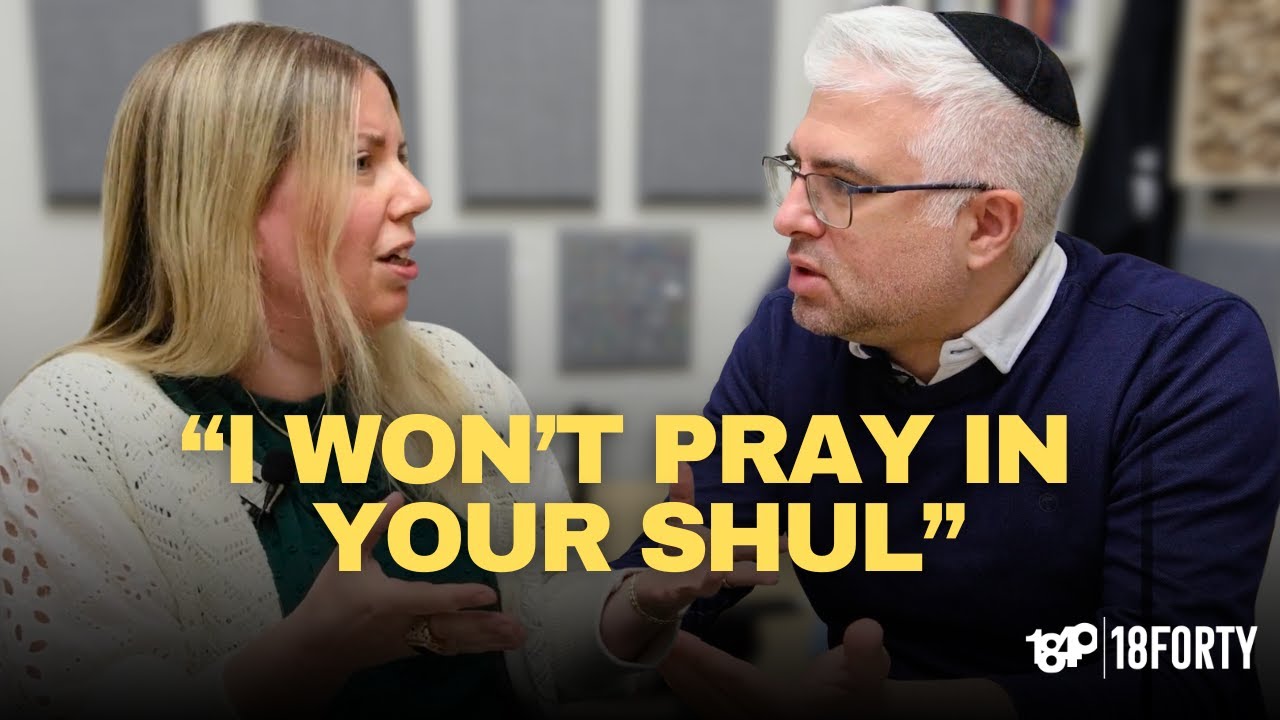
Ramban reads the same opening as Moshe establishing his teaching authority over a generation that never stood at Sinai. In Ramban’s reading, the rest of Devarim is Moshe delivering the law to children who must inherit what their parents received directly. Moshe, Yehoshua, and Calev are among the very few in the audience who actually saw what happened at Horeb. Everyone else heard about it secondhand. Sylvia and Simon Jacobson, a mother and son talking about how Jewish life moves between generations, run into the same problem from inside a single family. Each generation has to receive the tradition on terms it can hear, and the older generation’s job is to deliver it that way.
A few verses later, Devarim 1:34-39 names the demographic fact directly. God swore that none of the wilderness generation would see the good land, and the verse identifies the children Moshe now addresses as the generation that will enter. The same arrangement repeats in every Jewish generation, and the version most American Jews recognize is the fourth-generation problem. The first generation arrived from Europe carrying the practice with them in full. The second generation grew up surrounded by immigrant parents and grandparents who carried the world they had left behind. The third generation knew the immigrants only as elderly relatives. The fourth knows them as photographs and stories. Each step makes the question “what does this mean to me?” harder to answer.
What gets passed down across these generations is not always only narrative. A 2016 paper from Rachel Yehuda and her colleagues at Mount Sinai found measurable epigenetic differences in children of Holocaust survivors, including changes in genes that regulate stress response. How exactly this inheritance is transmitted is still being worked out, and how far the effect extends past the second generation remains an open scientific question, but the descendants of survivors often report carrying something they did not personally experience, and the science offers at least a partial reason. Devarim’s retelling of the spies is the Torah’s own version of that same work.
RELATED: Faith, Evil, and the Act of Remembering
2. The Spies Retold
In Parshat Shlach, the spies’ story begins with God instructing Moshe to send scouts into Canaan. 40 years later, Moshe retells the same events on the plains of Moav and changes who started the mission. “All of you came near to me,” he tells the audience in Parshat Devarim, describing how the people themselves brought him the idea of sending men ahead. In Moshe’s version, the spies are sent at the people’s initiative. Ramban reads the people as making the first request and God as permitting it, with Shlach reporting only the divine permission while Devarim records the original human request.
What looks like a discrepancy between Shlach and Devarim is actually a structural shift in the Book of Devarim itself. The first four books of the Torah are God’s narrative, transmitted through Moshe. Devarim is Moshe’s own narrative, addressed to the new generation in his voice. The Talmud preserves this distinction explicitly. Abaye teaches that the curses in Devarim were spoken by Moshe “on his own,” in contrast to the curses in Vayikra that Moshe delivered “from the mouth of the Almighty.” The voice of the rest of Devarim follows the same logic. Differences between the Devarim retelling and the earlier accounts come from Moshe contextualizing what the previous generation lived through for the new generation about to enter the land.
A skeptic encountering the two spies accounts might reasonably raise an objection. If Bamidbar tells the story one way and Devarim tells it differently, which version is the actual word of God? The first four books are the direct word of God, given to the generation that heard it firsthand. Devarim is Moshe delivering that same Torah to the next generation in language they could understand before entering the land, and neither account replaces the other. The Bamidbar account stays in the Torah for any reader to compare what God instructed with what Moshe now describes. Avivah Gottlieb Zornberg, in Bewilderments, reads this doubling as a way of making the reader hold both versions at once. Malka Simkovich traces the same pattern at the scale of the Jewish diaspora.
Every subsequent Jewish generation has continued this same project. The rabbinic tradition does not rewrite the Torah. Like Moshe in Devarim, it contextualizes the words for each generation in language that its audience can hear. The Modern Orthodox reader four generations removed from an immigrant great-grandfather inherits this same task. The Golden Calf is harder to retell, because the audience hearing it is being asked to inherit a failure their own parents committed.
3. The Golden Calf Retold
Moshe retells the Golden Calf, and he calls the people stiff-necked from his first sentence. “Know, then, that it is not for any virtue of yours that the Eternal your God is giving you this good land to possess,” he tells the new generation, “for you are a stiff-necked people.” Moshe then describes his own 40 days and nights on the mountain. When he came down he broke the tablets, and he pleaded with God on the people’s behalf. The account in Parshat Ki Tisa does not give any of this from Moshe’s perspective. Sforno reads Moshe as deliberately direct, since a people cannot be stiff-necked and righteous at the same time, and the children about to enter the land cannot claim a righteousness their parents never showed.
Sforno sees Moshe listing the people’s offenses on purpose, as moral instruction for the children. Moshe names each occasion the people had angered God under his leadership, building proof of the stiff-necked accusation as he goes. Marc Shapiro argues that suppressing institutional failures damages a tradition far more than the original failures. Shapiro’s Changing the Immutable documents Orthodox publishers airbrushing photographs to remove women from group portraits, editing responsa to soften controversial rulings, and sanitizing rabbinic biographies to hide failures and disagreements. The cumulative effect, he argues, is a tradition that has lost its capacity to acknowledge its past honestly. The children entering the land have to hear the worst chapter of their parents’ record told without softening. A record they cannot trust will fail them the first time their own conduct calls it into question.
That dilution leaves no room for doubts and failures, and when a marriage falls apart or a child leaves observance, what came down does not have enough weight to help. The question is whether the fourth-generation American Jew can still internalize what was passed down, even after generations of thinning have left them without a clear point of reference.
Moshe does the opposite in Devarim, telling the new generation directly that their parents made and worshiped the Golden Calf at Sinai. The Torah does this with every major character, putting their failures in the record right alongside their virtues. Avraham lies about Sarah, Yoseph’s brothers sell him into slavery, the whole nation worships the Calf, and David takes Batsheva and arranges Uriah’s death. A human author would have cleaned this up, but the Torah leaves the record intact. The tradition reads this preservation as deliberate, intended so that every generation can learn from where the people fell short. Moshe retells the sin of the Golden Calf once on the plains of Moav, and every Jewish generation since has retold its own story the same way, warts and all. The fourth generation has been given the same task, but cannot retell what they have not internalized, and the dilution has left them without a clear point of reference to anchor the retelling.
RELATED: The History of Halacha, from the Torah to Today
4. The Haggadah and the As-If
Moshe begins the as-if move within Devarim itself, telling the new generation that the covenant at Horeb was made with them, “who are all of us here alive this day,” even though many in his audience were children or unborn at Sinai. Centuries later, the Mishna codifies the same move as a Pesach Seder obligation, requiring each participant to see oneself as having personally left Egypt, and the Gemara works out the specific language each generation must speak at the table. At the Pesach Seder each year, every Jewish household now runs the same as-if move Moshe introduced, treating the Exodus as if the participants had been there themselves.
RELATED: This Pesach, We Honor Our Disordered Love
Yosef Hayim Yerushalmi, the historian whose work on Jewish memory shaped a generation of Jewish thought, argues in Zakhor that the distinctively Jewish form of memory is liturgical and participatory, with each generation re-enacting events the participants did not witness rather than reading them as historical accounts. If you re-enact what happened, you take the story on, and if you only hear it told, you do not. Rabbi Jacob J. Schacter takes up Yerushalmi’s reading and extends it to the Seder, where each generation joins the story by saying “we were slaves in Egypt” out loud at the table. Saying the line at the Seder is where that inheritance first enters your own consciousness.
RELATED: I Wanted Absolute Faith in God. I Got Something Else Instead
If you have led a Seder, you know the strangeness of saying “we were slaves” when you demonstrably were not, and Moshe’s answer in this parsha is that the strangeness is the obligation. None of us came into the world as a blank slate. The history of your ancestors was already shaping who you are before you knew there was a story to inherit, and the Seder line is the moment Judaism asks you to bring that inheritance into your own awareness. The Seder works only when it is not done by rote, when what you say at the table actually changes how you think about your own life. When you say the line with attention to what you are saying, you start to recognize what your ancestors’ history has already made of you, and you let that recognition shape how you live now and what you do with the rest of your life.
5. What Inheritance Asks of the Inheritor
Today’s Modern Orthodox reader inherits Sinai, the Shoah, and the immigrant Jewish life their great-grandparents brought from the old country, without having witnessed any of these events. In The Generation of Postmemory, Marianne Hirsch describes how the second and third generations carry events they did not witness, through stories, photographs, and how older relatives behave around what they survived. In Devarim 4:9, Moshe tells the people to teach what they have seen to their children and grandchildren. Sforno on Devarim 32:7 reads “remember the days of old” as a mandate to interrogate the past for the next generation. The Torah’s Hebrew literally says “sons and sons’ sons,” but the obligation today extends equally to daughters.
A reader who treats Sinai or the Shoah as historical curiosity treats their great-grandparents’ practices the same way, as ancient history with no bearing on how they live today. The other failure treats the inheritance from the old country as too distant to matter, dismissing the great-grandparents’ hard lives as a foreign world rather than the foundation this generation actually inherits. Moshe keeps the older account in front of the audience, addresses the new generation directly, and does not skip the parts they would rather not hear, until the story becomes part of how they live.
Dovid Bashevkin argues that Jewish identity is something you inherit rather than something you choose. It already shapes how a person thinks and handles setbacks, whether or not they’ve named it. Marika Feuerstein tells her grandfather Aaron Feuerstein’s story to people who never knew the man. What gets passed down depends on this generation receiving the inheritance and passing it forward. The chain runs from Moshe on the plains of Moav through the Haggadah and every Jewish home to the reader as the next link.
Questions for Reflection
- Where do you feel the gap between what you witnessed firsthand in your family and what you are being asked to pass forward?
- When you read the line at the Seder about being personally enslaved in Egypt, where does the obligation feel real, and where does it feel performative?
- What does your child, your student, or your reader need from you that you cannot give them by repeating what you were told?
This project is made possible with support from the Simchat Torah Challenge and UJA-Federation of New York. Learn more about the Simchat Torah Challenge and get involved at their website.