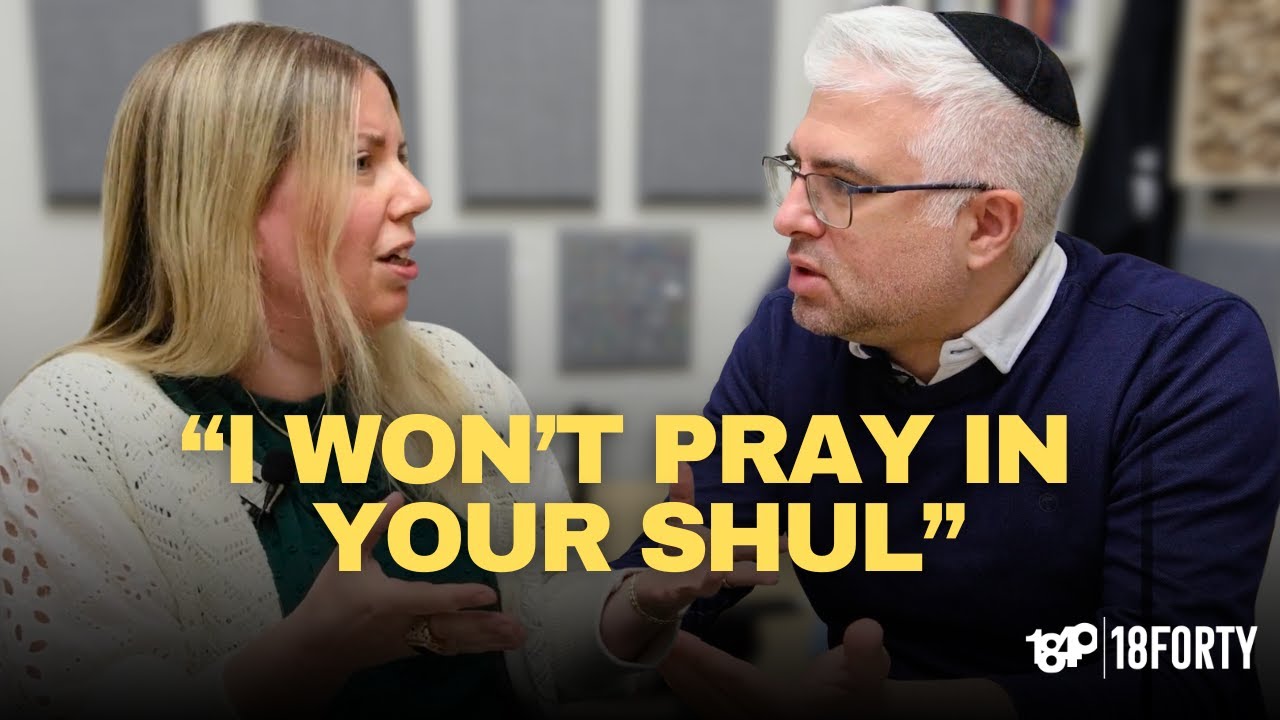
RABBI DR BENJI LEVY. Yehudis Golshevsky, it’s such a privilege and pleasure to be sitting with you in the heart of Jerusalem, an incredible teacher of women, adult education, the director of Shiviti, and here today you’re here as a Jewish mystic.
REBBETZIN YEHUDIS GOLSHEVSKY. I’m sorry, I’m sorry that I have to laugh. I mean, I’m not a Jewish mystic, but I do teach about the mystical tradition and I come from that place, but it’s a little laughable for me to be called a Jewish mystic, you know.
LEVY. I completely understand why. So I guess the first question is then, what is Jewish mysticism?
GOLSHEVSKY. So a lot of people would answer that it’s, we’ll say, the inner tradition of the Torah. Our tradition has a lot of aspects to it, has a lot of dimensions to it, and the way I think about it is Jewish mysticism is the way that you live when you’re informed by the deeper traditions of our Torah, and it changes the way that you live, and you don’t have to be necessarily a great scholar to be able to access it, but you do have to have some connection with this tradition to be able to live with it. So it changes the way you see things and the way you make decisions about things. That’s Jewish mysticism to me, like a living tradition.
LEVY. And how were you introduced to Jewish mysticism?
GOLSHEVSKY. Well, I always had a mystical bent even as a young child. So I was introduced to the deeper aspects of Torah, not in my conventional Jewish education, which is not there. But when I was about fourteen I started to take a class with a rabbi who was a friend of my parents on Rabbi Moshe Chaim Luzzatto’s Derech Hashem, The Way of God. I was a little kid, I was fourteen in a class full of adults, and it spoke to me. And then as I got older, I got more involved. I had a lot of opportunities presented to me that I took advantage of as they came.
LEVY. So not everyone had that kind of opportunity as a fourteen-year-old. If someone wanted to get into it, where would they start?
GOLSHEVSKY. My first teacher told me that a great place to start, especially for English speakers, is with Rabbi Kaplan’s books.
LEVY. Rabbi Aryeh Kaplan.
GOLSHEVSKY. Yeah, he was so wonderful at bringing the depths of the tradition into a really accessible format. I also loved reading his footnotes. I’m a footnote reader. So it just became a starting point to be able to look into all kinds of other things. But it took me years to be able to have the skills, the textual skills, to be able to explore more on my own.
LEVY. I remember when I started learning Aryeh Kaplan. They’re endnotes, not footnotes. I had to keep my finger in one place in the front. And it was prolific how he quoted so much.
GOLSHEVSKY. Yeah. And that sort of became my original bibliography. I remember when I was seventeen, I first came to Israel. I had this running list of books that I wanted to have. And I remember I went back. I mean, it was easier to ship stuff in those years. But I went back with boxes and boxes of books. And I remember buying all these sefarim, all these books that I would open them and say, I can’t read this now. I can’t understand this now. But I’m hoping that one day I’ll have access to them. And those books eventually became books that I do have access to, but it was a whole lifetime of work to get to them.
LEVY. So in an ideal world, would everyone be Jewish mystics?
GOLSHEVSKY. I mean, again, it depends on how you define it.
LEVY. Based on your definition.
GOLSHEVSKY. I think that it’s a, we have a phrase in Hebrew to be shaveh lechol nefesh, that something has an access point to everybody. And Jewish mysticism definitely does because this tradition has evolved in its expression over a really long period of time. I mean, with the advent of Hasidism, like part of that, the Chassidic [Hasidic] movement several hundred years ago was a way of bringing Jewish mysticism into the space where regular people live. And that’s only continued to evolve over time.
I mean, there’s so much Jewish mysticism now in popular Jewish culture that it’s almost impossible to extricate exactly what’s called Jewish mysticism and what’s not. It’s all over the place.
LEVY. So, ultimately Jewish mysticism at its source is related to the Source, which is God. When I say the word God, what does that mean to you? What is God?
GOLSHEVSKY. I mean, it could be simple, like the Mechaye, the Mehave, the One who is the Creator of all and the One who perpetually brings everything into existence on an instant-to-instant basis. That is God.[efn_note]Rabbi Shneur Zalman of Liadi, Tanya, The Gate of Unity and Faith, https://www.sefaria.org/Tanya%2C_Part_II;_Shaar_HaYichud_VehaEmunah.[/efn_note] That’s it.
LEVY. So, that sounds incredible to me if you understand what that means, but it is a bit esoteric. If I don’t understand what that means, is there something you actually think of or you conjure up?
GOLSHEVSKY. I like the language of Nachmanides.[efn_note]Rabbi Moses ben Nachman, “Letter of the Ramban,” https://www.sefaria.org/Iggeret_HaRamban.1.[/efn_note] He says God is closer to me than the blood in my veins, closer to me than the breath in my lungs. So I take a breath and I feel what that means, that I’m being perpetually renewed and created and enlivened by the life of all the worlds.
I think that it’s something so simple, even a small child can relate to this. And I think small children even do relate to this, the wonder of existence that there’s more than what you see, that there’s something that’s a kind of fabric holding everything together and giving it meaning. I think this is something that everybody, I mean, it’s universal, the search for it, the desire for it, the yearning for it. It’s human. It’s the most human thing there is to want to connect with this.
LEVY. I love that metaphor because no one questions their breath. No one questions their blood, but it’s continually sustaining them. And I think sometimes we’re in search of some specific item or expression or facet that is God. But as you say, like the breath, like the blood, it sustains us.
GOLSHEVSKY. It’s simple. When we talk about the oneness of God, I think about it almost like chemistry or the old pharmacology. “Simples” are substances that have only one thing in them. And something that’s complex has got an amalgam of things in it. And when we say that God is one, we mean He’s absolutely simple, like an almost physical, a kind of chemical sense, a chemistry sense, that there’s nothing but Him, and He is absolutely indivisible and one. And we live in a world of appearances where there’s a lot of multiplicity, but we’re always seeking to be able to feel and experience that oneness that’s underlying everything. I mean, it’s common to all human beings all over the world, every culture and every time.[efn_note]Tanya, The Gate of Unity and Faith, https://www.sefaria.org/Tanya%2C_Part_II;_Shaar_HaYichud_VehaEmunah.[/efn_note]
LEVY. It’s probably the most complex simple thing that exists. I wonder if there is a God and the Jewish people are tasked with a mission, what is the purpose of the Jewish people within the thought of Jewish mysticism?
GOLSHEVSKY. Let’s say more like a critical mass. I mean, I’m using a lot of physical parables, but a critical mass is when you have enough of an explosive material that’s able to afterwards bring on a chain of other reactions that cause a very, very big explosion. So Jewish people are not ever, we’re never, it says in the Torah that the Jewish people, atem hame’at, we’re a small people, but we’re supposed to be a critical mass of awareness of God and the drawing down of that awareness into the nitty-gritty of everyday life within what we call the four cubits of halacha, very specific practices that are meant to allow us to express our consciousness of God in action down here in this world. The rest of the world doesn’t need to do those specific actions, but the catalyzation of that kind of consciousness and drawing it down into the place of where human beings live, I think that that’s what our mission is.
LEVY. Interesting. And then if we want to engage with God, one of the key ways is through prayer. How does prayer work?
GOLSHEVSKY. I mean, what does it mean for prayer to work?
LEVY. You tell me.
GOLSHEVSKY. You said, how does prayer work?
LEVY. Well, if it works.
GOLSHEVSKY. Okay, so when people think about prayer working, they’re going to think about, let’s say, the most common way of thinking about it is you pray about something specific and you see it materialize. And that’s not really the way that our sources speak about it.
There’s a few different aspects to prayer. The first is that there’s the individual search for God and the desire and the need to connect with God. So tefilla, prayer, part of its meaning is like we say, naftulei Elokim niftalti. That’s the name of one of the tribes, Naphtali. And his mother gave him that name in order to express how she had sort of struggled and is bound together.[efn_note]Genesis 30:8, https://www.sefaria.org/Genesis.30.8.[/efn_note] So the idea of binding in Hebrew, a petil is a cord that’s bound with several strands together.
LEVY. It’s like a wick of a candle.
GOLSHEVSKY. A wick of a candle, a petil.
LEVY. So what you’re saying is the word petil and naftali and tefilla all share the same etymological root.
GOLSHEVSKY. They all share the same root. And the idea being that my human need comes to, I get to activate my thoughts, my feelings, and my words to express my human condition. And specifically in the search of trying to bind myself together with my Creator via the uniqueness of my human experience.
So tefilla, prayer, is very, very powerful. Because here I am, a person living in a world where I could conceivably go 120 years and never have a thought for God at all. And I’m having a completely terrestrial experience. I’m choosing to involve the unseen, the ineffable in my human experience. That’s wondrous that it’s possible to do it.
Now, whether prayer works or not, meaning whether you get what you want [or not], that’s a different issue. But prayer as an objective in itself of an act of binding oneself to God via human experience, this is extremely powerful.
And then there’s the fact that the world needs to be bound up with its Creator. And so regular prayer is something very important for the world as a whole.
LEVY. It’s interesting because you’re looking at tefilla, at prayer, as an end in and of itself to bind us to the Creator as opposed to a means to get what I want or to ask for something. It might have that as well, but it’s the vehicle by which I can connect to the infinite.
GOLSHEVSKY. You may get what you want, you might not. But prayer is a purpose unto itself.
LEVY. And therefore the measure of prayer is if I’m more connected to the creator through the process.
GOLSHEVSKY. As soon as I say a word, I’m already more connected. The Ibn Ezra, one of the great scholars of the Medieval Era, talks about how one word of prayer, even if it’s “help!” establishes, it affirms some of the most important aspects of faith. I believe that there is a force that I’m addressing myself to. I believe that this force is attentive to me. I believe that this force is benevolent. I believe that this force has the capacity to help me, that it’s interested in helping me. Otherwise, why would I appeal even [with] just the word “help”? So those are very essential, like the deepest essentials of faith that even one word of prayer brings into action. Prayer is the most powerful thing in that sense alone.
LEVY. So if that’s prayer, what about Torah study? What’s the purpose of Torah study?
GOLSHEVSKY. Chapter nineteen of Psalms,[efn_note]The Psalms: Translation and Commentary, ed. Rabbi Samson Raphael Hirsch.[/efn_note] this is a teaching from Rabbi Hirsch –
LEVY. Rabbi Samson Raphael Hirsch.
Yehudis Goldshevsky: Rabbi Samson Raphael Hirsch, one of the great nineteenth-century rabbis of Western Europe. So he says, if you look at chapter nineteen you find that the whole first half of the chapter talks about how hashamayim mesaprem kevod Kel, all of the universe is constantly broadcasting the glory of God, all of nature. It does it without any words. And so it means that I can have a mystical experience, let’s say, just being a human being with my awareness open, attentive to what’s going on in the world and the glories of creation. And I can get a sense of the numinous from that.
But the second half of the chapter speaks about the Torah – right, Torat Hashem meshivat nafesh [God’s Torah revives the soul], all of these different qualities of the Torah. So Rabbi Hirsch says that if I want to get a sense of God, I could just walk outside. But if I want to know what God has to say to me, I have to open the Torah. If I want to know what he’s specifically communicating, what the Creator wants me to do, practically, for that I need the Torah. A sense of God I can get just from opening my eyes.
LEVY. Fascinating. I was just in the Swiss Alps. And there’s the famous story about Rabbi Hirsch that towards the end of his life, he asked his students to take him to the Swiss Alps. And he said, because when I get up to heaven, God’s going to say, did you see My Alps?
GOLSHEVSKY. Did you see my Alps?
LEVY. But at the same time, most of his life he sat and wrote and he learned and all these things. And I guess it’s the balance between the two, the Torah giving you that specific, as you said, and the wonders of the universe giving you the universal.
GOLSHEVSKY. I think that great people have great spiritual imaginations also. And so a person could conceivably sit in his four cubits studying Torah and have a very deep experience of the greatness of the world even in the absence of going out to [experience] the greatness of the world. I think it requires a certain amount of spiritual imagination, but that’s the root of everything. That’s the root of all prayer. And the root of all prophecy is spiritual imagination. So I wouldn’t put it past somebody like Rabbi Hirsch to have had a deep experience of the world even in a more contained place. But most of us need to go out into the world to see.
LEVY. Even he decided to.
GOLSHEVSKY. Yes, he did.
LEVY. So I’m wondering, one of your hallmarks is [that you are] one of the greatest Jewish teachers, specifically for women in this space. And you’ve got incredible knowledge. What is the difference between men and women in Jewish mystical thinking and teaching? Or is there a difference?
GOLSHEVSKY. That’s a very broad question. It has a lot of different aspects to it. What do you mean by that? You mean in terms of what men and women learn, what the purpose is, or who they are and what they are? It’s too broad.
LEVY. A hundred percent. You can choose to take it however you want. I’m interested in all of the above. Are there different roles we have in the world? Is there a reason why men and women are created differently? And also in terms of how we engage through Torah, et cetera.
GOLSHEVSKY. Look, the language of Jewish mysticism is highly gendered. And it’s for a purpose, that it’s highly gendered. Because the objective of everything in Jewish mysticism is ultimately to make what’s called a yichud, that there should be unity. It means you have two polarities and you draw them together and you make something bigger out of them than was there before. So the best parable that we have to this is about men and women and what they can accomplish together, which is about physical joining. So the language of Jewish mysticism is highly, highly gendered.
But, yichudim [unifications], okay, so I have a cup of water. I haven’t had a drink of it yet. So a yichud, to make a unification, it’s very kabbalistic language, very mystical language. But it comes down also to, I mean, this is Judaism, it comes down also to very simple things. I have a cup of water in my hand. This is potentially a purely physical experience, and I’m going to make a choice that I want to connect with my Creator as the source of this cup of water, and also of me, and also everything that exists, by making a blessing over this cup of water. So when I do so, I accomplish this wondrous thing, this very abstract, spiritual thing called a yichud.[efn_note]Rabbi Yitzchak Isaac of Komarno, Netiv Mitzvotecha, Shaar Hayichud (The Path of Your Commandments, The Gate of Unity).[/efn_note]
Now in the kabbalistic language that’s called a masculine and feminine joining, because the feminine is called the place of experience, and the masculine is called the place of the drawing down of some consciousness. You have to join them together. One without the other is meaningless. You have to have them together. Now I’m self-conscious about making a blessing in front of a camera, so I’m not going to, okay. But it’s emblematic.
LEVY. I think it would be good to have the experience. You’re gonna have to drink the water.
GOLSHEVSKY. Well, I could wait. But I just mean to say that this is so much of Judaism, is the drawing down of consciousness into the actual physical details of life. That is always described in gendered language.
LEVY. Do you ever find that any women or men are offended by the gender descriptions, these metaphors?
GOLSHEVSKY. Everybody’s offended by everything. I mean, there’s a possibility of being offended by anything and everything. Yeah, because they’re generalizations, right? So if we talk about masculine qualities, feminine qualities, especially nowadays, people can definitely take offense because it sounds very reductionist. The only problem is that, well, it’s not a problem. I mean, the way that I think about it is, human beings are never just one thing or another thing. We never talk about masculine attributes or feminine attributes in isolation of men and women. All human beings are created in the image of God, which include all attributes. And men and women tend, again, this is generalization, tend to express more of masculine versus more feminine attributes. But it’s not, I hate to get reductionist about it. It’s just a pity to get lost in the language.
LEVY. So you need an expansive consciousness to appreciate that this isn’t here to offend or it’s actually there to unify ultimately and to understand the different parts of a greater whole.
GOLSHEVSKY. It’s such a human thing to try and put everybody into little boxes and categories.
LEVY. We do it.
GOLSHEVSKY. We do it. But to have more expansive thinking, this is language that’s meant to illuminate. It’s not meant to constrict. It’s meant to illuminate. And it does if you take it in the right way.
LEVY. So we do what we do. Why did God create the world? Why did he put us into this place?
GOLSHEVSKY. Oh, you want to hear about what it says in the books?
LEVY. There’s many things in the books. Which of the areas of the books do you relate to or you feel make the most sense?
GOLSHEVSKY. When I was seventeen, I came to Israel for the first time. And that was one of the great opportunities of my life. He is a mystic, a rabbi who I’m not going to mention by name. And I had the great good fortune of meeting him when I was seventeen years old, when I was in New York. And he invited me to come and study in Jerusalem. And I was so ignorant at the time. I thought he meant to become his apprentice or something. I didn’t know anything. But he gave me the opportunity to come to Jerusalem and ask him any question that I wanted. And the first time I met him, I went by bus to this very old family compound house in the back of Beit Yisrael. And I walked in there, seventeen years old, with all of my big questions. And I sat down. I had a little, remember those microcassette recorders?
LEVY. I do.
GOLSHEVSKY. So I had microcassettes and a recorder with me and I taped all of our conversations. And my first question was, this is typical, mystical-bent teenager. I said, I don’t understand how an infinite being could communicate with a finite universe. That was my first question. How is that even possible? Infinite and finite, they don’t go together.
So he said to me, this is a good teacher. He said, that’s the first question that all Jewish mystics ask. Right. He was giving me a nice little boost.
LEVY. Brilliant. Acknowledging.
GOLSHEVSKY. He said, all the books start with that. But there’s a question that you need to ask before that. You need to ask, why would an infinite Creator communicate with a finite universe? And then he started to give me a good answer. So we have a few different iterations of it. We say legalot malchuto,[efn_note]Zohar, Introduction 3a, https://www.sefaria.org/Zohar%2C_Introduction.1?lang=bi.[/efn_note] to reveal His sovereignty. Then we have legalot midotav,[efn_note]Zohar, Pinchas 257b, https://www.sefaria.org/Zohar%2C_Pinchas.257b (Hebrew).[/efn_note] to reveal His attributes. And then we have legalot rachmanuto, to reveal His compassion, His mercy. And all of them really work together.
LEVY. So you’re saying that God created the world to have a receptacle to be able to express those three areas.
GOLSHEVSKY. It means that God created “other,” which ultimately means the universe, human beings with God consciousness, possibility, everything that exists in order for that which existed only in potential, meaning His absolute mastery of all. There needs to be an other to be able to come and appreciate and know all that He is and to be able to experience it via the revelation of His qualities and His compassion.
So the objective is good. The objective is positive even though along the way, there are a lot of things that are difficult to deal with in the world.
LEVY. So you talk about a lot of things to deal with that are difficult. What is free will? Does it exist?
GOLSHEVSKY. Oh that’s – huh.
LEVY. I feel like I’m asking you the questions that you asked your rabbi when you came here.
GOLSHEVSKY. When Rabbi Nachman of Breslov had a student who came to him once and asked him that question, he said, Rabbi, explain to me free will. And what he meant to say was, is it just an illusion? So Rabbi Nachman was a very, very deep thinker. Big mystic, leader of the Hasidic world as well. And he would answer sometimes in a very pithy kind of way. So he said, he said in Yiddish, bechira? Free will? He said, if you want, you do it. If you don’t want to, you don’t do it.[efn_note]Rabbi Nachman of Breslov, Likutei Moharan, 110, https://www.sefaria.org/Likutei_Moharan.110.1.[/efn_note]
OK, so that’s kind of – So what did he mean to say? Then we have the commentary on it. What did he mean to say? So he meant to say that free will is not an illusion. You want to do it, you do it. You don’t want to do it, you don’t do it. Now, that doesn’t mean that we are masters of our situations, because obviously there are plenty of things we might want to do that we cannot do. But all things being equal, if I want to raise the cup, I raise the cup, even down to something as simple as that.
Now, the truth is that what gets people all tied up and all confused is that it’s not free will. The issue is free will in combination or in convergence with everything being already known and God being all powerful. So that’s one of the essential paradoxes that exist. Right. I’m a free agent. I get to do. I mean, I’m limited. So there are always mitigating factors. But let’s say, in essence, my free will is not an illusion. At the same time, the complexity of God’s orchestration of all that exists and how the two interrelate is something that’s a paradox that’s beyond human comprehension. And I can accept that. I can live with that.
LEVY. What about Mashiach [the Messiah]? What do you think about when I say Mashiach?
GOLSHEVSKY. Mashiach [the Messiah]. I hope that he comes because we’re talking about him. We should have been talking about Mashiach.
LEVY. Is it him? What is this?
GOLSHEVSKY. I mean, the language of all of our sources is that we’re talking about an actual individual, right? An actual individual comes from a particular family, has a particular lineage, who has a particular job to do.
So I’m looking forward. I’m hoping every day, as it says in the language of Maimonides, every day, I’m waiting. But Mashiach is also about time. It’s also about the evolution of history and ways of thinking and all kinds of movements. In the parasha [weekly Torah portion], right? We have the birth of the twins of Tamar. So she has two children with her. Well, I’m not going to go into that whole story. But OK, she has two children and they’re twins. The first one, one of them is named Zerah and the first twin thrusts his hand out first and the midwife puts a red thread [on him]. Zerah means to shine, to start to rise or to shine like the sun shines in the morning. And the next one, the second one is Peretz.[efn_note]Genesis 38:27–30, https://www.sefaria.org/Genesis.38.27.[/efn_note] Peretz means to break out. So in the course of events, the first twin stuck out a hand, got a little red thread tied on it to mark who’s the firstborn. Then he brought his hand back inside. And then the second twin was born first. Lama paratzta, Peretz, why did you burst out? But he’s really the firstborn.
These are two different ways of talking about Mashiach [the Messiah]. We know that Mashiach is a descendant of Peretz, not Zerah. That’s the family line. So Zerah is like the sun rises. It says in the mystical sources that Mashiach comes kima, kima,[efn_note]Jerusalem Talmud Berakhot 1:1, https://www.sefaria.org/Jerusalem_Talmud_Berakhot.1.1; and see Esther Rabba, ch. 10, 14, https://www.sefaria.org/Esther_Rabbah.10.14; Shir Hashirim Rabba 6:10, 1, https://www.sefaria.org/Shir_HaShirim_Rabbah.6.10.1; Midrash Tehillim, psalm 18, 22, https://www.sefaria.org/Midrash_Tehillim.18.1.[/efn_note] slowly, slowly, gradually, incrementally like the sun rises in the morning. You get up in the morning at Alot HaShachar, you get up in the morning way before the dawn and it’s dark as anything. If you stay up and you’re in view of the sky, then before you even know it, time goes by and incrementally, incrementally, the light of the sun is creeping over the horizon until finally, finally it’s daybreak. But already the sky has been getting light over a long period of time. That’s the historical process. Zerah, it’s happening. Mashiach is happening in that sense.
But the actuality of an individual who comes to help catalyze the Jewish people into change and by virtue of that, the world, that’s an individual that comes from Peretz.
LEVY. And in these historical processes, where does the State of Israel fit in? Is that part of the final redemption?
GOLSHEVSKY. We’re so locked in. We’re so blinded by the circumstances of our historical period. I also teach Jewish history. So the fact that the Jewish people have come back to the Land of Israel after 2,000 years of exile is an unprecedented reality that, there’s nothing to compare with it. There’s nothing even close to compare it to. There have been maybe three or four other attempts to re-indigenize people over the course of human history and none of them worked. It’s a very interesting period we’re living in. It’s only because we’re living in it at this moment that we’re sort of not able to see how completely impossible it is.
You read the prophets. There are prophetic selections that are [read] every week with the Torah portion of the week. And the Jewish people have been saying those weekly for a very, very long time in order to bolster our confidence and our faith that this is going to happen. And guess what? It happened.
LEVY. Amazing.
GOLSHEVSKY. Impossible, right? It’s impossible. It’s impossible that we’re sitting here in Jerusalem talking about this. It’s impossible that we’ve come to the point where all of this, I sit and teach, and I say to my students, I’ll just stop in the middle sometimes and say, can you believe that we are sitting in Jerusalem, a group of women who come from all kinds of backgrounds and all walks of life, and we’re sitting here with holy books in front of us, that until a very recent period, until very, very recently, not only did women not learn them but most men didn’t learn them either. We’re living in such a period that’s wondrous.
There’s so much negative, so it’s easy to focus on that. It’s human nature to focus on the negative. But if our great, great grandparents, great, great, great, great, right? Let’s go back a little bit further. If they could see how we’re living now, they would say, for sure, Mashiach [the Messiah] is already here.
Now, I’m not talking about politics. I’m talking about just the historical reality of the Jewish people returning to the land. It’s impossible, and yet it is.
LEVY. Amazing. Maybe they did see it through the prophecies.
GOLSHEVSKY. They did. That’s the only way that they saw it. And they have no other lens to see. I’m going to go back to Rabbi Nachman – we’re Breslover Hasidim so I have no choice. I have choices, but I have to. So he lived from 1772 until 1810. Towards the end of his life he told his students, when Mashiach comes, there will be an invention already in existence that will allow people to fly vast distances very quickly. So quickly, in fact – Now imagine, in his time they didn’t even have an understanding of geological time in Rabbi Nachman’s time, okay. There are so many modern concepts about time and distance that didn’t exist in his time. He said, it will be possible for a Jew to pray the morning prayers outside of Israel and feel that something is unclear to him in that prayer that he needs clarification on, meaning he should have been thinking something else. He needs clarity. He will have time to fly in that flying machine to Israel, ask Mashiach a question to help him clarify out the thought that he had in his morning prayer, and he will be able to go back home by the time it’s time to pray the afternoon prayer for the end of the day.
So one of his students, Rabbi Naftali, here we are back to Naftali. Rabbi Naftali said, if I lived in a time where I knew that there was such an invention, I would be dancing every day. I wouldn’t be able to stop dancing because it means that Mashiach is close, that there’s such an invention because he said that that’s going to [appear] before [the Messianic Era]. We’re just so not aware of the wonder of the time that we’re living in. It’s impossible.[efn_note]Oral tradition from Rabbi Levi Yitzchak Bender.[/efn_note]
LEVY. Because we’re in it.
GOLSHEVSKY. Because we’re in it.
LEVY. It’s hard to see beyond that.
Yehudis Goldshevsky: We can’t see beyond.
LEVY. It’s like the breath, it’s like the blood. Like you said, it’s always there.
GOLSHEVSKY. It’s so close. We’re so in it, but it’s happening.
LEVY. Wow.
GOLSHEVSKY. It’s happening.
LEVY. So what is the greatest challenge facing the world today? We saw these elements. You said not being able to see the broader perspective, but what would you say if you had to single in on the greatest challenge of the world today?
GOLSHEVSKY. We are too much not identified with each other. You’re you, I’m me. You have your story, I have my story. And let’s say for the Jewish people, or let’s say even in my own home, in one’s own home, we’re all part of a single organic whole. We’re different limbs. All of the Jewish people are called evarei haShechina, limbs of the presence of God. It’s a means through which the presence of God expresses itself in this world, it’s via individual Jews.[efn_note]Tanya ch. 37, https://www.sefaria.org/Tanya%2C_Part_I;_Likkutei_Amarim.37.[/efn_note] But the rectification, repair of the Jewish corpus, of that body, is via recognizing that we’re all part of a single whole.
And it’s not rhetoric, it’s not nice words. One of the great Jewish mystics, Rabbi Moshe Cordovero, says in his very wondrous work, Tomer Devora. He says that every Jew has to think about another Jew ki hu hu mamash[efn_note]Rabbi Moses ben Jacob Cordovero, Tomer Devora, ch. 1, https://www.sefaria.org/Tomer_Devorah.1.[/efn_note] – that you and I are, we are one in the same. It’s not theory. It doesn’t mean that I do nice things for you, you do nice things for me. Ki hu hu mamash. We’re only individuated parts for a particular purpose. We individuate outward in order to be able to accomplish what we need to accomplish. But ultimately, you and I, you and me, all of us together, we’re all part of a single organic whole that has to be unified in its root.
So if the Jewish people could only get it together, then hopefully we would provide a critical mass for the world to get it together too. Vaavdo shechem echad [and they served with one shoulder]. That’s one of the promises of the prophets, that we’ll serve God, all of us together, each of us in our own way.
I think that that’s where relationships break down, where marriages break down, where parents and children break down, where communities break down, is in feeling, being too much in the externalities of you’re you and I’m me. And not that you and I and all of us are in together as a we. We’re all we. We are all [one] single.
LEVY. You said that Jewish mysticism is all about ichud and yichud and achdut [unification] and bringing things together in a unified whole. So that could be a potential solution if we could appreciate the oneness of it all.
GOLSHEVSKY. Well, I mean, isn’t that what everybody describes? Like, people who are seeking mystical experiences. So what are they really, if you ask, what are you out there for? What are you trying to do this way, that way, the other way? What are you really looking for? I want to feel the cosmic unity. I want to feel the oneness that’s at the heart of everything. I want to be able to, okay, I’m all for that. Yes, absolutely. It’s unnecessary. It’s vital. How are we going to manage without it? It’s all one big fabric. The more we learn, the more we discover that everything is all connected, right?
LEVY. Yeah.
GOLSHEVSKY. So you don’t get to throw garbage in the lake there and have clean water there, right? In the end, if you go down deep enough, everything’s connected. The ground water’s all connected. The environment’s all connected. The human environment’s all connected. You can’t dump your garbage in one place and expect to be able to have it pristine someplace else. So the idea that maybe I could do that socially or familially or politically or physically, it’s just a waste of time. It’s not going to get us anywhere.
LEVY. Amazing. So how has modernity changed, shifted, altered in any way Jewish mysticism?
GOLSHEVSKY. I don’t know that Jewish mysticism is prone to alteration. I think that it’s just about expression and where it’s going.
LEVY. So is it expressed differently in modern times?
GOLSHEVSKY. I mean, it was not known until modern times. The Jewish mystical tradition was a heavily guarded realm that only great scholars had access to. And it’s been part of the evolution of the Jewish world, the world as a whole. It’s a historical progression that this comes out to be accessible to people.
LEVY. And why is that? Why can we even have a conversation in front of thousands of people about Jewish mysticism if it was a guarded secret? What’s changed?
GOLSHEVSKY. So King Solomon said, laasot sefarim ad ein ketz, there will come a time that there’ll be endless, endless books written. And it’s true. The proliferation after the beginning of the printing press, that’s where we have this explosion of Jewish books, books in general, but Jewish books.
And not long after that we have an expulsion of Spanish and Portuguese Jewry. We have the beginning of the kabbalistic renaissance in northern Israel at the time of Rabbi Isaac Luria. There is a progression of stuff getting out into the world. A few hundred years later, fast forward, then you have the Baal Shem Tov and the Hasidic movement. Further proliferation [and] all this stuff, which used to be the most precious, precious, and it is still precious, precious. It becomes available.
So I’m going to share, I’ll tell you a story. So once there was a king, I always tell stories. So once there was a king –
LEVY. Breslov.
Yehudis Golshevsky; Breslov, Hasidut, the Zohar. The Zohar is all parables like this. Parables of a king, a queen, a father, a son, battles, quests. It’s all there. So there was a king. He had one son. His son became deathly ill. And so the king brought in every doctor, every healer, every expert. They can’t do anything with him. He’s comatose and he can’t be revived. So he then starts bringing in the wonder workers. Nobody has any advice.
Finally, he brings one sage in who says to the king, “Are you willing to spend any amount of money, anything you have in order to revive your son?”
The king says, “I would spend everything that I have to save him.”
So he said, “I need you to sell all of your treasures and purchase –” it was a kind of medicine that was extremely valuable that people only took very, very tiny amounts of because it was so expensive and so powerful.
He said, “I need you to buy vats of that stuff. You’re going to need a king’s ransom to get it. You need to buy vats of that stuff. And we have to take your son and we have to immerse him in a vat of that substance, that precious substance. He is so far gone that we can’t give it to him to eat. We can only immerse him in it and hope that somehow in this deep immersion, in all of this precious medicine, somehow a little bit is going to get through and wake him up.”
So that’s how we explain the proliferation of Jewish mysticism towards the end of the exile. It’s not that the Jewish people are worthy, necessarily. It’s that it’s necessary. It’s the most precious, precious substance. And we have to immerse the Jewish people in it thoroughly. Maybe, maybe enough will get across to help wake up the comatose Jewish people. That’s why we have such a proliferation now.
LEVY. Amazing. So why Jewish mysticism and what makes Jewish mysticism different from any other mystical tradition? There are so many different traditions and cultures that talk about their mystical traditions. What makes Jewish mysticism unique?
GOLSHEVSKY. To be able to answer that I would have to have several doctorates in comparative religions.
LEVY. You do, don’t you? I’m joking.
GOLSHEVSKY. I have some experience, not the doctorates. But I don’t know if it’s, I don’t like the contrast. Here we go again. There’s no need to play one against the other. Judaism against the world, Jewish mysticism against all other forms.
LEVY. They’re all one.
GOLSHEVSKY. No, I, yeah, I don’t want to think about it like that. Let’s say like this. You have –
LEVY. Because there is a language. There is a unique angle. There is a unique –
GOLSHEVSKY. Well the uniqueness I think is really about, when I was a teenager, I remember, here’s a disclosure. I don’t mind. It’s a public forum, but it’s okay. So I, in 1987, I had a nose ring. It wasn’t very popular in 1987. And I remember taking a walk. I lived then in Queens, New York. So I had some business to do in Jackson Heights. Jackson Heights is a very, very big Southeast Asian community. And I had to go to Jackson Heights and I was walking in Jackson Heights and I was crossing Roosevelt Avenue and I saw a woman crossing at exactly the same time as I was. She had a beautiful sari on and she also had the most magnificent piece of very beautiful gold filigree nose jewelry.
And as I crossed by her, I said to myself, I should stop and ask her where she bought that. And then I had an epiphany. I mean, I was young. I was maybe sixteen or whatever. And I had an epiphany. Why does she know where to get that, and I’d have to ask her? She knows where to get it without having to ask someone outside because she’s part of this community and that’s the natural expression of the fashion and the mode of their community. For me to ask her, I’d have to go and breach into where her space is in order to get that information because it’s not native to me.
And that epiphany actually was very significant in my religious development because I realized that I needed to pay more attention to the realities of having been born into a Jewish family as far as my spiritual pursuits went. And that was significant. Being a person of spiritual bent who believes in the significance of everything, it certainly has to be of very great significance that I was born into a Jewish family and that should probably guide my direction.
Now, the prophet Malachi, who was the last of the recorded prophets, he says, well, let’s just say, from the east to the west, “gadol Shmi bagoyim” – My name, God says, My name is great among the nations. “Mimizrach shemesh ad mevo’o, gadol Shmi bagoyim,”[efn_note]Malachi 1:14, https://www.sefaria.org/Malachi.1.14.[/efn_note] My name is great among the nations and everywhere where incense and offerings are brought, it’s brought “lishmi.” It’s brought in my name. Now, the commentators have a whole discussion about it because if people are serving idolatry, how is that serving the one God? So they tell us that even when people’s cultures are directing them to express themselves polytheistically; nevertheless, everyone is ultimately concerned with touching the root of all and the cause of all causes. It’s just that Judaism addresses this extremely directly, as opposed to other traditions that kind of go through other channels.
For Jews, I think that there’s Jewish mysticism and the Jewish way is appropriate for the Jewish soul. And for other cultures, there’s mystical traditions that abound, that have a certain amount of better aspects to them and less good aspects to them, each one to be understood on its own merit. But I don’t think it’s about making a contrast between one and the rest, or that one is or an issue of exclusivity or superiority.
LEVY. So does one need to be religious to study Jewish mysticism? Or again, there’s no differentiation between your religious observant level?
GOLSHEVSKY. No, no, no, no, no. Ultimately for Jews, the Torah tradition is very, very clear about the need to express God consciousness through action that’s very proscribed. That’s our particular way. We don’t have a mystical tradition that’s divorced from the world of action. In fact, the very definition of our mystical tradition is that it comes down into the world of action. That mystical consciousness is not significant if it doesn’t have a keli, if it doesn’t have a vessel to contain it and to express it. And for Jews, this is through mitzvot. It’s through actually carrying out the mitzvot, the commandments of the Torah. That’s the keli. That’s the vessel.
LEVY. But if you don’t, can you still study Jewish mysticism?
GOLSHEVSKY. What does it mean to study Jewish mysticism? It’s always good to learn. The prophet says, they should forget me but remember my Torah. Forget God, but remember His Torah. It means you still study. And hopefully the study will have a positive benefit. The more that we learn, hopefully it sparks something inside of us. But ultimately, it does come down to observance.
LEVY. Yeah. So you’re saying it’s accessible to all and anyone can learn it?
GOLSHEVSKY. There’s always an access to it.
LEVY. But if it’s actually going to be applicable when one has to bring it down into the world of asiya, of action.
GOLSHEVSKY. The world of action, it does come down to carrying out mitzvot. But look, there are people who like Jewish mysticism because maybe it informs their relationships better or their spiritual pursuits, whether that’s prayer or something like that. I wouldn’t put it down. It’s good. It’s all good. However, the expression of our tradition is in action. There’s no question.
LEVY. So is it dangerous at all? Is there anything dangerous about Jewish mysticism?
GOLSHEVSKY. I mean, it’s like asking, is there anything dangerous about salt? Salt is necessary. You need salt and too much salt, you know, is anything dangerous? Yeah, of course. I mean, my father, zichrono livracha [may his memory be a blessing], used to say, a little knowledge is a dangerous thing.
LEVY. How does that express itself with Jewish mysticism?
GOLSHEVSKY. Well, you don’t want somebody to be kind of spouting Jewish mystical ideas and also promoting things that are antithetical to Torah values and law. OK, so that’s one thing that is quite important to be careful about. And I think in general, the loftier and the more spiritual, the deeper something is, the more care you have to have around it.
Overall, let’s say it’s Chanukka, right? So we follow the practice of Rabbi Hillel, which is that we add lights from day to day, not the practice of Rabbi Shammai, which was to start with eight candles and then go down to one. Both of those pathways have very good rationales behind them. Shammai, in some sense, is a spiritual conservative. And he says the more that the light is actually expansive, the more you need to protect it. So as the days go on, you need to be more protective of that light because you have to be careful that unworthy students shouldn’t access that light and that people who misuse it shouldn’t access that light. But the actual halacha [Jewish law], for the actual practice, we follow Hillel, which means mosif veholech, as we go, we expand.
Is it possible that somebody will, I don’t know, make a bad use of this tradition? Possibly. I’m not worried about somebody making a golem. I’m not worried about somebody stealing secrets and doing some kind of mystical alchemy. That’s not what it’s about. It’s about not being true to the tradition.
But that’s also true within the realm of halacha [Jewish law]. It’s also true within the realm of, with all areas of Jewish study, that a person has to have spiritual integrity and a fear of Heaven that guides them in the way that they talk about these matters, and the way that they share them, and who’s able to receive them.
LEVY. So you talked about it all coming down to action.
GOLSHEVSKY. Yeah.
LEVY. You’re a Jewish mystic. The question I’d like to ask is on a personal level: How has Jewish mysticism influenced or impacted upon your relationships with yourself and with those around you?
GOLSHEVSKY. First of all, I have to object to the use of the term being a Jewish mystic.
LEVY. You’re someone that studies Jewish mysticism.
GOLSHEVSKY. I’m a student, I’m a student. And it’s very interesting because I think it’s also because I’m a woman and because I work with women that my specific area of interest with Jewish mysticism has to do with what does this translate to in terms of action and the realm of life, especially for women.
So my husband also studies these matters, he teaches, and I’ll have these ideas sometimes, and I’ll say to him, what do you think about XYZ? I was learning this, and this is how it speaks to me. And we often have the same interaction. He’ll say, it sounds right. It sounds good. I never would have thought of it. It never would have occurred to me, because he’s coming from a different place of experience.
So in terms of Jewish mysticism and relationships and life, I try to remember what I said before about hu hu mamash [you and I are the same], like in my interactions with people, whether we’re talking about my children, my grandchildren, my husband, my students, my neighbors. Hashem is with us in our interaction. He’s here. I have to have that consciousness with me. It’s not something that’s prone to somebody being able to see or not see. The whole idea of even designating someone as a mystic or not a mystic is ridiculous because it’s something that is dwelling only inside of the awareness of the person themselves. So only Hashem, only God Himself knows whether the person has God consciousness or not, right? And we could also be very self-deluded about it as well.
So I’m hoping that my learning of the Pnimiyut [inner dimensions] of the internality of Torah helps to provide more solidity and reality, God reality, to all of the interactions that I’m having, whether it’s with my children or my husband or anybody, my students. My father, zichrono livracha [may his memory be a blessing], used to say, every interaction is three, it is you and me and He. And that’s a very mystical observation to make. So I think that’s a good one to go with.
LEVY. Beautiful. And just to end, we’ve asked you questions. I’d love to ask you to share one teaching. What’s one teaching from the mystical sources that you take with you everywhere that’s one of your favorites? What’s one that comes to mind?
GOLSHEVSKY. Okay, so here, down to the realm of practice. When Jews wake up in the morning, they are meant to wash their hands. It’s just about the first thing that you do. I mean, the first thing you do is you have a thought, okay? And that first thought is very, very important. It helps set the tone for the rest of the day. And then you have your first word. Your first word, we have a codified set of first words, which is to express gratitude for having God bring your soul back to you upon awakening in the morning. And then we have our first action. The first action is the washing of the hands.
Now, in washing the hands, we have a very specific practice about washing hands. So you’re supposed to use a vessel, right? A very specific kind of vessel. And you are supposed to – you use your right hand to fill it. You pick it up with your right hand. It’s supposed to have handles. Pick it up with your right hand, pass it to your left hand. And this is just halacha, right? This is Jewish law. And then you pour from your left hand, right hand, and then you switch. And you do it however many times as your custom. So what you’re doing is you’re starting with your right. You’re transferring to your left. You have the left serve the right. That’s the language of the books. And then you go back to the right.
Rabbi Natan of Breslov says in the Likkutei Halachot, this is an idea that I wake up with every morning, is that everything that exists and everything that I do in my day and in my life should always be emerging from the right hand side.[efn_note]Rabbi Nathan of Breslov, Likutei Halakhot, Laws of Rising Early in the Morning, law 5, https://www.sefaria.org/Likutei_Halakhot%2C_Orach_Chaim%2C_Laws_of_Morning_Conduct.5.1.[/efn_note] That means it’s coming from the place – right is associated with love and kindness. Sometimes you have to take a detour to the left side. Life is filled with all kinds of things that are difficult. Even in the case of my, let’s say, at home, that you have to discipline children, right? Or that you have to act with self-discipline, or that you have to accept that sometimes things are difficult in whatever capacity. That’s called a detour to the left, but the left is always serving the right.
And then you pass it back to the right, meaning you have to do this circle from right to left to right. Left is never the departure point. Left is the harshness. Left is the toughness. Left is the stick, so to speak, of life. So I’m always starting from the right. I have to have my intentions clear. I’m always trying to start from the place of chesed [loving-kindness]. I’m coming from a place of compassion and love. In the course of the day I might have to be a little bit firm about certain things, and I might experience firmness from on high also. But it comes from chesed. It comes from loving-kindness. It’s going back to loving-kindness.
LEVY. Beautiful. So I think it’s a beautiful way to end because at the end of the day, you clearly express that loving-kindness. I’ve heard from many of your students how profound the impact you have on them is, and we’re feeling that throughout the world. And we just hope and pray that we can create this ichud, this achdut, this oneness, and recognize that it all comes from compassionate, loving kindness. It comes from chesed [loving-kindness], and we appreciate this unique perspective and pray that you continue to share it for many years to come.
GOLSHEVSKY. Thank you so much. Amen.
LEVY. Thank you.
GOLSHEVSKY. Thank you for having me.