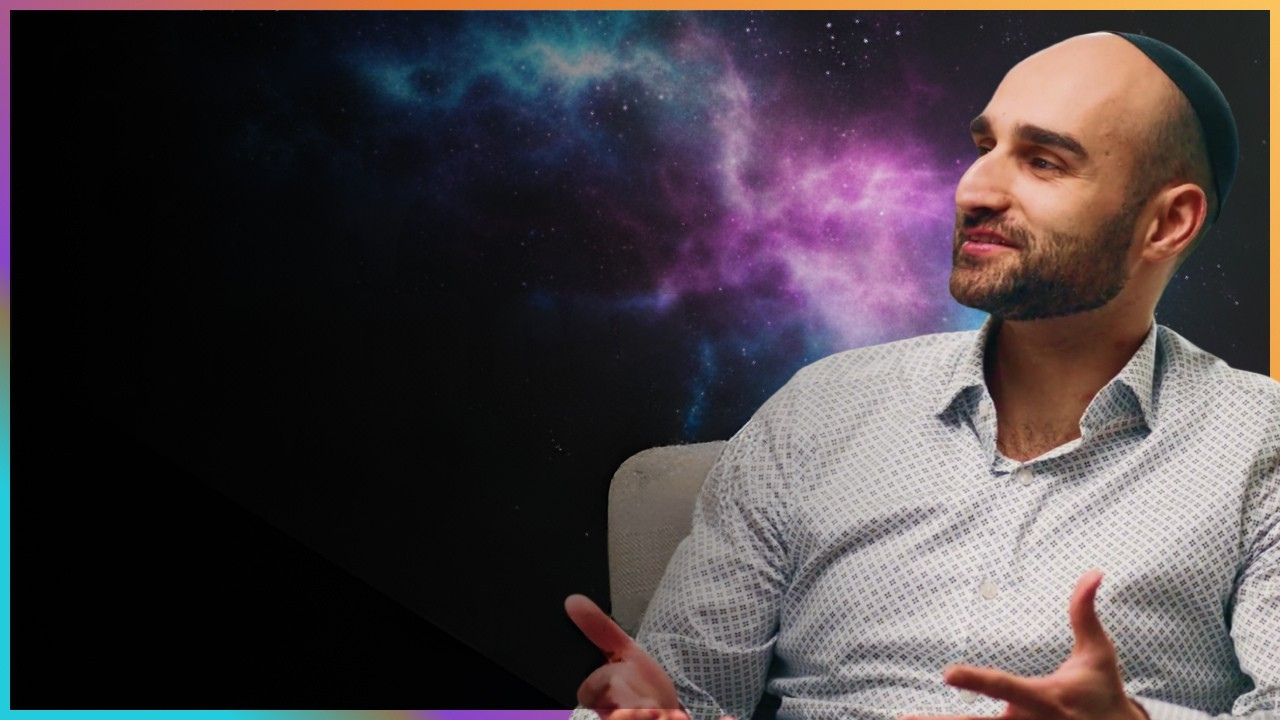
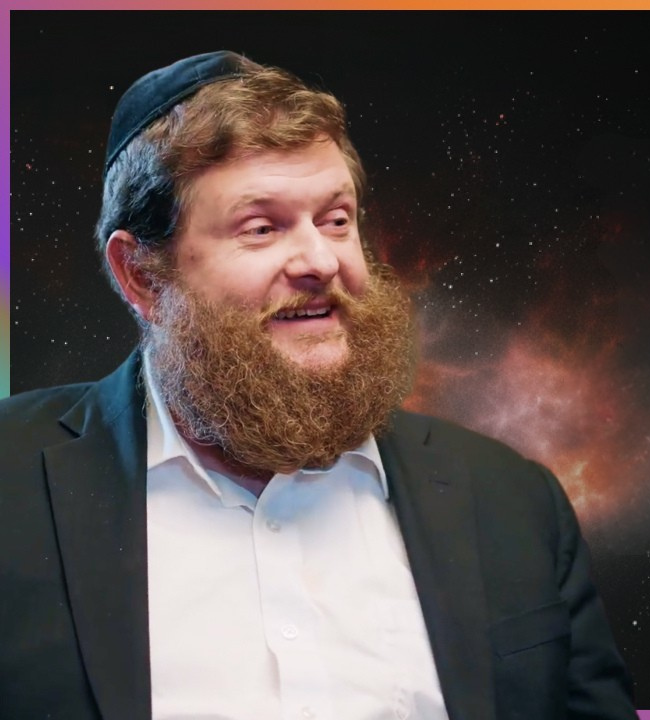
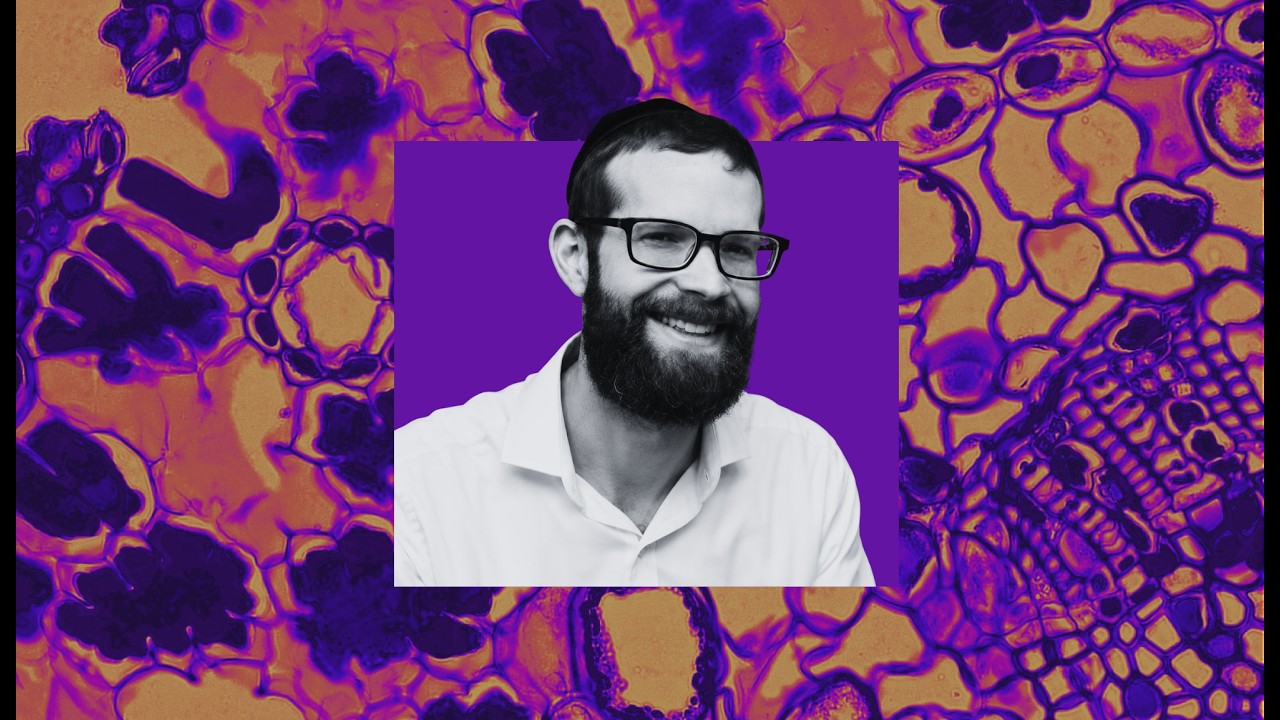
RABBI DR BENJI LEVY. Efraim Palvanov, born in Uzbekistan, living in Toronto, teaching, writing, and really inspiring hundreds of thousands of people around the world through your audio and visual messages. Thank you so much for being with us here today in Eretz Yisrael [the Land of Israel].
EFRAIM PALVANOV. It’s a pleasure.
LEVY. What is Jewish mysticism?
PALVANOV. Jewish mysticism is the ability to see God in all things, to see God everywhere. The word for Jewish mysticism is Kabbala, which means receiving. It’s a reception. And I think the best metaphor for being a kabbalist or a mekubal [mystic] is being a radio receiver. This room is full of music right now but you can’t hear it. But if you pull out a radio receiver and you tune into the right frequency, suddenly you hear the music. I think Kabbala and being a mekubal [mystic] is being a receiver to tap into those hidden frequencies and bring out the music that’s all around us.
LEVY. So how did you attune yourself to that frequency in the first place? Like, what introduced you to this Jewish mysticism?
PALVANOV. It was probably a book by Rabbi Aryeh Kaplan, who’s one of the great mystical masters of the last century. He has one book called Encounters, which I read when I was fourteen years old. And I think that was the first time I was ever really exposed to not just Jewish mysticism but deeper Jewish thinking in general, beyond the childish childhood stories that you hear.
LEVY. And should all Jews be mystics?
PALVANOV. I think all Jews should aspire to be mystics. I think all Jews actually are mystics deep down. I think the Jewish soul is mystical; it yearns for mysticism. So I think it’s the natural place of the Jew to actually be a mystic and to see God in all things.
LEVY. So seeing God in all things, but what is God? What are you seeing? What is this concept?
PALVANOV. It’s seeing the interconnectedness of the cosmos, of how I am a part of a greater whole. The kabbalists phrase that as each person is an olam katan, a little microcosm of the universe, and the universe is described as an adam kadmon, as like a primordial man. So it’s as if the whole cosmos is like a large large human being and every human is a little bit of the universe. We’re all interconnected. And so [you] see how we’re all linked together, how we are all intertwined. All of humanity is intertwined; how we are connected to the stars, because we are. Scientifically speaking, we are literally made of stardust. Our atoms were forged in the cores of exploding stars in the past and coalesced into this planet.
And then the Torah, actually the Midrash, says that the Jewish Sages say that to build this world, God had to actually create other worlds, and he was Boneh olamot uMachrivan, boneh olamot uMachrivan. That in preparation for creating this world, God actually created other worlds and destroyed them so that he could create this world. And science has discovered precisely that. That our planet and our solar system are condensed from previous exploding stars.
So we are literally made of stardust. And I think it’s important to be aware of that all the time. Being a mystic is remembering that and being aware of that and living it and understanding how we’re totally intertwined with the universe.
LEVY. So that universe, which is intertwined, was also differentiated. God distinguished between things. One of those distinguished components are peoples. And one of those peoples is the Jewish people. What’s our purpose? What is the purpose of the Jewish people?
PALVANOV. So the purpose of the Jewish people, I think, is to rectify life on Earth, rectify the earth itself, rectify the world and bring it to a higher state, and return it to its most pristine state as it was originally in the Garden of Eden according to God’s original plan of a peaceful, prosperous, united world. And God created that world, but unfortunately through mankind’s actions, that world was destroyed. And so God chose Abraham, or some would say Abraham chose God, to fix the world. Abraham looked around and said, this can’t be it. This world that’s so full of evil and suffering and violence and immorality. This can’t be what the world’s all about. Let’s recreate, let’s rebuild a better world. And Abraham, Avraham, started to do that. And God said, yeah, this is the one. That’s the thinking that we need to restore the Garden of Eden.
And so Avraham and his descendants, that is their role: to rectify the world spiritually, physically, to go out there and make the world a better place. That’s what the Jewish people have done. And to be a moral guide, a beacon to the world, and to be a light unto the nations, or lagoyim, to illuminate the world.
LEVY. And how does prayer work?
PALVANOV. Prayer in relation to fixing the world or prayer in general?
LEVY. I’d say you can relate it, but prayer in general more as a concept. What are the mechanics of prayer? What is happening?
PALVANOV. So in Hebrew lehitpalel, which means to pray, literally means to judge oneself, right? Any verb that starts with lehit means it’s something that’s reflexive. It’s something that you do to yourself. And lehitpalel is self-reflection, it’s self-judgment. It’s figuring out your place in the bigger picture. It’s cheshbon nefesh, it’s doing an accounting of the soul and figuring out where you are. Are you doing what you’re supposed to be doing? Are you on the right path? What might you need to change? So it’s actually a process of self-reflection. That’s what it is at its core. And it’s also a meditative thing. It’s to focus yourself, to center yourself.
The Mishna famously states that our sages would meditate, “hayu shohim shaa achat,” they would meditate for an hour before they could pray. So it’s getting into that meditative mindset. And the Zohar says that prayer actually accomplishes many of these rectifications, including of the self and the world around you.
And today we, again, we have beautiful scientific evidence for this, biological evidence. As somebody who actually has a background in biology and did research specifically in epigenetics, which is how our genes are expressed, and it can also be actually inherited, those expression patterns. One of the amazing findings of recent years is that meditation can actually affect your epigenetics. It actually may affect how your genes are expressed. So prayer, meditation, has an actual physical real effect on our bodies. It’s not just empty words.
And neurological studies show something amazing too [about] your thalamus, which is the relay center for all inputs into your brain. If you’re watching a movie and you’re getting a lot of input, a lot of visual, auditory input, your thalamus is firing like crazy, right? It’s very active. If you’re just sitting quietly, it’s not very active because there is not much stimulus, not much sensory information coming in. And yet, studies show that when you’re praying or meditating, your thalamus is very active. It’s as if it’s receiving all this information and stimulation from somewhere. So it’s as if your mind is actually connected to something greater.
So prayer and meditation actually do have a real effect on our bodies, on our brains, even on our genetics and on the world around us, as we know from quantum experiments from the last century: well-known things like the observer effect, wave particle duality, and collapsing the wave function.
We, as observers, actually have an effect on the world around us. And Wolfgang Pauli, who’s one of these great quantum physicists of the last century, said that quantum physics has turned man into, in his words, “a little lord of creation.” It’s like we are all little lords of creation. We create our world. We recreate our world, right? Our thoughts have an effect on the world around us. So prayer is a huge part of that. If you can have a focused, centered mind, it’s like a laser beam, right? Your prayers can be very powerful on your own body and on the whole world around you.
LEVY. And so you’re a teacher and a learner of the Torah and of Jewish mysticism. But what is the purpose of Torah? What is the purpose of studying it?
PALVANOV. The Midrash famously says that the Torah was given specifically to help us rectify ourselves. That’s what, really, Torah is all about: to refine the person. The Midrash says the Torah was given, the mitzvot were given, to refine us, to make us better.
But I think the Torah speaks for itself. It actually says what it’s for. The Torah says that if you follow, “im bechukotai teilechu umitzvotai tishmoru,” if you follow in My paths, God says, and keep My laws, it’ll be good for you. It’s actually beneficial for you. You’re going to have a great life.
And one of the amazing things about the Torah is that it never speaks of an afterlife. Never. It does not speak of heaven, it does not speak of hell, nothing. There is no concept of an afterlife in the Torah itself, in the Torah of Moses in the Chumash, which is amazing. We know there is an afterlife, and yet the Torah doesn’t mention it. It doesn’t want to mention it because it wants to keep the focus on this world. We’re not doing things for some other future world. You’re here, you’re in the present; live in the present. The Torah wants you to focus on the present and make the most of your life right here. It says, if you follow in My paths and you fulfill My laws, your life will be good. It’ll be good for you. You’ll have abundance, you’ll have physical satisfaction, spiritual satisfaction. You’ll have good relationships, marriage, family, you’ll have lots of healthy kids. So it’s actually practically beneficial to you to fulfill the Torah, and then it has this ripple effect where it’ll inspire others to be better too. And it’ll have a positive effect on the world around you.
And Moses says at the end in Sefer Devarim, in Deuteronomy, that the nations will see you and will see your success. And they’ll be so amazed. They’ll say “rak am chacham venavon hagoy hagadol hazeh” [surely this nation is a wise and understanding people]. This is wow, this is so amazing, this great nation, and we want to be like you, a model people that will inspire others. Your success will inspire others to be successful and be moral and and live ethical lives and live better lives. So in a nutshell, the purpose of Torah is both for your own personal well-being and for that to have ripple effects to the rest of the world.
LEVY. Amazing. Is there any difference in the view of Jewish mysticism between women and men?
PALVANOV. Ultimately, no. I think Jewish mysticism is actually all about unification and everything seeing the oneness in all things. And seeing [that] even within God, who is infinite and eternal and entirely singular, which is the Jewish motto that Hashem echad, that God is one. And yet we look at the world around us and it seems like there is a lot of disunity and there are a lot of different things.
But the whole concept of Jewish mysticism is that that’s just an illusion. Everything is really one. And there are different aspects, different manifestations of this one God. And God has certain masculine manifestations and God has certain feminine manifestations. So what’s referred to often as the feminine manifestation of God in this world is called the Shechina. But they’re equal and our job is actually to see the oneness between them, between those male and female aspects. And so each plays a very important role. There’s really no difference between the ultimate goal of men and women.
Practically speaking, there are differences because men and women are different. Can’t deny that. Biologically different. There are clear differences and we can’t pretend like men and women are the same. And in the social world, the liberal world has gone a little too far here and has forgotten that men and women are clearly biologically different. And there are people out there who are trying to negate those differences and they confuse equality with sameness. Right? Equality and sameness are not the same. Men and women are equal, of course, but they’re not the same.
So Jewish mysticism, Kabbala, Torah in general recognizes the differences between men and women and tries to bring out the best in each and provides guidelines to make the most of each so that men can be the best they can be and women can be the best they can be. So each one can extract their full potential, but [they are] totally equal and ultimately the end goal is the same.
LEVY. Should Judaism be hard or should it be easy?
PALVANOV. That’s a great question. It should be just right. It should be just challenging enough that it makes life interesting. It shouldn’t be too difficult, but it also shouldn’t be too easy. So it’s got to be just the right balance. And we see various expressions of Judaism today, and sometimes people are turned off by certain expressions that seem very strict and that seem to have extra rules. And you’ll often hear criticism of rabbis that they’ve added a lot of extras and things like that. But there are different expressions of Judaism.
And if we go back to the way things were, let’s say a thousand years ago in the time of the Rambam, Maimonides, it was actually a lot more lenient. So there is truth to that argument that, at least in the Orthodox world, there have been a lot of extras added on in the past 500 to 800 years. And you see a big difference between the Rambam’s Mishneh Torah, the Rambam’s code of law, which is about 850 years old, versus the Shulchan Aruch of Rabbi Yosef Karo, which is less than 500 years old.
And then compare that to modern codes of law from the last couple of centuries. There is a clear progression of more stringencies, expanding certain things, adding fences, saying, oh well, this is not allowed. So let’s just do a little bit more so that we don’t risk transgressing that. But what happens over time with each generation, if you keep adding a little fence, a little fence – it’s incremental, but then over 800 years you’ve added quite a bit. So I think it’s also important to remember, a lot of people are turned off by all the, what seem to be so many, prohibitions. Actually, it’s not that many, but there is also another way, you know, if you follow the Mishneh Torah for instance, it’s a lot more lenient than a modern code of law.
So there is a way to be perfectly halachically observant and fulfill the Torah perfectly and yet not have to do various stringencies that have only been imposed or introduced in the last few hundred years. So it shouldn’t turn people off from Torah.
LEVY. So it should be a challenge but not too far. Right.
PALVANOV. This was an issue that happened 2,000 years ago already that there was a certain group of sages that instituted eighteen new rules. Among them things like chalav yisrael and gvinat akum and not eating certain cheeses and milk and certain things. And even at that time there was a huge debate – should they have done that or not? And there are those who said, hey, this is good. This is going to protect Judaism. But there are others like Rabbi Yehoshua who said, no, no, this is terrible, because what’s going to end up happening is people are not going to want to keep any Torah, right? If you’re going to add too much, they’re going to throw out the baby with the bathwater, so to speak. And then not only are they not going to do the rabbinic extras, they’re not even going to do the actual Torah things that God commanded.
So I think that’s one of the oldest challenges that Judaism has had, certainly in the last 2,000 years, that balance between where do we draw the line? Of course we want to protect the Torah and we want to make sure that people don’t transgress. And we do need to add fences to kind of push people away to ensure that people won’t transgress. But then how far do you go? That’s an ancient argument that’s been going on for 2,000 years.
LEVY. We’ve got to try to get it right.
PALVANOV. Right. We want to find the balance. That’s the goal. And that’s why the Rambam’s whole thing is balance. Let’s find the right middle path and let’s not veer to extremes.
LEVY. So why did God create the world?
PALVANOV. Ooh, this is the million dollar question. I don’t know if anybody can really answer that question. Why, we can’t say for sure why he did. The classic kabbalistic Hasidic answer is that he wanted to make for himself a dira betachtonim, right? A lower world. Whatever that means.
I think there’s a beautiful answer that some in philosophy and in the scientific world have suggested, which is that mankind is the universe looking back on itself. If everything is ultimately Godliness, [then] the universe, as well as the whole cosmos, is an expression of Hashem, of God. And there’s this progression in the universe from just pure light at the beginning of creation, which both science and Torah agree on. Science will say that the whole universe began with a singularity, with this tiny little point that had this super inflationary period, and it expanded really quickly and there was this burst of radiation. And then everything kind of condensed into matter and small particles formed and then bigger ones. And then everything condensed from that original primordial energy burst, that light if you want to call it that. But that burst of energy.
And the Torah says the same thing, that the first thing God created [was] “vayehi or,” let there be light. And the Zohar explains that. What does that mean, let there be light? The Zohar actually says that God created the whole universe from “nekuda chada dezohar,” from a little point of radiance, from this ball of expanding energy. That’s what [the word] zohar means. The book, the main textbook –
LEVY. Emanation, radiance.
PALVANOV. Right, the main textbook of Kabbala is called Sefer HaZohar, right? The Book of Zohar. But what is zohar? It’s actually based on that passage from the beginning of the Zohar based on a verse in the book of Daniel, “vehamaskilim yazhiru kezohar harakia,” that the wise ones illuminate like the glow of the rakia, of the heavens, of space, of the firmament. And the Zohar explains what that means, that the firmament itself is still glowing. We just don’t see it. It’s based on a verse in Job that there’s a bright light that men don’t see. “Lo ra’u or bahir hu bashchakim.” There’s this bright light in the universe that people are not tuning into. They can’t see it. Our eyes have a very narrow range of wavelengths that we can see. But there’s so much more out there. And this verse in Job says there’s all this light. The whole universe is glowing. And yet we can’t perceive it. And if you ask a scientist today, a physicist, they’ll tell you the same thing. The whole universe is glowing with microwave background radiation. We just can’t perceive it.
And so the book, the Zohar actually comes from – zohar means radiance because the whole cosmos is still radiating from that initial “nekuda chada dezohar,” that initial singularity, that point of light. So we’re all condensed light ultimately. So there’s this process of condensation, you might call it hishtalshelut, in kabbalistic terminology it is a process of just pure oneness becoming this expanding energy [that is] slowly condensing into matter, ultimately becoming man who now has this divine consciousness that can reflect back on the entire process and recognize itself. And then we have the opportunity to again recognize ourselves as olam katan, as a little cosmos, part of an adam kadmon, part of this cosmic human body, part of this Godliness.
So to answer, to go back to your question, why did God create? It’s like we are a little bit of God looking back and reflecting on God. We’re all still part of that one Godliness.
LEVY. So if we’re reflecting on that Godliness and God created us, put us in this world, what are the limitations, or are there limitations to our free will?
PALVANOV. I don’t think so. I think it’s a fundamental principle of Judaism that you have 100 percent free will, that God gave you the ability to choose. And there are no limitations on that, except there are verses that suggest that the will of a king is in the hand of God. So meaning when it comes to a person whose choices might affect many, then in that case, like we see with Pharaoh in the Exodus story, God hardened his heart. So that means that He almost did restrict his free will a little bit, because history had to drive in a certain direction. So maybe in those situations God will sometimes put roadblocks, but otherwise, I think it’s a fundamental Jewish belief that everybody has 100 percent free will to choose.
LEVY. So what do you think of when we say Mashiach, the Messiah?
PALVANOV. It’s an interesting question. Again, different ways to view it. I think as history progressed, the whole idea of Mashiach [the Messiah] became bigger and more ingrained in Judaism. The truth is, a couple of thousand years ago it wasn’t so deeply embedded in the Jewish psyche. And you’ll see even in the Gemara in Sanhedrin, there are opinions that say there won’t be a Mashiach, right? So there’s a famous [rabbi], Rabbi Hillel, who says in [tractate] Sanhedrin that Mashiach won’t come “ki kvar achluhu biyemei Chizkiyahu,” that all the prophecies in the Tanach that are presumably about Mashiach were already fulfilled in the time of King Hezekiah. It was really all about him, and we don’t have to yearn for some savior to come and, whatever, take us out of the exile. It’s already happened and it’s all about the individual Mashiach within.
That’s not the way that the sages understood it generally. That’s not the consensus. The Rambam again, Maimonides, he codified it almost as law that there are thirteen principles of faith. And one of them is to believe in a redeeming figure. But then Rabbi Yosef Albo countered that and said, no, we don’t have thirteen principles of faith. That’s too complicated. We only have three. You just have to believe in God, that God gave the Torah, and that there’s reward and punishment. There are consequences for your actions. Mashiach [the Messiah] is a secondary belief, but it’s not a primary belief. And a Jew technically doesn’t necessarily have to believe in it. It’s not a primary fundamental Jewish belief.
LEVY. But what is it? Like what if you believe in it, what –
PALVANOV. Right, so that’s where I’m getting. So at its core, all Mashiach is – literally Mashiach means the anointed one. And it’s the anointed king of Israel. That’s all. So at its core, all that we’re really yearning for when we want Mashiach to come is the reestablishment of the Davidic dynasty, that we can have proper leadership, good government, not corrupt government that we’re used to but moral leaders who believe in Hashem [God], who want to fulfill God’s law, and who want to help the people and to be a conduit. A Jewish king is supposed to be like a conduit for the people, an inspiration, a role model to help to connect people to God. And that’s all. We really just want the reestablishment of the Davidic dynasty. And Mashiach should not necessarily be confused with some divine child and some special holy figure, some holy soul. This is just a king, a political figure. And the [Gemara] says Mashiach will be king for forty years like King David, and then his son will be king, and then his son will be king, and because that’s the whole point of reestablishing the Davidic dynasty. So it’s not like some magical figure from the clouds. It’s very much an earthly political figure who’s a righteous, godly person who can lead people, who can be a good leader for the Jewish people and for Israel.
LEVY. So is the State of Israel part of this journey towards the final redemption?
PALVANOV. So I think so. I think it’s pretty clear that the State of Israel is part of the process of – we finally, after 2,000 years, again have sovereignty in our own land and are able to go freely to the holy land, to the Kotel, to our holy sites and to live here and prosper here. It’s an amazing thing. I think it’s clear that we’re part of the redemption process. We’re in ikvot hamashiach, we’re in the footsteps of the Messiah.
The Talmud actually says, what is the greatest sign that we’re in the ikvot hamashiach, in the footsteps of the Messiah, that the redemption is near? And it says you only need one proof for it. “Ein ketz meguleh mizeh,” it says. There’s no greater sign of the redemption, the Talmud says, than, and it brings a verse from the Tanach, when the trees of Israel will give their fruit again to the world. When you see that Israel is once more flourishing with produce and is even able to export produce, you know for sure that Mashiach is near and that you’re in the times of geula [redemption]. “Ein ketz meguleh mizeh.” This is the number one sign of the redemption. Because it’s never happened in history. There’s never been a time in history when Israel exported fruit.
If you look in the Tanach even, in most of history, Jewish history is like the land has been kind of barren. There hasn’t been too much. It can support its people but not more than that. And when the Jews weren’t here there was nothing. Like no other nation has ever been able to make a prosperous state in the holy land. Nobody. Many have tried. Jerusalem is one of the most conquered cities in the world. It’s been conquered at least forty times in history. Nobody has been able to make a prosperous, successful state here except Jews. And never in history has Israel exported produce to the world. And yet today, Israel has an abundance of produce, right? And Israel is a leader in agricultural technology. And anywhere you go in the world, you can, most places in the world, you can go to your local supermarket and buy Israeli grapefruits and Israeli tomatoes and cucumbers and dates and figs. It’s amazing that Israel is actually exporting fruit all over the world.
And the Talmud says that that’s how you know Mashiach is near and you’re in the times of geula [redemption]. So the fact that we have been able to reestablish a state, we’ve been able to make it such an incredible, advanced state in terms of its technology and high-tech and all these things, exporting all this amazing good stuff to the world, that is a fulfillment of prophecy. And the Talmud says that’s the greatest sign that the redemption is near.
So therefore, I believe the State of Israel is definitely part of that process. And our sages always said that it would take time. Geula [redemption] is not just something that will just drop out of the sky in one second, right? And the Ramchal, for instance, Rabbi Moshe Chaim Luzzatto wrote that it’s going to be a long process. It’s going to take time. You’re going to need time to bring all the Jewish people back to the holy land. You can’t have fifteen million people return overnight. You have to slowly build the infrastructure, build the roads, build the homes, the desalination plants, make sure there’s enough water and electricity. It’s a process.
So we’re clearly in that process. The State of Israel has established the groundwork to transition to the Kingdom of Israel, to the holy Kingdom of Israel with a king as leader and with a proper Sanhedrin [Jewish supreme court] as opposed to a Knesset, you know, a king instead of a prime minister. So we’re in the transition period.
LEVY. What’s the greatest challenge facing the world today?
PALVANOV. The whole world or the Jewish world?
LEVY. The whole world.
PALVANOV. Misinformation.
LEVY. Can you unpack that a bit?
PALVANOV. Yeah, I think we live in a world where – this is also a fulfillment of prophecy – that Isaiah says that in the end of days, the world will be full of information, full of knowledge, divine knowledge, but full of knowledge as waters fill the seas. And we’re living that now. We’re in a world of, in your pocket you have access to all the world’s information.
LEVY. But that knowledge is not always meduyak, it’s not always exact.
PALVANOV. Exactly. So unfortunately, we have the tools now to have basically almost infinite knowledge accessible at any second. But the sitra achra, the side of evil, is still at large. And so there’s tons of evil information and misinformation, and that’s confusing people. And you have access in your pocket to all kinds of nonsense and propaganda and immoral things and inappropriate things and confusing things.
And that’s what’s driving, we can see it with our youth. It’s destroying them mentally. They’re confused, their minds are corrupted. And today we have sky-high levels of depression, anxiety, right? Self-esteem is at all-time lows, suicide, God forbid, is at all-time highs. So people are just not happy and they don’t know who they are and they’re confused. And the confusion goes so far that it’s confusing even to the most fundamental things that in the past nobody ever questioned, like are you a boy or a girl? Even that’s now challenging young people. Something that in the past would have sounded funny. Like, what do you mean? It’s the most – it’s so simple. Nobody questioned this before. And today even that, children are confused about something as basic as your biological identity. And that’s how deeply the confusion runs.
So misinformation is really destroying the world, all this propaganda and the social media and constantly being connected, and wired, and addicted, and plugged in.
LEVY. So what’s the solution to that?
PALVANOV. Number one is Shabbat, because Shabbat is all about detaching, disconnect. Imagine if the whole world kept Shabbat. Let’s have twenty-five hours where everything is down. The 5G networks are down, nothing. You can’t, no nothing, right? You have no phones, you have no screens, just reconnect with yourself. Just give your mind a break. Twenty-five hours, no nothing, no stream of information, no misinformation. Just be with people face-to-face, right? Talk to people, reconnect with your family, with your friends, with your community, go out on a nature walk. That’s already huge.
And I think that’s why the Torah starts with that. The first thing that the Torah says is Shabbat, right? God is infinite. God didn’t need to make the world in six days and rest on the seventh. God doesn’t need to rest. Everything in the Torah is a message for us. Torah means instruction. It’s an instruction for us. What did God want to teach us? God doesn’t need to rest. It’s for us to structure our lives that way. Six days, be productive. Seventh day, disconnect, detach, rest, let your mind and your soul rest.
That’s what Shabbat really is. It’s resting. And the Torah starts with that before there’s even Israel, before there’s anything about Jews or mitzvot, nothing. It’s a universal thing. Even for Adam and Eve in the Garden of Eden, they weren’t Jewish. Nothing to do with Judaism. It’s universal. Shabbat is for all mankind. And that’s why the Torah even says, when you keep Shabbat, it’s going to be everybody. “Ata uvincha” – whoever is there, your employees – “gercha asher bish’arecha, behemtecha,” even your animals should rest on Shabbat. The Torah makes it clear that Shabbat is universal. Leave everything alone.
So I think that’s a huge part of it, of fixing the mess that this world is in, the mental mess that this world is in. One tool is Shabbat, to at least do one day a week where you can disconnect, detach, and let your mind rest and restore.
LEVY. So how has modernity affected Jewish mysticism?
PALVANOV. I think it’s only confirmed the truth of Jewish mysticism. And going back, again, to the science of creation, it’s only recently since the 1960s that scientists realized using radio telescopes and things like that, non-optical telescopes, that the universe is glowing. That’s what our sages have been saying for centuries.
The Zohar was first published in the thirteenth century – published. We believe it dates back to Rabbi Shimon bar Yochai almost 2,000 years ago. But for sure it was published in the thirteenth century and already it tells you, hey, the whole universe began with a “nekuda chada dezohar,” with a tiny point of expanding radiance. It even says it was expanding inflation – “itpashtuta dinekuda chada dezohar,” it was an expansion of an inflation of that point of light.
And then comes science now in the last fifty, sixty years and says exactly that. Right? So science is only confirming what the Jewish mystics have been saying for centuries, for millennia. So I think it’s actually a good thing. You’ll find that everything that scientists are discovering now already has a source in the Zohar including things like the rotation of the Earth, which wasn’t confirmed until the late 1800s. And the Zohar actually says “kol yeshuva mitgalgela be’igula kakadur.” That the whole Earth is spinning like a ball. Those are the exact words.
LEVY. It’s crazy – they thought it was crazy then and now it’s an absolute fact.
PALVANOV. Right. In the thirteenth century to say that was like, oh my gosh, that’s a crazy mystical secret. This is like intense Kabbala. Like how can this be that the earth is a ball and it’s spinning. Crazy.
LEVY. And now it’s just basic science.
PALVANOV. And now you teach it to all the kids in school, right? So it took hundreds of years for scientists to catch up. So I think modernity is only actually just reinforcing and helping us understand better and just confirms what the Jewish mystics have been saying. [It] confirms all these secrets that we’ve known all along and brings those secrets out to be revealed. They’re not secrets anymore.
LEVY. So you talk about Jewish mystics, Jewish mysticism. What differentiates Jewish mysticism from other types of mysticism, other schools of thought by this nature?
PALVANOV. I think the ultimate goal might be very similar, which is seeing God in all things, connecting to a higher power, transcending the physical world. So those things are similar, meditation, prayer, those are aspects of all meditative, most mystical systems from around the world.
Judaism has one aspect of it that is an allergy to anything idolatrous and a complete dismissal of any intermediaries. Judaism is all about you and God. God is the infinite and it’s your connection to the infinite. Israel is literally, if you split the word, yashar El, straight to God. What makes Israel Israel is no idolatry. It’s a complete rejection of any type of idolatry or any form of shituf [joining] of an intermediary or I don’t need another human to be my savior. God and God alone. And it’s my connection to the infinite.
So in other mystical systems, that’s lacking. Buddhism, for instance, which is a very popular form of mysticism. Buddhism has the Buddha as its intermediary. Buddhists see the Buddha as their person, you know, they have little images and icons of the Buddha and statues and they’ll give offerings to the Buddha and they’ll light incense to the Buddha. The Buddha plays a big role. He’s almost been deified into a god himself, which defeats the whole purpose.
And so Judaism is really not about idolizing or deifying any human. Your salvation does not come through a human. Your connection is directly to God and to God alone, no intermediaries. So I think that’s one critical difference between Jewish mysticism and other forms of mysticism.
LEVY. And that’s very empowering because it means each of us can connect in a deep way. In this connection, do you have to be religious to study Jewish mysticism?
PALVANOV. I don’t think so. I think all of Torah knowledge is for everybody and one of the highest values in Judaism is Talmud Torah keneged kulam [Torah study is equal to them all], that you have to learn, learning Torah is the most important thing. And the Torah has to be understood on various levels. It’s not enough to just learn the peshat, the simple story. We learn that as children. It’s not enough to carry that through your life. So the Arizal, one of the greatest mystics from the sixteenth century, Rabbi Yitzchak Luria, says a person has to learn Torah on all four levels of what our sages called Pardes: peshat, remez, derash, sod. Peshat is just the simple story, the simple narrative. Remez is what you get out of it. What is it actually trying to teach us, the lessons behind that story? And then the derash is the metaphorical, the allegorical. And then you also have sod, which is the secrets, the deep, mystical part. What is the mystical meaning of this? And the Arizal says every Jew has to learn Torah on all four levels. And if you don’t, he goes so far as to say you haven’t learned Torah. You haven’t fulfilled the mitzva. And he goes even further to say, if you don’t learn Torah on all four levels, you will reincarnate and keep coming back into this world until you do. So I think it’s for all Jews.
Of course, there is a process. To use the analogy of a school child, you can’t teach quantum physics or calculus to a grade one student who just needs to learn basic arithmetic, right? So there does need to be a process, you do need to learn the basics first, and then you keep moving. But that doesn’t mean that you have to put off learning mysticism until some indefinite time in the future.
Some people say there’s this almost, I don’t know if I should call it a myth, but maybe a misconception that you can’t learn Kabbala until you’re forty. It’s not really a thing. There were such statements made in some places at some times, but that’s not really the law. And the Arizal certainly didn’t hold that way. And in fact, the Arizal himself died when he was thirty-seven or thirty-eight. So he never even reached forty. And he’s one of the greatest mystics of all time. And that’s true with many of the great mystics. The Ramchal also died when he was forty and he’s one of the greatest mystics of all time.
LEVY. So if it’s accessible to all, can it be dangerous?
PALVANOV. It might be. I think in the past it was dangerous more than today, again, because they didn’t have the scientific knowledge to support it. So it seemed really crazy and mind-blowing. But today, when a lot of it overlaps with scientific wisdom anyways, it’s not so dangerous anymore. It’s not so wild. We have scientific proof. We see how prayer can affect our genetics. We see how our thoughts and our observation can affect the world around us. These are not crazy things anymore. These are just scientific facts.
So I don’t think it’s so dangerous anymore. Although the Talmud does have this famous story in masechet [tractate] Chagiga about the four who went, nichnesu bePardes. They actually went into the orchard, into that Pardes, [which] is paradise, almost. The English word paradise comes from Pardes, right? They went into the heavenly orchard. Meaning they went deeper into that study, peshat, remez, derash, sod. And of the four rabbis, one died, one went mad, one became a heretic, and only Rabbi Akiva entered in peace and exited in peace. I think one of the messages of that story is that it could be dangerous. And for some people it leads to an untimely death, and for some people it makes them a little crazy. And for some people it might even turn them to heresy. But if done right, it leads to peace. It’s shalom. It actually leads to perfecting the human and brings you total inner peace. It just has to be done right.
The danger in the past, I think it was a lot more dangerous than today. The danger today is that there are things, teachings, people posing as Kabbala, but they’re not. That’s the danger. I think the only danger today is when it’s not authentic Kabbala. You’ll have Christians who call themselves kabbalists. There’s Christian Kabbala now, right? There’s secular Kabbala. There’s all these new age movements that take Kabbala and then integrate it with other things or non-kosher things. So if you fall into that, that’s dangerous because you’re getting something that’s not genuine Kabbala, [but it is] posing as Kabbala.
LEVY. I think what’s interesting is you said that Akiva went in with peace and came out with peace. If you come in with peace, [if] you come with the right intention, [if] you come with the right way, you’re more likely to come out that way as well.
PALVANOV. Exactly. Absolutely.
LEVY. So, you talked about how Kabbala and mysticism can have an effect. In a practical, very personal way, how has mysticism affected your own personal relationships with yourself, with those around you?
PALVANOV. I’m reminded of a famous quote from one of the great Hasidic masters, Rabbi Pinchas of Koritz. You know, he said it very succinctly. He said, “the Zohar has kept me Jewish.” So I feel sometimes the same way. I think if you’re learning Torah just by itself, without the mystical commentary, you’ll see many contradictions with the Torah, within the Torah, but also with, again, scientific wisdom, modern secular wisdom. And it will seem like this can’t be true. And I think it’s only when you actually open up the Zohar and the Arizal that you see all the contradictions melt away. That’s where a lot of these problems are resolved, including things like creation. If you just look at the Torah itself and read, oh, God created the world in six days and rested on the seventh. And if I add up all the years, it seems like this only just happened less than 6,000 years ago. That doesn’t fit with what we know about the cosmos. But then you open the Zohar and the Zohar says, no, there was a “nekuda chada” and there was an inflation and then it’s like, oh yeah, that’s what the scientists say. Exactly. So that’s good now, right? So you’ve actually just solved the contradiction when you see the mystical meaning there. And the Zohar, of course, proves it from the Torah. It’s not making it up. It’s just understanding the Torah correctly. It’s showing you how to properly understand the Torah.
So for me as well, being in my twenties and studying science, and being in university, and having many atheist professors, and debating with them, and challenging them, and they challenge me [back] and talking about it is, I think, without the mysticism it wouldn’t help my Judaism and my faith. I think the mysticism really solidified my faith, showed me that there are no contradictions, showed me that not only is it very scientific, but we even knew about it first, right? Science is only now catching up to what we’ve been saying all along.
So not just for me, but for everybody, I think learning Kabbala, Jewish mysticism, is so vital because it’s really the soul of Judaism, right? All the laws and the rituals and the basic stories, that’s the body of Judaism. But you can’t just have a body, you need to have a soul. And mysticism is really the soul of Judaism.
LEVY. So we’ve reflected on so many beautiful ideas about Jewish mysticism. Can you actually teach us one? What’s one profound idea that you can share?
PALVANOV. So, one of my favorite Zohars is – and I think it’s really pertinent to our previous discussion about Mashiach and bringing about the final redemption and a perfect world – first of all, two things. One big part of that is the idea of rectifying the world and freeing all the sparks in creation. That’s a well-known idea, that everything that we do is slowly rebuilding the universe. So even if you eat an apple and you make a beracha [blessing] on that apple and you do it right with intention, if there are spiritual little sparks, nitzotzot, of holiness, it’s like you’re freeing them and you’re putting them back to where they belong in the cosmos. And so every action actually becomes deeply meaningful. Right? Drinking water becomes very meaningful. Getting a new shirt and making a beracha [blessing] on – I have this wonderful new shirt, actually it extracts the sparks that might be in that fabric. Everything that you do now has meaning everywhere that you go. The Arizal would say you pray in a new place. You’ve gone to a forest, a pristine forest that no Jew has ever been in and you prayed there. Whatever sparks were there, you’ve now lifted them. So it actually brings so much meaning to every action that we do.
And the Arizal also uses that to explain why the Jewish people had to be spread all over the world. It’s not that we were exiled throughout history as a punishment. It was all part of God’s plan. Again, it’s all an illusion. God’s plan was to spread us all over the world so that we would liberate all the sparks wherever we are. There are Jews in every corner of the planet and that was done deliberately by God so that Jews can do mitzvot, and make berachot [blessings], and recite prayers, and meditate, and bring people together, and do all these things everywhere in the world so that we can actually rectify the whole planet. I think it’s a very powerful idea that makes life meaningful, that makes every moment meaningful, that makes every meal meaningful.
And the final stage to that, which is the Mashiach bit, there’s a beautiful Zohar that says: Who is Mashiach [the Messiah]? Are we expecting, again, some holy miracle child who’s going to now come and save us, some intermediary? Judaism doesn’t like intermediaries. Judaism is allergic to the whole concept of it. Judaism is all about you and God. That’s it. We don’t need an external human to come and save us. You are your own, you know, it’s all in your hands. Your salvation is in your hands. God says you fulfill My Torah, you’ve redeemed yourself. That’s it.
So what is the Mashiach role here? The Zohar has a beautiful teaching. The Zohar says, in the end of days, when it’s going to be time for Mashiach, for the anointed king to return, God’s going to look, who can be Mashiach? And there’s a verse in Isaiah that the Zohar is commenting on. It says “ve’abit ve’ein ozer.” God says, I looked and I didn’t find anyone. I didn’t find a helper. “Abit,” I looked, “ve’ein ozer,” and there’s no helper. And the Zohar says, what does this verse mean in Isaiah? It says God is looking for Mashiach. Just like we are. God is looking for him and saying, who’s going to be Mashiach? Right? I looked and nobody, the world seems to be so corrupt. Like we said earlier, there’s so much anxiety, and depression, and poor self-esteem, and the world is so messed up that nobody seems to be worthy of being Mashiach.
So what’s God going to do? The Zohar says. And it brings another verse where it says, God will try us like gold, refine us like gold and silver. So He’s going to send trials and tribulations and challenges and tests to all of us and see what we do with it. And He’s going to try to refine us so that one person who is worthy to be Mashiach will finally emerge.
I think it’s a beautiful teaching, which is saying: Don’t wait passively for somebody else to save you. You be Mashiach, right? Every person can be Mashiach. God is looking – “ve’abit ve’ein ozer.” God is looking for his helper. Who’s going to be worthy to be Mashiach? Who’s going to make the most of their life and overcome all these challenges and find God and help people and maximize their mitzvot and their chesed, their kindness? Who’s going to go out there and free sparks? Who’s going to go out there and do good and rectify the world and do the tikkun olam [fixing the world] and be a model person and spread truth and proper information, counter the misinformation? Who’s going to do all these things? Who’s going to live up to the challenge to be that Mashiach figure? All of us. And each of us should be doing that. We should all tap into that Mashiach energy inside, right? And each of us should be a little savior, a little lord of creation, a little savior.
And that’s really what God wants. God wants us all to tap into that energy, be the best version of ourselves that we can be. And thereby we will bring about the perfect world that we await.
LEVY. Well, in speaking to you Efraim, we definitely feel that energy. You’re liberating sparks, connecting so many people, helping God to be helpers themselves. And we wish you continued blessing and appreciate your time.
PALVANOV. Thank you very much. I appreciate it. Thank you.