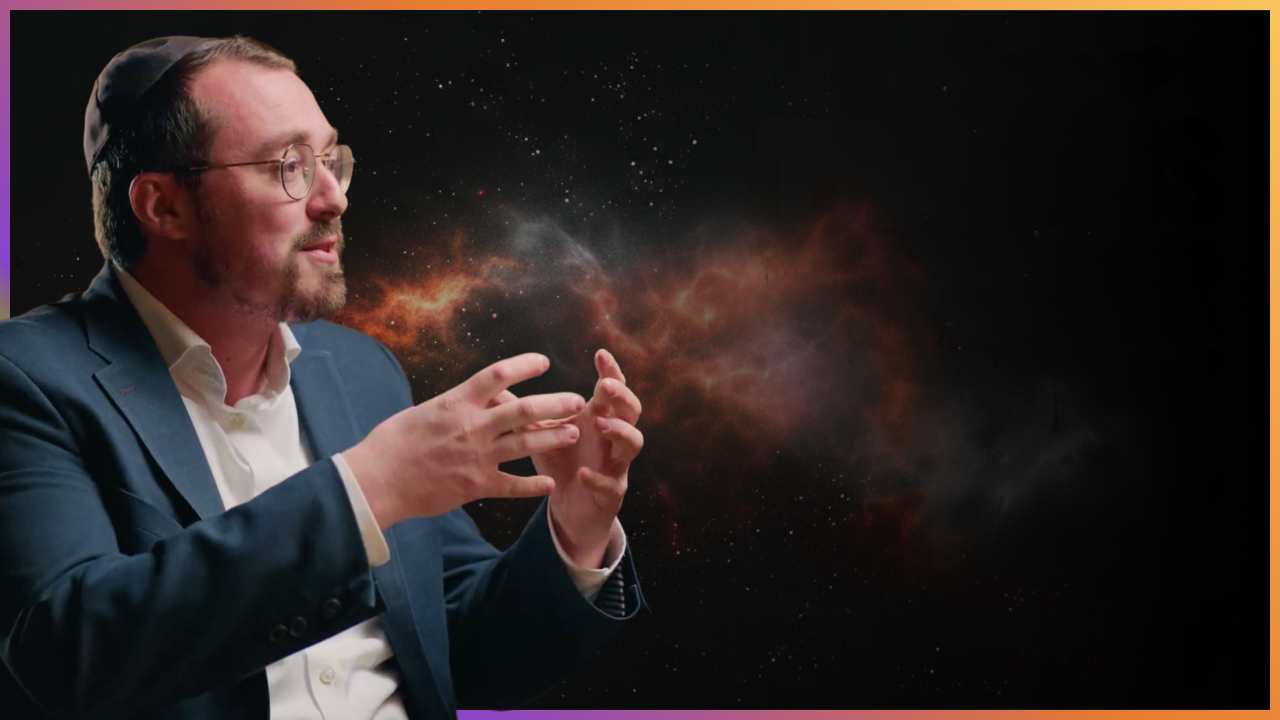
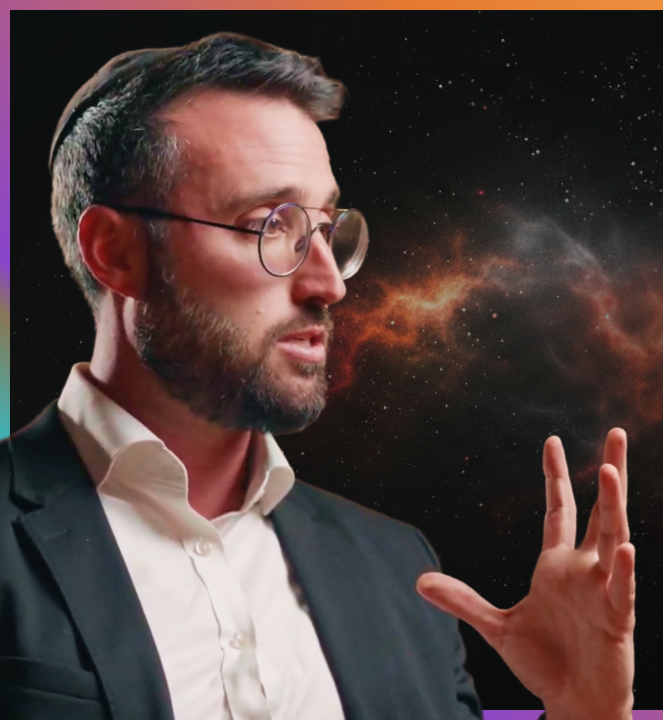
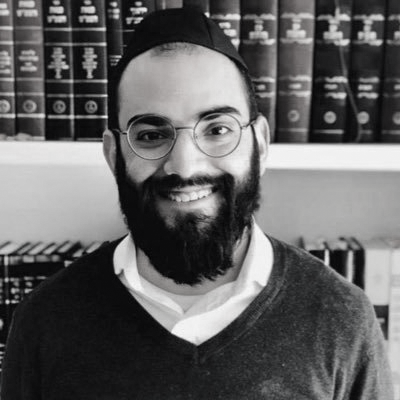
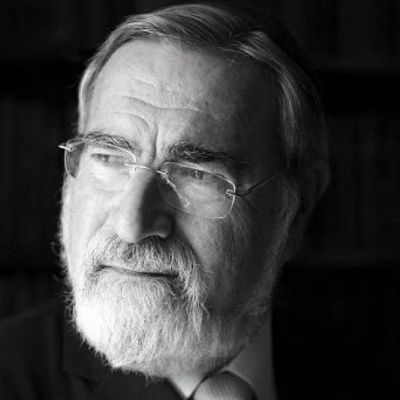
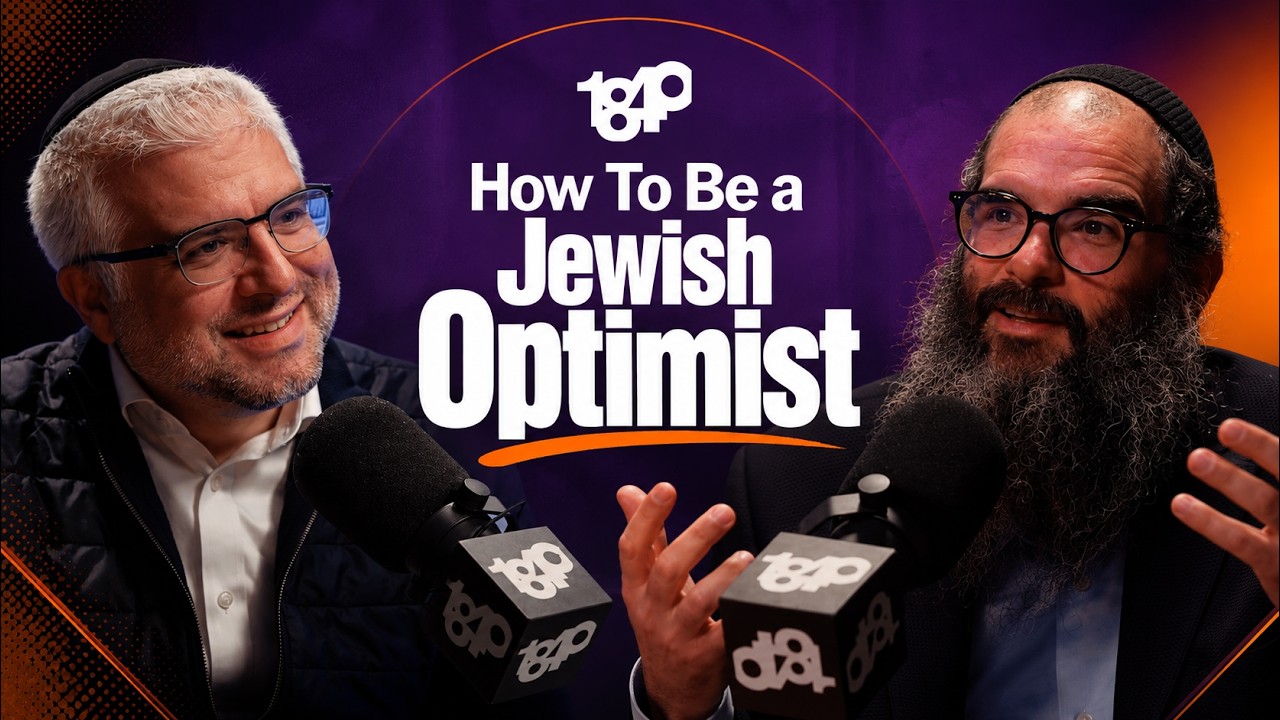
RABBI DR BENJI LEVY. Rabbi Yaakov Klein, it’s such a privilege and pleasure to be sitting here with you in Jerusalem. Only a few months ago we actually met together in London. The founding director of Eilecha in London, [you are] really spreading such incredible thoughts across the world. And it’s remarkable that at such a young age you’ve become such a prolific writer and speaker. And thank you so much for all you’re doing for the world.
RABBI YAAKOV KLEIN. Privilege, thank you for having me.
LEVY. So, you’re a Jewish mystic, and you’re part of an interesting genre. And that word even makes us feel a little bit uncomfortable sometimes. What is Jewish mysticism?
KLEIN. Yeah, it’s an excellent question. Personally, I wouldn’t classify myself as a Jewish mystic. I would say that’s a bit of a mistake – mystic, mistake. Don’t know. Not a Jewish mystic. In order to understand what mysticism is we have to go back to the root of the English word, which is mystery. And the word mystery really comes from the Hebrew word nistar. Right? Nistar is that which is hidden. Jewish mysticism is a science of how to engage with life in such a way that we’re able to look beyond the surface of things and intuit, connect to, and channel something deeper, something beyond the surface. In that sense, I’m a mystic because I hope to be plugged into the mystery of life. I’m not in any way an expert in Kabbala. I’m not a kabbalist. I’m just a Jew. In that sense, I think every Jew is a mystic because the essence of what it means to be a Jew is to learn, guided by the principles of the Torah, how to live life in an immersive framework of consciousness that we call Jewish law, Jewish commandments, Jewish culture, Jewish thought, in all areas of the Torah. So in that sense, you cannot be a Jew and not be a mystic from that sense because it means you’re plugged into that place of the mystery, of the nistar, of the hester, of that layer of reality that’s beyond what the eyes can see where all you see everywhere you turn is an opportunity to connect to the Creator of the world.
LEVY. So if a mystic is the person that can plug into the mystery and the nistar and the hiddenness – from my understanding, you weren’t always like this. When did the journey begin? How did it begin? What brought you into this type of Torah, this type of framework?
KLEIN. Excellent question. I appreciate also – thank you for having me. It’s a privilege to be here. A part of the fundamental sort of framework of mysticism understood in this way of nistar, being able to look at that which is deeper, precludes the relevance, really, of the word potential in any context because potential means that something is a certain way; that is how it is now. And that maybe sometime in the future it will become something else. Let’s say teachers or parents describe a child that has a lot of potential. What does that mean? It means that right now, nothing. Maybe one day, if he gets lucky, somehow something will come from him. And that means that a person is looking at the world or that child not with the eyes of a mystic because you’re only seeing the outside. The way that a mystic would look at it is to recognize [that] he has greatness in him now. Right? He’s great. He’s fundamentally great. And the question is only a question of revealing that. So it’s not transforming into something else, just revealing it. So from that standpoint, I was always this way, you know? I always had this inside of me. I was searching for God, really searching for an intimate connection with God my whole life. And part of the frustration was that just like every human being has a body and a soul, the whole world has a body, has the physical element, and then there’s the spiritual energy behind it or beyond that. Torah has a body and a soul. And sometimes because we seek to preserve the tradition of what it means to be a halachic, Torah-oriented Jew, who’s really living in accordance with what’s revealed in both the written Torah and the oral Torah and codified in halacha – sometimes what can happen is that we attach ourselves to the body of Torah, which is essentially the what to do, where to do it, when to do it, how to do it. And sometimes what can get lost in the process is the why. The why is the soul. Because why animates the what, where, how, and when? To the extent that a person has a strong why, which is a fundamental principle of Kabbala, that the whole system of the way that God reveals Himself in the world called the ten sefirot [divine emanations] begins with keter, which correlates to will, correlates to why. It means crown, but it’s connected to the concept of God’s motivation to create the world. If we don’t have a why, we can’t begin. But sometimes what can happen is that the body takes over.
And so what I felt growing up in a very religious community was that institutionally there was a bit of an imbalance toward the side of what’s called in Kabbala and Jewish mysticism the vessels or the body, which is the receptacle for what’s supposed to then be saturated with an experience of godliness and an encounter with the Divine. But sometimes, because we’re so careful that we should protect and preserve that sort of traditional body of Judaism, sometimes the soul can get lost. And so what I was searching for from a young age is the why, is the big picture. Judaism is a puzzle. There are so many different pieces, but if we never look at the puzzle box and see what the picture is supposed to be, you have no idea how, like what’s this all for? Why am I here? Don’t tell me that now you’re in the world so here’s what to do. I want to know why I came in the world in the first place. And so I was searching and searching and searching. It’s a whole long story, not going to go into every single detail. But [I was coming] from a very alienated place, having really disregarded this whole experience as shallow and surface level and just not relatable, not relevant. I had the great privilege of really stumbling upon the world of Chasidut [Hasidism], the world of, more broadly, Jewish mysticism, specifically through the path of the Hasidic masters, who were intent on bringing the soul back into Judaism. They didn’t intend to do away with any of the halachic vessels but they sought to reveal to us how those vessels were intended to be an immersive program of consciousness.
LEVY. Was there a person? Was there a moment? Was there something that brought you through that or did you just come to it on your own?
KLEIN. It’s a little bit of a longer story. The entry for me was walking into a lecture that was being given in Yiddish, it just so happened to be. Interestingly enough, I don’t speak a word of Yiddish, but I could understand it because I went to a Hasidic cheder day school when I was very young. It tells you a little bit about the nature of the day school that I only understand it but can’t speak a word, because we weren’t allowed to speak. We were allowed to listen. So I can’t speak a word of Yiddish, but I understand it. And I walked in and the person was speaking about Purim, about the Megilla. And the whole story of Purim, many of us are familiar with Haman, and threatening the whole Jewish People, and Esther and Mordechai, and the whole thing. So I know the story, it’s part of my whole life, reading the Megilla. But the way that he was speaking about the Megilla through the prism of the teachings of Rabbi Nachman of Breslov, a great-grandson of the Baal Shem Tov, the founder of Chasidut, who himself remains one of the most original and impactful Hasidic masters in the whole corpus of the Hasidic tradition. I had never heard anybody speak about the Megilla in this way. The relevance, the depth, the way that it’s not a commemoration of a story that happened thousands of years ago, but that each year anew those lights that were revealed on that original Purim are available to each and every Jewish soul in our own lives, and what Mordechai means to me, and what Esther means to me, and who Haman is inside of me. And what it means to find, like the Sages say, a person should drink until they get to a point where they can actually say baruch Haman, they can say that Haman should be blessed, it’s a counterintuitive thing. But that means that we can get to a level of faith that’s beyond intellect, beyond our rational mind, where a person is able to come to the realization retroactively that all the Hamans in my life, all the difficulties, all the troubles, I can turn to them and I can bless them. And I can say that I can’t imagine myself getting where I am now if I hadn’t gone through it. And so on and so forth. This was a whole different Megilla. And so from there, my eyes really became open. There are a lot of other details along the way, which I’m leaving out. But that began my lifelong love affair, until now at least, and I hope that it will continue, with Rabbi Nachman of Breslov and his primary disciple, Rabbi Nathan of Nemirov.
LEVY. So should all Jews be mystics? Should they all be exposed to, connected to, and tapped into this type of Torah?
KLEIN. I believe that all Jews are mystics already, if we’re defining it as people who are plugged into nistar, into hester, into the mystery. So I think that’s what it means to be a Jew in the first place. But from the standpoint of mysticism, I believe that some people have that element more revealed, and for some people that concealment seeking element within their Jewishness is itself concealed.
LEVY. But should they try to reveal it more? Should they tap into it more?
KLEIN. Absolutely, absolutely –
LEVY. Across the board?
KLEIN. Across the board. Who doesn’t need this? Everybody’s looking for more meaning. Everybody’s wandering the world. We have access to every kind of entertainment and every kind of information. It’s like we have it all at our fingertips. We can do everything. People are looking for a why. They want to be a part of a cosmic story. They want to know that they matter. The one thing that our generation, I find, is struggling with more than anything is self worth. Our teenagers are walking around, they’re insecure. I just mentioned on a podcast earlier today, somewhere else, that the whole thing is crazy because I see – and I teach in high schools – I see that this one is trying to get validation from the other person, and their whole self worth is contingent upon the validation that that person’s giving. What they don’t realize is that that person is getting their whole self worth and validation from this other person. And so what you have is two insecure people that you understand – it’s crazy.
Where should self worth come from? Mystic, mystery, nistar, hester, the greatness that’s inside. The greatness that’s inside comes from the collective soul of the Jewish nation. Judaism is not a culture, it’s not an ethnicity, it’s not a religion. It’s a collective spirit that has come down consistently into various bodies all throughout the world, throughout 2,000 years of exile, to move the world forward to a state of redemption. That’s our greatness. It’s innate. And so if every Jew was plugged into that greatness they wouldn’t struggle with self worth. God is breathing a soul into you every minute. He expects you to do your part in bringing the world toward the redemption.
LEVY. So you talk about this God that’s breathing into us, this greatness that we can tap into. What is God? How would you describe this phenomenon, this entity? What is it?
KLEIN. The truth is we can’t say anything about it because the Zohar, the primary textbook of Kabbala, teaches us “leit machshava tefisa bei klal,” that there’s no thought that can grasp the Divine. That the water that’s in the cup can’t grasp the outside of the cup. It’s something that’s other than our experience. But our Sages do try to communicate to us in various parables and different ways of understanding what God is. Many, many times it’s by understanding what God isn’t. He’s not limited, and He’s not needy and so on and so forth. But to me the most relatable definition for what this Being is is brought in the Talmud in the tractate of Berachot, which is all about blessings.
And what are blessings? Just parenthetically for a second. [For] a lot of people, especially those who grow up in a halachically observant home, a blessing is some liturgy that you murmur, you know, as quickly as you possibly can before putting something in your mouth. There was a rabbi who once said that the speed of the blessing is commensurate to how far the food is from your mouth. So if you’re picking something up from the table, you have a little bit more time. If it happens to be over here, you just – and put it in your mouth –
LEVY. Very sad.
KLEIN. It’s supposed to be. A blessing is a station of consciousness. It’s an opportunity to plug yourself in before you engage with the physical world to remember that this is an opportunity to connect to the Divine. So in that tractate that’s all about the blessings, our Sages teach that the same way that our body functions in what appears to be a fragmented sort of space, where this is a hand, and this is a nose, and these are ears, and those are toes, and they’re all in different places and doing different things, but there’s a soul, a singular entity that infuses the whole structure, and brings it to life, and animates every single aspect, thereby uniting all the different facets and features. What is God? God is to the world what our soul is to our body.
LEVY. It animates everything.
KLEIN. It animates and it unifies all of what appears on the surface to be relegated to the realm of duality, multiplicity, fragmentation. To me, God is the unity, the creator, the motivator, the loving being that brought [us] into the world to pursue a relationship with every single human, who are created in His image. So from this standpoint, being a mystic, really to be a Jew, in terms of how we’re supposed to be, how Abraham was, and Isaac, Jacob, and so on, is to develop our sense of perception so that when we look at a circumstance, or an experience, or any facet of our journey here in life, you don’t just see the body. You find God, which is the soul of that experience. God is meaning. God is Love. God is our Teacher. God is our King. God is our Father. God is our best friend. This is what it means in my humble opinion to be a mystic, but really, this is what Judaism is.
People think that mysticism is something divorced from the halacha [Jewish Law], because they appear on the surface to be two things that [could not be] more different. One is Talmudic dialectics and working out the parameters of how many hours do I have to wait between when I eat meat and milk, and how do I tie my shoes, and so on. And the other thing is mysticism. And I say they are literally the same thing. Because they’re two sides of one coin. Because halacha, Jewish law, is nothing other than the implementation of mystical consciousness. So that tefillin, wrapping on those boxes of phylacteries, every morning on my arm and on my head, is an opportunity to bind myself with the Divine. And shaking a lulav on Sukkot – you know how many pages in the works of the kabbalists – Kabbala, it doesn’t exist divorced from [halacha], otherwise it’s a flame without a wick. Now maybe even more tragic is if you have a wick without a flame.
The key point is integration. How do I bring together the soul of Torah with the body of Torah? How do I bring together the soul of the world, God, with our lived experience of being human? This is what the whole purpose of Judaism is.
LEVY. So then, is that really what the purpose of the Jewish People are as an embodiment of that? Meaning if God is what you described, what’s the purpose of the Jewish People? To be integrators?
KLEIN. Is that our job? First of all to be integrators. Keep in mind that the other two primary religions come also from the Abrahamic tradition, but they come from Abraham and Isaac respectively through the son of Abraham, Ishmael, so that’s Islam. And the son of Isaac is Esau, and from that more generally is Rome, Christianity, and so on.
And in Jewish mysticism, Abraham is the trait of loving kindness, because you see that embodied and it’s all in the Bible by the way, this is all in the text. You see that Abraham is a person who’s just full of loving kindness. He has a tent that is open on all four sides so that he shouldn’t have to trouble anybody to walk out of the way to get in. Abraham is love. Isaac is severity. Isaac allows himself to be tied down on the altar. Judaism comes neither from Abraham alone, nor from Isaac alone, but from Jacob. In Kabbala, Jacob is seen as the midda, the trait, of tiferet, which means harmony. It’s the sum that’s greater than the total of the parts. It’s something new that’s created when we integrate. Abraham in this context would be soul, Isaac would be body, and we come from Jacob, which means that our whole task in this world is to reveal the light of integration.
Lights and vessels, souls and bodies, flames and wicks. And then to do our job as the priesthood sect, hopefully animated with the consciousness that’s gifted to us through a consistent experience with Jewish halacha that’s infused with spirit, to then from that place shine the light to the nations of the world, who have themselves the seven Noahide laws, because Judaism is not for Jews. Our God is not the Jewish God. He’s the creator of heaven and earth. He’s the God of every human being who’s created in his likeness. And the prophets describe that the coming of Mashiach [the Messiah] means that the whole world is going to get together. We’re all one family. Now, our 613 commandments that are special for the priesthood sect, which is the Jewish nation within humanity, [which] has a body and a soul, you don’t think the seven Noahide laws have a soul? You know how much mysticism there is underlying each of those seven Noahide laws that we’re supposed to teach the world? But the only way that we can do that is if we’re activated first.
And today there are Jews who have the body but they don’t have the soul. There are also Jews who have the soul [but] they don’t have the body. And then there are Jews who just altogether think that Judaism is some culture, and maybe they support the State of Israel, and maybe that’s their Jewish identity. What we don’t understand is that God is literally waiting for us to stand up and to reclaim our mission. It’s not an ethnic identity, it’s not a culture, it’s not even a religion. It’s the redemption of humanity and it’s in our hands.
LEVY. So part of that reclaiming the mission, and part of the mission, and one of those commandments in and of itself, some say rabbinic, some say based on the Torah, some say it depends on the circumstances, is to pray. Prayer is a very deep thing. We prayed together, you know, this past Shabbat and we invited you to lead the congregation we had of incredible people. And it was clear that you were in a state, you were in a mind frame, you were connected in something deep. So how does prayer work?
KLEIN. Prayer is incredibly deep. Prayer also has a body and a soul. The body of prayer is: I want something and God is some kind of vending machine. If I push the right buttons, if I say the right words, I’ll get what I want and I’ll carry on. I’ll tell you a short teaching from the Kotzker Rabbi. The Kotzker Rabbi – even the word kotsk is very sharp, it’s curt. The Kotker was very biting, he was very sharp –
LEVY. The word kotz actually means something.
KLEIN. Exactly, a kotz cuts. It’s like kotzk. But kotz means a thorn. Exactly right. Interesting. So the Kotzker said a very sharp thing. He said in the book of Genesis, right in the beginning of the Torah, the serpent, the snake seduces Adam and Eve to eat from the tree of knowledge of good and evil, which is incredibly deep. Many, many, many layers of meaning – that snake gets cursed and the curse is that you’re going to have to eat dust. Dust will be your food. So asks the Kotzker Rabbi, why is that a curse? Imagine if wherever you went, you had what you needed. You have to eat not a specific food, it’s arbitrary. You just eat whatever you see around you. Beautiful. You never need to work to make a living, put food on the table. What food on the table? The food is everywhere. So the Kotzker says, you’re right. The curse wasn’t that you’re going to have to eat dust, because that’s a blessing. The curse was that because you’ll always have what you need wherever you go, you’ll never need to pray. That’s a curse.
Now that turns prayer on its head, because on the contrary, I thought that all the while that things are good in my life then I don’t need to pray. Says the Kotzker: Don’t you understand that praying itself is the blessing? There’s a great master of Jewish thought called Rabbi Hutner. He was the rosh yeshiva, the head of a very, very large talmudical academy. And he said the most wonderful thing. He says that most of us think that prayer is [meant] to get us out of trouble. He said the truth is that trouble is to get us into prayer. Beautiful. We have it all backwards. We have the whole thing backwards. We don’t understand why we’re here in this world. So we identify with the body. The body needs something, okay, I might as well chuck up a couple of liturgical lines from a book that I don’t know what it means. That’s not prayer. A person who knows what prayer is never asks, I wonder, when is my prayer going to be answered? Because your prayer was already answered.
LEVY. That Pachad Yitzchak is fascinating because there’s a famous debate between the Rambam, Maimonides, and the Ramban, Nachmanides, about whether it’s biblical or rabbinic. And Rabbi Soloveitchik basically harmonizes these two opinions saying, at the end of the day, even if you’re going to say it’s rabbinic, it’s actually biblical because the rabbinic opinion is to say it’s only [required in] a time of need. And we’re in a state of perpetual need.
KLEIN. Yes. Ah, it’s amazing that Rabbi Soloveitchik –
LEVY. But that really relates to Rabbi Hutner.
KLEIN. Exactly. Because we always need it. And we always need prayer. First of all, we always need something –
LEVY. We think prayer needs us, it’s us that need prayer –
KLEIN. Us that need prayer. Exactly right. And that’s really the soul of prayer. And so prayer is an answer in and of itself. It’s a gift. It’s an opportunity to take time out from our otherwise very mundane [lives], this worldly experience, and to take some time to stop being a body and to show up as a soul.
LEVY. So we show up as the soul. But there’s a limit to how much prayer can be. We also need to learn. And that learning, limud HaTorah, it’s called Torah study, it’s “keneged kulam” [equal to all of them], it’s one of the greatest, highest things we can possibly do. But what would you still, according to this mystical approach, [say is] the purpose of Torah? Why is it there?
KLEIN. Torah study is the essence of everything. But it’s interesting when the Talmud says that Torah study is the most important thing, which is what you quoted – “talmud Torah keneged kulam” – remember that there’s another part of our tradition from those very same teachers who teach that “gadol halimud” [study is great], the reason why Torah study is so important is “shemeivi lidei maaseh” [for it leads to practice], is because very practically, it teaches us what to do. So a lot of times we get so caught up in the study of it that sometimes we forget the whole point is the actual how do you treat your wife and how do you treat your kids? You know, how do you deal with frustration, and how do you deal with challenges at the workplace, and just in life more generally? But that’s also still the body of Torah. That’s [why] Torah is important on the level of the body.
The Baal HaTanya, Rabbi Shneur Zalman of Liadi, the founder of the Chabad Hasidic movement, is very famous all around the world. So he was the first in that dynasty, which had seven great, great luminaries. The Baal HaTanya explains that the Torah is more than a text. The Torah is the transmitted will of the divine. It’s the wisdom of God, which, according to the mystics, is one with God. It’s God literally communicating Himself, in a certain sense, in a text and that’s echoed in a teaching from our Sages in the Talmud that sees the word “Anochi,” that first word with which God introduces himself to the world, really to the Jewish nation, which means I am. “Anochi Hashem Elokecha.” I am this – these four letters yud and hei and vav and hei. Hashem just means the name, but it’s very deep. I am the Oneness, your God. They see that as an acronym for four words. “Ana,” I, “nafshi,” my soul, “ktavit,” I wrote down, “yehavit,” and I gave it to you. The Torah is the soul, it’s a wild thing. And that’s not in the mystical text, that’s in the Talmud. The Torah is the soul of God. Says the Baal HaTanya.
LEVY. No, it sounds like it’s not the physical expression, but it is God itself.
KLEIN. In a certain sense, [it is] hard for us to understand that. It’s one with God’s –
LEVY. God is packaging Himself and giving Himself over.
KLEIN. Pretty much. So says the Baal HaTanya, what’s the highest part of the human sort of structure? Is the head, you know, and the head houses the skull, houses the brain. The mind is the seat of consciousness. That’s who we are. It’s an interesting exercise. If you take away different body parts, are you still that person? Aside from the physical, yeah, there obviously are limbs that the body depends on. But we are our brains. Says the Baal HaTanya, when the essence of you, which is your brain, is grasping and contemplating the essence of God, which is communicated in the Torah, he said there is no greater intimacy with the Divine than that experience. And it’s counterintuitive because on the surface, it looks like the most technical thing. Like literally a person studying information. But the question is how we study that information with a priori, sort of first principle, perspectives. To a person for whom the Torah is the soul of God, there’s no greater mystical encounter with the driest talmudic passage because it’s saturated with God’s will. And if I love someone, I love what he loves. I want what he wants. That’s the ultimate, ultimate, ultimate unity. Ritzonenu, our will, laasot, is to do, is to actualize Ritzonecha, Your will. That’s Torah study from a mystical perspective.
LEVY. So really the purpose is therefore to be connected to God’s will. What’s really interesting there is if God, according to the Talmud, packaged a part of Himself through the Torah, the deepest part, to go into our brain, which is the essence of us, essentially, we’re ingesting God. Essentially, this intimacy is God in us and us in God and it’s one and the same –
KLEIN. That’s exactly right.
LEVY. And so therefore the purpose of Torah study is actually to become godly, so to speak. It’s for us to be given over to God and God to be given over to us in this computational formula that allows us to become one.
KLEIN. That’s right. And that’s Torah study in and of itself. When you hold Torah study together with tefilla [prayer], which are the two basic pillars of the whole Jewish tradition, relies on these two fundamental ways of interacting with God. So then in a more abstract formulation, the Torah is God speaking to us, and prayer is us speaking to God. So it’s certainly an interesting thing to say, well, our prayer is like God’s Torah. Because Torah, we learn what God wants. Prayer, God learns what we want. And this is this symbiotic relationship between Torah and prayer. Prayer is when we allow our souls to just rise out of the body and up and up and up into the embrace of the Divine. And that’s the concept of prayer.
Tefilla is a Hebrew word that means prayer, but it also means to bind. Like tefillin, it [has] the same [root] word, it means to bind. So to be bound with God, and then in Torah, God descends on Har Sinai [Mount Sinai]. On that mountain God is coming down to us. Where’s the mountain of prayer? Har Habayit [the Temple Mount]. “Ki beiti beit tefila yikarei lechol haamim.” It’s a verse. It says My house will be a house of prayer for all the nations. How do you get to Har Habayit? You ascend the mountain. And so prayer means going up to God, Torah means allowing God to come down into our lived experience.
LEVY. Interesting. You basically connected our last two questions. Praying is us speaking to God. Torah is God speaking to us. When I sat with Rabbi Sacks in his home in London, where you’re from, he described it to me as a conversation. Prayer study and Torah is the conversation between humanity and God –
KLEIN. It’s that dialogue.
LEVY. So I guess the question is, there are so many different people in this world, and there are many different ways of subdividing them. And now traditionally, sociologically, we have something called gender. We have men and we have women.What do the mystics think of this? Are we one and the same? Are we different? How do men and women feature in this type of literature?
KLEIN. Unbelievable. You know, there’s a verse that says “ki Kel deot Hashem.” God is a God of deot, right? Which means knowledge, but it’s plural. And a very great mystic, who’s called Rabbi Hillel Zeitlin, had a tremendous impact on me and continues to have a tremendous impact on me. He’s a prolific author and writer. There’s a fantastic book that I highly recommend. It’s called Hasidic Spirituality for a New Era. Can’t recommend that book highly enough. He knew. He really knew. He was a real mystic. He was an amazing soul.
So he writes, you know what it means “ki Kel deot Hashem?” God is a God of plural consciousnesses? He says there are two ways of approaching this world. There’s something called daat tachton, which means a lower perception. And he says from that perspective, this world is real and spirituality is just, either it’s an imagination or it’s some fluffy, abstract realm and spiritual. Daat Elyon, a person who has upgraded and risen into a higher, more mature consciousness, to him the real reality is the spiritual realm. This world is just an extension, like today we have good parables to use because we have this evolved tech. So you have the ability to talk about code and then the app. But the app – you don’t speak about the app and then from there extrapolate the code. That’s not how it works. The app on the front end is literally just the front end manifestation of the code that’s in the back end. So for the kabbalists who are operating on a level of daat elyon [higher perception], of that more evolved higher consciousness, that’s the real reality.
So I don’t look at men and women and then say, I wonder what this means. I go back to the code and I say, oh, well, that’s why there are men and women. It’s a whole different thing. Why are there men and women? Because the way that God expresses, I would say Himself, but really it’s Itself, because it’s not a him or a her. The way that God reveals Himself is through a transcendent element that’s aloof, that’s removed, that’s more abstract, as well as an imminent element that we refer to as the Shechina, the Divine Presence. That’s the latent potential spirituality that can be discovered everywhere in this world without appealing to higher realms. It’s here. And it’s in exile because it’s waiting for you and me to redeem it using our consciousness. There’s the transcendent and imminent. Now because those two elements exist in the higher realm in the code, so as God, who is really unified, comes down into the human race, that produces males and females. Where the male aspect is the more big picture, abstract, visionary, you know, and again we’re speaking in abstractions here. Every male contains the female energy and every female contains the male energy. We could never speak about –
LEVY. It’s really important you clarify that because –
KLEIN. For sure, we could never –
LEVY. The labels are so confusing for people –
KLEIN. It’s terrible. It’s terrible. We’re just –
LEVY. So the kabbalistic language of male and female is not per se how we perceive and see.
KLEIN. No, it’s not men and women –
LEVY. And by the way, also on a biological level, you know, there’s different hormones, there’s different.
KLEIN. That’s right. Each one has X and Y chromosomes. They both contain both. No question. But generally – to use a generalization, at least historically, traditionally, the man was going out into the world, the hunter gatherer. But the animal that he brought home couldn’t be eaten. It needed to be prepared, it needed to be developed. And that was the role of the female, more traditionally, classically. And this is true on varying layers of functionality in modern day relationships, where it might not be that way. In fact, the roles could be reversed, but that’s not the point. The point is that there’s a general nature and a tendency that’s a masculine energy that again, might exist within the woman, that’s not the point. But the masculine energy is this transcendent, bigger picture, visionary energy. And the feminine energy is much more pragmatic. It’s detail oriented. It’s like, how do we take that and turn it into something practical? Without being crude, you know, it’s a mature audience. This is what happens between a man and a woman in the process of reproduction. And this has remained true. What the man contributes, you can’t do anything with it. It’s nothing. The female doesn’t have anything other than what the man is contributing. From the integration of the two, which is that and we call it a seminal drop for that reason, right? A seminal concept means it contains the whole, then it’s taken and it’s developed. And the female has the womb that’s capable of taking this visionary energy, developing it, and then between the two [they] could produce a child. This is male and female to me.
LEVY. So what is the biggest obstacle to a spiritual life? You spend your time day in, day out with people of all ages but primarily teens, which I think is really the place where this expresses itself most. And you mentioned one idea before, but even more broadly beyond the specific core audience that you deal with, what’s the biggest obstacle? What’s stopping us from all living a more spiritual life?
KLEIN. It’s an excellent question. To me it comes down to identity. How do you view yourself? How you view yourself will transform how you view the world. If you identify as a body, and maybe a soul is in there somewhere, all you’ll see in the world is the physical world and maybe there’s some spiritual realm somewhere. If we can train our children, and we can educate, and we can teach people how to identify as a soul primarily that has a body – there’s something in me, in this, like this is just this is a garment. I’ll take this off after [I die at the age of] 120 and I’ll happily discard it and it’s not me. When I identify as a soul then I’m much more likely to be able to discover the soul with the capital S in the body of the universe and history, which is God.
And so we need to be speaking about Jewish identity. What’s our mission? Why are we in this world? What do we hope for the world? What do our prophets tell us about where this whole thing is going? What do our Sages tell us about where this whole thing began? What’s the point? If we can root our Jewish identity not in anything having to do with this worldliness but in the collective soul of the Jewish spirit in Abraham and his vision, and in the prophets that teach us about what that vision is going to look like actualized, and to realize that I have a part in it, everything changes. My engagement with Judaism changes. And I know that there’s a wick and there’s a flame, and I have to integrate. And I know that it’s not just for me with 613 particularized commandments. It’s particularism for the purpose of universalism. I’m a priest, I’m a kohen. I have something to say to the world. So say it. And then a person begins to live a truly spiritual life.
LEVY. So this is so complex, this world we live in. Why did God create it? Why did God create the world?
KLEIN. I don’t know. I can give some reasons that are expressed by the mystics, but the ultimate answer is it’s just a mystery –
LEVY. Would you say that –
KLEIN. Mystic. Nistar [hidden]. It’s a mystery. God doesn’t need this world, because like Maimonides teaches, God is perfect, He doesn’t need anything. But God desired to show vulnerably to pursue a relationship with sparks of His consciousness that would perceive themselves as being separate from God, for the purpose of an even greater revelation of God’s unity, through integration. Where specifically in a fragmented world, fragmented sparks of godliness could seek the unity that’s so unified that it could be revealed even here, which is the greatest manifestation of God’s oneness. Why did He create it that it should be necessary like that? I prefer not to know. Even if I could know, I wouldn’t want to, because it takes away all the fun. It’s a mystery. I have no idea.
LEVY. But it’s interesting because it’s very hard to be able to say I don’t know. It’s very hard to live in the I don’t know. And it’s very hard to live in the mystery because at the end of the day, you talked about ego earlier, and at the end of the day, I want to know. I remember in my own personal growth becoming someone that is more practicing. Obviously, I’m completely growing, always. For me that was one of the biggest challenges. I like to know the answer. I like to know why.
KLEIN. Sure. And it’s hard to live in that mystery. What has caused more pain to humans? Our knowing or our not knowing? Ego is the source of all issues. It’s the source of our own pain. It’s the source of the pain that people cause to other people. It’s the desire to control and it’s the illusion that we could actually control. Part of the healing that Judaism seeks to bring to the world is this humility. Prayer equals humility. Standing vulnerably in front of God, I say, I’m not the be-all and end-all. There are certain things in life that I cannot do. And I rely on you. I need you. That fosters within the individual a spirit of humility, which makes them less likely to trample on somebody else or less likely to cause themselves pain because they don’t have that ego that’s constantly being wounded and protected because they’re not living for them, they’re living for something higher. When each individual Jew can onboard that consciousness and collectively the Jewish nation is activated with that energy of prayer, and humility, and depth, and sweetness, and innocence, and – we can project it to humanity. And then there will not be wars because no one will feel the need. And nobody will lift a sword against their neighbor because there won’t be a need. Because instead of pointing fingers at each other we’ll be able to link arms and look up.
LEVY. And where does free will fit in with all of this? Is it something real? Is it an illusion?
KLEIN. Yes. Both. From our perspective, it’s absolutely real because that’s our experience. And no matter how much I can tell you free will doesn’t exist, it will not take away the fact that you’ll still probably have to make a decision on what dinner you have to eat. So okay, it’s not ultimately real. Nothing’s ultimately real, but we experience it as real. From that standpoint, it’s fundamentally real. If a person sits in bed and says, I expect that I’ll just make a living because it will come through my mail slot, it won’t. People who train, and study, and work hard, they’ll get ahead. There are certain things that are predictable based on our illusory experience of free choice that for us [feels] fundamentally real, and God wants us to live within that reality. In the ultimate, ultimate, ultimate sense, “ein od milvado,” these three words that we find in Deuteronomy, don’t just say there is no God other than Him –
LEVY. There’s nothing.
KLEIN. But they say there is nothing other than Him. This conversation –
LEVY. Which means everything is Him.
KLEIN. Pretty much. This conversation that we’re having here in this beautiful, physical space, the tech that’s allowing anybody who’s going to be watching this to watch this, and the room that they’re sitting in is just part of an expression of godliness. It’s a ray of the sun that exists if you see it from the ray’s perspective, but if you see it from the sun’s perspective, it’s just wrapped up into that. And so the story’s already been told, but you and I are expected to make conscious decisions to enable our part of the story to be manifest through the role that God needs us to play.
LEVY. The role that God needs us to play, you talked before about bringing this incredible world together where we don’t need to pick up swords, where we don’t need to have wars. I assume you’re alluding to this Messianic Era, to Mashiach [the Messiah] –
KLEIN. Sure
LEVY. So what is Mashiach?
KLEIN. Yeah. Classically, Mashiach [the Messiah] is an event. It’s exile, exile, exile, exile, and then one day someone flicks on the light switch, oh, the Messiah is here. Jewish mysticism sees the coming of the Messiah, Mashiach, not as an event but as a process. And it’s based on a story in the Jerusalem Talmud, also in the midrashic literature, in Tehillim, Psalms, that describes two talmudic sages who were walking, probably not far from here, on one of the hills, mountains, and they saw the sun rise. And one of them said to the other, “kach geulatan shel Yisrael.” This is going to be what the redemption of the Jewish nation and the whole world is going to look like, the sunrise. “Batchila kima kima,” in the beginning, a little, little, just little by little. “Ve’chol she’hi holechet,” the more that it develops and evolves, “holechet ve’rabba.” It’s going to get brighter and brighter and brighter, just like the sun.
So from my perspective, do I believe that there’s going to be a messianic figure that brings this thing to the finish line? Sure. But that will not be the beginning of the process. That will be the final hammer blow. That will be the makkeh bepatish [striking the final hammer blow], that last closing, that last brick. That’ll be the end of the process. You and I are the process. You and I and everybody listening to this, and really, every human being has a spark of the Mashiach inside of them. It doesn’t look like that on the outside. I don’t look like a messianic figure. Look deeper with Jewish eyes of faith. And you’ll find that you have a spark of redemptive energy inside of you. When you can redeem yourself and graduate from the daat tachton [lower understanding] we spoke about to start to see the world from a daat elyon [lower understanding] perspective, where the first thing you see like the Baal Shem Tov taught his students, when you look at a table, you see God and then you see the table. You see the code, you learn the code. So then you brought another spark of messianic energy to the world.
And the Baal Shem Tov taught that when every Jew redeems their spark of Mashiach, and we’re so busy waiting for Mashiach to come, we don’t think: When are we arriving? When are we going to arrive? And Mashiach is waiting for us to come. “Hayom im bekolo tishmau.” Mashiach says I’m coming today. Different midrash [homiletics]. But I’m waiting for you and we’re waiting for God. And God is waiting for us. The Baal Shem Tov said that when each and every one of us can redeem our spark of Mashiach, that’s it. So the more that this Torah spreads, the more that these perspectives begin to become mainstream, regular, that these are the ways that our children are being educated in school by people who know how to give over this kind of education, not just from the standpoint of the material but from the lives that they live, the energy that they exude. And what we said just now in this conversation is that is a drop in the ocean of Jewish depth, guidance, teachings, paradigm shifts. The more that this spreads, dawn is breaking. Dawn is breaking.
LEVY. So as dawn is breaking, you described just on these hills the fact that we can even sit in this place. Is the State of Israel part of the unfolding of the redemption?
KLEIN. This is a very complicated issue. Anybody who has studied this topic a little bit knows that there there are tremendously fierce voices on on either side trying to decipher what exactly this is, because it’s not exactly the way that we would have assumed our return to this Land would look: through a largely secular, political national movement that was really antithetical in many ways to a lot of what we spoke about now. So it’s not the way that we always imagined it would look. And therefore, there’s reason for skepticism and some even go so far as to say that on the contrary, that this is withholding the unfolding of the redemption. Generally speaking, for a person that looks through a simpler lens and looks at the metziut, just looks at reality, irrespective of how this came about, the bottom line is we’re back. We’re back in tremendous numbers. All around the world there are Jews that are flooding this place. And by all appearances on a simple level, the prophecies have been fulfilled and we’re literally living through that time. Because irrespective, again, of how it looked, or how we assumed it would look, or how it ended up looking, it makes no difference. Right now, this is the reality. Are there hurdles? Tremendous hurdles. From without and from within.
My belief is that the more that we can resolve our internal hurdles, which would require the body-[focused] people, the [candle] wick people, the halachic Jews discovering their soul, and the soul people, right? Using it as a broader term, you know, even those people who aren’t necessarily super spiritual, but those people rediscovering tradition and rediscovering what it could look like to wed all of our various incredible strengths that each of us bring as part of this prism of the Jewish People into one collective, multi-faceted diamond of an integrated whole that’s healthy and that’s balanced. I think that our external issues would be resolved in a much easier way. I believe that we would be better positioned to be able to communicate with each other. I think that we would be better positioned to figure out how to live with each other.
Because unbeknownst to many, if you read early Zionist literature, there were voices at the fifth Zionist Congress, for example, [and] at other places, that spoke very clearly about the quote unquote Palestinian question. And it was largely overlooked, as if it would resolve itself. What’s going on now was predicted word by word by many of the voices. There’s one in particular, and I’m forgetting his name now, who literally said: This is what’s going to happen. There are hundreds of thousands, maybe a million – I don’t know what the numbers were, are – of people who aren’t just going to roll over and allow you to just sort of take over their land. But it’s our land. True, but it’s also their land. You know why? Because they were living there. So, but it’s really our land. That’s true. So you have to figure out a way to make this thing happen. Extremism in my opinion is taking us in the opposite direction, both on our side and on their side.
Is it the same? We can’t even mention it in the same word. Can it conceivably get to a point where you actually can start mentioning it in the same word? We’re seeing the early dawn of that and it terrifies me. Because to be a Jew is to be a person to whom war is the last, last option. To communicate with the religious entity, politics is not going to do it. We need to interact with them on a religious level. And this is where Rabbi Menachem Froman, for example, the chief rabbi of Efrat, [or] Tekoa, was it?
LEVY. Tekoa.
KLEIN. This was his belief. He believed you can’t come from a secular European background and try to speak to people who are living in a religious consciousness. Is it our exact religious consciousness? Probably not. But we can have dialogue. And in order to have dialogue, we need to have compassion. And in order for us to have compassion, they need to have compassion. And then I think that if we can return to our roots, to our religious roots, I think it would be so much easier for us to iron out our difficulties because we would approach it with humility and they would approach it with humility. And I think that will be the greatest fixing, the greatest, greatest fixing for us and for all of humanity. That’s my particular opinion. You’re free to take it or leave it. I haven’t expressed all of my thoughts on that issue, but just this is the beginning of my personal approach too.
LEVY. We asked about the unfolding of the State of Israel. You said that on a soul level it’s impossible to ignore what’s going on. You’ve talked about potential solutions, but you brought in humanity. So if we go broader than that, all of humanity. What do you think is the single greatest challenge that humanity is facing today?
KLEIN. I think again, it goes back to the concept of identity. Who are we as humans and why are we here? If we’re here to have as much dopamine flooding into our brain as we possibly can, so if that’s what it’s all about, then of course everybody’s at everybody else’s throat, because if somebody else has [something], that naturally means that I have less. But if we can begin to see ourselves as created in the image of God for the purpose of transforming this otherwise hell into paradise, then we can find a way to see our differences as just the different puzzle pieces that all connect to create that beautiful image, which is exactly what the prophets are describing. When all nations get together.
You know, Judaism is unique among the other two religions, the major world religions. Because number one, we don’t seek to convert anybody. And number two, not only don’t we seek to convert anybody, the world converting is not even one of our ideals, our values. We don’t see humanity that way. We are perfectly happy to allow the Indians to remain Indian. In fact, it would be a detriment to all of humanity if the Indians suddenly felt an awakening and they felt that they have to be something other than what they are. You don’t think Indian culture is a revelation from the code that we spoke about? Indian culture is a revelation of God. Chinese culture is a revelation of God. Islamic culture is a revelation of God. All we ask is that this diversity should begin to think more broadly than themselves as individual cultures and begin to see a patchwork quilt, a tapestry of humanity. Where does that begin? That begins with each individual looking at their very own, what looks like a fragmented body and see it as just part of a bigger expressing one individual soul.
Then we start to look at other Jews and we say, hey, they’re not separate from me – [he] wears different clothing, he affiliates differently, we’re one soul. And then we could have unity. And then we can in that unity, which is all built on the consciousness of synthesis, like we spoke about earlier, which is the integration of the spiritual and the physical, which is the integration of the body and the soul, and the flame and the wick, and the external and the internal, so then we can do our mission to be a light unto the nations of the world, where we teach them how to maintain their diversity but to join together in a in a universal project to allow our individual and certainly collective image of God to become a channel through which God reveals himself in all of existence.
LEVY. Beautiful. So, in the process of time, how has modernity changed Jewish mysticism, or has it at all? What does modernity mean?
KLEIN. Sure. You know, there’s a great sage called the Chofetz Chaim, which means the one who desires life. It comes from a verse that a person who desires life should be careful how they speak – [he should] only say good things about people. So he wrote a book all about that. It’s called Chofetz Chayim, about how to make sure that we’re only saying good things and the laws of evil speech and gossip. He said a fascinating thing. He lived in the early 1900s. And he said that this technology was evolving, which was basic, rudimentary technology, like the camera and an early version of the phone and things like that, because God is giving us the capacity to understand spiritual concepts as they reveal themselves in our lived experience of reality. So for example, there’s a mishna, it’s a talmudic teaching, a tannaitic teaching, which says a person should always be aware that there’s an eye watching you. There’s an ear that listens, even in private. Your actions are not private because you’re not private, because the whole world relies on you, and everything you do brings energy to the world, and so on. The Chofetz Chaim says a person should be conscious of that. Before the camera and the phone, nobody could understand what that meant – I’m here. There’s no one here. There’s someone else, somewhere else, who hears what I’m saying? There’s someone else who can see what I’m doing? So the Chofetz Chaim said that modernity, technology is evolving in such a way to allow us to really make these concepts real.
Now as we get to postmodernity and the technological explosion, especially as it relates to AI and what we’re experiencing currently, is that whereas early tech was giving us parables to be able to understand the revealed aspect of the Torah, the technological innovations that we’re currently experiencing, whether it’s in science, quantum physics, quantum mechanics, or whether it’s in just pure tech, artificial intelligence, is giving us the tools to be able to understand the esoteric aspect of Torah. To be able to really understand how it is that that godliness quite literally infuses everything because everything is energy, you know, string theory, everything is energy. Everything is vibrations. Everything is unified. Science is beginning to discover this. And so the technological revolution is perfectly aligned with the spiritual emergence of a higher consciousness. These are two sides of the same coin. Again, body and soul, male and female, light and vessel, and the key is to integrate.
LEVY. So modernity’s given us almost a new language, new parables to access –
KLEIN. Brand new language.
LEVY. To access the old. That’s the irony here, that modernity allows us to understand the ancient.
KLEIN. Precisely
LEVY. So you talked about the dynamics of universality, and there are different traditions, and they all emanate from God. But in terms of specificity, is there a difference between Jewish mysticism and other mysticisms, other schools of thought traditions in that sense?
KLEIN. So let’s take – I mean, I’m not an expert by the way, let’s just make this clear. Everything that I say is my personal opinion. And based on my personal experience and my thinking, I’m not an expert in anything. I’m not a mystic. I’m just a Jew who cares about life and wants to live for real and has spent the last fifteen years essentially searching, and digging, and learning, and then sharing and teaching what I found to be helpful to me with others. I’m not an expert at all. I’m not authoritative. I’m just sharing opinions. But the real secret is that even the experts are only sharing opinions. But even me, it’s just an opinion. Certainly not on other traditions. I don’t know anything.
From the little bit that I know, Buddhism actually contains a tremendous amount of similarity and reflection of certain core principles of the way that Judaism perceives the world. It’s interesting, in the 1960s almost everybody who was going to India were all Jews, they called them Jubus, Jewish Buddhists. Even today Jews are very drawn to Buddhism. The fundamental difference though is, again, to my understanding, where the Buddhist deity is not relational or covenantal, it’s just the ground of being, just is. Judaism believes that that ground of being, the essence of all of reality, what’s called in the Zohar: “Ikra ve’shorsha de’kula almin,” the root and the essence of all the spiritual worlds and all of existence actually reaches out to us covenantally. And sticks out His hand, as it were, and says, please take it. Let me into your life. Build a relationship with me in the same way that you’d build it with another human being, which is just a reflection of me. Speak to me. Buddhism is not prayers, meditation. Prayer is a Jewish thing. It’s a biblical thing.
LEVY. So it’s the idea of covenant. It’s a different expression of a relationship theologically that’s happening –
KLEIN. That’s right.
LEVY. Through Jewish mysticism.
KLEIN. That’s right. And even though ordinarily we seem to separate the two where on the revealed level of Torah, it’s a covenant and God is up there and we’re down here, and God gave us a Torah and He’s going to punish us if we don’t [do mitzvot] and He’s going to reward us if we do – Jewish mysticism understands that all of that is absolutely one with the more, so to speak, esoteric or almost Buddhist-oriented experience, of what’s called in more modern terms panentheism. Spinoza was basically [holding] the position that the world is God. Like the world itself is God. Panentheism means that God suffuses every particle of this world but still is separate from it. That’s called mekomo shel olam. God is the place of the world, ve’lo haolam mekomo, the world is not God’s place. That’s called pantheism. Panentheism is God is the place of the world and God is suffusing everything as it’s all within him, but God is other than the world. It’s that God, through the system of the Torah in its written form, in its oral clarification, in its halachic codification, gives us an opportunity to turn all of life into an immersive experience of a direct relational, dialogic encounter with that energy that pervades all. It’s a marriage between those two.
LEVY. So that’s a certain plane, it’s a certain, for lack of a better term, religiosity to be able to tap into. Does one need to be religious in the typical way of observance to be able to study mysticism?
KLEIN. [My belief is] based on a teaching from the Talmud that says that each and every person needs to say bishvili nivra haolam, the whole world was created for me. I believe that there is no such thing as relative spirituality. Meaning, as far as your spirituality and religious observance is concerned, there is no other standard. It’s just you. Given your background, given your traumas, given your experiences, your hopes for the future, disappointments, your talents, ambitions, abilities, your affiliations, associations, the blockages, the walls, and so on and so forth. For every person it’s different.
However, for each and every person there’s always a next right step. And I believe that for people who are, like I think it’s called SBNR, spiritual but not religious. It’s beautiful. Flame without a wick. Soul without a body. Amazing, but it’s a ghost. God has angels; He wanted humans. The whole point is integration. And so from my perspective, it depends where you’re at. If you’re in a place of halachic observance where that’s your whole life and you’re really studying it to keep it and you’re really, to the letter of the law, your next right step is probably in. It’s probably to discover the more spiritual meditative aspects that will enable you to infuse your halachic observance with vitality, and vibrancy, and meaning, and God. But if you find yourself in the other place, then it’s probably true that a deeper dive into the traditional way, that probably if you’re listening to this, your grandmother or great-grandmother certainly lived [as an observant Jew] because there was no such thing as as irreligious Jews before about 300, 280 or so years ago; they didn’t exist. There was no such conception of spiritual but not [religious] – what does that mean? Based on everything that we said, that you cannot have Jewish mysticism without halacha [Jewish law], in the same way that you cannot have halacha without Jewish mysticism. It’s a farce. They’re one thing. So when a person understands it, halacha is not optional. It’s the whole reason that we’re here. God gave us commandments with very clear parameters. He gave us what to do. Not to be robots; a body without a soul is a corpse. God doesn’t need idiots walking around with plants and waving them for no reason. God envisioned a vibrant Jewish experience with a body and a soul, a flame and a wick, male and female, imminent, transcendent. This is what it means in my opinion to be a Jew.
LEVY. So can it be dangerous studying this mysticism?
KLEIN. Sure. It absolutely can be.I believe it’s far more dangerous not to. There’s a risk to everything in life. I believe that we cannot afford to withhold from our souls at this moment in history when it’s clearly exploding and the – I was watching a podcast recently. Apologies for my voice, you made reference to the Shabbat we had together. I wasn’t screaming the whole Shabbat, I was crying the whole Shabbat. Apparently crying does this to you; I didn’t know. I was watching a podcast –
LEVY. Crying from joy, for those that are not –
KLEIN. Crying for many reasons –
LEVY. Those who were not with us for that Shabbat.
KLEIN. Crying, yes, crying for many reasons. Go into why I was crying –
LEVY. So you were watching a podcast.
KLEIN. It was mostly joy. I was watching a podcast and he said something that blew my mind. He said he grew up a totally unaffiliated Jew, the type [for which a] bar mitzva is the last Jewish thing you do. And he was looking for spiritual connection. And he heard somewhere, this is in the ’70s, not so long ago, that in Kabbala, that’s where you find God. So he showed up in a yeshiva. And he asked them, you know, where can I learn Kabbala? Like he showed up in some Talmudic academy. And then he just threw out a sentence that blew me away. He said at that time there was nothing available in English on Kabbala. There was nothing available in English. This is in the ’70s. You know where we’re holding today? Thousands and thousands of books: academic, religious, spiritual, meditative, experiential. You know how many – you know the literature on Jewish mysticism is exploding. Exploding. So anybody with eyes can see, this is what God is bringing about in the world. But it’s got to be done in a healthy, balanced way. Lights and vessels.
LEVY. And how has this impacted your own relationships? With your wife, with your kids, with yourself? Like practically, does this come into who you are as a person? And if so, what’s an example? How do we see this practically?
KLEIN. It’s my whole life. This is my whole life. My relationship with my wife, whom I love very much and she’s, everything that I do is her – is an encounter with the Divine. Because godliness can be revealed in the space between husband and wife. The Talmud says “ish ve’isha,” a husband and wife, “zacha,” if they merit it, and the word zacha can mean merit, it could also mean refined. If they’re refined, we work on ourselves, “Shechina sheruya beineihem.” The Divine Presence is in that place. There’s a Beit HaMikdash, there’s a Holy Temple between husband and wife. You can either have a Temple between husband and wife that’s miracles and God’s presence, or you can destroy that Temple. There’s a Temple between parents and children. That Temple could be bursting with God or it can be in shambles. So for me, my relationships are the lived application of hopefully everything that I learn. Am I perfect? Very far from it. But my whole life’s [purpose] is to work on this. I want to be a Jew. I want to really be a Jew. I don’t want to be a card carrying member of some, you know, I want to feel the spirit of Abraham, Isaac, and Jacob pulsing in my being. I want to help others rediscover that because there’s a world out there and it’s in pain and it’s waiting for us. So that spirit pervades all of life.
Of course it enhances the relationship. All relationships we have are really expressions of our fundamental relationship, the fundamental relationship, which is between us and our Creator. And it’s all there to teach you a little bit. I have my books, you know, I put out a book recently called From My Heart to Yours. It’s a collection of writings, musings, and reflections. There’s a whole section in the book of lessons that I learned from my son, Shmuel Shmelka, six years old now, the best. Because being a father has taught me so much about the way in which God relates to us as our Father. You don’t know what it means, this thing that God is our Father, bini bechori Yisrael, we’re the firstborn child of God, which, by the way, connotes that there are other children, which is all of humanity. We have a special job. You can’t really understand that. And the implication of the love, the implication of what that means [is hard to understand] until you have children of your own.
LEVY. So those relationships are the expression of all this. We’ve looked through the teachings at these different questions in life. I’d like to end this with one teaching. An actual teaching itself that animates your existence [like] we talked about [when we discussed] Torah study. I know there’s a lot of teachings in your mind; you put out all these different books, these thoughts you share. Can you share just one profound teaching to conclude this incredible conversation?
KLEIN. Sure, there’s one teaching that’s just coming into my head. I don’t think it’s the most essential teaching. For some reason this came into my head, so I’m going to share it. It comes from a great Hasidic master called Rabbi Levi Yitzchak of Berditchev. My first book that I wrote was called Sparks From Berditchev. It was basically an expression in hopefully clear, plain English of the tzaddik’s, this righteous person’s, teachings on the weekly Torah portion.
So what I’m going to share with you now is a good example of the way that Jewish mysticism or Hasidic teachings enable you to look at the very same words but it means something completely different. And the words are, we say it in the Aleinu prayer that we recite after the three standardized prayers each day. We say God, You are the Divine, “bashamayim mimaal,” in the heavens above, “ve’al haaretz mitachat,” and on the earth below, “Ein Od,” it’s all You. And of course that means in the spiritual, in the physical, like the whole conversation, Ein Od. At the end of the day, it’s just You. It’s really just You.
Says the Berditchever Rabbi, he turns it into a much deeper guidance for life in a way that it becomes really relevant. He says, you know what “bashamayim” means? This word bashamayim translated: in the heavens, is a reference to our spiritual pursuits. So he says “bashamayim mimaal” doesn’t mean in the heavens above. He says “bashamayim,” when it comes to our heavenly pursuits, “mimaal,” look at those who are higher than you. Those who are more advanced. Strive to be like them. Strive to be ever growing. Take your, like I said before, your next, right step.
“Ve’al haaretz”: The Berditchever says, when it comes to physical things, [like the] size of your house, the make-model of the year, of the decade, of the century of your car, how much money [you have] in the bank and so on. “Ve’al haaretz, mitachat.” When it comes to physical things, look at the people who have less than you and be grateful.
It just came into my heart to say this teaching. Maybe that’s helpful for somebody. But again, it’s a good expression of the way that this lens of the interior spirit of Torah takes the same Torah, the same verses, the same episodes, the same stories, the same commandments, the same details, and it changes everything. It changes nothing. It changes everything. It’s the same body, but it’s expressing a soul.
LEVY. Well that’s truly beautiful and your soul has truly come through. And I can tell you on a personal level, and I’m sure many of our listeners [feel this way as well], that while you may be younger, the mimaal, you know, looking up to the journey that you’ve taken and how many people you inspire has been phenomenal –
KLEIN. Thank you.
LEVY. My only blessing to you is that number one, you can carry on looking to others mimaal and you carry on that journey, and number two –
KLEIN. I’m looking at you Benji. We look at each other. That’s also part of it.
LEVY. We look at one another and the other thing is that you constantly become that mimaal for others, that you just grow, go deeper and deeper and deeper and inspire the world around you.
KLEIN. Thank you. Thank you so much. Thank you for having me.
LEVY. Thank you.