Transcripts are produced by Sofer.ai and lightly edited—please excuse any imperfections.
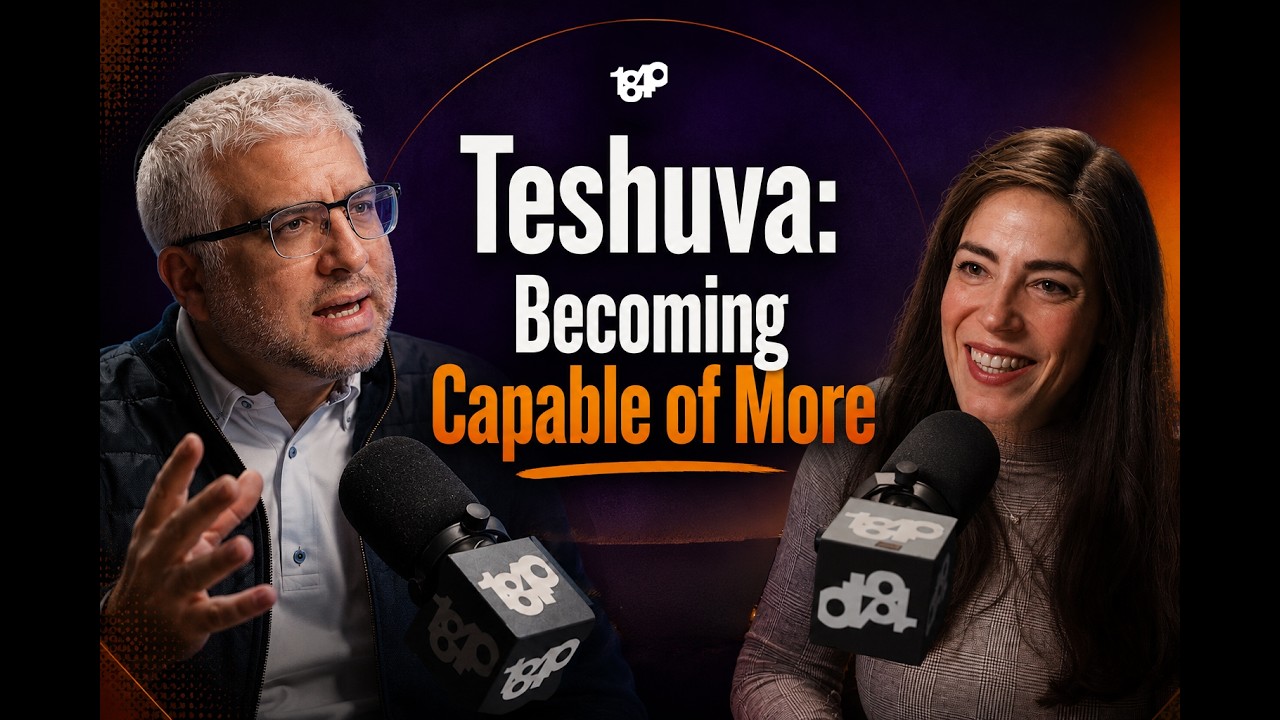
David Bashevkin: Hi friends, and welcome to 18Forty, where each month we explore a different topic, balancing modern sensibilities with traditional sensitivities to give you new approaches to timeless Jewish ideas. I’m your host, Dovid Bashevkin, and today we are continuing our exploration of teshuvah. And thank you so much to our annual sponsors, Danil and Mira Stokar. I am so grateful for your friendship and support over all these years.
This podcast is part of a larger exploration of those big, juicy Jewish ideas, so be sure to check out 18forty.org, that’s 18 f-o-r-t-y dot org, where you can also find videos, articles, recommended readings, and weekly emails. Before we get to today’s conversation, I wanted to call your attention to something that 18Forty published in partnership with the students of Rabbi David Ebner. We published a very brief collection, you can see it over here if you’re watching on the video, it is called The Dance of Teshuvah. I could hold that up.
Rabbi David Ebner, who I never had the privilege to meet, was an incredible educator, he was an incredible writer and thinker, and we collected some of his essays and poetry related to teshuvah into a small collection that we sent out, but is also available online at 18forty.org, 18 f-o-r-t-y dot org, our website, for a free download. We sent this out really to all of our supporters over the years. If you sent in, you know, whatever it is, we sent out the a hard copy. It is so incredibly beautiful and relates in so many ways to the work of 18Forty.
It has so many stories from the great Chasidic leaders. Those who have been listening for a while know that 18Forty is named after, in many ways, the Chasidic revolution that began in that year on Simchas Torah from the world of Izhbitz, that there was a Chasidic community that finally broke off and started on, in the year, you know, 1840, 1841, on Simchas Torah, that is the school, the Chasidic school of Izhbitz. Their approach to Jewish life, their approach to Jewish thinking, is captured so beautifully through stories, through the Torah in this collection of the Torah of Rabbi David Ebner that we have entitled The Dance of Teshuvah. I would encourage all of our listeners, if you’re looking for something to read, something to accompany, to enhance your High Holidays, to enhance your own prayers and experience on Yamim Noraim, the High Holidays, please take a look, go online to 18forty.org, you can download this incredible reader.
It is really a privilege that that we are welcomed into people’s lives specifically around this time of year in conversations about teshuvah, about religious transformation, religious change. It is a special privilege to be welcomed into people’s lives, and that’s why I thought it would be so appropriate to partner with the students of Rabbi David Ebner, zichrono livrachah, to to share his poetry, his words on teshuvah. Go online, 18forty.org, The Dance of Teshuvah is available now. And that really is the perfect introduction for today’s conversation, which is it is honest and it is raw.
I have been watching Rabbi YY Jacobson for some time. His Torah, his ideas, have animated so much of my own life. But recently, if you pay close attention, I’ve been noticing he’s been sharing differently, and really sharing more of himself in a very different way with a tremendous amount of vulnerability. And what I wanted to explore with him, and what we explore in today’s conversation, is what’s going on behind the scenes? Why has there been a a shift in just the way he approaches and shares Torah? This is a very honest conversation about teshuvah, not teshuvah for them, but teshuvah that that us, people who are sharing publicly, who I mean, he has an extraordinarily an extraordinary following, and and what is the purpose of why we share this way? What is the nature and the Torah approach to vulnerability? What are we trying to achieve with our own teshuvah? It is my absolute privilege and pleasure to introduce our conversation with Rabbi YY.
YY Jacobson: Have value, do you like me, am I doing well, am I successful?
Even in a religious context: am I learning well, am I doing mitzvos, am I an observant Jew, am I a talmid chacham, am I a gadol hador, am I a good guy? Am I—does my wife like me? The best guy. The best guy, almost the best guy, at least second, you know? Am I going to get the trophy? And, listen, all that is the trauma of existence, where my ego hijacks my soul. And suddenly I become an existence, and I may live my entire life in that bubble like a chicken in an egg and not even know anything else. Teshuvah is the posture of a soul that experiences that pain, and it’s homesick.
It’s homesick to experience ego death and to be subsumed in infinity. Of course, if I have sins and transgressions, I want to get rid of them because that’s like the stain that simply blocks the ability to experience my intimacy with Hashem. That’s the outer layer of teshuvah. But the inner layer of teshuvah is the awareness of the pain of separateness.
And that pain of separateness is at the core of all of our anxiety. Deeper than all the anxiety is the anxiety of me thinking that I need an ego to exist. The burden of me having to exist outside of infinity is the most painful thing for the soul, because it’s really completely one with Hashem. And yet, He sent me here.
So it’s not a mistake. This is my mission. So teshuvah is the dual recognition of, number one, there’s a deep pain, and the pain is not because I’m a bad guy or because I have psychological problems. On the contrary, the more sensitive and spiritual you are, the more anxiety you’re going to have of this level, because you’re more aware of how homesick you are.
You’re aware that there’s something unnatural in the very definition of existence. Bittul, being in flow, alignment, is surrendering that, letting go, seeing it, and then saying, “And now I could choose, once again, connection, surrender, love, trust, transcendence.” And that’s that’s teshuvah.
David Bashevkin: I want to build on that and and push a little bit further and talk specifically about teshuvah in adulthood, of what what that process feels like. One thing that I find really interesting, ’cause I listen to quite a bit of your classes and conversations, is recently—and I don’t know if this was a deliberate choice or this was a strategy or something that you saw was very desperately needed in this moment in this generation—is that you started talking more about your own transformation later in life, talking about waking up and like re- re-sanctifying the holiest, most intimate parts of your life: family, children.
And and and that’s really what spurred my opening question, which is trying to understand, how is it that somebody like yourself, who I assume was the best guy in yeshiva, or second to the best, third to the best, but you you you were of you had all of the pedigree and everything, and you you were seen and appointed and were rewarded for your excellence, and then you step out and you start building an individual life where in your home you have a wife, you have children, and you started talking about how a transformation later in life of, what, waking up. And my first question I wanted to really understand about this is why did you choose to start talking about this publicly? Why did you choose to share this in this moment right now? I’m sure these are things that you’ve been grappling with for some time. Why did you choose to start talking about it now? Wow. Very—
YY Jacobson: Deep question.
There’s probably many layers here, and I’m not even sure I’m conscious of all the layers. I hope with time I’ll become conscious of more layers. But I think at least one very important truth about this is as follows: I grew up in a home and in a community which was extremely intellectually stimulating. I was very into learning.
I think I was a pretty decent student in yeshiva. With God’s grace, I did well. I even had the privilege in my young years as a yeshiva boy—it was the last years of the Lubavitcher Rebbe’s life—to join the team of chozrim, oral scribes of the Rebbe, which was an extraordinary privilege, and also profound responsibility, and also extremely challenging and difficult simply from an intellectual perspective, to memorize hours of the Rebbe’s talks and then transcribe them and be on that team. So it was really a blessed, blessed opportunity, but quite stressful for a young yeshiva boy.
My motzei Shabbos could not be as fun and as exciting as a lot of my classmates and friends, and I was a little jealous of them. But I but I understood the privilege and the zechus and also the achrayus, the responsi- Responsibility. And generally, you know, I learned a lot, I excelled, and I did well, thank God I did well. I also, you know, built it into a career that was successful, impacting people, inspiring people, lecturing all over the world, visiting hundreds of communities, Chabad centers, shuls, universities, botei medrash, yeshivas, schools, seminaries, etc., non-Jewish centers, which was all a great privilege and I’m very grateful for it.
As I was growing later in my life, I still felt there was something that was intangible, but I was feeling my anxiety more and more, acute anxiety. And I always had anxiety. At a young age, I started to pull out my hair, at a very young age. In those days, nobody sent you to therapy.
Therapy was not part of the cosmic Jewish… Today, if you don’t have a therapist, you’re meshugah, okay? What’s wrong with you? You know what I mean? But then if you had a therapist, you, in therapy, you were really, you know. So it wasn’t part of the equation, but I was pulling out my hair. And I had different internal challenges, but I overcame them because I did well and I was successful and I proved myself to myself and I proved myself to the world.
But then as you get older, I guess layers start being removed. Especially, I was struggling in my marriage, I was struggling with my children, my children were struggling. And Hashem has blessed me with a partner, with a spouse who was not very impressed with my external accomplishments. It was hard for me because I could go out to the world, get a standing ovation after a speech to 5,000 people, and yet in my home base, my wife was not impressed by that.
I remember I was once featured on the front page of a distinguished magazine, and from my perspective, it was an accomplishment, it was a great accomplishment, and I saw that my wife was unhappy. In retrospect, it was God’s greatest gift because what she was really telling me, not through these words, what she was really telling me is, “I see in you something that you don’t see yet. There’s a greatness inside of you that you don’t know yet.” And I was feeling pain, I was feeling anxiety, and something was not adding up, something was not adding up. And I began a journey of deep, deep emotional and spiritual work, a very, very deep journey, which came with a lot of blood, sweat, tears, and pain.
And I ultimately discovered that my heart space was blocked. I was a, I was really, really shut down. I was shut down, but it was so sly and clever because I could talk about emotions better than most people. My lectures can describe trauma, can describe people shutting down.
And the reason is because I got it. Somehow, I understood it. I understood it intellectually. I had the empathy to articulate it.
But internally, I did not have the courage to experience it. It turns out that because of my sensitive heart, at some point, a lot of it shut down. And I was operating from a brain space, which was very successful, because I was like AI. AI is very, very good.
You know, gets all the information, processes it, knows how to say it better than most people, articulates it. The only thing that AI lacks is a soul, there’s no neshamah. You can’t get married to AI. You can’t have an intimate relationship.
And that’s what, that was my story. And when I started to explore it, it was very, very painful. I had to go back to the rupture. I had to go back to the breaking points.
There’s a reason I disassociated. There was a reason my heart shut down. There was a reason my brain said, “I’ll take over. I’ll take over your life.
It will be much more successful, it will be less messy, you won’t have to deal with the the intensity of real emotional experience.” And it’s still something I struggle with. It’s something I struggle with. I was reading, I used to, I would learn a lot, and I I saw the beauty of Yiddishkeit, the depth of Kabbalah, Chassidus, of course Gemara, Halachah. But there was an emotional component that simply was was missing, it was missing.
And I didn’t even know it. That’s how funny it was. I didn’t know it because my brain really compensated for it. And I thought that to be inspired means you intellectually understand something.
You get it, that’s what inspiration is. As I disintegrated, with the help of my wife and my children, and a good support system, and a lot of inner work, and a lot of healing work, I started to feel more of my heart space. And then I realized something. I realized that I wasn’t the only one.
I realized that this is probably one of the greatest challenges of our generation. We have been incredible at survival. We have been incredible at intellectual achievement and accomplishment. We’ve been incredible at creating, as you said, institutions and infrastructures that facilitate tradition and commitment and learning and scholarship, and also stories and inspiration, and and chesed and kindness, and so forth.
But I suddenly realized that the embodied experience of the Divine in my nervous system and in my in my body was virtually nonexistent. It was completely relegated to the sub-subconscious. As I started to experience all these things more, my heart started to open up more.
I went back to some of the greatest Chassidic works of the Alter Rebbe, Rabbi Schneur Zalman of Liadi, Torah Ohr, Likkutei Torah, his Tanya, his discourses. And I remember one morning I was reading it, and I started to cry, because I realized he was articulating, in words, the vision of the other side, of the space in which the heart actually channels the frequency of the Divine. And I realized this was the whole secret of Yiddishkeit that I never knew about! I knew about it intellectually, but what is it to actually embody the reality of Hashem, not in my brain, not in mathematics, not in a Gemara, not in a Kabbalah, not in Chassidus, not in philosophy, not in mussar, not in machshavah, but actually in my nervous system, in my in my physical, visceral experience. “Mibsari echezeh Eloka,” he says, “From my flesh I shall experience Hashem.” And I realized that that that that’s it! The trauma of galus is the trauma, not just of geographical exile, I think much more of emotional exile.
“Karvah el nafshi go’alah,” the Baal Shem Tov says, redemption is in the soul. And when I started to experience it, I realized, this is what I this is what I want to teach, this is what I want to channel, this is what I was looking for my whole life. This is the only thing that’s going to heal my anxiety, my disassociation. My soul is searching for truth, for authenticity, for a living experience of the Divine in which there’s no ego, in which I don’t have to be defensive anymore, in which criticism is not suicide, in which an intimate, vulnerable, authentic relationship is actually the deepest and most blissful experience, in which I don’t have to live anymore for validation of others, even for self-validation, in which I could let go of all forms of self-consciousness, and the deeper I can go into a real, authentic ego death and just be a channel for the Ein Sof, for the Infinite, I can actually start breathing and living and be present in life.
But all of my protectors were going crazy, and with a vengeance! They would they they still do, they constantly come back to monitor, to criticize, to make me better, to make sure that I’m impressive, to make sure that I’m safe, I’m successful. And it’s it’s it’s literally a daily choice of leaning into the frequency of trust and surrender and love and faith and transcendence. These are higher frequencies, they’re not easy, they’re not low-hanging fruits. Guilt, shame, anxiety, need for validation, success, these are low-hanging fruits.
They’re very easy to get: jealousy, resentment, comparing myself to others, do you like me, do you not like me. The higher frequencies that are available are surrender, love, faith, bliss, transcendence. They do require the ego to dissolve, at least dissolve somewhat. And once I started to teach like this, I realized I’m not going to be teaching this I’m not going to be authentic.
Maybe I can give a beautiful speech. Somebody close to me called me one day and said, “Your old speeches were much better! Your old speeches were much better!” Those were their words. Would’ve given me I’m like—
David Bashevkin: “Why?” I would’ve called Hatzalah on the spot.
YY Jacobson: I’m like, I’m like, “Why?” And the person said, “You used to speak about ideas, and nobody was as good as you.
When you spoke about the Rambam, you allowed people to understand who the Rambam was. When you spoke about the Baal Shem Tov, the Alter Rebbe, the Rebbe, people And now, you’re talking about yourself! What happened to you? You became, from a large person, you became a small person.” And I was like, “Wow. Wow.” And I I I I had to feel into that, and then I had to ask myself, “Is that true?” And then I realized, no. What happened was, I’m trying to teach much more from a heart space.
I’m trying to teach viscerally. It doesn’t always work. My my mind sometimes takes over, and I go back into that space. But to really experience the fusion, that’s my own teshuvah.
And it’s a daily teshuvah, it’s a daily avodah. It’s it’s it’s something that my coping mechanisms, my survival instincts have a very hard time with it, because I have developed pretty effective coping mechanisms. And they were not sinister, they were not evil, they were not abusing people, I was not a perpetrator of any form. They were doing good things: I was teaching, I was speaking, I was inspiring people.
I even said a lot of good things, I think, I hope! But I realized that I was cut off from myself. There were certain wires that have been severed very early on in my system, and I did not know that. I simply did not know that. And when they started to rewire, and Still working on rewiring, that’s my own teshuvah, that’s my own process of daily teshuvah.
Rosh Hashanah, Yom Kippur, and throughout the whole year, even on Purim I got to do teshuvah, in the middle of Pesach, in the middle of Lag BaOmer. There’s simply nothing close to it. I remember one of my mentors told me, and it was it was such a powerful moment, he said to me, he said, you know, YY, Yosef Yitzchak is my full name, he said, you know, even if you put up your videos on YouTube, and you don’t have 100,000 views or 50,000 views or a million views, you’ll have seven billion views, all of humanity, from President Trump to the president of North Korea will be watching your videos. In other words, you’ll reach success that your ego will have to say, “Amazing! Amazing! I affected the whole world.
Seven billion people are watching and being inspired and sharing it. Like, what else?” And your ego is actually, “Wow!” Said, “I want to tell you, even if that happens, you haven’t even scratched the surface of your true greatness, because your true greatness is your infinity, you’re channeling Hashem’s infinity.” And I got it. Trauma is really reducing ourselves to such smallness. The litmus test of my success is if a million people or 10 million people or 100 million people or 10 people or my wife and kids and my beis medrash, my shul, my colleagues, my comrades, whatever it is, like me.
And that means that I’m actually a pathetic, insignificant reality, and that’s the core of the anxiety. That is the core of the anxiety. And paradoxically, it’s in the death of all of that, it’s in the death of all of that, that I, we, can actually begin to breathe. And I still have a hard time articulating it because it’s still a shock for my ego brain.
For my egoic mind, this is still a shock. Like, “What are you doing now? What are you doing? Why are you being so vulnera- Why are you being vulnerable? What are you doing? Like you had a good life, you weren’t a shmatte, shlimazel, nebich, a homeless beggar, impoverished and destroyed. Like what are you trying to do?” But yet I know that it’s in the heartbeat of my authenticity, where I can find some truth, some peace, and that’s what that’s what I want to channel.
David Bashevkin: So I I want to ask you, because when I was listening to you, you know, I I want to be very careful, I don’t compare at all.
I’m, I’m, in every metric, I am a much smaller, less influential person than you. And yet, I feel like I experienced something around three years ago. It’s very interesting because you mentioned, you were talk- I’ve always been talking about mental health. I did a series on mental health on 18Forty, right before Pesach, three years ago.
And what was so strange is that for the for, not for the first time, but of the most significant episodes I’ve ever had, I I suffered afterwards like what I would call an actual nervous breakdown. Like I I couldn’t get out of bed. I couldn’t move. Like I felt like that the way I described it was like I I felt like the the floors kept on caving in.
Like I was on like a 50-story building, and I and it was genuinely frightening. I had to relearn how to exist in the world. I had to relearn literally like my wife, my children, like I had to restart from scratch. But something I’m still genuinely struggling with is we’re both in this place of like of of being out there, of of trying to influence, and and and loving that and and enjoying that responsibility and that commitment.
And I still struggle to this day with what you said, looking at the at the numbers, at the views. 18Forty is not the TheYeshiva.net, even though, you know, like it’s not, it’s not. We don’t have the reach that you do, and I sometimes, I look at the other podcasts, the other people, and and it I know it’s not healthy, and I know it’s not it’s not going to get you anywhere, but you can feel the sting—
YY Jacobson: Of—
David Bashevkin: Of compari- And I I wonder for you, did you did you let go? Do do you look at the stats on your YouTube videos? Does it does it do you still notice what hits and what doesn’t hit? Is it that you stopped noticing and looking, or that the noticing and the looking is done in a healthy, more trustful context? Beautiful question.
YY Jacobson: And there was a moment when I said, “Hashem, you know, if you really want me to delete every single video of mine on YouTube, on TheYeshiva.net, every Instagram, every message, every clip, bal yera’eh, bal yimatzei, I’ll become like chametz on Pesach.
Bal yera’eh, not a clip, not an audio, gornisht, gornit, not in writing, not in saying, that’s what you want? Hineni. Hineni.” It was such a comforting feeling. It was such a liberating feeling. So what I’m going to tell you honestly is, I try to lean into that posture.
I can’t always. I have the other parts. I want to know what’s going on, I get stressed, I get overwhelmed. But because I have a reference point of the other side, of the vocabulary of an authentic soul, I think it just dictates my life much less.
I don’t worship it in the same way. It used to be when I finished a speech or a shiur, my trauma, I should say, craved feedback. I needed people to tell me how amazing it was for me to feel like I’m a good guy. And the more I yearned for it, the more the yearning increased, as the Gemara says, eiver echad yesh ba’adam, the more you satiate it, the more hungry it was.
And it could never be enough. And if I got one criticism, it canceled out all the praise. And the reason of course was because the void was internal. The void was I didn’t like myself.
So the more people can tell me that they like me and I changed their life, the more I could start believing that I’m liking myself. But it’s all fake, fraud, phony, because inner self-love could never come from the outside. And if there’s a million people telling me they like me, it just makes me hate myself more, because I realize how desperate I am. And even with a million people, it’s now a million people telling me how lonely I am, which is why celebrities are more depressed than everybody else.
Yeah. So a poshete guy, there’s two people who tell me that I’m a nobody. But if I’m a choshuve guy, there’s two million people telling me every day that I don’t exist! Wow. That’s hard to deal with.
10 million people telling you every day you don’t exist? That’s tough. That’s tough. And then I realized it’s simply because I am not in touch with my heart space. I am not in touch with my soul.
The moment I had even 30 seconds of an embodied experience of what does it mean to feel Hashem‘s infinity in my nervous system, and at that moment, I don’t need an ego ever again. I don’t need anybody giving me attention. I’m literally channeling infinity. I remember somebody once told me, a therapist once told me, a very profound person, person said, “Feeling your own spiritual energy is infinitely more valuable than getting feedback from 1 million people.” And I know how true it is.
If I’m giving a shiur, a class, a lecture, and I’m in touch with my own spiritual energy, which means with the divine flow coming through me, I’m just a channel for the divine flow, that will be infinitely more satisfactory emotionally, psychologically, spiritually, than being disassociated and having a million people giving me a standing ovation for 20 minutes, and telling me I changed their life for eternity and I’m the greatest gift to humanity since I don’t know who. That’s great. It’s great for three and a half minutes. I saw when I came home from a lecture, I got a standing ovation, then I was eating uninhibitedly.
Why am I eating? I was numbing the pain of loneliness. And in the good Jewish way, the great numbers is, you know, I wasn’t addicted to terrible things, I was addicted to food. You know, a chocolate Danish doesn’t seem to be harming the world, but it was simply numbing my soul. How do I know? Because I finished the Danish, and then I went for a second Danish, and then I needed some sushi, and then I What What was happening? I was hungry like you’re a frog.
Yeah. I wasn’t hungry, I was hungry for, for love, I was hungry for connection, I was hungry for authentic attachment. And I still feel it. I come home after an intense lecture, and my coping mechanisms say, “It’s time to eat, time to eat.” Because they’re experiencing again this anxiety that I need to numb, numb, numb, numb.
And some of our numbers are intellectually rewarding. Some of us numb ourselves through religion. Some of our self, some are, some of us numb ourselves through Yiddishkeit. Some of us numb ourselves through worshiping God, but I’m worshiping a god that’s simply numbing me from my own trauma.
So as the Berditchever, as the Berditchever told the atheist, you know, the god you don’t exist, you don’t believe in, I also don’t believe in. You know, the god that’s here to simply allow myself to numb myself, because to say, “I have this also,” it’s it’s it’s it has nothing to do I realize it has nothing to do with the real experience of Hashem. And then I started to be so grateful to people like the Baal Shem Tov and the Alter Rebbe, the Baal HaTanya, and I realized what they were doing. What really happened was that the trauma and the suffering of exile caused so many of us to disassociate from an embodied experience.
It’s very hard to remain present with your nervous system with so much persecution and pain. It’s very difficult. You can’t You can’t blame anybody. You can’t judge anybody.
You know, we have thousands of years of faith and of suffering in our genes. And the Baal Shem Tov, who was an orphan, was thrown out of the system, who didn’t make it in any school or yeshiva, who hung out in the forests, in that vacuum, he could hear the voice that Avraham Avinu heard, that Moshe Rabbeinu heard, the original voice of experiencing the Divine. Hashem Elokeinu, He’s my consciousness, He’s in my nervous system. And it was breathtaking, because I realize that’s where all bliss exists.
That’s the only place it exists. It doesn’t exist anywhere else. There’s no attachment outside of that attachment. Once I’m present in that attachment, I could be attached to myself, I could be attached to others.
So—
David Bashevkin: I want to ask you about the context in which a lot of your vulnerability, but that’s not even the right word, a lot of your insight emerges, and it’s a place that actually I feel extraordinarily close to, even though I’ve only gone once, and it is in the organization that is called Kesher Nafshi. Want to talk about that for a moment. Kesher Nafshi, which, you know, it’s mostly for more Chassidishe clientele, more heimishe clientele, but it is an organization that’s dedicated to coaching and mentoring parents who have children who are struggling in in a whole variety of ways, and how to keep that family unit intact. And I notice that you go, you speak there a lot, you’re very drawn.
In almost the founding of 18Forty, we put that at the center. Every year before Pesach, we do conversations, parents and children. We call it Intergenerational Divergence. And there was something about the family unit and the struggles within the family unit that I found were like literally like a like almost standing at Har Sinai.
You’re getting a new revelation that you didn’t get when you were in yeshiva. When you really start to grapple with the immediate family unit, all the broken And every family has their own, you know, what what I think is the line from Dostoevsky, all happy families are alike, and all unhappy families are unhappy in their own unique way. What do you think is unique about the religious revelation that comes in the context of families struggling with their own children? You go into that room, and I’ve been there, you see chevra, shtreimels, bekishes, people learning, they’re doing Dirshu, they’re doing Daf Yomi, they’re they’re really like at the highest level, and yet they all have this very similar struggle where their their children are not in the image that they wanted. Yeah.
And I I look at that as I I’ve I’ve said it many times, it’s the holy of holies, it’s the Kodesh Hakodashim. But what I’m trying to understand is what is unique about the revelation that comes in the context Why why is the revelation so different when it comes in the context of spouse and children than it does in the context This is really my my opening question. Than it does in in yeshiva? Yeah. You had an audience with the Rebbe.
You you had there’s there’s nothing more supernal of a revelation in the last hundred years than to stand eye-to-eye with the Lubavitcher Rebbe. And yet, there was a revelation that you were only able to receive in the context of familial struggle. Yeah. The most like getting seeing spouses seeing each other, children, adjusting expect—why is it—
YY Jacobson: I learned that I could not live vicariously off the Lubavitcher Rebbe.
It’s a very deep and profound and acute truth, and that is sometimes you can encounter very, very great souls, and that too can be a crutch that allows you to avoid confronting your own pain, your own soul. You see such holiness, you see such greatness, and you almost live off it. But she’ol, our word for the abyss, is the same letters like the word sho’el, borrowing spirituality from somebody else. That’s what it means to live in the abyss.
David Bashevkin: That’s a Wow. I’ve never heard that Torah before. That’s the The abyss, the language we use, which appears throughout the liturgy, is she’ol, the the lowest level, and that’s the language of borrowing. Sha’ul.
Borrowing. Yeah. Where it’s not really yours.
YY Jacobson: It’s not yours.
I’m borrowing energy. I’m borrowing your wisdom, your energy, your heart, and it’s nice, it’s beautiful, because I could transmit it, but it’s borrowed energy, it’s not authentic. It’s because I don’t believe that God wants me. I don’t believe that I am the greatest thing that ever happened to Hashem.
Or as our Sages put it in Sanhedrin, Bishvili nivra ha’olam. I don’t believe it. I may believe it intellectually, I may give a thousand lectures about it, I’m good with this topic: believe in yourself, Tzidkas HaTzaddik, os kuf-daled, Yeah, I was going to quote that. kshem she’adam tzarich leha’amin baHashem Yisbarach, achar kach tzarich leha’amin be’atzmo.
I’m good at it, I did it. And it’s helpful, it’s a good it’s a good message, it’s a good message, but viscerally, my nervous system got another message. There’s a lot of guilt, there’s a lot of shame. I realized that at a core, this is hard to say, but it’s true, I realized that I have an existential shame at my core.
There was an unconscious fear that if people would really know me, not my oratory skills, not my charisma, not even that I’m a nice guy, because I think I’m a pretty nice guy, but they would know my core, my real, real core, they would not like look at me again. They certainly wouldn’t be my friend. I would not look at me again. So I couldn’t even know about that part.
I’m going to show it to you? And imagine that much of my life is dedicated to avoid confronting that part. So I’m like standing at the edge of a cliff, and my entire life is invested making sure that nobody sees the cliff, and I don’t even see the cliff. Which means I can only be facing in one direction my whole life. I don’t have the freedom to see reality, ’cause I’m going to see reality.
Until I was not ready to face that, and it’s daily work, I couldn’t even begin to integrate all of my parts. So, I think, you know, as as I developed and as I grew up, I had to go back into me. Where this Where did this all land inside of me? And I realized I couldn’t even see the Rebbe until I did not see myself. Because I don’t think we can really see the core of another human being if we haven’t seen ourselves.
All I will see in you is how you make me feel better. All I would see in you is the part of you that works for my survival system. And I could do that with a big tzaddik, too. I think it’s true that all great people in history, real great people in history, had at least one person who saw them.
They really, really saw them. Seeing them not their talents or their gifts or their resources, seeing them at their core in the most regulated way. Almost like a regulated mother who’s looking at her infant and sees the infant at its core. Not what you need to do for me, not what you’re going to be, not what I hope for you, but actually, the you that heaven conceived of when heaven conceived you into existence.
What that you looks like. I was always moved, the previous Lubavitcher Rebbe describes the meeting between the Alter Rebbe, Rabbi Shneur Zalman of Liadi, and his teacher, the Maggid of Mezeritch. And when he came to him, he told him a few words. He said, “The Baal Shem Tov told me that a neshamah chadashah, a soul,” it’s very emotional, “a soul that was never here yet, because most souls are reincarnated, is going to come down into the world, is going to pave a new path, revealing the infinite depth of Yiddishkeit, and he’s going to have incredible, incredible adversaries, very significant ones, who are going to try to cut him down, but he will prevail.” And he turns to the Alter Rebbe, and he says, “That’s you.” Imagine that gift.
Because when he was being persecuted by some of the great contemporaries of his day, and he was a humble man, you start doubting yourself. You feel like, “Maybe I am a weirdo. Maybe I am distorting Yiddishkeit.” Right? And you’re talking about one of the biggest geniuses. The Shulchan Aruch HaRav is a master work of ga’onus.
Like, but he had one person who saw him. The Maggid says, “I see you. I know you. You don’t have to doubt yourself.” If I never had one person to see me, I’ll never see myself.
I’ll doubt myself. Once I have one person to see me, I could see me, and then I could see others. So, till I cannot see me, I couldn’t even see the Baal Shem Tov. I couldn’t see the Alter Rebbe.
I couldn’t see the Rebbe. Because it’s only in meeting, you’re Somebody once asked me, was the Five Towns, and Yaakov Langer did this public podcast with me, with the audience. And I remember at the end, you know, he throws these surprise questions like you do, “What time do you go to sleep? What time do you wake up? What’s your favorite book? When do you go to the bathroom? How much cholent do you eat?” You know, all these questions to confuse brilliant experts who don’t remember how much cholent they eat on Shabbos. So he throws out a question, “If you could meet one person in history, who would it be?” And I remember I told him, “Myself.
I would love to meet myself. Because if I don’t meet myself, I won’t meet anybody in history. I’ll just meet my version of them.” And once you do meet yourself, you could meet every person in history, because in the core of energy, everything is there. You know, what did the poet say, “You’re not a drop in the ocean.
You’re the entire ocean in a drop.”
David Bashevkin: You’re—
YY Jacobson: The entire ocean in a drop. And if you’re the entire ocean in a drop, so then you meet the entire ocean. That that that’s what divine embodiment means: you meet the entire ocean. So, coming back to your original question, I think it’s our most intimate relationships, our wives and children, who don’t allow us to settle for our mediocrity.
What I find with the youth today is, and I describe it with the verse in the Song of Songs, “Kol dodi dofek: Pischi li, achosi, rayati, yonasi, samasi.” These are our spouses and children banging on the closed doors and the walls that have surrounded our hearts, called orlas halev, the foreskin of the heart. Dofek there. Pischi li. Tatty, Mommy, I want to feel your heart space.
Can you open up your heart? Can you open up your heart? In yeshiva nobody challenges me that way. In my community, often people don’t challenge you that way. Certainly around the world, world, and among fans or likes, they don’t say that. They’re like, “You’re amazing, Rabbi YY! That was life-changing! I’m never going to have the same Yom Kippur in my life! Incredible! Amazing! You’re a gift!” Shoyn.
But my children were struggling. My marriage was struggling. And they weren’t impressed with Friday night speeches by Rabbi YY. They didn’t care for it.
It didn’t mean anything to them. They were looking for something else. What they were looking was, pischi li. “I want your heart space.
I want your your your embodied, embodied heart space, not philosophy, not ideas, I want to feel you. I want to feel your etzem, your your core.” That’s what real, real attachment is. I didn’t know about that. I didn’t know it existed.
I didn’t know it existed. And I think a lot of us in Kesher Nafshi began to learn that. And there were two stages. Stage number one was realizing not to take it personally.
Your child is struggling because your child is struggling, not because you’re a failure and a horrible parent. And if you don’t give me nachas, I am a miserable failure, because then we can’t be here for our children, because we’re busy getting angry at them for not living up to our expectations, and not getting the shidduch we wanted, the yeshiva, the seminary of fiddledis. So that’s number one. That’s step one and it’s an important step.
Can you recognize your child’s pain? Can you see your child? Can you separate, cut the umbilical cord, and just be there for them, with attachment, with love, allow their healing process? That’s step one. Step two is harder and deeper. Step two is, what if actually much of the pain of my child is a response to my own unresolved wounds? What if my children are mirroring for me the fragmented parts of my personality that I never made peace with? What if the pain of my children is really a gift to reflect back to me where I have disassociated, and they’re just, as good children, they’re bringing it out to the fore? You know, like somebody once said, what’s this weird custom that we hide the afikoman, and then our children are the ones who find it, the ones who expose it, the ones who return it, and then they want a prize? And then somebody once said, a gevaldike vort. He said, there’s a profound message here, exactly on the night of liberation.
And that is, we hide a lot of parts of our life, especially our broken matzos. Our broken matzos we put into pillowcases and under couches and in drawers, and we cover it up, and we hide it very, very well, sometimes for generations. And whatever we hide, our children are going to reveal. They’re going to find it, and they’re going to show it back to us.
And then you could do one of two things. You could scream at them. You could disassociate from them. You could explain to them how much chutzpah they have, and how you would have never done this to your parents, and how ungrateful they are, and they are an entitled, despicable, bratty, self-centered, narcissistic generation, addicted to internet and technology, how dare they reveal this, and they’re rebelling against the mesorah, and they’re destroying 3,000 years of Yiddishkeit.
Take a deep breath. Look your child in the eyes. Thank him or her for the afikoman, because only when you take it, and you internalize it, can you together finish the Seder and say, Leshana haba’ah biYerushalayim? Can you actually set yourself free? And that is, I think, what we are really, really seeing. Our youth today are very, very sensitive.
They are picking up, you know how in the 1960s they finally could pick up the sound of the Big Bang and authenticated it? And I say our youth today is detecting the sound of the tzimtzum. The original Big Bang is the tzimtzum, the Lurianic Kabbalistic tzimtzum upon which much of Kabbalah, Chassidus are based on. The sound of the The sound of the tzimtzum.
David Bashevkin: The contraction—the contraction—the absence—the—
YY Jacobson: Absence of infinity, which allows existence to emerge, feeling that it’s separate from the divine embrace and love, and therefore, creating anxiety at the core of our DNA, because existence knows deep down that it’s based on a lie.
It’s based on concealment. And the tzimtzum, as the great chassidic masters would say, is shelo kipshuto, meaning it’s not a real absence. It’s the divine allowing you to emerge as an independent person who will choose trust. You have to choose it because it’s it’s coming from your your space, and I think they’re all picking up on it.
Can you hear that this is what they’re hearing? And if this is what they’re hearing, don’t throw them back into the tzimtzum. Don’t just beat them into compliance and pressure them just to follow you, because then you’re crippling yourself and they don’t buy it. There’s a much deeper response. And the deeper response is, can I find my heart space? Can I hear the pain of the tzimtzum in my life and let go, not intellectually—I did this intellectually for many years.
I got it figured out—viscerally? It’s very vulnerable. It’s extremely visceral. It’s your children feeling the authenticity of your own relationship with God. It’s them feeling that you act- actually don’t need them to have a very deep relationship with yourself and God, because they will not compensate for the attachment that you’re searching for.
And once you can meet it, it’s fascinating how it shifts. It’s fascinating. I saw it in my own family.
David Bashevkin: One thing that I want to ask, and this is in many ways the inverse of the question of like looking at the views on on YouTube, but something that I have have struggled with and you alluded to, and it and it may be a very almost an identical it’s an inverted question, but I I want to talk a little bit about how this awakening allowed you to deal with criticism.
And specifically, I’m coming from a a very real place. For whatever reason, at different points in 18Forty, as we’ve come up, we’ve hit some real bumps in the road where people who listen to us either get very worked up and upset and they’ll you know, we have a community where people can be very zealous, and they’re going to try to shut you down and say this and this, and they’ll really like there was a point this year where like I felt there was somebody who was really rodef me, like genuinely like sending out emails to other people, maybe you got email, and and and and genuinely trying to shmutz me up and get me dragged down. And initially, they were gevaldik successful. And not in the outside, in me.
They shut me down, because I have a lot of doubt. I I I don’t always know that I’m right. I try to share what I think is authentic and true. I try to have rabbeim who I ask, and we every episode that we release is is always listened by another set of ears.
And even with all that, one person gets upset and they try to make a ra’ash and they go around, and you feel so isolated, betrayed. Yeah, betrayed, yeah. You’re you’re waiting for everybody, you’re waiting for rabbonim to get up and klap and say, “Leave Bashevkin alone, he’s gevaldik, he’s a gem that we want.” And I see I want people to say something like, what it’s a ridiculous expectation. What are they No one’s laying down on the tracks for me.
I I wanted to know, you’ve also, maybe in a different and and most of these things, people who follow me, they probably have no clue that there’s one guy, but when you’re in it, it’s your whole life. All it takes is one self-righteous person, and they usually have their own and they always have their own issues, their own brokenness, but it’s still it still can shut you down. And I’m curious for you how, not the positivity, but how did you learn to really tame or grapple with vocal negativity directed at you? And I don’t even need to take I’m not even going to ask whether whether you have any, ’cause my assumption is you are out there enough in the world that there’s somebody who really does not like you and makes it an effort, makes an effort to let everybody know and try to And how do you deal with that negativity? Yeah. Yeah.
Such—
YY Jacobson: An important question. So here too, I have been working on evolving. Evolution. I used to crave compliments and loathe criticism.
In retrospect, I understand why. The compliments made me believe I exist, they made me believe I’m a good guy, I’m valuable. They avoided the need for me to see the cliff and face the shame. And they created an external facade that made me feel good for six minutes, hoping for the next compliment six minutes later.
And it was very, very difficult. It was difficult because the compliments and the criticism were literally operating on the same frequency. They were doing the same thing. They were talking to a shell of me.
They weren’t talking to me. The compliments weren’t talking to me, the criticism wasn’t talking to me. They were both dealing with a shell. And the shell didn’t really exist.
So it was being created by a compliment and being destroyed by a insult or by a criticism. It’s a very torturous way to live. What I realized was that the compliments were as torturous as the criticism, because the compliments verified to me as much how much in how inauthentic I am, that I’m really a shell of myself. It’s a it’s a flimsy shell.
It’s a house built a palace built of cards, you know, kechalom ya’uf, as we say, ke’avak porei’ach vechachalom, literally a dream. And it comes and it goes. It’s one of the most beautiful Shlomo Maimon was a real apikoires. Grew up in a religious home, went to Germany, became friends with Mendelssohn, wrote a biography, went to the Ram, I mean he met the Maggid of Mezritch, and he hated he hated Chassidim, he hated, so that’s why you could trust the good things he says.
And he says that there were three Toros that he heard in the name of the Maggid, and they blew him away. In other words, even Shlomo Maimon had to concede, had to acquiesce to the to the richness of it. And one of the Toros, two of the Toros, that they’re they’re life-changing Toros when you can viscerally internalize them. And it’s fascinating that years later they found these Toros in manuscripts of the students of the Maggid, so it’s really incredible because the original source comes from Shlomo Maimon, not from Chassidic Chassidic texts.
One of the Toros is, one of my all-time favorites, Elisha is in has anxiety, he can’t prophesy, he says ve’atah kechu li menagen, Melachim Beis, vehayah kenagen hamenagen vatehi alav yad Hashem. As the musician begins to play, the hand of Hashem rests on Elisha. And the Maggid says, what’s vehayah kenagen hamenagen? It could have said vehayah keshenigen, kasher nigen, kasher hischil lenagen. And he says there’s a big difference between a musician, a musician, a vocalist, a rabbi, a cantor, a speaker, and the instrument itself.
The vocalist or the musician has self-consciousness. I come home and I say, did they like me? Why is somebody texting in the middle of my speech? Why did you just leave in the middle of this mesmerizing drasha? I’m self-conscious. You think they’re going to hire me next year? You think I can ask for more money? You think I’m really good? The violin doesn’t have self-consciousness. The violin doesn’t come home and say, you think I did a good job? I’m a Stradivarius.
You think they like me? The violin has no ego. Says the Maggid: Vehayah kenagen hamenagen. When the menagen becomes the niggun, becomes the, like the instrument of the song. In other words, no self-consciousness.
I’m just a violin. Lechol shirayich ani kinor. Reb Yehudah HaLevi says ani kinor leshirayich, right? I am a harp to your melodies, Yerushalayim. Vatehi alav yad Hashem.
Ego death. I’m not there, you’re in flow. That’s the Maggid. He says something else from the Maggid.
Says in Pirkei Avos: Yehi chevod chaveircha chaviv alecha keshelach. The honor of your friend should be as precious as your own honor. In other words, the way I respect myself, I should respect my friend. But the Maggid says, we would think in Pirkei Avos, you shouldn’t be so into giving honor to yourself.
And he says: Yehi chevod chaveircha chaviv alecha keshelach. The honor that you get from people should be as valuable as the honor and the accolades you give to yourself. Imagine I finish a speech, and nobody applauds me, so I go home and I give myself a standing ovation for 15 minutes, and I don’t know if to stop. It’s a joke, it’s a bluff, I know it’s worthless.
So he says, that’s exactly the value of chevod chaveircha, of the accolades that other people give you. The moment I could start internalizing this, I could let go of more and more and more. I would finish a speech in a shiur, and I was waiting for the feedback, and then I realized, I am actually stealing from God. I’m a ganav.
The Rebbe once said, the Lubavitcher Rebbe once said something beautiful, the Maharal points to it already in Pirkei Avos: Kol ha’omeir davar b’sheim omro meivi geulah la’olam. When you say something in the name of the one who said it, you bring redemption to the world. You know, when you’re paraphrasing, give credit, attribute it to the one who said it. Why do you bring redemption to the world? Oh, it’s a nice thing, it’s a nice thing, it’s copyright, don’t steal, that’s my Torah, say it, you say it in the right, in the person’s name.
The Rebbe said, kol ha’omeir davar b’sheim omro, right, Baruch she’amar vehayah ha’olam. Hashem is speaking the world into existence. Every davar, everything in the world is dibbur, it’s really God speaking it. Omeir davar b’sheim omro, when you identify in every davar the sheim omro, right, the One who says it, you’re channeling, meivi geulah la’olam, you redeem the world from olam, from he’elem, from the concealment, from the blockages.
So when I realized, when I finish a speech, if I’m looking for your validation or somebody else’s validation, what I’m really doing is I’m seeking to hijack something from Hashem. Somebody once wrote, creativity is eavesdropping on God. If this was a creative class, it’s simply because I was eavesdropping on the Creator. Creativity is from Creator, it’s creativity of the Creator.
So now you say, Rabbi, wow, it was the best class ever, it was life-changing, I never heard such a class, it changed my marriage. My coping mechanism wants to take that, own it, hijack it, and ask for a little more: Could you explain to me how it changed your life? And all I’m looking for is build up my ego more. What did I just do? I stole the energy that Hashem just channeled through me. I took it home, I own it as myself, and you know what the sad thing is? It’s never going to be enough.
In 10 minutes I’m miserable, because I’m building up a self that doesn’t exist. I am part of Ein Sof. Ein Od Milvado, there’s nothing outside of Him. I watch my coping mechanism, and I say, I know you want to be, I know you so hard want to be validated.
I’m here for you, and now give that up and just be a channel. It’s literally the avodah of surrendering the ego and the insecurity again, and again, and again. We call it bittul. Now when there’s criticism, I can go into the same posture.
It’s not always easy, I’m not going to say that it doesn’t occupy any space in me, but I have to ask one question, and that is, when I look in the mirror and I can see the innermost space of my heart, was this the right thing that I said, or the wrong thing that I said? And that counts billions of times more than any any compliment or any criticism. What does God think of Rabbi YY Jacobson’s shiur this morning, or lecture, speech? And if I find out that I made a mistake, and maybe I said something wrong, maybe I was insensitive, maybe I was disrespectful, maybe I exaggerated, maybe I dramatized, maybe I lied, maybe I said something wrong, maybe I was a little clueless, I can also turn to Him and say, I’m human, I have my traumas, what a good lesson, what a lesson, help me fix this for the future, and surrender it. Now, it’s hard ’cause my coping mechanism will come in and say, no, you’re a loser, you’re a failure, you always do this, it’s always you always do this! It wants to now completely detach me from source and put me into guilt. So now I’m the most miserable person who ever lived ’cause I made a mistake and somebody got insulted, and I need to hold that, and again bring that into the relationship, and say, yeah it feels horrible, but deep down I know, I’m an innocent person, I’m a good person, I’m going to learn from my mistakes.
Somebody recently came to me and said, you know why you’re being vulnerable recently in your classes? ‘Cause you’re looking for attention. You’re looking for attention! You used to get attention by being a skillful charismatic presenter, and now today’s generation, everybody wants vulnerabilities, now Rabbi YY has new attention. I could listen to him, but God inside of me knows the truth, and I know the truth. Somebody else told me something a little deeper, and said, you’re like a little boy who discovered a sandbox.
At 54 you discovered vulnerability, so you’re talking about it all the time. You know, you found a new—you found a new love of your life. Don’t worry, you’ll grow out of it. That’s a very deep observation.
And you know what? Maybe. I’m sure I’ll evolve and emerge, and I want to be honest about it, and I hope I could be a channel to truth, ’cause I think at every point of our life, we really have to you know, ask ourselves. Right now, one of the most life-changing for me insights of the Baal HaTanya, the Alter Rebbe, in Likkutei Torah, is he says we say every morning in davening, velo neivosh, velo nikoleim, velo nikosheil le’olam vo’ed. I shall not be embarrassed and humiliated for eternity.
Why would I be embarrassed for eternity, le’olam vo’ed? And he says what it means is like this. The second the soul departs from the body, the consciousness of the material world is gone. The soul is not anymore in the body. And suddenly, in a split second, the soul experiences itself as subsumed in infinity.
There’s complete, complete ego death, and suddenly you’re part of the eternal bliss of Hashem. And he says, the Alter Rebbe says, the shame of looking back and saying, wow, I invested my entire life in building up a reality that doesn’t even exist. How much pain and shame! He says it was all a mekach ta’us. I was building and building a self that doesn’t exist.
That shame is the shame of seeing eternity, of facing your own eternity, and asking, where was I living? Which part of me was alive? And I think this is the question I have to ask myself. The person may be very, very critical. The person may be saying, I’m embarrassing Judaism, I’m embarrassing God, I’m going against the Torah, whatsoever. Then I want to ask myself, if I had a complete ego death, I had no blockages, I had literally survival coping mechanisms opened up and unraveled, and I came out of my egg, and I faced infinity, Ein Sof, and I faced the place of me that doesn’t need any validation because it has the divine confidence of being part of Hashem.
Will I have made peace with what happened today, because I was a channel or not? That’s that’s the that’s the only criticism that matters.
David Bashevkin: I want to pose a question again thinking about where we are in history and what needs to change. I feel like every generation had a much clearer understanding of what we were waiting for and what needs to change in order to have what we’ve been anticipating, you know, some messianic redemptive experience of of the Jewish people. And, you know, a few generations ago, like my grandparents’ generation, it was having yeshivos and basic Jewish education for people.
You know, all four of my grandparents grew up in the United States of America. It’s a miracle that that my family even has a connection to Jewish life. Most Bashevkins in the world, very, very distant, don’t really have a Jewish education. Right.
So, we spent a generation building building yeshivos and communities. And we developed a model of Judaism, which is the chiddush of American Judaism, it’s the innovation, doesn’t require state power, it doesn’t require coercion, you know, they’re they’re we don’t get taxed, nobody’s getting If you get excommunicated from one shul, you go to the one down the block. There’s a lot of shuls and a lot of great options. And there is this sense right now of like, where should we be focusing? Where is the work focusing on? And especially when we come to the High Holidays and the Yamim Nora’im, you know, there’s a sense yeah, I could try to say a little bit less lashon hara next year.
Is that what’s going to like move the needle at this point? Is that what’s going to send us over? It feels like it’s very unclear. I feel a deep ambiguity in where Klal Yisrael should be investing their focus and their resources to get to the collective bliss that we’ve all been waiting for. I was wondering if you could talk almost generationally, in this moment, what do you feel like the collective body of the Jewish people, what do we need to learn and what do we need to unlearn in order to really realize what we have been waiting for?
YY Jacobson: Wow. What I could say is what I am experiencing in my own heart and my own soul.
And that’s who I could speak for and what I could speak for. Karvah el nafshi ge’alah. I feel that one of the most incredible avodah, deep work of our generation is cracking open. This is the first generation in Jewish history when at least for most of us, our nervous system is relaxed from outer threats.
If I ask my eyes, are you seeing a lion or a Cossack or a Nazi coming? No. My ears, my nose, my mouth, my hands. Most Jews, thank God, most, at least in most situations, I know of course there are some very difficult situations, have safety most of the time. That means this is the first generation in history where we could turn inward.
Because if it’s a Nazi is banging at my door, both my parents grew up in Stalinist Russia, you couldn’t go inward. Survival, survival, survival, mesiras nefesh. And this is true for thousands of years, in one form or another, very small breaks. But this is actually a generation where most of my life, all of my life, 54 years, relatively, external safety.
And yet, we see anxiety everywhere. From what? Why are my kids anxious? Why am I anxious? We have prosperity and money and parnassah that our great-grandparents couldn’t even dream of. The biggest shnorrer today is a bigger gvir than the gvirim of yore. Yeah, you go to our shul here, Shomrei shul, you can eat six meals a day, b’harchavah, k’seudos Shlomo b’sha’ato, from soup to watermelon to a bit of more soup to cholent to some sponge cake to honey cookies, of course, and some more food, and then somebody brings from the pidyon haben some good sushi, and you’re good to go.
You don’t have to go home for supper. The anxiety is coming from a deeper place. It’s coming from the sound of the tzimtzum. This is a generation that can actually heal our history, crack open, and start experiencing the Divine in our bones and in our nervous system.
It’s very foreign to us because we have showed up with tremendous commitment, but with a lot of outer layers, a lot of facades, at least I can speak about myself. And I think the unique avodah today, and it’s very, very creative, it’s very beautiful, I’m grateful for it, is what does it actually look like if each of us can find the Mashiach inside of us, can experience redemptive consciousness? The Baal Shem Tov says, Ge’ulah, redemption, begins in the mind. What does it look like if each of us is living in their full, infinite greatness and power? There’s no defensiveness. There’s no ego.
There’s no need for anybody to rub shoulders. There’s no living from anxiety, fear, self-consciousness. There’s what if I am embodying the full Divine bliss in my bone. I can feel Hashem’s infinite love to me and operate from that heart space.
Everybody shines in their deepest, deepest greatness that is incomprehensible and inconceivable. Here’s the tragedy. For me, I didn’t even know what these words mean. If you would tell this to me a couple of years ago, I would look at you: this is a goal? This is a task? What in the world are you talking about? Opening up what? What do you want me to do? I was so closed up.
I didn’t even understand the vocabulary of redemption. You know, if I’m a chick in an egg my entire life, and there’s nothing outside of that egg, that egg becomes reality. I may laminate the egg, I may expand the egg, I may bring in some furniture into the egg, but that’s the egg. Ge’ulah is the egg cracking open, and it’s breathtaking.
It’s literally breathtaking when you could start feeling and having a reference point of what it is to experience The bliss of Hashem in you, inside of me, because we are all channels for infinity. And I think this is the unique shlichus, or certainly one of the unique shlichuses and missions of our generation, where Judaism will not be taught, Yiddishkeit will not be preached, it won’t be communicated only through words and through rituals, but it will actually be embodied. Embodied. Ve’ahavta es Hashem Elokecha bechol levavcha uvechol nafshecha uvechol me’odecha.
What does that feel like in my nervous system? To feel love to Hashem with all my heart, with all my soul, with every fiber of my being? What does that feel like in the nervous system to experience ein od milvado? What does that feel like in a marriage? What does that feel like between parents and children? What does such a davening, learning, look like? What does learning Mishnayos, Gemara, Chumash, Halacha experienced as a divine embrace, as my opportunity to hug Hashem and Hashem hugging me, like the Tanya puts the learning of Torah? I know the intellectual richness is very satisfying for many, many people, but sometimes that’s eclipsing the experience of it, the embodiment of it. And what would that look like for Jewish leaders to be able to radiate that to the world? We’re worried about Israel, we’re worried about our future, we’re worried about Jewish continuity, worried about assimilation. Critical. But sometimes we’re worried about it from a very, very limited vantage point.
Live the greatness that you really are and you set the world on fire. Moshe Rabbeinu was really saying this to the Jewish people in Sefer Devarim: The greatest exile of the Jewish people is the internal exile, the galus hapnimi. Can you imagine if every Israeli leader, if every Jewish leader, if every rabbi, rosh yeshiva, rebbe, teacher, parent doesn’t practice Judaism, doesn’t even teach Judaism, doesn’t even believe in Judaism, but actually embodies it, Shechina medaberes mitoch grono? How do you think the world will respond to a Jew who is channeling the divine energy through them, where there’s no insecurity, there’s no ego, there’s no fear?
David Bashevkin: What do we need to unlearn in order to learn that? What do we need to let go of? Meaning, everything comes at a cost, and I feel like we have like we’re at a moment where we’re holding so much, as you said, not just trauma, we’re holding a lot of good stuff. Of course.
Do you think that there’s something that we’re holding onto that we need to let go of in order to create the space for this kind of living?
YY Jacobson: So much pain. So much pain. So much fear. So much pain and so much fear, and we can’t judge it.
We have survived 3,600 years after Avraham Avinu. We have survived. And Heaven knows it wasn’t easy. Heaven knows the price we paid to survive.
And we have survived. And for the first 60, 70 years after the Holocaust, this was the theme of every good keynote speech at every Jewish conference, organization, and convention. And I’m guilty for that. I’m not guilty, it’s beautiful.
And for good reason. A person who saw his parents being, Rabbi Lau saw all of his paren-, both of his parents and siblings being taken to Treblinka and the gas chambers, and a whole generation like that. Is there another message? Give your children the gift of Yiddishkeit! Rebuild our schools, rebuild our yeshivos, rebuild our shuls! And we did it! We did it. Israel was rebuilt, the Jewish world was rebuilt.
That was the message. The kids don’t tune into this message so much. I speak to teenagers. They’re like, not that they don’t care about Auschwitz, they care about Auschwitz.
Of course they care about Auschwitz. Their hearts are not deaf and closed down. But the soul is looking for aliveness. Where’s Hashem today? Hashem Elokim chayim.
A relationship with Hashem. The word Hashem sometimes is our greatest problem. Our God is a God of old, our God is a God of a fixed image. It’s not a living, vibrant reality of infinity vibrating through my bones because that’s alive, it’s alive! So the shift is a very, very profound one.
It’s a shift from galus consciousness to geulah consciousness. It’s like all of history was given to us, and now you have the ball! Go to the end zone! Don’t drop the ball, and don’t just say, “I’m going back!” Sometimes we talk about, let’s just go back and back, the good old days! Learn from the good old days! They weren’t so good, whatever, but learn! Learn everything! Learn, of course learn. Don’t back off. Don’t lament about the old.
You’re missing the point! You were given, the quarterback, called Hashem, threw the ball into your hands. You caught it! Don’t drop it! Now run! And run for your life! But that’s a revolution. That’s openness. A lot of people are afraid of that.
“Oh, so now we have a new religion?” Because when we don’t really get Elokus, when we don’t really understand what it means, Godliness, we’re afraid chodosh ossur min haTorah, that everything is going to destroy halacha, rather than actually bringing the Shechina back to earth, Basi Legani achosi kallah, bringing the divine presence back to earth viscerally, the way heaven intended the world. That begins in my heart, an embodied experience of Hashem in my bones. I don’t have to say another word to my children. I don’t have to say another word.
I’m fully here because my I is just an extension, extension of the Source. So, it’s a very, very deep moment of awakening and an opportunity, but it’s letting go of a lot. There’s so much pain and there’s so much fear. And I get it.
I get it. It’s true in the secular Jewish world, it’s true in the Jewish world, but the funny thing is there’s a common denominator. We’re both being dictated by pain and fear, and everybody’s just doing what they know to do best. Now, of course the religious Jewish world is flourishing in terms of Yiddishkeit and yeshivos, and it’s amazing, and Torah and mitzvos, so we have the groundwork, because hama’aseh hu ha’ikar, we have, we have the groundwork, bringing in that Geulah consciousness, opening up the heart, opening our eyes.
It’s literally opening opening our eyes. It’s, I had an experience one day, it was very, very intense. The experience was, what if The Chassidic masters say, it says in the Midrash, the difference between Golah and Geulah, the word for exile and redemption is the same word in Hebrew, just one alef. Golah is exile, and Geulah, redemption, is an alef.
It’s putting in the alef. And I realized, what if the real secret of Moshiach is not anything outside. There’ll be a lot of things coming from outside. I’m not Hillel who says ein Moshiach, and that therefore nothing is going to happen, but what if the real revolution of Moshiach is that I’ll actually be able to look into my own life, my own home, my own family, my own presence, and experience Hashem’s infinite love and presence in this moment, and know that it’s as perfect as it can be.
Give myself permission to be really okay. Know, as the Alter Rebbe always says, that nothing changed from before creation to after creation in the sense of the oneness and the unity, and if I can really experience it, I look at exactly the same life and the same world, but I see the alef, and that’s the most perfect moment that ever was and ever will be. And I’m like, what, are you crazy? Do you know how many problems people have? There is illness, there’s death, there’s tragedy, there’s mental health crisis, there’s shidduchim problems, there’s kids, there’s marriages falling apart. I get that.
I get that. I also have some pain in my life. And yet, there’s a deeper layer of consciousness where the soul can really trust, where the soul knows that it’s perfect, it’s exactly the way it’s supposed to be. That’s redemptive consciousness.
Karvah el nafshi g’alah. The Baal Shem Tov says, the Gemara says, the Rambam brings, ein bein Olam Hazeh l’Yimos HaMoshiach ella shibud malchiyos. The difference between this world and the Messianic world is, will we be subjugated to the kingdoms. So the Baal Shem Tov says, what’s shibud malchiyos? He says shibud malchiyos is thoughts of stress and anxiety.
So the difference between Olam Hazeh and Yimos HaMoshiach is often in the mind. If I could let go and actually experience in my nervous system the presence of ein od milvado, what does that feel like? Who even knows what does that feel like? But, Reb Dovid, there’s no bliss in history that ever existed and ever will exist outside of the ecstasy and the bliss of allowing our egos and insecurities to die and surrender into this most open, parted space where Hashem fills every cell of our 70 trillion cells, every neuron of our 86 billion neurons, every organ, every tissue, every molecule, every atom, every subatomic particle, and we’re channeling it. This is I think the most important conversation. These are the conversations around our Shabbos tables, dinner tables.
This is the 24-hour conversation. What I learned from my own work is that any conversation, I don’t want to sound too weird, but any conversation in life that is not about Hashem, it’s not a real conversation. It’s not an authentic conversation, because either about Hashem or it’s about my insecurity, it’s one of the two. Either I’m trying to find favor in your eyes or manipulating you ploiting you, or impressing you, or just talking about nothing, or we’re both cracked open, and we’re connecting.
What does it mean we’re connecting? We’re channeling the divine energy. So any conversation that’s not about Hashem, it’s not a conversation worth having.
David Bashevkin: After that episode I had where I really felt collapsed, I did something a little unusual, which is, you know, I’ve been in therapy since fifth grade. You know, my parents saw I, my whole life, I actually started group work, and it was group work when you’re sitting around with others Yeah.
That actually showed me it’s the only conversation I ever have. Even if I’m even if I’m not even if I’m just sneering at somebody because I don’t like the way they talk, that’s also part That It’s It’s It’s always that.
YY Jacobson: Yeah. The The Toldos Yaakov Yosef writes, Reb Yaakov Yosef of Polnoye, Reb Yaakov Yosef HaKohen Katz, one of the great students of the Baal Shem Tov, and in his sefer Ben Poras Yosef, parshas Toldos, in a derasha for Shabbos HaGadol Taf-Kuf-Kaf-Heh, which is 1765, he says that the Baal Shem Tov used to say something before the blowing of the shofar.
It’s really a parable for the whole year, but he would say it before tekias shofar. And it’s incredible to know that the Baal Shem Tov spoke before the blowing of the shofar and to know what he said. That’s unique, and we know it from his student who says he heard it he heard it from the Baal Shem Tov. What What should you tell your students before blowing of the shofar, especially if you’re the Baal Shem Tov? You would think, chevrah, it’s time to do teshuvah.
It’s time to apologize for your sins. It’s time to coronate Hashem. It’s time to make a cheshbon hanefesh. It’s time to let go of your transgressions.
Chazak chazak venischazek. Whatever, good, beautiful pre-tekias shofar messages to arouse the people to teshuvah, to repentance, to to closeness to Hashem. The Baal Shem Tov actually would tell a story, that which is not surprising. And the story he tells, the Toldos Yaakov Yosef says, is as follows: He says there was a beloved king who invited all of his people, his subjects, to come visit him and spend time with him.
Wow, what an invitation. Everybody came. But here’s the catch. As they are approaching the palace, they see a huge fortress.
So some people just went home. Some people climbed it. They came to the other side, and on the other side there were huge, huge treasures of gold, silver, jewelry, money. Ah! What a beautiful king we have.
They took the prize, and they went home. Those who continued, there was another wall. And on this island, next wall, the other side, there were more treasures. And so there was wall after wall.
Most people either went home, took the treasures and ran. He says, but then there were a few anshei daas who realized, it’s not what he said. He said, “Come visit me.” And they continued the effort, and they climbed the walls. And they saw the trophies, but they went on and on until they reached his presence.
And as they walked into his presence, they turned around, and they saw there were no walls. It was all optical illusion. It was achizas einayim. And this is the story the Baal Shem Tov would say before the blowing of the shofar.
And the Toldos Yaakov Yosef explains it’s literally the story of life. All of life is Hashem‘s desire to be with you, to be with me. I want you. Why do I want you? It’s beyond why.
Logic was created because of this relationship, so logic will never understand the depth of the relationship. My mathematical mind will not understand my love to my child. The mathematics was created after the bliss, not before the bliss. Come.
But I want the relationship should be your relationship with me, which means you have choices. We come from radical infinity. We come from radical love. We go back to radical love.
But during our years here, we get to choose radical love. So there are walls. And I climb the wall. Those of us who have courage, we penetrate the wall, we go beyond the wall.
The walls, the Baal Shem Tov says, is anxiety. That’s what he says. The walls are anxiety, self-consciousness, guilt, shame, resentment, jealousy, hatred, a lot of the pain that we have. Those are the walls.
And he says people climb the walls, and you know what? There’s a good rewards, psychological rewards of facing your walls. And this is the big mistake. Some of us doing the work take the rewards, and we go home. And we never get to the destination.
We look for enlightenment, spiritual consciousness, expansive consciousness, healing. So, don’t stop. And then when you get to the other side, you turn around, and you see there was never a wall. Leis asar panoi minei.
Inside every struggle, inside all of the anxiety, He was always there, literally holding you. That’s the breathtaking experience of our generation. This is our work. It’s literally that moment.
There was a moment in my life, I remember, I was doing a lot a lot of inner work and crazy pain, sobbing, sobbing, sobbing. And then there was a release, and I looked around I looked at, and I’m looking at it, and suddenly I saw all the anxiety It was like a drop inside the ocean, but I only felt the drop. That’s what our anxiety is like. We’re inside an invisible ocean of God’s love and bliss, but we only feel the drop, which is, by the way, how quantum mechanics is described.
You see the ripple, and you don’t see the invisible field. That’s Ein Sof, because the tzimtzum doesn’t allow us to see the quantum fields of godliness, so we just see the the drop of water. And I live in that drop. And I need to live in that drop, because those are the walls He created.
But on the other side, you see, you were completely in the ocean. That duality and the fusion of that, which Kabbalah and Chassidus calls yichuda ila’ah, yichuda tata’ah, the lower level of unity, the higher level of unity, there is nothing that can even come close to it. This is the tikkun of the world. This is the healing of every marriage.
This is the healing of every soul. This is the bliss that Hashem had before all of creation, where we’re all striving for. This is it. That’s what the Baal Shem Tov would say.
David Bashevkin: I cannot thank you enough. You know, there’s a beautiful book, I think it was written by Mark Epstein, it’s called The Trauma of Everyday Life. And he has a story right in the beginning that everything that your words and your voice really says a patient came in to him and said, “I feel like I’m in a little canoe with a tattered sail, and I’m The ocean is mamesh storming, and it’s beating down on my boat, and I feel like I’m hanging on for dear life, and I don’t know how to escape this.” And he said something that always stuck with me, and at moments I’m able to to embody it in the right moments, but this Mark Epstein looks at this patient and said, “You’re in this boat, but you have to realize you’re also the ocean. You’re also the ocean.” That all of that feeling Right.
And and really, your voice and what you’ve done, I’m just so incredibly grateful for what you bring.
YY Jacobson: I think I just want to add something because I think it’ll be beneficial for people, because they might be thinking like, “Is this guy dreaming? You know, what did he put into his coffee this morning?” Right now, as I’m saying all of this to you, there’s a voice in my head. You know what it’s saying? It’s saying, “You don’t believe any of this. You don’t feel this.
You’re just preaching because it sounds good.” I can hear this voice literally shlepping me down and trying to tell me that I’m disassociated, that I don’t believe any of this. And it’s a painful voice. I wish it wouldn’t be there. I wish I could just be holistic.
I wish I can just be open-hearted and just allow the tears of joy to come down. But this protector is trying to protect me, and I could see it. And I’m saying this because I can literally see the galus and the geulah inside my own brain, literally. I know without a doubt that I had those reference points, I had those moments where I experienced this.
And that’s why I’m not going to go back, because I know the the distinction between torturous, self-conscious existence and emancipated, surrender, blissful existence. I know it, I feel it, I’m never going to go back. With God’s grace, I’m never going to go back. I don’t want to go back into the abyss of she’ol.
But I just think it’s important for all of us to understand, because we’re in the transition moments between redemption and exile, we are privy to literally hold on to both, which is unique, because the next generation won’t have that, the previous generation didn’t have that. This is our generation, to be able to literally look at both sides, see both mechanisms, and then choose, in a very humble and humanistic way, where I want to live, where I want to dwell, where I want to spend my time, what I want to trust. Do I want to trust my anxiety and my ego, or my divinity? I just wanted to share that.
David Bashevkin: I am beyond grateful.
If you’ll allow, I always end my interviews with more rapid-fire questions. My first question is really we always love book recommendations, and I’m specifically looking for books that helped you really discover this new path, looking for a book that was introduced to you, a way of thinking that introduced you, that helped to open your eyes to this new approach to teshuvah and embodiment in life itself.
YY Jacobson: So, to be very honest with you, something very interesting happened to me, and that is, I would read books, especially on psychology and healing and self-help, and some of them were very helpful. But after my deeper journey, I realized that they’re all touching the tip of the iceberg.
They’re saying good things, they mean well, but I realized that my soul starts dancing when I learn Likkutei Torah from the Alter Rebbe, when I learn the discourses of the Baal HaTanya, when I start learning real, real Chassidus from the Alter Rebbe or his successors all the way to the Rebbe, the Baal Shem Tov and his students, I started to feel that’s where my soul is coming home. It’s time to come home. So, although I appreciate the wisdom, but it really doesn’t do it for me anymore. And and when I start like I I I learn the Alter Rebbe’s Torah every day, and it’s just like it’s like a homecoming.
It’s like, wow, this is the vocabulary I was craving for. So, that’s just the truth. I did appreciate very much there’s a woman named Devorah Nussbaum, and she just published a book on Tanya through the lens of a psychologist. She’s a therapist in London.
It’s called How to Live with an Open Heart. And I really appreciated the book because she took the Tanya and she showed it as a blueprint for people to be able to implement it viscerally. One of the greatest challenges of a lot of our works were spiritual works is they remained aloof. The language is abstract, kabbalistic, mystical, and people didn’t know how to translate it into a very visceral way.
So I found that to be a very, very beautiful contribution.
David Bashevkin: Devorah Nussbaum, How to…
YY Jacobson: Living with an Open Heart. It’s a book on the Tanya.
Beautiful.
David Bashevkin: If somebody gave you a great deal of money, and you took a sabbatical, and you go back to university, you could study any subject of your choice, get a PhD in any new subject, what do you think the title of those studies would be? I—
YY Jacobson: Don’t want to go into a whole lecture, but I’m just going to tell you an experience I had. I grew up in an environment where the mind was considered to be very, very significant, to put it mildly. It was considered to be, you know, the greatest thing: the mind, seichel, learning, especially Torah.
And I grew up among a lot of intelligent people, people who took learning very seriously. They challenged me intellectually, I challenged myself intellectually, and I excelled. I always knew that the Arizal writes, and the Alter Rebbe, the Baal HaTanya, quotes this often, pnimiyus Abba, pnimiyus Atik, which means in simple English, at the core of wisdom is bliss. I always read it.
Some time ago, I experienced it viscerally. I realized as my emotional wires were reconnecting that all of logic is really an experience of bliss. And what that means is, all of reality begins in God’s bliss and love. And as a result of that bliss and love, He allows His own infinity to be contained in different experiences.
One of the richest experiences is logic. So really logic is just an experience of the divine bliss through the container of logic. There’s no such a thing as a logical idea. It’s really Hashem‘s bliss and infinite presence being manifested in a particular container.
Back to quantum fields, they’re expressed through a particular ripple, through a particular formation, but it’s really an invisible field of bliss. Because I started to realize that logic is really just channeling an experience of reality through a particular prism. And it was such a loving, loving experience. And I think that that’s the future of all wisdom, when we’re going to be able to reveal that all wisdom in the world is simply manifesting God’s infinite bliss and love in each and every one of us.
Whether it’s geology or mathematics, engineering or psychology, biology or physics, cosmology or astronomy, certainly philosophy and everything, and of course, lehavdil, all of Yiddishkeit, that’s that’s the blueprint for it. That’s what it is, this fusion. The heart and the mind are really one. They’re just different manifestations of capturing the truth that Hashem says, “I want a relationship with you.” Sometimes the relationship will be through understanding, I’m sharing with you something, sometimes it’s pure emotion, but that’s what I want.
And the Rambam says at the end of Mishneh Torah, his last words is that in the future when Mashiach comes, there’s going to be no hunger, no war, no jealousy, no negative competition, which really the Rambam is describing AI in 15 years. It’s going to take over everything. So the question, what is everybody going to do? Says the Rambam, velo yiheyeh eisek kol ha’olam ela ladaas es Hashem bilvad. The occupation of the whole world, not only Jews, the whole world, all of humanity, is going to be do the one thing that AI can’t do: ladaas es Hashem.
Daas is not intellectual knowledge. Daas, veha’adam yada es Chavah, Adam knew Eve, it’s not knowledge, not a resume, it’s intimacy. The whole world is going to be experiencing daas, intimacy with Hashem. My—
David Bashevkin: Final question.
I’m always curious about people’s sleep schedules. For you, I’m actually curious about how your transformation affected your daily schedule.
YY Jacobson: I used to think that I don’t need sleep. Part of my coping mechanism was telling myself, like all the greats, “I don’t need sleep.” And I would go on very, very little sleep, and I worked very, very hard, because I was overriding my system.
I was not present. I was not embodied. That’s why I ate things that were not healthy for me. That’s why I did not focus on my body, because I was disassociated.
I was doing much more. Because I was dis— When you’re disassociated, when your neshamah is not in a guf, you could do much more. What happened as a result of my work is I started to feel my body. I started to respect my body in a completely different way.
I realized, ve’im ruchi geviyasi, Hashem li velo ira. The only way I can experience Hashem is when my spirit is in my body. And therefore, everything changed on that level: my eating habits, my sleeping habits, my relationship with my body. I’m still working on it, because this is one of my big traumas.
I disassociated from my body very early on, not to feel pain, and therefore I used to live outside of my body, and it looked very spiritual. But it’s really just pure disassociation.
David Bashevkin: Wow. Rabbi YY Jacobson, I am so grateful for you joining today.
Hi friends. You know, recently I was in a some kind of gathering, like a small, little mini-conference, and a friend of mine who lives in Lakewood named Moishe came over to me, and he was talking about, you know, 18Forty, and he said, “You know, in in Lakewood, where where where my friend Moishe lives,” says, “in Lakewood, everything comes back to Torah. You know, if we’re having, doesn’t matter what the holiday is, what the gathering is, the central theme is always going to be Torah. That is kind of the value that is championed, prioritized, and centered in Lakewood.” And he said with a very sweet and mischievous smile that, on 18Forty, everything comes back to teshuvah.
Everything comes back, doesn’t matter what the topic or who you’re talking to, it comes back to teshuvah. He was saying that in a way to to kibitz a little bit, you know, to to tease a little bit in a very sweet way, but it genuinely warmed my heart because I think there is a tremendous amount of truth to what he is saying. If there is one central value, it is why every year before the High Holidays, we have several episodes and we really try to center this theme of teshuvah, about religious change and religious transformation. If there is anything that we are trying to accomplish on 18Forty, it is giving language and space for this idea of sincere religious growth, development, and transformation, even in this very cold, harsh, cynical modern world.
That is what we are trying to accomplish. And the truth is we try to accomplish it whether it’s in podcast, whether we This year, we started Talmud Daily, a 40-week tour of the entire Talmud. We’re doing a tractate a week. It’s so exciting.
It’s not too late to join. We have thousands participating already. Whether it’s “I Read This Over Shabbos” and building substance and highlighting the opportunities that come across every single Shabbos, this is what we are trying to do. This is what we’re trying to do with our reader, The Dance of Teshuvah.
Again, thank you to the students of Rabbi Ebner for partnering with us and publishing this incredible reader, The Dance of Teshuvah, that is available online for download. Anything that we are trying to do is essentially trying to preserve sincere religious examination and growth in this what sometimes feels like somewhat of a harsh modern world. And in our efforts to do so, undoubtedly, every year, we fall short, we mess up. I’ll be honest, this past year this past year was very difficult.
This is a very difficult year that that we’re that we’re now reflecting on. In the past year, we had the loss of Rabbi Hauer. Rabbi Hauer worked extraordinarily closely with myself and with 18Forty, and it was so important to him that 18Forty has a place of privilege within the Orthodox community and with the establishment, and he made a tremendous effort to make sure that we have the guardrails and the sensitivities in place to make sure that we could broadcast an authentic, kind of Jewish confrontation with modernity, which is not always easy. Aside from that, this year, one of the more difficult things was I heard from several people, some of whom I respect tremendously, honestly, some of whom I respect a great deal less.
But there were people who took issue with some of the things that we said on 18Forty this year, and one person in particular, honestly, you know, made a made it this was his his life’s mission and really tried to to make things very difficult for me, both personally and professionally. And I don’t want to talk about this in depth But I do want to highlight in in my own relationship with our audience and what we’re trying to build, that this was this was an extremely difficult this was an extremely difficult year. And you know, because we try to share and highlight what it means to have you know, a sincere relationship with Jewish life, a sincere relationship with our own growth and our own religious identity, I I do think it is important to surface the difficulties that we have, the very real difficulties that we have each year. That, of course, is not going to stop us, but you know, I really grappled you know, people took issue with certain episodes, especially episodes where I was trying to present a Jewish perspective, an Orthodox Jewish perspective to those who do not have the same background.
And very often, I know for myself, you know, I love language and I love describing and talking about Torah and the Jewish people. This is my entire life. But I’m not perfect, and I can say things that can be overly ambiguous, that can be easily misunderstood, that people can take in the wrong way. I think, and I really know in my heart, that people who have been listening for a long enough time or really anybody who has taken the time to know and to talk to me or even share their own concerns or questions that may have come up on 18Forty, I know that is not the audience that I need to to apologize to, because I really do put in a tremendous amount of effort to respond, especially you miss emails or or calls here and there, but I think people who have been listening for long enough know that what I’m trying to do is really help the Jewish people, is really be a voice to articulate and and surface other voices who are able to highlight what it means to connect to the Jewish people, what it means to connect to God, what it means to connect to Torah in this modern era.
But that does not excuse maybe new listeners, maybe people who, you know, just listened to one or two episodes and they can it is possible to come away with a very skewed view of what we are trying to accomplish here. And this is really a way of me, and I try to do this every single year, because I take 18Forty and our work that we are doing here with a tremendous amount of seriousness and responsibility, I think it’s important every year that I apologize, and that I say I am sorry. And I want to be very specific, most importantly because I think the issue that that I heard from from many, not all of whom I think had good intentions of their own, but that doesn’t excuse me, and that doesn’t excuse ambiguities or questions or disappointment that people may walk away from any episode or any idea that I share here. And that is why I try to, you know, go into Yom Kippur with a genuine accountability and responsibility for our work here.
And there is no way to take accountability and responsibility, especially in a public audience, without publicly saying I am sorry. And I am sorry for any listener who came to an episode looking for inspiration and walked away with more questions. I am sorry for any listener who is looking for a lifeline to make sense of their Jewish life, and walked away with more ambiguity and more uncertainty. This is a very uncertain world, and there is a lot of ambiguity in this world.
I don’t try to dismiss or ignore that. We try to articulate it, we try to talk about it. You know, the language that we’ve used in the past is, you know, when a car is careening out of control, our instinct is always to grab the steering wheel and go in the other direction. That is is not what we do on 18Forty.
If you do that, the car starts really spinning out of control. We actually steer into the controversy to give language, to give conversation, to give space for some of the questions, dilemma, struggles that I think occupy all of our minds, whether that’s how we relate to Jews who have different backgrounds than us, different practices than us, whether that’s how we think and conceive of Yiddishkeit and the Jewish people in Israel, how we think and conceive of the Jewish people in diaspora, how we think about our own religious journey. I was talking to a to a mentor of mine, and you know, during this period where where I was really receiving a tremendous amount of criticism, criticism that I listen and pay attention to, and maybe in a future episode we can go through that that’s not for for for today. But for right now, I want to just say I’m sorry.
I want to say I’m sorry if we have ever fall short in your eyes to the to the work of 18Forty. to the standards of 18Forty, and even if in our efforts to reach that standard, if you walked away with a negative experience, if I interacted with you in a curt way on social media, there are so many ways in this very public world, unfortunately there are so many ways to disappoint, to betray, and to let people down. But thank God, there are also so many ways to uplift and to heal and to move forward. And I think that is the spirit that I want our listeners to go into the High Holidays with.
Every year we have a list of mess-ups, of disappointments, of people we let down, of conversations we wish went a different way, and this year is no different. And I want to say from the bottom of my heart, thank you and I’m sorry. Thank you to all of our listeners and supporters who allow us to continue and grow this work, which I think is very important collectively. And anybody who supports us in whatever which way, whether it’s financial, whether it’s clicking subscribe, whether it’s whether it’s sharing an episode with somebody who you think would gain or benefit from it, whether it’s sending out, you know, the Talmud Daily to a friend you know who has a background, who this would really be helpful to them.
There are so many ways that we can support one another, and there are also so many ways that we can disappoint one another. So, I wanted to say both I’m sorry and thank you. There are so many ways that we can support one another, and there’s also so many ways that we can disappoint one another. And my hope for our community is that the ways in which we support each other, the ways that we uplift each other, the ways that we just pick up a phone call, send a text, find some way to make somebody else’s life a little bit easier.
Like Rav Tzadok writes in Tzidkas HaTzaddik, everybody has the capacity to be somebody else’s Moshiach, to be somebody else’s redemption on an individual level. That’s not just me, that’s everybody in our community has the keys that somebody else is looking for. And as we close this year, I want to say thank you to all of our listeners for the growth that we’ve had over the years, for the focus of focusing on sincerity, on sweetness, on building a future for the Jewish people, and being able to talk about and have space to talk about some of the difficulties that we face, and that includes, of course, myself, and of course, the difficulties within 18Forty itself. Mechilah is the Hebrew word that we ask when we grant for forgiveness, and I’ve written about the word mechilah may come from the word chalal, which means a space, which means to ask for forgiveness is asking somebody else to create space for you, to create space in their lives for you.
And may all of us, as we go into the High Holidays, as we go into Yom Kippur, and then finally Sukkos, may we have capacity in our hearts for love, for support, for feedback, for criticism, for even the difficult conversations and the joyful conversations. May we make space for one another, may we make space for Torah, may we make space for the Jewish people, may we make space for divinity and God in our lives, wishing everybody a kesivah vechasimah tovah, a gut gebentsht yohr, a year of all things happy, healthy, and of course, sweet. So, thank you so much for listening. This episode, like so many of our episodes, was edited by our incredible team of Denah Emerson and Tzvi Simchon.
I am so grateful to both Denah and Tzvi for their incredible work over all these years. If you enjoyed this episode or any of our episodes, please subscribe, rate, review, tell your friends about it. And of course, thank you to our dearest friends and sponsors over all these years for our Teshuvah series, Daniel and Mira Stokar. We’re so grateful for your friendship and support.
And of course, we’re grateful for all of our donors and all of our supporters over these years, and no matter which way, there are so many ways to support our work. Thank you. If you enjoyed this episode or any of our episodes, please subscribe, rate, review, tell your friends about it. And of course, you can also donate at 18forty.org/donate.
It really helps us reach new listeners and continue to put out great content. You can also leave us a voicemail with feedback or questions that we may play on a future episode. That number is 212-582-1840. Once again, that number is 212-582-1840.
If you’d like to learn more about this topic or some of the other great ones we’ve covered in the past, be sure to check out our website at 18forty.org. That’s 18forty.org, where you can also find videos, articles, recommended readings. Thank- Thank you so much for listening, and stay curious, my friends.